
From One API to $1.9 Trillion of Pipes
The questions this chapter answers: How did Stripe grow from a payments API into “infrastructure for the internet economy”? Its valuation fell from $95 billion to $50 billion and then climbed to $159 billion. What did it get right, and what did it get wrong, along the way?
A Funding Round It “Didn’t Need”
On March 15, 2023, Stripe announced it had raised more than $6.5 billion at a valuation of $50 billion.
For almost any company, that would be a fortune. For Stripe, it was an awkward moment. Two years earlier, it had been valued at $95 billion, one of the most valuable private tech companies in the world. This round priced it at nearly half that.
Stranger still was one line in the press release: Stripe “does not need this capital to run its business.”
So why raise it? The answer lay in the stock employees were holding. In its early years, Stripe had granted employees restricted stock units, a kind of equity with an expiration date that triggers income tax when it vests. The company had stayed private, a large number of employees’ grants were about to expire, and there was no money to pay the tax, because the shares couldn’t be sold. Most of the $6.5 billion went to covering those taxes for employees and giving current and former employees a chance to cash out.
A company that didn’t need money, because it chose not to go public, had to raise a huge sum at its lowest valuation. Of everything in Stripe’s fifteen years, this says the most about its character: it is willing to pay a short-term price for long-term freedom.
Three years later, in February 2026, Stripe arranged another employee tender offer, at a valuation of $159 billion, more than three times the 2023 figure.
This chapter is about what happened in between: how Stripe grew from a payments API into a company with $1.9 trillion in annual payment volume, what mistakes it made, and how it got back up. Only by understanding this can you understand why it dared to bet so big on stablecoins.
Following the Customer’s Money
Stripe’s mission is stated in grand terms: to increase the GDP of the internet. It sounds like a slogan, but it actually sets the rules for how Stripe expands: any step that makes it easier for internet companies to make and manage money is fair game.
Look at Stripe’s product line and you’ll see it grew almost step by step along the life cycle of a company’s money:
- Starting a company: Atlas, launched in 2016, helps founders around the world register a Delaware company and open a bank account online. By 2025, about a quarter of new companies formed in Delaware were registered through Atlas.
- Getting paid: the original Payments, later joined by the hosted checkout page Checkout, one-click payments with Link, the in-person payments terminal Terminal, and more than 125 local payment methods.
- Fighting fraud: Radar, which turned the “after-the-fact review” capability described in Chapter 1 into a product.
- Bookkeeping and billing: Billing for subscriptions launched in 2018, later followed by invoicing, tax (Stripe Tax, launched after the 2021 acquisition of TaxJar) and revenue recognition. By 2025, this group of products was nearing $1 billion in annualized revenue.
- Splitting payments: Connect, launched in 2012, lets platforms like Shopify and Lyft pay out to thousands of merchants and drivers.
- Holding and spending money: Treasury lets platforms offer their users bank-account-like balances; Issuing lets businesses issue their own cards.
- Lending: Capital makes loans based on a merchant’s transaction history on Stripe.
- Cross-border payments and currency conversion: from supporting 139 currencies to today’s stablecoin accounts and on- and off-ramps.
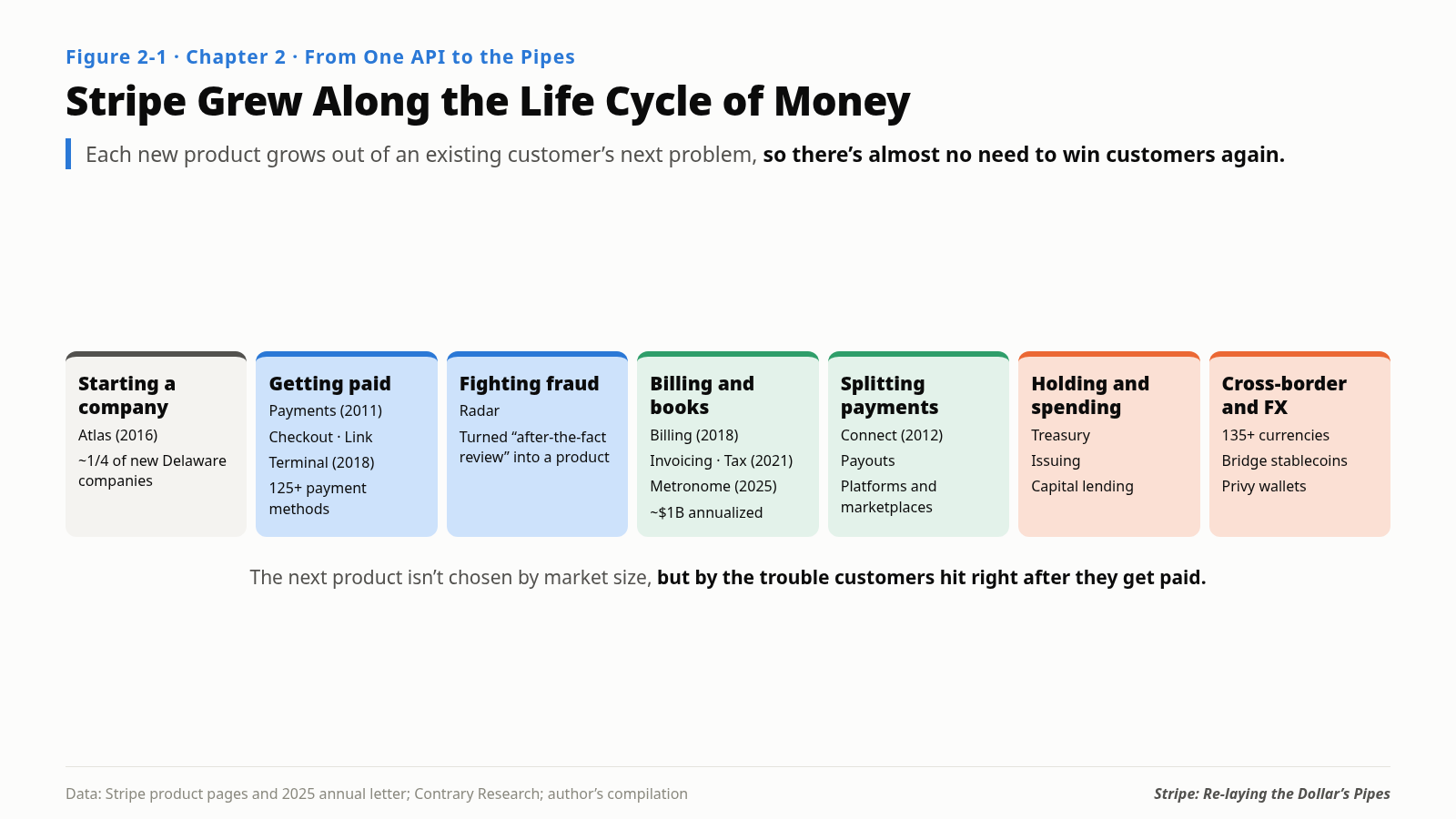
Behind this map is a pattern that is rarely spelled out: when Stripe picks its next product, it doesn’t look at which market is biggest, but at what trouble customers run into right after they get paid. Once you’ve been paid, you need to fight fraud; once you have subscriptions, you need billing; once you sell abroad, you have to pay taxes; platforms need to split payments; and merchants who receive their share need somewhere to keep it. Each new product grows out of an existing customer’s next problem, so there’s almost no need to acquire customers all over again.
Expanding this way has two advantages. First, the more customers use it, the harder it is to leave: once a company runs payments, billing, tax and payment splitting on Stripe, the cost of replacing Stripe is staggering. Second, each additional product lets Stripe collect one more fee on the same money, and that fee often doesn’t have to be shared with the card networks or banks. As the last chapter showed, most of the money in card payments goes to the owners of the pipes. Software revenue from billing, tax and risk is what Stripe gets to keep for itself.
The Customers Grew Up, and the Customers Changed
Stripe’s early customers were almost all startups. Its growth ran on a simple flywheel: small companies joined Stripe, the small companies grew, and Stripe’s transaction volume grew with them.
Payment volume shows how fast that flywheel turned:
- 2021: more than $640 billion
- 2022: more than $817 billion
- 2023: $1 trillion
- 2024: $1.4 trillion
- 2025: $1.9 trillion, up 34%
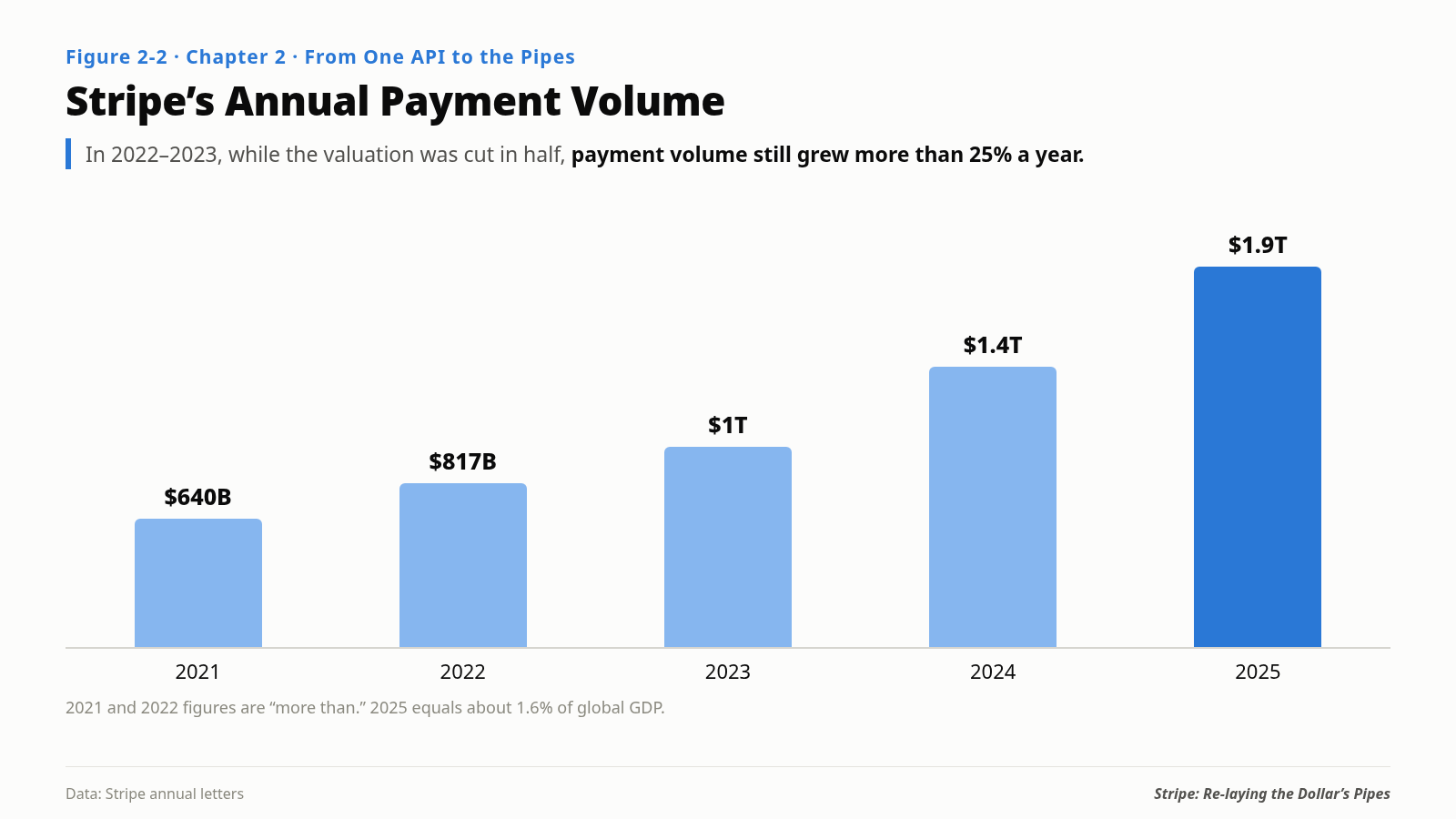
But flywheels can stall. After interest rates rose in 2022, startups struggled to raise money, and the “small companies grow up” path suddenly slowed. Stripe had to find a second growth curve: winning big companies.
It was not an easy pivot. Large companies want different things from startups. They already have several payment providers; what they want is higher payment success rates, lower fees, unified global reporting, and integration with aging finance systems. Stripe began building an enterprise sales team, negotiating prices and customizing to big customers’ needs. By 2025, about 90% of the companies in the Dow Jones Industrial Average and about 80% of the Nasdaq-100 were using Stripe.
Another new curve came more unexpectedly: AI companies. The AI companies that rose after 2023 are nearly all software businesses that charge by subscription or by usage, exactly the kind Stripe is best at. Stripe’s annual letter says the top AI companies all use Stripe. This wave of customers also explains why several of Stripe’s later big acquisitions were all related to AI.
Cut in Half: Two “Very Consequential Mistakes”
In March 2021, Stripe raised $600 million at a $95 billion valuation. That was the peak of the zero-interest-rate era: online spending had soared during the pandemic, startups had never found it easier to raise money, and everyone assumed growth would go on like that forever. Like most tech companies at the time, Stripe went on a hiring spree.
Then the wind changed.
In July 2022, Stripe cut the valuation implied by its internal share price from $95 billion to $74 billion. In January 2023, it cut it again, to $63 billion. On November 3, 2022, Patrick Collison emailed all employees to announce layoffs of about 14%, roughly 1,100 people, bringing headcount down to about 7,000.
The email was later held up by many as a model of how to do layoffs, because it didn’t blame the economy. Collison wrote that leadership had made two “very consequential mistakes”: first, overestimating how fast the internet economy would grow in 2022 and 2023, and second, letting operating costs grow too quickly. Collison also wrote:
The two of us, as founders, made this decision. We overhired for the world we’re in.
A few months later came the $50 billion funding round described at the start of this chapter.
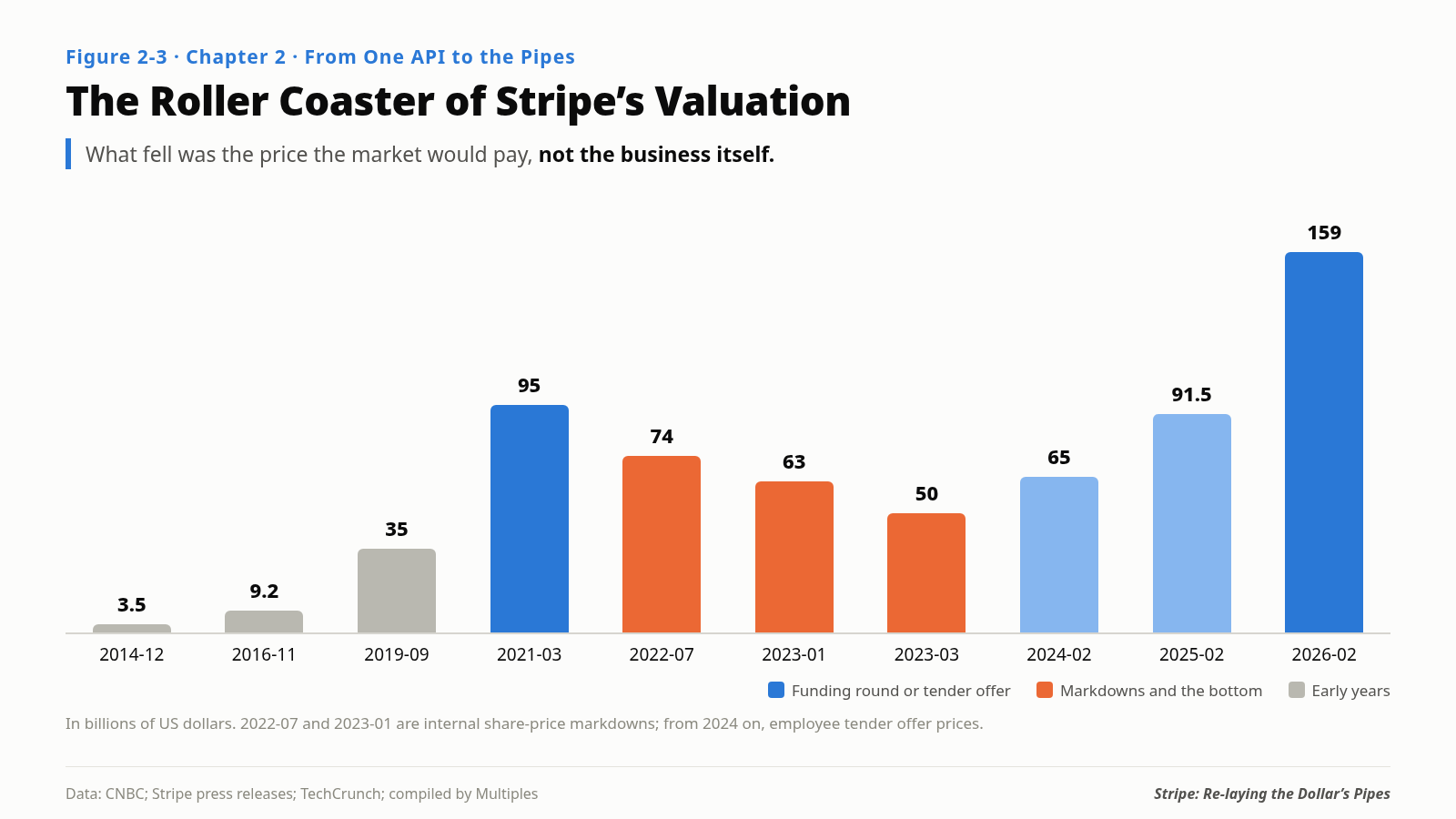
The valuation was cut in half; the business wasn’t. Payment volume grew 26% in 2022 and 25% in 2023. What fell was the price the market was willing to pay, not the business itself. What Stripe did was straightforward: control costs, shift toward profitability, and keep winning big customers. By 2025, the annual letter said Stripe had “remained robustly profitable.” According to The Information, Stripe’s 2025 revenue was about $6.8 billion and free cash flow about $3.2 billion, up 52% from the year before. Stripe has not confirmed these figures.
The valuation then climbed steadily: $65 billion in February 2024, $91.5 billion in February 2025, and $159 billion in February 2026.
The Economics of Staying Private
The Collison brothers have never been in a hurry to go public. In 2021, when the valuation was at its peak, John Collison said publicly: “We’re happy being private.” Stripe has used round after round of employee tender offers in place of the liquidity an IPO would bring.
Staying private has its bill, of course: liquidity problems for employee stock, outsiders unable to see full financial statements, and the need to find willing buyers for every tender offer. The “unneeded” 2023 round was the moment that bill came due all at once.
But it also bought something public companies find hard to have: the patience to make long bets.
This matters a great deal for understanding Stripe’s crypto strategy. Imagine Stripe were a public company. In 2018, when it shut down bitcoin payments, analysts would have asked whether its crypto strategy had failed. In 2024, spending $1.1 billion on a stablecoin company valued at just over $200 million might have sent the stock down the same day. In 2025, building a blockchain with Paradigm that has no token and no near-term revenue would have taken a lot of explaining on the quarterly earnings call. Each of these moves takes years to prove right or wrong. One important reason Stripe dares to keep placing these bets is that it doesn’t have to hand in a report card to the public markets every three months.
A Giant’s Appetite
From late 2025 into 2026, Stripe did three deals in a row that made the industry sit up.
The first was Metronome. In December 2025, Stripe acquired Metronome, a usage-based billing software company, for a reported price of about $1 billion. Anthropic, Nvidia and OpenAI are all Metronome customers. Patrick Collison wrote on X that usage-based pricing is the native business model of the AI era, and that the change it brings could be as big as the arrival of SaaS, “or much bigger.”
The second was OpenRouter. On August 19, 2026, Stripe announced it would acquire the AI model routing platform OpenRouter. Through a single OpenRouter API, developers can call hundreds of different AI models. The deal was reportedly valued at $7 billion to more than $8 billion, over six times the price of Bridge, making it the largest acquisition in Stripe’s history. Three months earlier, OpenRouter had been valued at $1.3 billion.
The third was PayPal, and it didn’t happen. In July 2026, according to Reuters, Stripe and the private equity firm Advent made a joint offer for PayPal at $60.50 a share, a premium of about 28% over the previous day’s close and more than $53 billion in total, backed by about $50 billion in committed bank financing, split evenly between the two. PayPal’s board considered the price too low. At the end of August, Bloomberg reported that the two had abandoned the bid. Some media have since reported that the two sides might return to the table, but neither side has confirmed it.
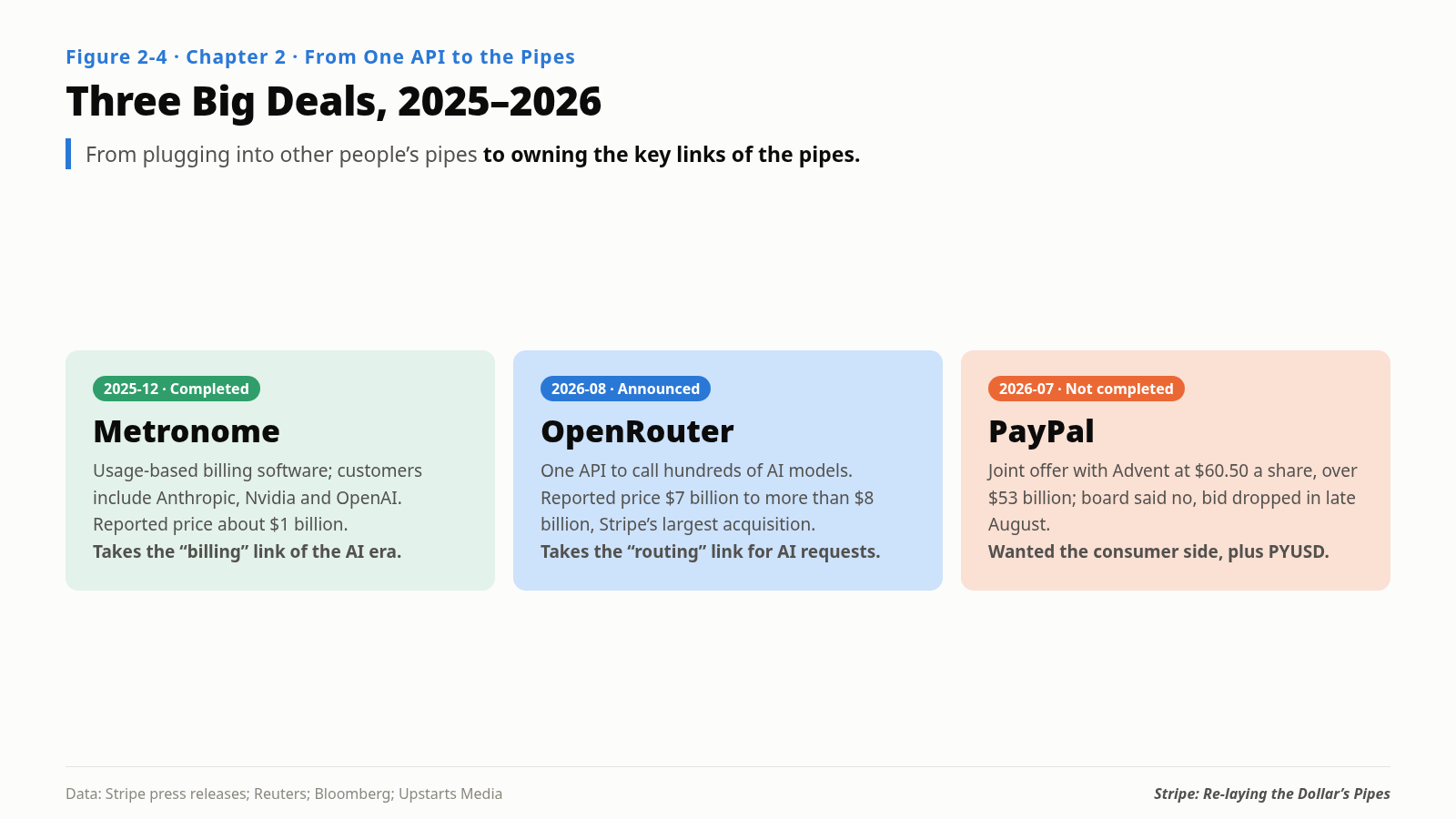
Put the three deals together and you can see how Stripe’s identity has changed.
Fifteen years ago, Stripe was the challenger winning developers away from PayPal. In 2026, it tried to buy PayPal itself. Metronome and OpenRouter show that Stripe is no longer content to charge at the moment AI companies get paid. It wants to own two key links in the AI economy, “usage-based billing” and “request routing”: who is using which model, how much, and how much they owe all flow through Stripe’s systems.
The PayPal deal that didn’t happen also had an easily overlooked crypto dimension. PayPal has its own dollar stablecoin, PYUSD, with about $2.7 billion in circulation in early November 2026, plus hundreds of millions of consumer accounts and Venmo. Stripe is strong on the merchant side; PayPal is strong on the consumer side. Combined, the two would hold both sides of the checkout counter, plus a ready-made stablecoin. The deal didn’t close, but it laid bare Stripe’s appetite: moving from plugging into other people’s pipes to owning the key links of the pipes. Stablecoins are simply the most complete step in that shift.
How Stripe Grew Up
To pull this chapter together: Stripe grew from one API into a giant by way of three concentric circles.
- The inner circle: do one thing as well as it can be done. A payments API so easy to use that developers recommend it unprompted.
- The middle circle: follow the customer’s money. The next problem a customer hits after getting paid is the next product.
- The outer circle: own the key links. Once it reached a certain scale, it began acquiring or building the links that set prices and rules: billing, routing, wallets, issuance, settlement.
The first two circles made Stripe a great software company. The third will decide whether it can become a true infrastructure company. The crypto strategy is Stripe’s biggest bet on that third circle.
Lessons for Other Companies
1. Expand along the customer’s next problem, not along the biggest market. Stripe’s product line looks sprawling, but the logic is consistent: each new product grows out of existing customers, so there’s almost no need to acquire customers again, and each additional product makes customers less able to leave.
2. Make your customers’ growth your growth. Charging by transaction value puts Stripe on the same side as its customers: the more they sell, the more Stripe earns. That holds up through cycles better than per-seat or annual pricing, and it naturally places Stripe beside the fastest-growing companies, from mobile apps to AI.
3. When mistakes are made, the founders own them. The 2022 layoff email didn’t blame the macro environment; it said plainly “we overhired.” Admitting a mistake isn’t hard in itself. What’s hard is keeping the team’s trust while the valuation is cut in half. Stripe’s later rebound had a lot to do with that candor.
4. Staying private is an asset, and it comes with a bill. Being private bought the patience to make long bets, at the cost of employee liquidity, control over fundraising timing, and transparency. A company that wants to be long-term infrastructure should design in advance how it will pay that bill, for example through regular employee tender offers.
5. Past a certain size, you have to own the key links. If you only build the access layer, the owners of the pipes will keep taking a cut of your profits. Stripe’s path was to win scale with the access layer first, then use that scale to buy or build the key links. Reverse the order and it almost never works.
The bottom line: Stripe won customers by being easy to use, won scale through its customers, and now wants to win the pipes through its scale.
Data and Sources
Verified:
- Series I of more than $6.5 billion on 2023-03-15 at a $50 billion valuation; “does not need this capital to run its business”; funds used for employee liquidity and taxes related to equity awards: CNBC, 2023-03-15; Stripe press release.
- $95 billion valuation and $600 million raise in 2021-03; internal valuation cut to $74 billion in 2022-07 and $63 billion in 2023-01: CNBC, 2023-03-15 and 2023-05-09; Wikipedia.
- Layoffs of about 14% on 2022-11-03, about 1,100 people, headcount reduced to about 7,000; “two very consequential mistakes”; “We overhired for the world we’re in”: CNBC, 2022-11-03; email text as quoted by Yahoo Finance.
- John Collison, “happy being private”: CNBC interview in 2021, as quoted by CNBC, 2023-03-15.
- 2025 payment volume of $1.9 trillion (+34%), 5 million businesses, 90% of the Dow, 80% of the Nasdaq-100, about 25% of new Delaware companies registered through Atlas, Revenue suite nearing $1 billion annualized, all leading AI companies, “robustly profitable”: Stripe 2025 annual letter and press release (2026-02-24).
- 2021–2024 payment volume ($640 billion, $817 billion, $1 trillion, $1.4 trillion): Stripe annual letters for each year, compiled and cross-checked by okara.ai.
- $159 billion valuation (2026-02), $91.5 billion (2025-02): Stripe press release, TechCrunch; $65 billion (2024-02): compiled by AI Funding Tracker and Multiples.
- Product timeline: Connect 2012; Atlas and Radar 2015–2016; Billing, Terminal and Sigma 2018; Capital, Treasury, Climate and Tax 2019–2021; TaxJar acquisition 2021-04: Contrary Research; Wikipedia. More than 125 payment methods: Stripe product page.
- Metronome acquisition (signed 2025-12-02) and Collison’s “usage-based pricing is the native business model of the AI era”: This Week in Fintech, 2025-12-03, citing Collison’s post on X.
- OpenRouter acquisition (2026-08-19): Stripe press release; Reuters, 2026-08-19.
- PayPal acquisition offer ($60.50 per share, premium of about 28%, more than $53 billion, about $50 billion in committed financing, split evenly): Reuters, 2026-07-15, as cited by TSG; bid abandoned: Bloomberg, 2026-08-28.
- PYUSD circulation of about $2.7 billion: DefiLlama, data pulled 2026-11-03.
Media reports (not confirmed by Stripe):
- 2025 revenue of about $6.8 billion and free cash flow of about $3.2 billion (+52%): The Information, 2026-07-22.
- Metronome price of about $1 billion: Upstarts Media.
- OpenRouter price: Reuters put the valuation at more than $8 billion; other media reported $7 billion to $7.5 billion; OpenRouter’s 2026-05 Series B valuation was $1.3 billion.
- Bridge Series A valuation of about $200 million in 2024-08: compiled by Spark Research and others; verified in Chapter 4.
- Possible resumption of PayPal talks: Seeking Alpha, Startup Fortune and others; unconfirmed.