
Chapter 1: The Rules Land: America Changes Course
The question this chapter answers: What did the GENIUS Act, the CLARITY Act, and the new posture of the SEC and the OCC each change? And who gets to enter as a result?
If you are responsible for a three-to-five-year crypto business decision at a bank, broker, payment company or asset manager, this chapter is meant to help you answer one question: will the rule you are betting on disappear after the next election?
Two Pieces of News, Two Days Apart
On September 15, 2026, the U.S. Senate held a procedural vote on the CLARITY Act, the crypto market structure bill. It failed 49 to 50, short of the 60 votes needed to advance. The bill had passed the House in July 2025 by a wide margin, 294 to 134, and had cleared the Senate Banking Committee 15 to 9. In the end it fell on a technicality: whether to begin debate at all. Two issues held it up. One was an ethics provision on whether officials and their families can profit from crypto projects. The other was whether stablecoins can pay interest through the back door.
Two days later, on September 17, the SEC issued an “innovation exemption” order allowing approved platforms to trade tokenized U.S.-listed stocks on-chain, valid for five years.
Put the two events side by side and America’s crypto turn of the past two years comes into focus: where Congress could not finish the road, regulators paved it first with administrative tools.
Most people sum up the changes since 2025 as “America loosening up on crypto.” That is only half right. The more accurate version is: America is folding crypto into the banking system. Every door that has been opened, where it opens and how wide, answers the same question: whose balance sheet will the hundreds of billions of dollars in stablecoin float end up on?
The Three Gates
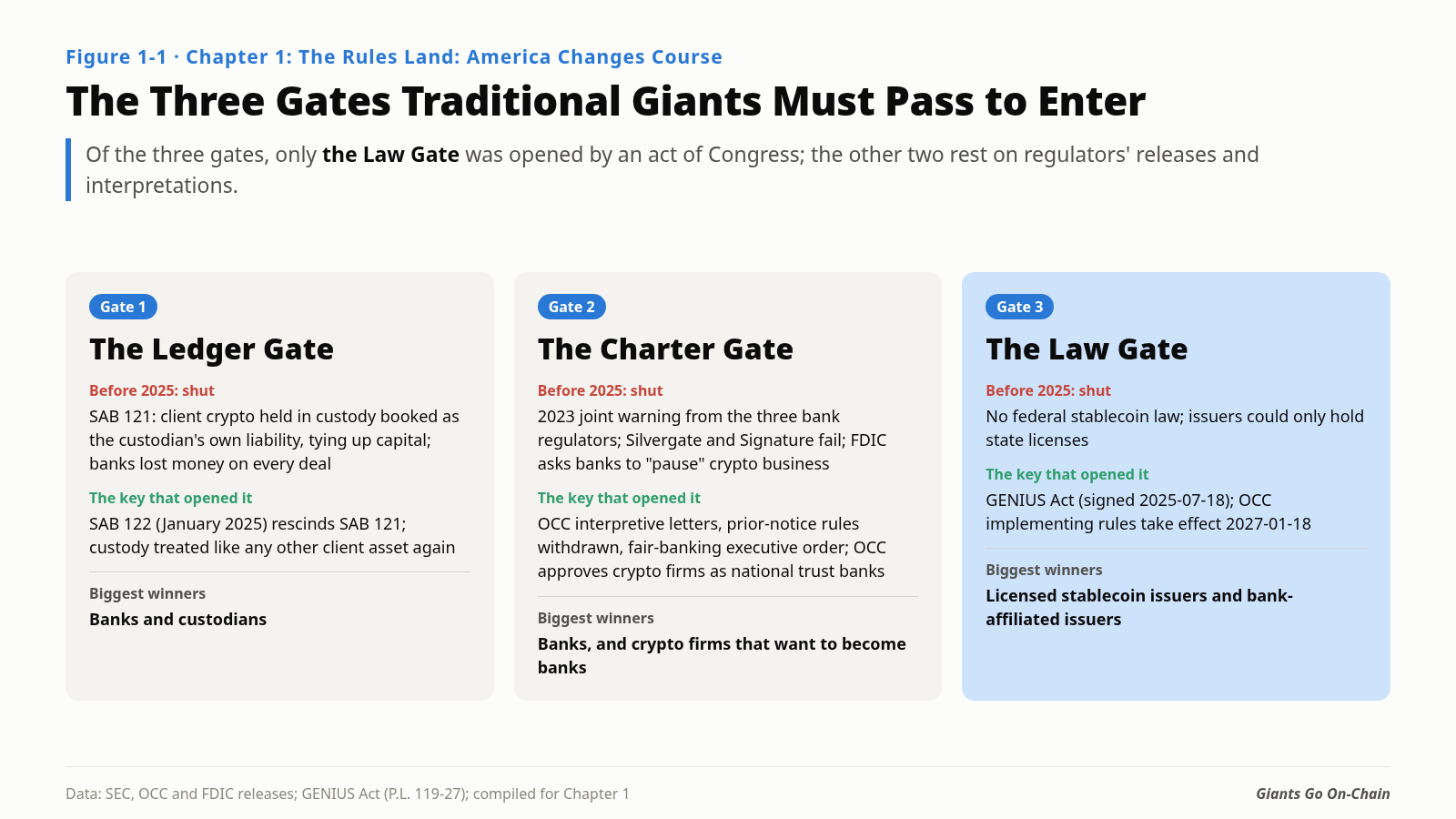
For a traditional giant to enter crypto, it has to pass through three gates. Before 2025, all three were shut.
The first gate: the Ledger Gate. In 2022, the SEC issued Staff Accounting Bulletin No. 121 (SAB 121), which required public companies holding crypto assets in custody for clients to record those assets as both their own assets and their own liabilities. On paper the two entries cancel out and seem to have no effect. But for a bank, an extra liability on the balance sheet ties up extra capital. The result: in the business of safekeeping bitcoin for clients, banks lost money on every deal they did.
In late January 2025, the new SEC rescinded the rule with SAB 122. Holding crypto assets in custody went back to being treated the same way as holding any other client asset. This was the least conspicuous step in the whole turn, but the one that mattered most to banks: it was not a permission, it was the removal of a rock that had been sitting on their capital.
The second gate: the Charter Gate. In January 2023, the Fed, the FDIC and the OCC issued a joint statement warning banks about crypto-related risks. Over the following months, the two banks most concentrated in serving the crypto industry went down one after the other: Silvergate announced a voluntary liquidation on March 8, and Signature Bank was taken over by regulators on March 12. In February 2025, the FDIC released a batch of letters it had sent to banks at the time, asking them to “pause” their crypto business. The industry later named this period “Operation Choke Point 2.0.”
In 2025, this gate was opened layer by layer:
- The OCC issued Interpretive Letters 1183 (March 7) and 1184 (May 7), confirming that banks may do crypto custody and stablecoin-related business, and need not first obtain a regulatory “non-objection”;
- The FDIC (March 28) and the Fed (April 24) withdrew guidance that had required banks to notify them before starting crypto activities;
- On August 7, the President signed Executive Order 14331, which bars regulators from refusing banking services to lawful industries on grounds of “reputational risk”;
- On December 12, the OCC conditionally approved Circle, Ripple, Paxos, BitGo and Fidelity Digital Assets to establish or convert into national trust banks. In February 2026, Crypto.com also received conditional approval.
Notice the direction: it is not only that banks may now do crypto; crypto companies are also becoming banks. A trust bank takes no deposits and makes no loans, but it gains a federal regulatory status and can operate nationwide. This is the crypto companies’ pledge of allegiance to the banking system.
The third gate: the Law Gate. On July 18, 2025, the stablecoin bill, the GENIUS Act, was signed into law (68 to 30 in the Senate, 308 to 122 in the House). It is America’s first federal law written specifically for crypto assets. To understand it, four provisions are enough:
- Reserves must be 1:1. They can consist only of cash, bank deposits, short-term Treasuries, repos backed by Treasuries, government money market funds and the like. The reserve composition must be published monthly, signed off by executives and examined by an accounting firm; issuers with more than $50 billion in circulation must also file audited annual financial statements.
- Issuers may not pay interest to holders.
- A non-financial public company that wants to issue a stablecoin needs the unanimous approval of a committee made up of the Treasury Secretary, the Fed Chair and the FDIC Chair.
- In bankruptcy, stablecoin holders are paid ahead of all of the issuer’s other creditors.
Provision 3 deserves a second look. Who is it aimed at? Public companies such as Meta, Amazon, Walmart and Apple, which have billions of users but are not regulated as banks. In 2019, Facebook launched Libra, and central banks around the world joined forces to shut it down. In January 2022, the project, by then renamed Diem, sold its technology assets to Silvergate for about $182 million. A year later, Silvergate wrote those assets down by $196 million, and two months after that, it failed itself. Seven years on, the lesson Libra left behind has been written straight into U.S. law: tech giants can use stablecoins, but if they want to issue their own, they need three keys.
Provision 2 is where the real battle over the whole law is fought.
The Interest Ban: A Moat for the Banks
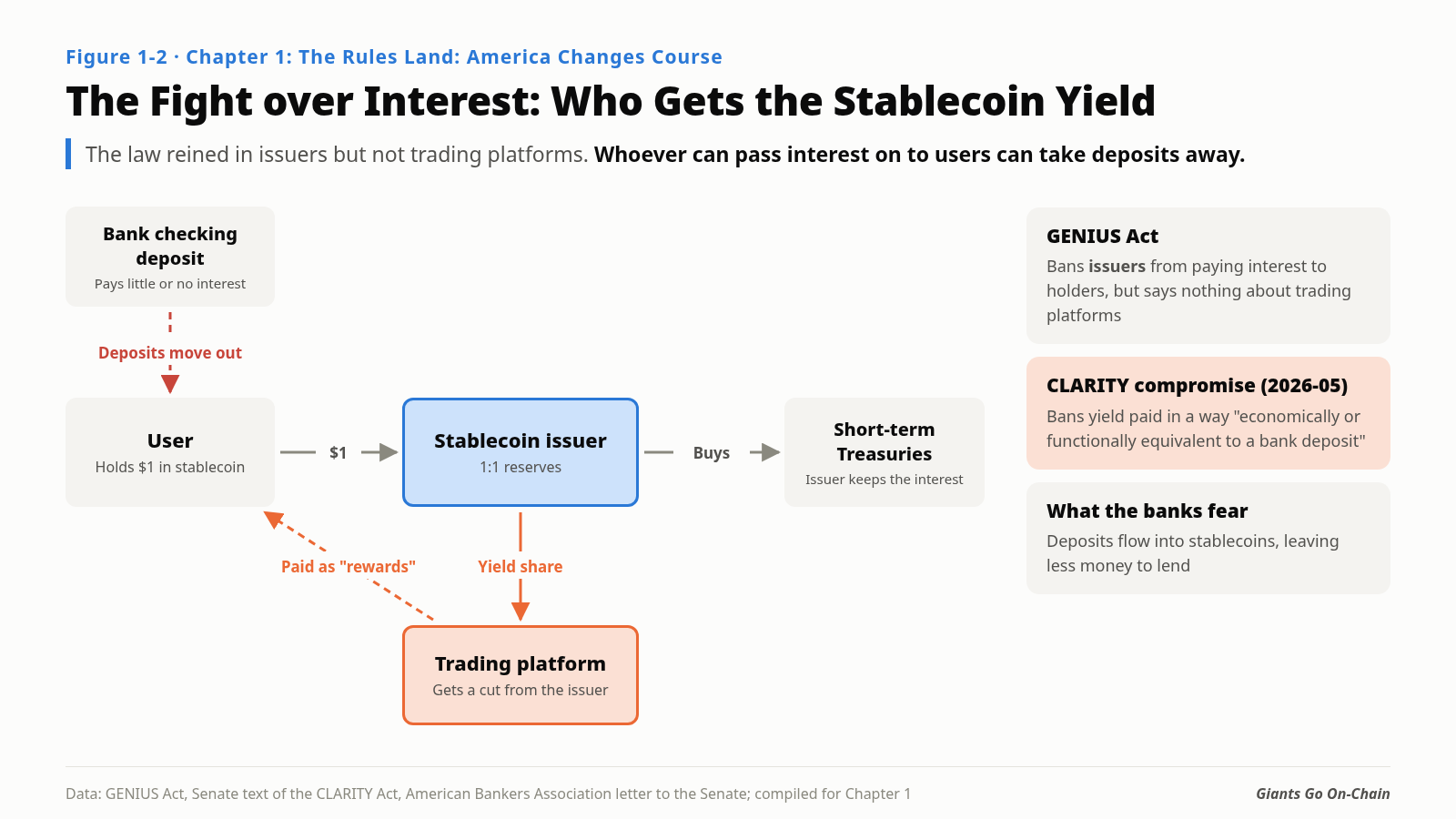
A stablecoin issuer’s business model is simple: a user gives you $1, you use it to buy short-term Treasuries, and you keep the interest. When rates are at 4%, it is a spread business with almost no cost.
The GENIUS Act bans issuers from passing interest on to holders. On the surface this protects consumers; in practice it protects bank deposits. If holding a stablecoin also earned interest, why would $10,000 stay in a checking account that pays nothing?
But the law only governs issuers. It says nothing about exchanges. That loophole was put to use at once: trading platforms can take the share of reserve income the issuer passes to them and hand it on to users under the label of “rewards.” The banking industry knows exactly what that means. In the spring of 2026, as the CLARITY Act was being negotiated in the Senate, six banking trade groups, including the American Bankers Association, jointly pressed for the loophole to be closed, arguing that deposit flight would reduce credit to small businesses and farmers.
On May 1, a bipartisan group of senators produced compromise text: it bans paying interest or yield on stablecoin balances in a way that is “economically or functionally equivalent to a bank deposit.” The banks still found it insufficient; the crypto industry reluctantly accepted it. When the September vote failed 49 to 50, the interest issue and the ethics provision were the two straws that broke its back.
The lesson of this fight: American crypto legislation is, at heart, a negotiation over distribution and float, not a debate about technology. Whoever has the right to pass interest on to users can take deposits away; what the banks are defending is the cheapest liability in America.
The Two Locks: The Statutory Lock and the Administrative Lock
Back to the opening question: will the rule you are betting on disappear?
Rank the changes of 2025–2026 by how hard they would be to reverse:
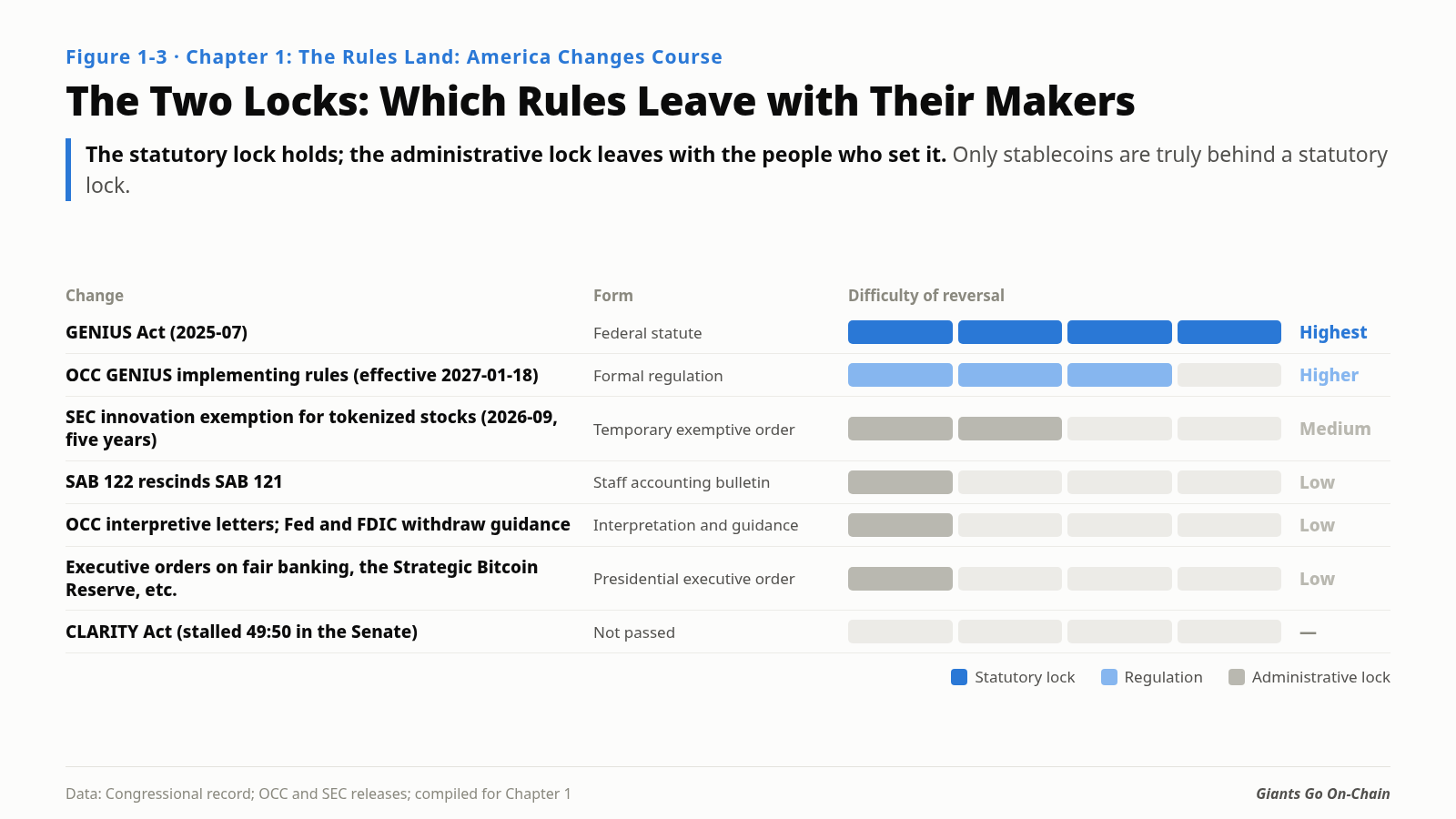
I call this “the Two Locks”: the statutory lock holds; the administrative lock leaves with the people who set it.
This chart shows that the doors currently most friendly to the traditional giants, such as bank custody, trading in tokenized stocks and the attitude of the regulators, mostly hang on administrative locks. Only one item is truly behind a statutory lock: stablecoins.
This also explains what looks like a contradiction. Since 2025, banks, payment companies and tech companies have almost all rushed into stablecoins and deposit tokens, while in tokenized securities and crypto trading, large institutions have been noticeably more cautious, mostly running pilots, forming partnerships and opening up in small doses. It is not that they don’t want to do it. They are discounting the administrative locks.
If You’re Making the Call
For people working in banking, brokerage, payments and asset management, my advice is to check every crypto business line against three questions:
- Which kind of lock does it depend on? A business that depends on the statutory lock (stablecoin issuance and reserve management) can be planned and funded on a horizon of five years or more. A business that depends on administrative locks (custody, tokenized trading, connecting to crypto platforms) should be built so it can be scaled back within a year or two: for example, partnering rather than building, and holding a license rather than relying on an exemption.
- Does it touch interest? Any design that passes yield on to users stands in the line of fire of the banking lobby. How the CLARITY Act finally words its interest provision will directly decide whether stablecoin rewards products can exist.
- Which license does it need? The reality of 2026: the OCC has started granting federal trust bank charters to crypto companies, and the GENIUS implementing rules take effect on January 18, 2027. More and more players are gaining federal status, and if your partner has no license, the risk concentrates on your side.
One last fact that is easy to overlook: on the day the GENIUS Act was signed, the total supply of dollar stablecoins was about $257.7 billion; by the end of October 2026, it was about $299 billion. That is growth of about 16% in 15 months, and it has barely moved since July. Rules landing does not mean demand exploding. The law handed out admission tickets; the business still has to be built.
In one sentence: America has not opened the front door to crypto, but a side door into the banks. The only thing the law has locked in is stablecoins; every other door still hangs on the people in office.
Data and Sources (as of 2026-11-03, all verified)
- CLARITY Act, House 294:134 (2025-07-17); Senate Banking Committee 15:9 (2026-05-14); Senate procedural vote 49:50 (2026-09-15, Roll Call 234): Latham legislative tracker, CoinDesk 2026-05-14, DeFi Rate fact sheet
- Interest compromise text (2026-05-01) and joint pressure from banking trade groups: Baker McKenzie, ABA Banking Journal
- GENIUS Act signing date, vote counts, reserves, interest ban, restriction on non-financial public companies, $50 billion audit threshold, bankruptcy priority: CRS report IN12553, Fenwick
- OCC final GENIUS rule, effective 2027-01-18: OCC press release nr-2026-92, OCC Bulletin 2026-50
- SEC innovation exemption (2026-09-17, five-year term): SEC press release 2026-90
- SAB 121 rescinded by SAB 122 (late January 2025): Duane Morris
- OCC Interpretive Letters 1183 (2025-03-07) and 1184 (2025-05-07), FDIC FIL-7-2025 (2025-03-28), Fed withdrawal of SR 22-6 (2025-04-24): Greenberg Traurig, Arnold & Porter, Clifford Chance
- Executive Order 14331, “fair banking” (2025-08-07): DLA Piper
- OCC conditional approval of five trust banks on 2025-12-12; Crypto.com approved in February 2026: Mondaq, Invezz
- Silvergate’s purchase of the Diem assets for about $182 million (2022-01-31; $50 million in cash plus about 1.22 million shares): Holland & Knight, Banking Dive; $196 million write-down: Wikipedia: Silvergate Bank (secondary source, citing Silvergate’s Q4 2022 earnings)
- Total dollar stablecoin supply: about $257.7 billion on 2025-07-18, about $303.4 billion on 2026-07-01, about $299 billion on 2026-10-31: DefiLlama stablecoin totals (API
stablecoins.llama.fi/stablecoincharts/all, pulled 2026-11-03)