
Chapter 2: The Global Regulatory Map
The question this chapter answers: Which path is each of the EU, Hong Kong, Japan, the UK, Singapore, South Korea and mainland China taking?
If you work in cross-border payments or collect payments for international trade, or run the digital asset business at a bank outside the United States, this chapter wants to help you see one thing clearly: stablecoin rules around the world look wildly varied, but they are all answering the same question: whose currency goes on-chain?
A Lopsided Map
Start with a few numbers. In early November 2026, stablecoins worldwide totaled about $297 billion. Of that:
- Dollar-pegged stablecoins came to about $295.7 billion, more than 99%;
- Euro-pegged stablecoins came to about $940 million, 0.3%;
- Stablecoins pegged to the pound, the Swiss franc, the Singapore dollar, the Hong Kong dollar and the yen added up to less than $150 million.
One more number is even more glaring. A ruble-pegged stablecoin, A7A5, has a market cap of about $470 million, half the size of all euro stablecoins combined. Its reserves sit in a sanctioned Russian state-owned bank, and in October 2025 it was banned by name in the EU’s 19th sanctions package.
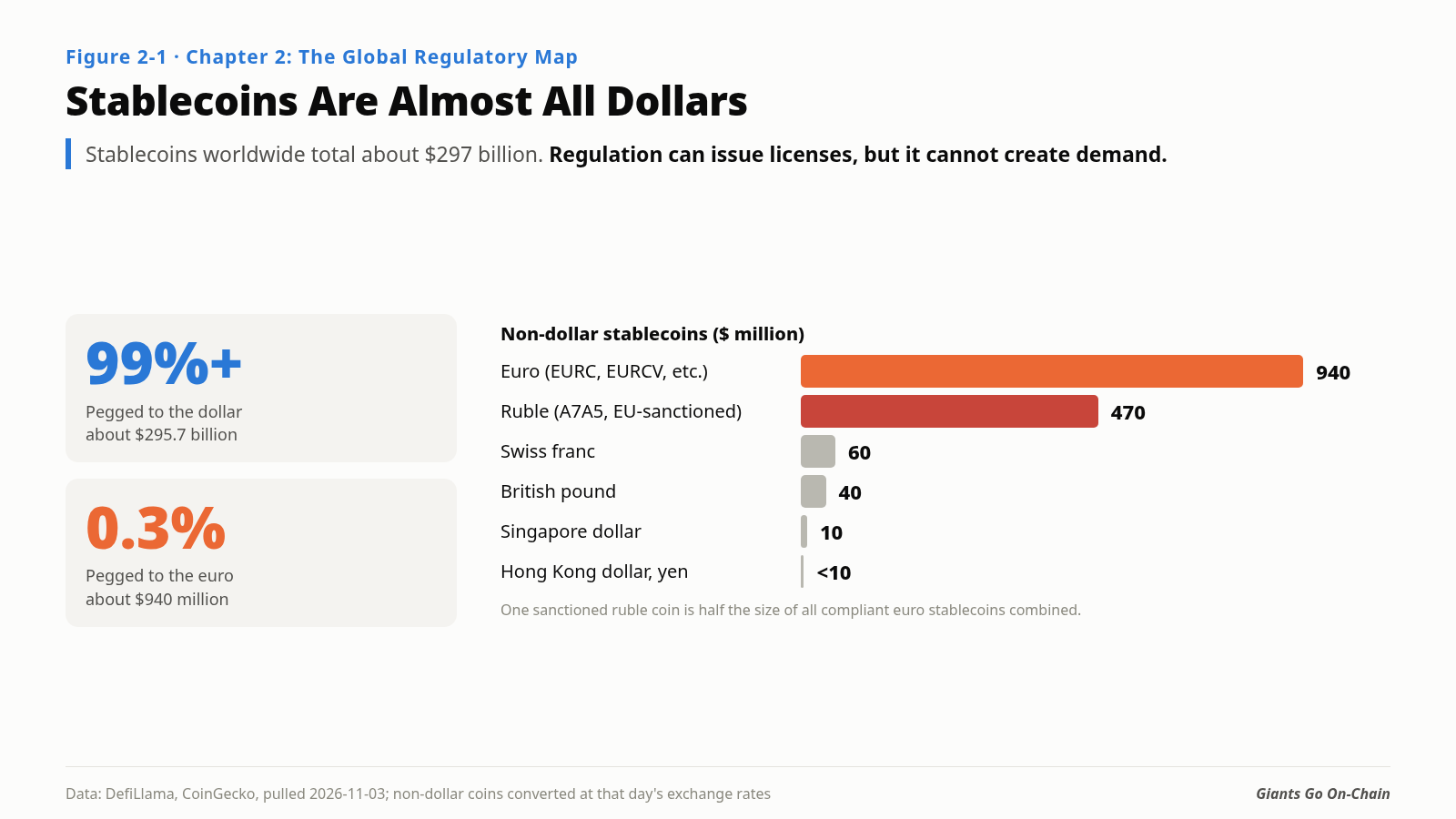
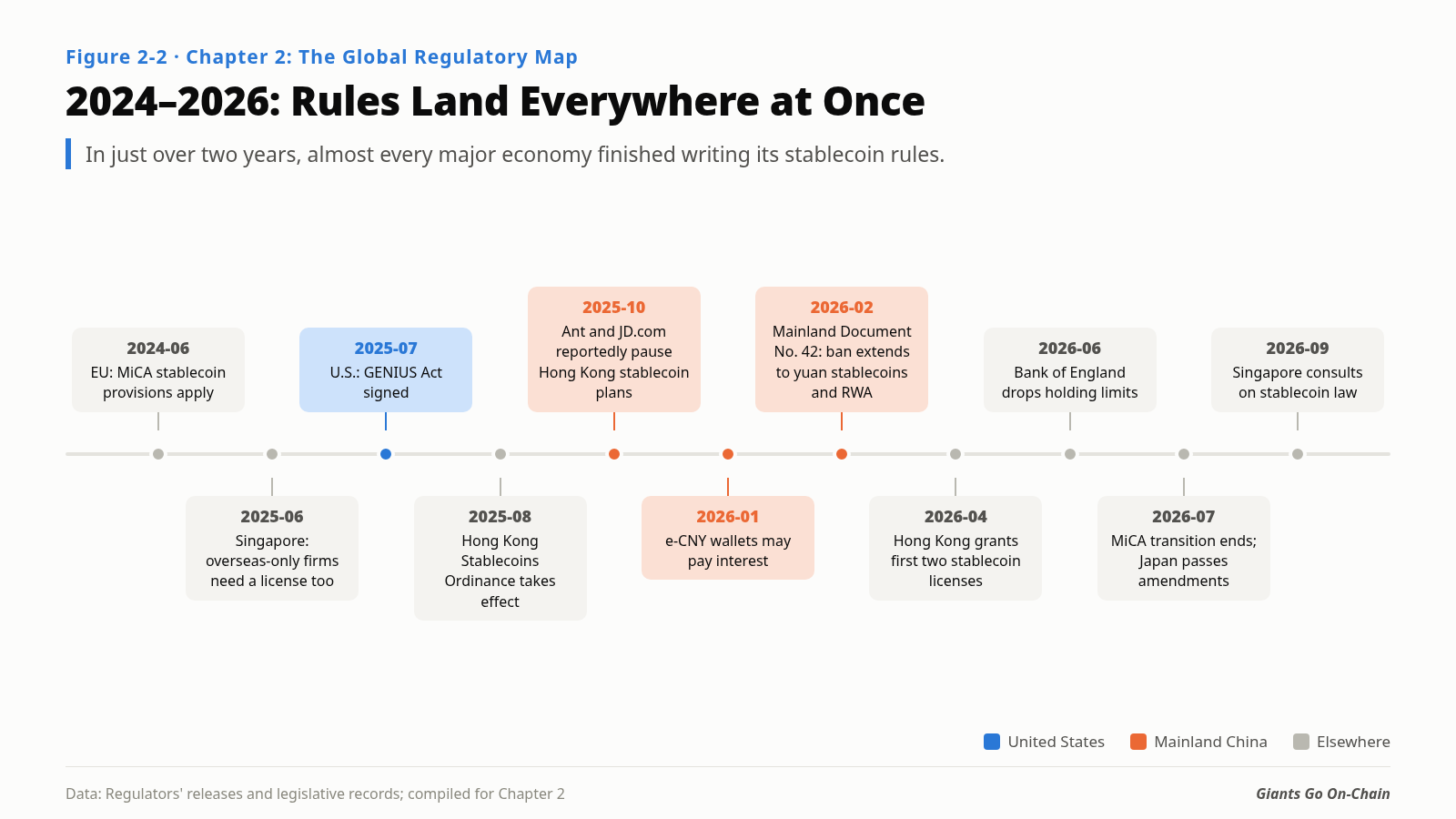
The EU was the first major economy in the world to write comprehensive rules for stablecoins: MiCA’s stablecoin provisions began to apply on June 30, 2024. More than two years later, compliant euro stablecoins still total less than $1 billion, not much bigger than one sanctioned ruble coin.
That tells you something: regulation can issue licenses, but it cannot create demand. Demand for stablecoins comes from two groups of people. One group wants to trade in crypto markets, where almost every trading pair is in dollars. The other group lives in a domestic financial system where they cannot get dollars, cannot hold them safely, or cannot send them abroad. The euro meets neither group’s needs.
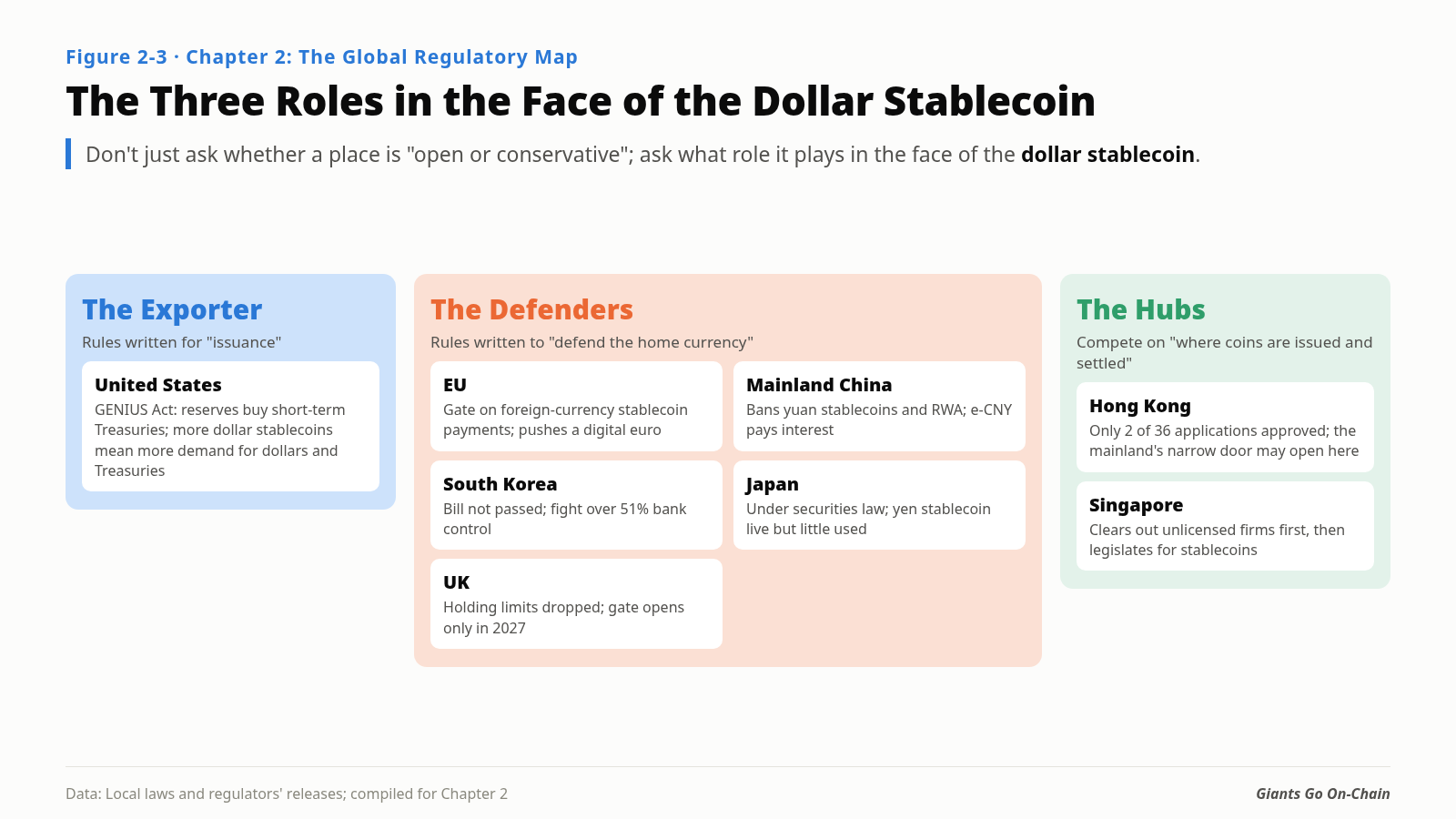
So when you read stablecoin rules outside the United States, it is not enough to ask whether a place is “open or conservative.” The more useful reading is to ask what role each place plays in the face of the dollar stablecoin.
The Three Roles: The Exporter, the Defenders, the Hubs
The Exporter: the United States. As the previous chapter explained, the GENIUS Act requires stablecoins to be backed 1:1 by assets such as cash and short-term Treasuries. In other words, every dollar stablecoin issued adds a bit more demand for dollars and short-term Treasuries. For the United States, the more dollar stablecoins the better; its rules are written for “issuance.”
The Defenders: the EU, mainland China, South Korea, Japan and the UK. Their rules are written to “defend the home currency,” though each defends it differently.
- The EU: set a cap, then build its own currency on-chain. MiCA puts a gate on non-euro stablecoins: if a foreign-currency stablecoin is used as a means of payment in the euro area for more than 1 million transactions and €200 million a day on average, its issuer must stop issuing. The gate covers only payments, not crypto trading, but the intent is clear. Meanwhile, ECB President Christine Lagarde has said publicly, more than once, that dollar stablecoins will erode Europe’s financial sovereignty, and has urged lawmakers to pass legislation for a digital euro quickly. On July 1, 2026, MiCA’s transitional period ended, and crypto service providers without a license had to leave the EU market.
- Mainland China: ban, while making the e-CNY more attractive. On February 6, 2026, the People’s Bank of China and seven other agencies issued Document No. 42, extending the ban to yuan stablecoins and real-world asset (RWA) tokenization: no yuan-pegged stablecoin may be issued offshore without approval, and offshore institutions may not provide RWA tokenization services in any form to entities in the mainland. Before that, in October 2025, according to the Financial Times, regulators had already told Ant Group and JD.com to suspend their stablecoin plans in Hong Kong. At the same time, starting January 1, 2026, commercial banks may pay interest on e-CNY wallet balances. One hand shuts out private stablecoins; the other lets the official digital currency earn interest like a deposit.
- South Korea: first, settle who gets to issue. As of the end of October 2026, South Korea’s Digital Asset Basic Act had still not passed. The biggest dispute is over who issues won stablecoins. The Bank of Korea insists they must be issued by consortia in which banks hold more than 51%; the Financial Services Commission worries this would stifle competition. The FSC chairman has said the goal is to pass the law by the end of the year.
- Japan: bring crypto under securities law, and allow a home-currency stablecoin. On July 15, 2026, Japan’s Diet passed amendments moving crypto assets from the Payment Services Act into the Financial Instruments and Exchange Act, introducing insider trading rules and applying a flat 20% separate tax on gains from qualifying crypto assets. (The crypto provisions take effect by July 2027 at the latest; the new tax treatment applies from the January 1 after they take effect, so by 2028 at the latest.) The yen stablecoin JPYC launched on October 27, 2025, and by September 2026 had issued more than ¥10 billion in total, but its CEO has admitted publicly that circulation fell short of expectations. Japan’s three megabanks, MUFG, SMBC and Mizuho, are jointly issuing a trust-type yen stablecoin as co-settlors of the trust. They completed a joint trial on October 16, 2026, and aim to complete the first commercial transactions by March 2027.
- The UK: from strict to looser, but still slow. On June 22, 2026, the Bank of England published its final policy, dropping the holding limits it had proposed earlier (£20,000 for individuals and £10 million for businesses) and replacing them with a £40 billion cap on the total issuance of any single systemic stablecoin. The FCA’s crypto licensing regime will not take effect until October 25, 2027.
The Hubs: Hong Kong and Singapore. Their own currencies are limited in size. What they compete for is the position of “where coins are issued and where they settle.”
- Hong Kong: a bar so high only two get through. The Stablecoins Ordinance took effect on August 1, 2025. On April 10, 2026, the HKMA granted its first licenses: out of 36 applications, it approved only 2. One went to HSBC; the other to Anchorpoint, a joint venture of Standard Chartered Hong Kong, HKT and Animoca Brands. What makes Hong Kong special is that the mainland stands behind it. Document No. 42 leaves a narrow door open for “approved offshore yuan stablecoins.” That door is most likely to open in Hong Kong, but the key is in Beijing.
- Singapore: clear the field first, then legislate. From June 30, 2025, crypto service providers registered in Singapore but serving only overseas clients also had to be licensed; those without a license had to shut down. On September 1, 2026, the MAS launched a consultation on stablecoin legislation that would require full reserves and bar issuers from paying interest. The consultation closed on October 16.
Post-mortem: Why Home-Currency Stablecoins Don’t Take Off
What happened to euro and yen stablecoins is a warning for every “defender.”
Their problem is not compliance; it is use. Once a euro stablecoin is on-chain, what can you do with it? The main trading pairs on crypto exchanges are in dollar stablecoins. Transfers inside the euro area already have SEPA, which is instant and almost free. When you pay suppliers across borders in the United States, Asia or Latin America, most of them want dollars. Compliant euro stablecoins are in this position: legal, but with no use case that truly requires them.
The JPYC case is even more direct. At launch, it set a target of ¥10 trillion in circulation within three years; after one year, total issuance had only just passed ¥10 billion. The issuance and redemption channels were open and the accounts were in place. What was missing was “a reason to pay with it.”
Now look at A7A5 from the other side: its users are exactly the people locked out of the dollar system. Where there is real demand, scale follows, even at the risk of sanctions.
That gives a simple way to judge the prospects of any home-currency stablecoin: ask whether it solves a problem that neither dollar stablecoins nor the local payment system can solve. If it can’t answer that, no matter how complete its licenses are, it won’t reach scale.
Another Common Thread: The Licenses Went to Banks First
List the first institutions in each place to receive stablecoin status, and a pattern emerges:
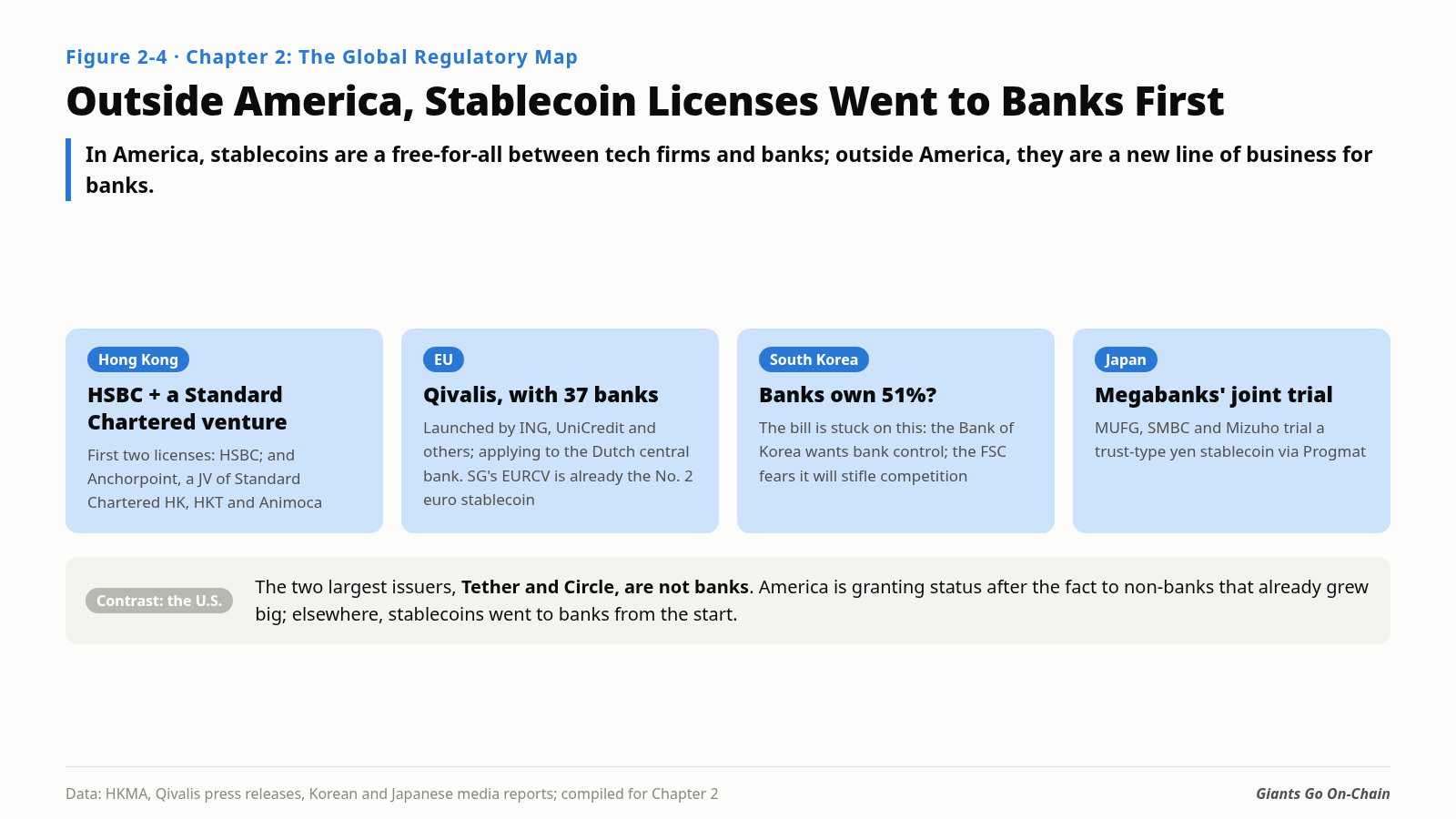
- Of Hong Kong’s first two licenses, one went to HSBC, and the main shareholder behind the other is Standard Chartered;
- Europe’s largest euro stablecoin project, Qivalis, was launched by banks including ING and UniCredit. In May 2026 its membership grew to 37 banks; it is applying to De Nederlandsche Bank (the Dutch central bank) for an electronic money institution license and is targeting launch in the second half of 2026. Société Générale’s euro stablecoin EURCV, at about €190 million, is already the second-largest euro stablecoin;
- In South Korea, the heart of the dispute is whether banks should hold a 51% stake;
- In Japan, the most closely watched effort is the three megabanks’ joint trial.
This is very different from the United States. In America, the two largest issuers, Tether and Circle, are not banks; regulators are handing official status, after the fact, to non-bank firms that have already grown big. Outside the United States, regulators gave stablecoins from the start to the institutions they know best and find easiest to control.
In America, stablecoins are a free-for-all between tech companies and banks; outside America, stablecoins are a new line of business for banks. That is also why, in the two chapters on banks later in this book, half the main characters are in Europe and Asia.
If You’re Making the Call
For businesses that trade across borders, and for banks and payment institutions outside the United States, three questions are worth asking first:
- Which currency? Apart from the dollar, every stablecoin has thin liquidity. You can consider a home-currency stablecoin for collecting payments, but first make sure the other side can and will accept it, and that the channels for converting back to fiat are deep enough.
- Where are the people you serve? The rules look at where the clients are, not just where the company is registered. Singapore requires even companies doing only overseas business to be licensed; mainland China’s Document No. 42 explicitly bans offshore institutions from providing RWA services to mainland entities.
- Does your counterparty have a license? MiCA’s transitional period is over, Hong Kong has granted only two licenses, and the UK won’t open the gate until 2027. If you partner with an unlicensed platform, the risk lands on you.
In one sentence: America is issuing dollars; everyone else is defending their own currency. Rules can block the dollar but not demand. The licenses went to banks, but users still have to find their own reason to use the coins.
Data and Sources (as of 2026-11-03)
Verified:
- Total stablecoin supply and currency mix (dollar about $295.7 billion, euro about $940 million, EURC about €500 million, EURCV about €190 million, XSGD, tGBP, etc.): DefiLlama stablecoins (API
stablecoins.llama.fi/stablecoins, pulled 2026-11-03; non-dollar coins converted at that day’s prices) - A7A5 market cap about $474 million: CoinGecko (API, pulled 2026-11-03); EU 19th sanctions package bans A7A5 transactions: BeInCrypto, Cointelegraph, Elliptic
- MiCA transitional period ends 2026-07-01: AMF/ESMA statement, Elliptic
- MiCA threshold of 1 million transactions and €200 million for non-euro stablecoins: Ledger Insights, The Block
- Lagarde on dollar stablecoins and the digital euro: Euronews 2026-06-22, MarketScreener/Reuters
- Qivalis: 37 member banks, application to De Nederlandsche Bank, target launch in the second half of 2026: Qivalis press release 2026-05-20, Qivalis press release 2025-12-02
- Document No. 42 from the People’s Bank of China and seven other agencies (2026-02-06): Library of Congress Global Legal Monitor, Ledger Insights
- Ant Group and JD.com suspend Hong Kong stablecoin plans (October 2025, per the FT): The Block, Decrypt
- Interest on e-CNY wallet balances allowed from 2026-01-01: Caixin, Trivium China
- South Korea’s Digital Asset Basic Act not yet passed; the dispute over 51% bank ownership: CoinDesk 2025-12-30, CoinDesk 2026-04-08, Cryptonite 2026-10-23
- Japan’s three megabanks complete joint yen stablecoin trial on 2026-10-16, targeting first commercial transactions by March 2027: BigGo Finance, Decrypt/Yahoo Finance
- Japan’s amendments to the Financial Instruments and Exchange Act passed 2026-07-15, promulgated 07-23; 20% separate taxation (applies by 2028-01-01 at the latest): CryptoJazz, Seoul Economic Daily, Pro-Innovation
- JPYC launched 2025-10-27; three-year target of ¥10 trillion; total issuance over ¥10 billion; CEO says circulation fell short of expectations: The Block, Crypto Briefing
- Bank of England final policy of 2026-06-22, dropping holding limits in favor of a £40 billion issuance cap; FCA regime takes effect 2027-10-25: Freshfields, crypto.news, FCA
- Hong Kong’s first stablecoin licenses (2026-04-10; HSBC and Anchorpoint; 36 applications): Legalink, Elliptic
- Singapore’s DTSP regime in force from 2025-06-30; stablecoin legislation consultation of 2026-09-01, closed 10-16: CMS, Allen & Gledhill, Baker McKenzie