
Chapter 2: Cannes: To Catch a Token
For anyone evaluating an institution’s tokenization strategy, Robinhood’s first public move onchain offers a useful case study: what the company announced in June 2025, what happened the following day, and how the experience shaped Robinhood Chain one year later.
An Onchain Strategy Unveiled by the Sea
On June 30, 2025, Robinhood held an event in Cannes, France, called “To Catch a Token,” a play on the title of Alfred Hitchcock’s To Catch a Thief. The announcement had three main components:
- Stock tokens for the European Union. Customers in 30 EU and European Economic Area countries would be able to buy and sell tokens linked to more than 200 U.S. stocks and exchange-traded funds inside the Robinhood app. Transactions would take place on Arbitrum One.
- A purpose-built Layer 2 blockchain. Based on Arbitrum technology, the network would be designed for tokenized real-world assets and would eventually handle settlement for Robinhood’s stock tokens.
- A broader crypto offering. Robinhood would introduce perpetual futures in the EU and staking and other features in the United States.
At the event, Tenev said the products would “lay the groundwork for crypto to become the backbone of the global financial system.”
In retrospect, the Cannes announcement established two principles that have guided Robinhood’s onchain strategy ever since:
- International markets first, the United States later. The stock tokens were offered to EU customers, not to customers in the United States.
- Use mature infrastructure rather than build a technical stack from scratch. Robinhood chose Arbitrum instead of developing its own consensus mechanism or virtual machine.
Both decisions carried through to the launch of Robinhood Chain’s mainnet in July 2026.
The Next Day: OpenAI Says, “These Are Not OpenAI Equity”
The Cannes event included another announcement: Robinhood would give some EU customers “private-company stock tokens” linked to OpenAI and SpaceX.
On July 2, 2025, OpenAI responded through an official account:
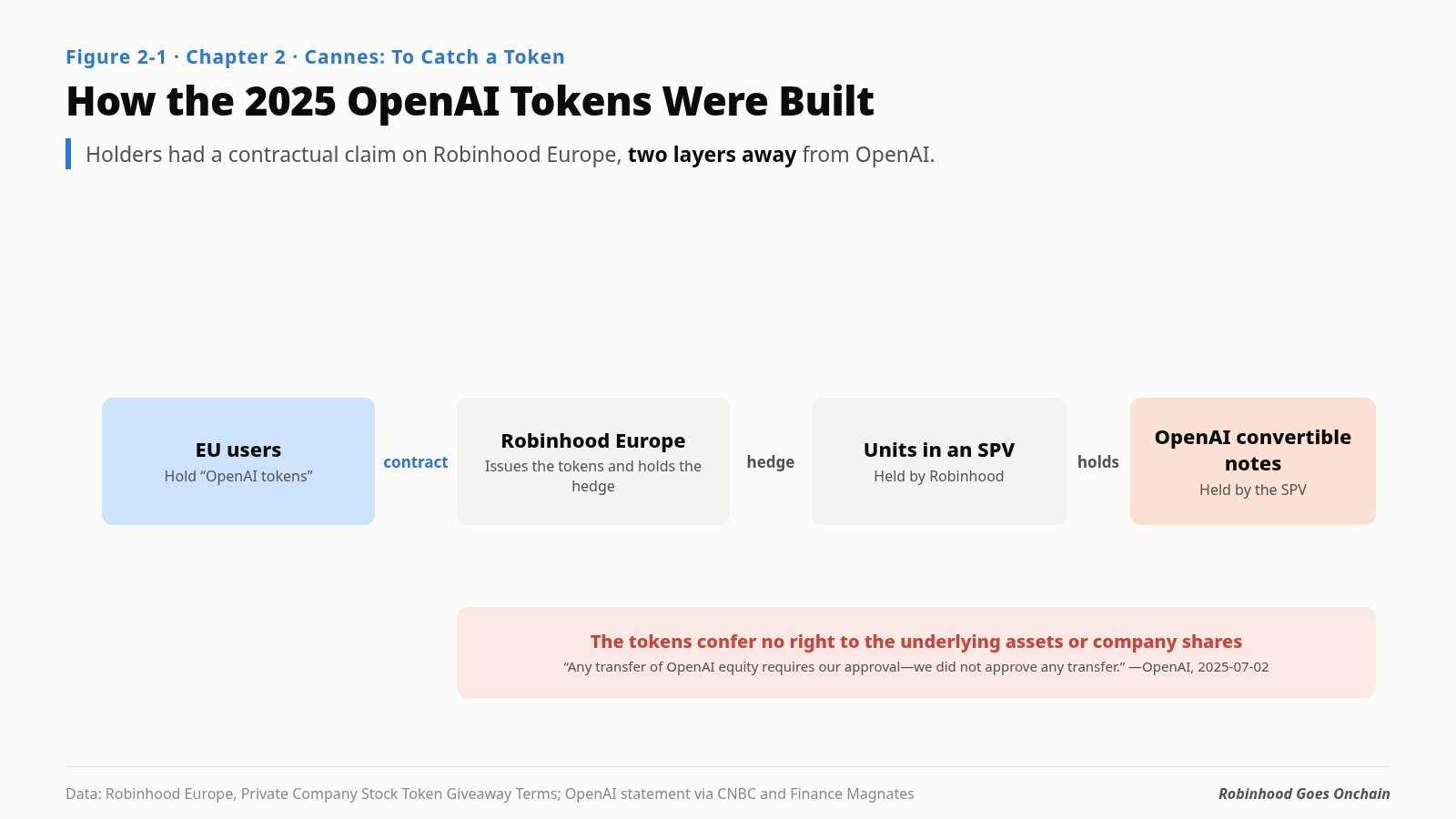
These “OpenAI tokens” are not OpenAI equity. We did not partner with Robinhood, were not involved in this, and do not endorse it. Any transfer of OpenAI equity requires our approval—we did not approve any transfer.
Several days later, the Bank of Lithuania, Robinhood’s principal EU regulator, said it had contacted the company seeking an explanation of the tokens’ structure and of how they had been presented to customers.
Robinhood said the tokens provided economic exposure through a special-purpose vehicle, or SPV, holding the underlying asset. The giveaway terms published by Robinhood’s European entity described the OpenAI token’s hedge as follows: Robinhood held an interest in an SPV, and that SPV held OpenAI convertible notes. The token itself gave its holder no right to receive the underlying asset or any shares in the company.
What the Controversy Revealed
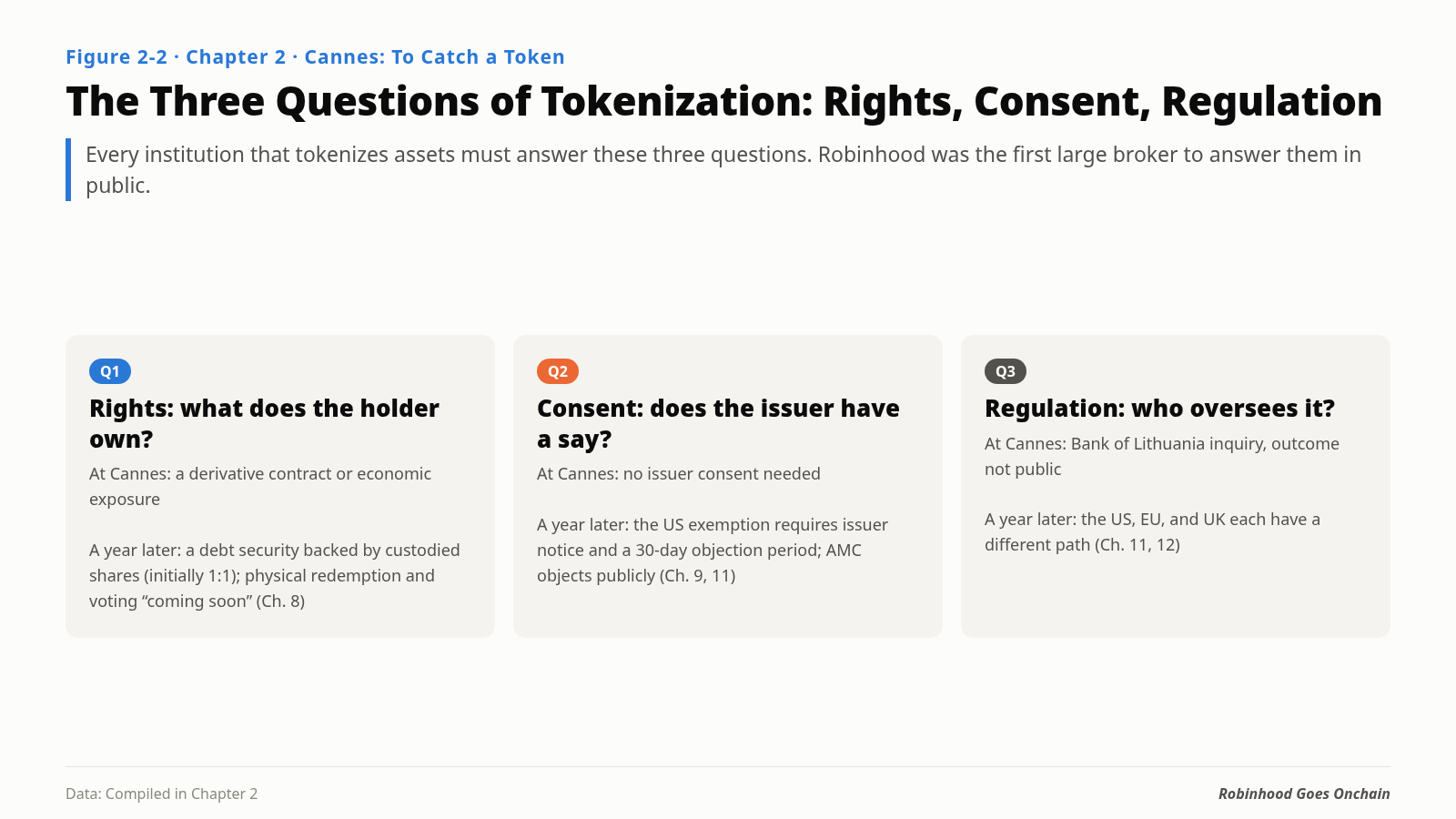
The episode is often treated as an embarrassing chapter in Robinhood’s tokenization effort. Structurally, however, it was more useful as an early stress test. It exposed three questions that every tokenization project must eventually answer:
| Question | The answer at Cannes | What changed one year later |
|---|---|---|
| What does the holder actually own? | A derivative contract or economic exposure—not a share | The next generation of Stock Tokens took the form of debt securities backed initially 1:1 by shares held in custody (Chapter 8) |
| Does the issuer have a say? | No; tokenization did not require issuer approval | The SEC’s September 2026 exemption required notice to the issuer and a 30-day objection period (Chapter 11); AMC publicly objected (Chapter 9) |
| What does the regulator think? | The Bank of Lithuania opened an inquiry; no conclusion was made public | The EU, the U.K., and the U.S. developed different regulatory paths (Chapters 11–12) |
This book calls them the three questions of tokenization: rights, consent, and regulation. Every institution seeking to tokenize an asset must answer them sooner or later. Robinhood was simply the first large broker forced to do so under a spotlight.
The First Generation: Tokens That Could Not Leave the App
Robinhood later renamed the EU stock tokens introduced at Cannes Classic Stock Tokens. According to its European entity, they were “derivative contracts between you and Robinhood Europe, priced by reference to the underlying security, but conveying no rights in that security.”
The first-generation product came with an important limitation: it could be traded only inside the Robinhood app. The tokens could not be transferred to an external wallet. Customers saw a token in the app, but they did not hold it in their own wallets and could not use it in decentralized finance.
That was the problem the second generation of Stock Tokens set out to solve one year later:
| Dimension | First generation: Classic, 2025 | Second generation: Stock Tokens, 2026 |
|---|---|---|
| Legal form | Derivative contract between RHEU and its customer | Tokenized debt security issued by Robinhood Assets (Jersey) |
| Backing | Price-linked exposure | Backed initially 1:1 by underlying shares held with a U.S. custodian, then adjusted through a multiplier |
| Transferability | No; confined to the app | Yes; standard ERC-20 tokens that can enter wallets and DeFi |
| Geographic reach | 30 EU countries | More than 120 countries, excluding the U.S., U.K., Canada, and others |
| Network | Arbitrum One | Robinhood Chain |
| Number of instruments | More than 200 at launch; reportedly more than 2,000 by 2026 | Approximately 200 as of October 2026 |
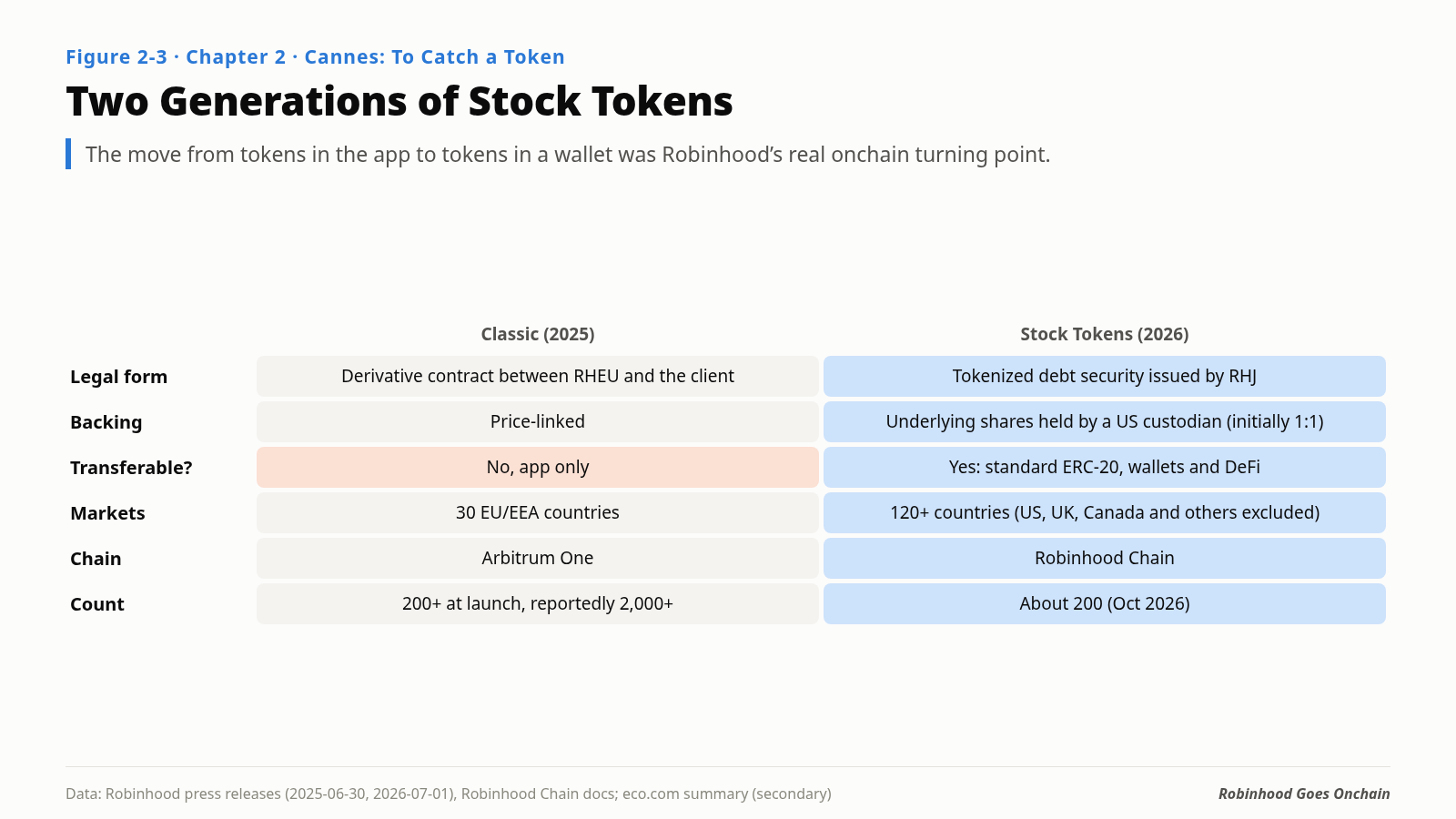
The move from a token inside an app to a token inside a wallet was the true dividing line in Robinhood’s onchain strategy. The first changed the format of an internal ledger. The second allowed stock-linked instruments to enter an open environment that Robinhood did not fully control. From that point on, Robinhood had to contend with everything such an environment brings: memecoins, arbitrage, bots, compliance challenges, and opposition from issuers.
What This Means for Tokenization Projects
- Answer the three questions before building the product. Any uncertainty about rights, consent, or regulation is likely to return as a crisis after launch.
- Distinguish tokens inside an app from tokens held in a wallet. The former may be little more than a change in accounting format, with risks contained by the platform. The latter enter an open market and require fundamentally different compliance and risk controls.
- Tokenizing private-company exposure will almost always require cooperation from the issuer. Private-company shares commonly carry transfer restrictions, making structures created without issuer consent difficult to sustain over time. Chapter 10 examines this problem in detail.
The Takeaway
The Cannes event proved that Robinhood wanted to move stocks onchain. OpenAI’s response proved that the old questions of rights, consent, and regulation would move with them.
Sources for This Chapter
- Robinhood, “Robinhood Launches Stock Tokens, Reveals Layer 2 Blockchain, and Expands Crypto Suite in EU and US,” June 30, 2025: Cannes announcements and Tenev quotation
- OpenAI Newsroom statement on X, July 2, 2025, as reproduced by Finance Magnates and CNBC
- CNBC, “Robinhood Stock Tokens Face Scrutiny in the EU after OpenAI Warning,” July 7, 2025: Bank of Lithuania inquiry
- Robinhood Europe, “Private Company Stock Token Giveaway Terms”: hedge structure for the OpenAI token
- Robinhood announcement dated July 1, 2026: legal form of Classic Stock Tokens
- Eco.com summary published in May 2026, citing Robinhood’s EU website: expansion of Classic Stock Tokens to more than 2,000 instruments; secondary source
- Robinhood Chain documentation, “Stock Tokens”: structure of the second-generation product