
Chapter 3: Why Build a Blockchain?
For investors assessing Robinhood Chain’s value to HOOD—or financial institutions considering chains of their own—this chapter offers a simple answer: Robinhood Chain’s value lies less in sequencer revenue than in the options it creates.
A Number That Looks Larger Than It Is
September 2026 was Robinhood Chain’s busiest month since launch. According to DefiLlama, the chain generated approximately $35.93 million in sequencer fees. After the cost of publishing data to Ethereum, its net protocol revenue was roughly $32.31 million.
These figures require two qualifications. First, they reflect DefiLlama’s chain-level methodology, not revenue recognized in Robinhood’s financial statements; Robinhood did not report this item separately. Second, under its licensing arrangement, the chain owed 10% of net protocol revenue to the Arbitrum ecosystem. The estimates below all use the chain-level methodology.
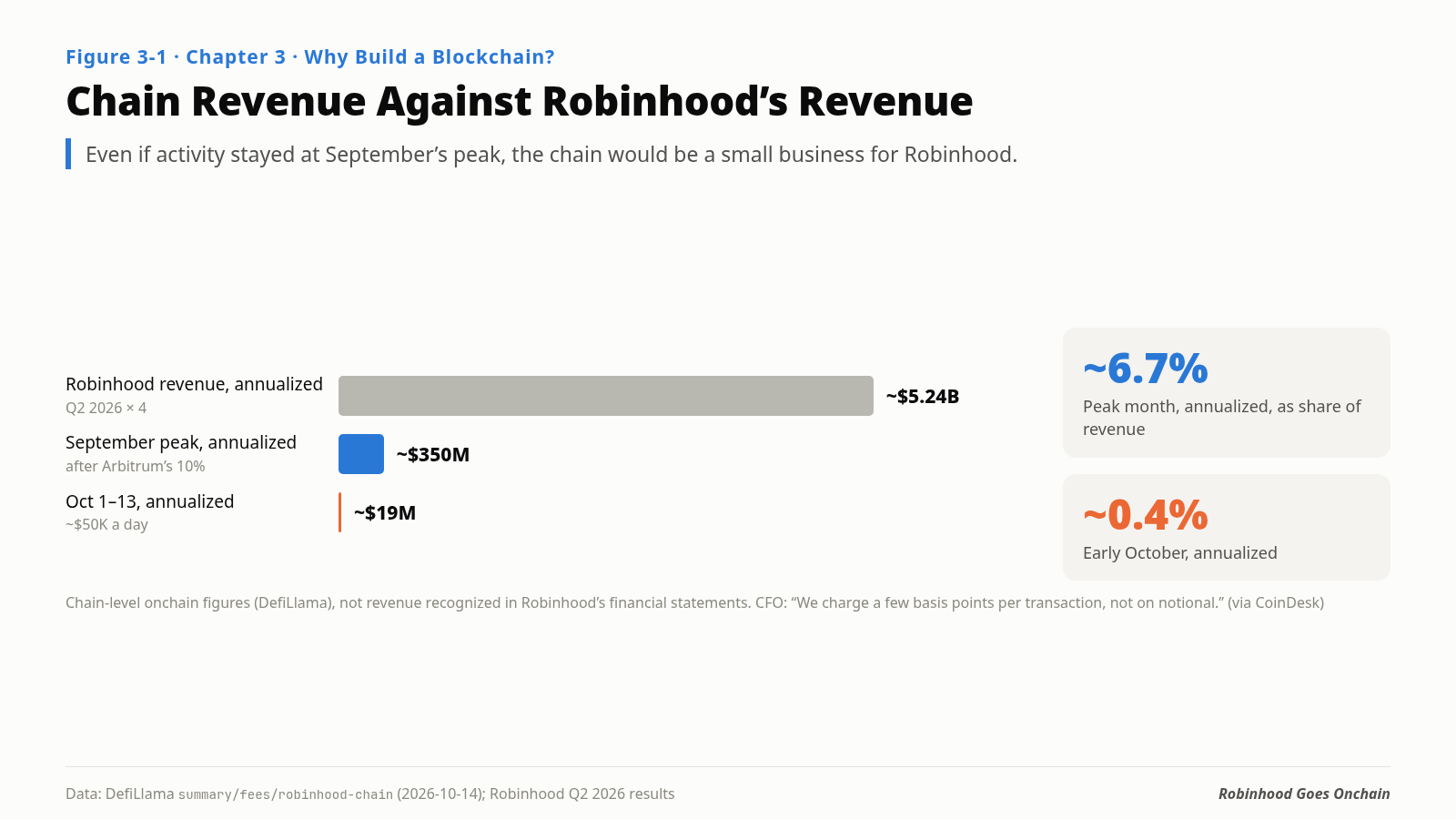
The September figure sounds substantial until it is set against the size of Robinhood’s business:
- Robinhood generated $1.31 billion in net revenue in the second quarter of 2026, equivalent to an annualized rate of approximately $5.2 billion.
- Annualizing the September peak and deducting the 10% paid to the Arbitrum ecosystem produces roughly $350 million, or 6–7% of Robinhood’s annualized revenue.
- From October 1 through October 13, chain-level revenue fell to an average of approximately $50,000 per day. That is an annualized rate of a little more than $18 million—less than 0.4% of Robinhood’s revenue.
Robinhood Chief Financial Officer Shiv Verma described the model succinctly, according to CoinDesk: “We charge a few basis points per transaction—not on volume, but on the number of transactions.”
These figures make one point clear: Robinhood did not build the chain for sequencer revenue. Even if activity remained indefinitely at September’s peak, the chain would still represent a relatively small business for Robinhood.
Why Build It, Then?
Robinhood’s public statements and product decisions point to five motives, listed below in descending order of evidentiary support:
| Motive | Evidence | Support |
|---|---|---|
| Distribute U.S. equity exposure internationally | Stock Tokens reached more than 120 countries and approximately 200,000 holders; Robinhood had about 1 million international funded customers | Strong |
| Capture fees that would otherwise accrue to another chain | On Arbitrum One or Base, sequencing revenue belongs elsewhere; on its own chain, approximately 90% remains with Robinhood and 10% goes to the Arbitrum ecosystem | Strong |
| Turn DeFi yield into a product | Earn lets U.S. customers lend USDG to an onchain Morpho vault with a single action inside the app | Strong |
| Prepare infrastructure for 24/7 markets and AI agents | Weekend-trading plans, Robinhood Agents, and agent trading accounts | Moderate |
| Reduce clearing and custody costs in the core brokerage business | No evidence yet shows Robinhood moving brokerage settlement onto the chain | Weak |
The first three motives are supported by operating products. The final two remain strategic directions that have not yet reached Robinhood’s core brokerage operations.
Why Not Use Someone Else’s Chain?
If direct revenue is modest, an obvious question follows: why not repeat the first-generation approach and deploy on Arbitrum One?
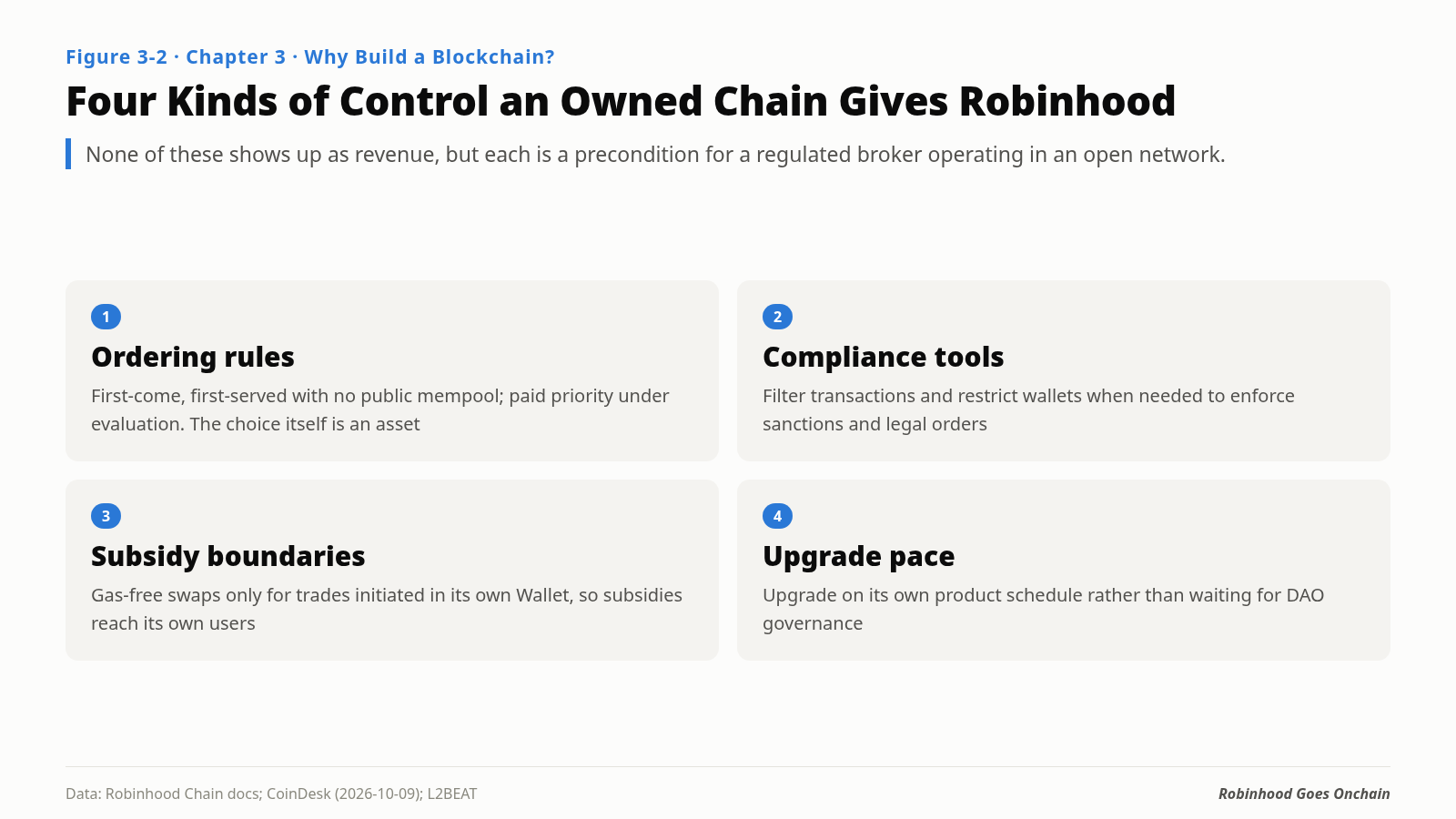
The answer is control. A purpose-built chain gives Robinhood four things it could not obtain to the same degree on a general-purpose public blockchain:
- Transaction ordering. Robinhood Chain’s documentation describes first-come, first-served ordering without a public mempool. This can make onchain price discovery more predictable and reduce the public-mempool sandwich attacks common on Ethereum mainnet. The sequencer is centralized, however, so an outsider cannot verify from the policy alone that every transaction was processed strictly in arrival order. In October 2026, CoinDesk reported that Robinhood was evaluating Arbitrum’s new Priority Gas Auctions, which would allow users to pay more for priority execution. The power to choose the ordering policy is itself an asset.
- Compliance tools. The operator can filter certain transactions or restrict particular wallets when necessary, as Chapter 7 explains. For a regulated broker, that capability may be essential to complying with sanctions and legal orders.
- Targeted subsidies. Robinhood can waive gas fees only for swaps initiated through Robinhood Wallet, directing the subsidy precisely toward its own users.
- Control over upgrades. On its own chain, Robinhood can coordinate upgrades with its product schedule instead of waiting for a decentralized autonomous organization’s governance process.
None of these forms of control appears as revenue in Robinhood’s financial statements. All four, however, help make regulated financial activity possible in an open environment.
Framework: The Chain Is an Option, Not a Profit Center
The argument can be compressed into one framework:
Robinhood Chain’s value to Robinhood lies primarily in a portfolio of options, not in a standalone profit center.
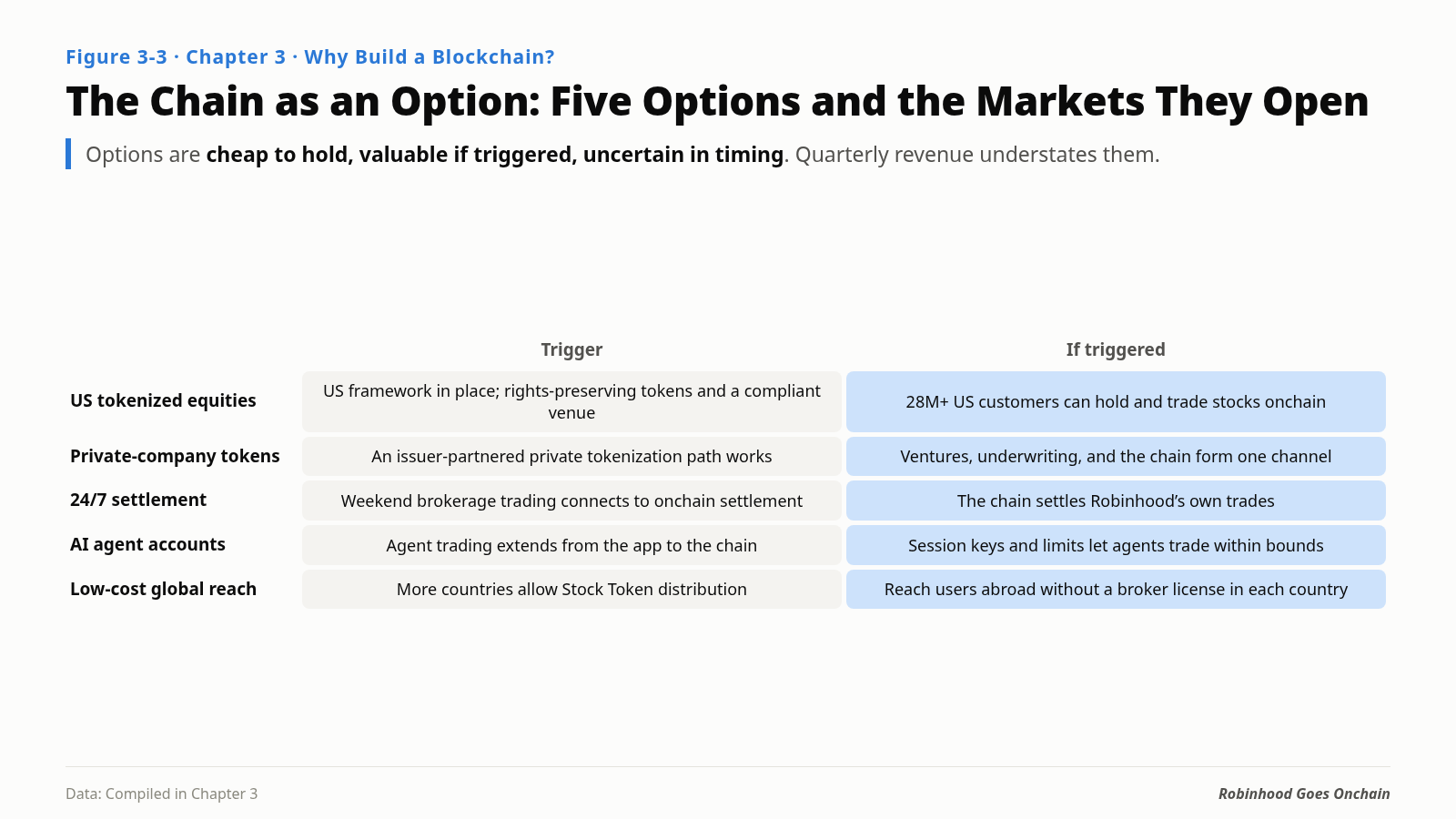
Each option corresponds to a market that could open in the future:
| Option | Trigger | What exercise of the option would mean |
|---|---|---|
| Tokenized U.S. equities | The SEC’s framework becomes operational, and Robinhood creates rights-preserving tokens and a compliant trading venue | More than 28 million U.S. customers could hold and trade stocks onchain, turning the network from an international tool into infrastructure for the core business |
| Private-company tokenization | Robinhood develops a workable, issuer-supported path for tokenized private securities | Robinhood Ventures, underwriting, and the chain become a single channel extending from the pre-IPO market into public trading (Chapter 10) |
| 24/7 settlement | Weekend brokerage trading connects to onchain settlement | The chain begins settling Robinhood’s own trades rather than only third-party transactions |
| Financial accounts for AI agents | Agent-based trading expands from the app onto the chain | Agents can use session keys, spending limits, and other onchain controls to transact autonomously within defined boundaries |
| Low-cost international distribution | Additional countries permit the distribution of Stock Tokens | Robinhood can reach international customers without obtaining a full brokerage license in every jurisdiction |
Options have a distinctive profile: they can be inexpensive to maintain, valuable if exercised, and uncertain in timing. The cost of developing, operating, and subsidizing a chain is modest relative to Robinhood’s revenue. If the option on tokenized U.S. equities becomes exercisable, however, the chain’s strategic value changes by an order of magnitude.
This is why sequencer revenue is the wrong primary measure of Robinhood Chain. Evaluating the chain only through quarterly revenue is like treating an unexpired option’s current cash flow as the whole of its value.
How Analysts See It
Analysts’ approaches to valuing the chain map neatly onto the two views: profit center and strategic option.
- Bernstein, writing in September 2026, took the profit-center view. It projected that Robinhood Chain could generate as much as approximately $160 million in annual fees by 2028, provided stock-token trading grew as a share of total network volume.
- Morgan Stanley, in a September 2026 report summarized by TheStreet, took the option view. It argued that Robinhood’s base of 28 million customers who already trusted the platform gave it a “right to win” in tokenized finance.
The views are not contradictory. Bernstein offered a scenario for measurable chain-level fees. Morgan Stanley emphasized the strategic option created by distribution. Both depend on assumptions, and neither should be treated as a floor or a ceiling for valuation. The long-term significance for HOOD depends primarily on whether—and when—the second kind of value can be realized.
What This Means for Institutions Considering Their Own Chain
- Begin by asking whether the objective is revenue or control. If the objective is simply fee income, deploying on an existing public blockchain will usually be more economical. A purpose-built chain begins to make sense when the institution needs control over ordering, compliance tools, subsidy boundaries, and upgrade timing.
- The hardest cost is not the technology. Arbitrum, the OP Stack, and similar systems have dramatically lowered the technical cost of launching a chain. The more difficult problems are bootstrapping liquidity and building an ecosystem.
- Make the case with an option inventory, not just a revenue forecast. Each option should identify a trigger and an observable measure of progress.
The Takeaway
Sequencer revenue answers the question, “How much money does the chain make today?” The option inventory answers, “Why does Robinhood want to own a chain?” The second question explains why Robinhood Chain exists.
Sources for This Chapter
- DefiLlama,
summary/fees/robinhood-chain, accessed October 14, 2026: monthly chain-level fees and revenue; daily revenue in October - Robinhood’s second-quarter 2026 results: total net revenue
- CoinDesk, September 3, 2026: paraphrase of CFO Shiv Verma’s description of the fee model
- ArbitrumDAO Factsheet: 10% share of net protocol revenue, consisting of 8% for the DAO treasury and 2% for the Developer Guild
- Robinhood Chain documentation: first-come, first-served ordering
- CoinDesk, October 9, 2026: Robinhood’s evaluation of Priority Gas Auctions
- Robinhood announcements dated July 1 and September 29, 2026: Earn, Agents, and weekend trading
- Investing.com and Yahoo Finance, September 8, 2026: Bernstein’s forecast of 2028 fees
- TheStreet, September 2026: secondary account of Morgan Stanley’s research view