
Chapter 1 Bitcoin for Grandma
2012 Founding, the custodial wallet, and a front door for ordinary people
In the summer of 2012, a few days before Y Combinator’s program began, Brian Armstrong did something people would bring up again and again: Armstrong locked the planned co-founder out of the company’s accounts.
The co-founder was Ben Reeves, a British programmer. According to later media accounts, Reeves had been building a bitcoin wallet of their own and put it on hold, at Armstrong’s urging, to help full time. The plan was for the two of them to take the project into YC together. But they could not agree on a question that sounded purely technical: who should hold the users’ private keys?
Reeves believed the keys belonged in the users’ own hands. That was the whole point of bitcoin. Armstrong insisted on keeping a backup of the keys, held by the company. The reasoning was simple. Ordinary people lose passwords, switch phones and forget recovery phrases. If losing a private key meant losing your money forever, bitcoin would remain a toy for geeks.
The two parted ways, and not gracefully. Reeves went back and restarted the earlier project, which became Blockchain.info, one of the best-known bitcoin wallets in the world. Armstrong took the custodial road into YC. The company was called Coinbase.
The split left behind a side story that only became clear years later. At the end of 2013, a programmer named Changpeng Zhao, known as CZ, joined Blockchain.info as head of development. According to CoinDesk at the time, Zhao came to the company through the early bitcoin investor Roger Ver, and the company had just grown from a one-person side project into a team of four. Zhao stayed only about five months. In June 2014, Zhao left to become chief technology officer at OKCoin, then China’s largest bitcoin exchange. In July 2017, Zhao founded Binance, which would be Coinbase’s biggest rival for years to come.
This was the first key decision in Coinbase’s history, and the source of nearly every decision after it. Over the next fourteen years, through licenses, banking relationships, an IPO, institutional custody and endless dealings with regulators, Coinbase kept answering the same question: if you decide to hold other people’s money for them, what are you signing up for?
1. An engineer’s payment problem
Armstrong did not come from finance.
Armstrong studied economics and computer science at Rice University and ran a small tutoring-matching business while still a student. After graduating, Armstrong spent about a year in Buenos Aires working for an education company, and saw there how inflation ate into ordinary people’s savings and how painful it was to move money across borders. Armstrong has said many times since that the experience made money feel personal.
Armstrong then worked in technology and consulting at IBM and Deloitte, and in 2011 joined Airbnb as a software engineer. Airbnb was a cross-border payments headache in its own right: hosts and guests lived in different countries, and money had to move between banks, currencies and regulatory systems. It was slow, expensive and error-prone.
Even before Airbnb, over the holidays at the end of 2010, Armstrong had come across a link to Satoshi Nakamoto’s bitcoin white paper on Hacker News while visiting family. A programmer saw a kind of money that could be sent the way you send an email. Seeing how painful cross-border payments were at Airbnb later made its significance even clearer.
But on actually trying to use bitcoin, Armstrong ran into a huge problem: it was far too hard to use.
To buy bitcoin in 2012, you first had to find an exchange. The biggest one, Mt. Gox, was in Japan and took deposits by wire transfer, which often took days. Once you had bought, you had to download a bitcoin client, sync the entire blockchain and manage a string of letters and numbers called a private key yourself. Lose the key and the money was gone for good. No customer service, no “forgot password.”
One bitcoin was worth about $6 at the time. The people who knew about it were, as Fred Ehrsam later put it, just “a few nerds on the internet.”
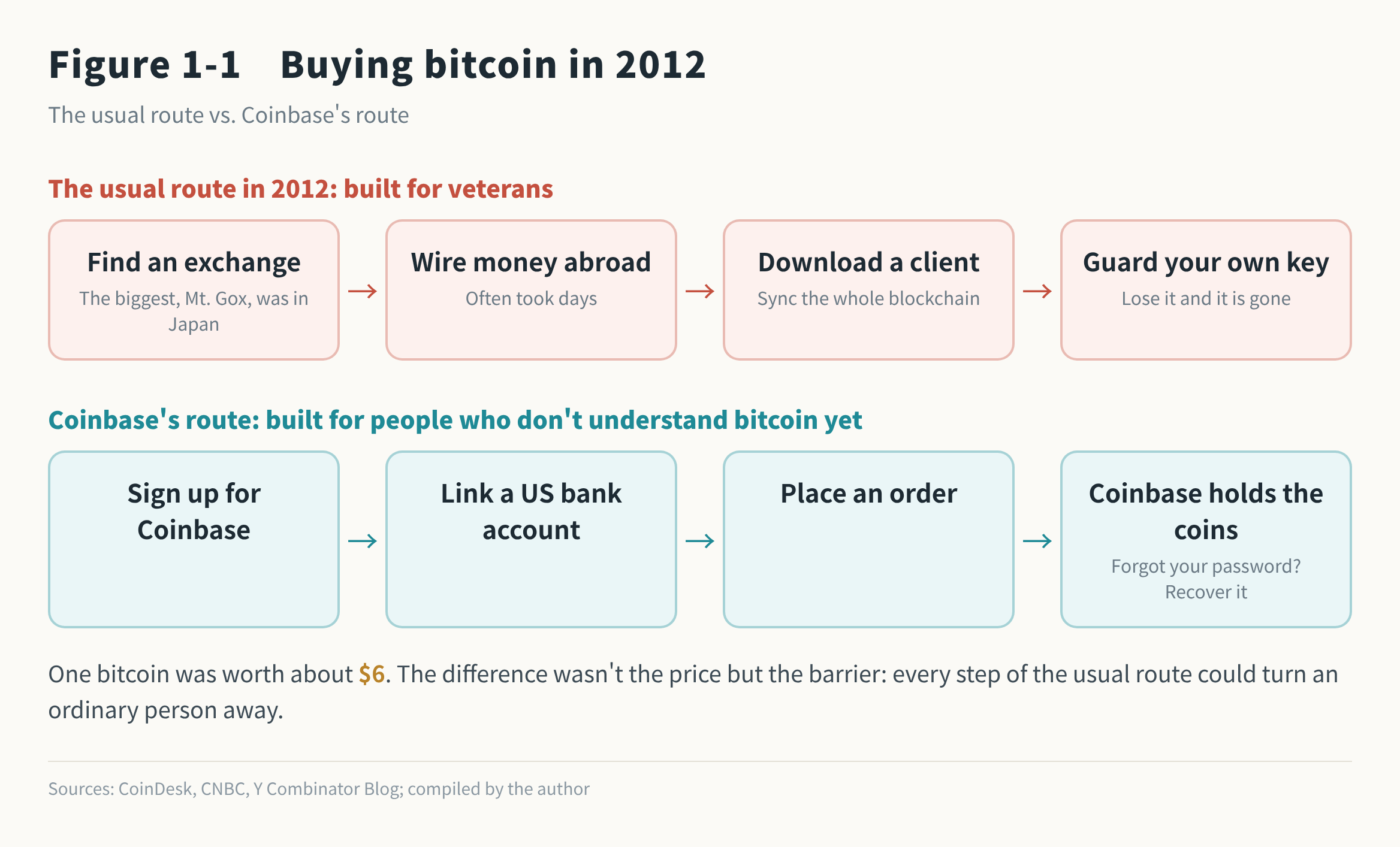
Armstrong’s conclusion was that for bitcoin to break out of that circle, what it needed was not better technology but a product as easy to use as online banking.
2. Finding a partner
On March 29, 2012, Armstrong applied to Y Combinator. After the split with Reeves, Armstrong needed a new co-founder.
Armstrong posted an early prototype on Reddit. A former Goldman Sachs foreign-exchange trader read it and sent a cold email. That was Fred Ehrsam. They met and quickly decided to work together. Armstrong later called the meeting “very lucky.”
The pairing was naturally complementary. Armstrong was an engineer focused on product and long-term mission, introverted and stubborn. Ehrsam came off a Wall Street trading desk and understood markets, liquidity and how financial institutions think. A company that wanted to bring bitcoin to ordinary people, and that would have to deal with banks to do it, needed both perspectives.
Coinbase joined YC’s Summer 2012 batch and received about $150,000 in starting capital.
That summer at YC, Armstrong was already clear about which side to be on, and wrote a post on Hacker News that almost previewed the next decade of Coinbase’s strategy. The biggest risk to bitcoin businesses, the post suggested, might not be technology but the law. Anyone in the business would sooner or later have to choose between cooperating with authorities and revealing customer identities, or protecting anonymity to please the community. Armstrong’s own leaning was stated plainly: anonymity may not be as important to the masses.
On the bitcoin forums of the time, that was close to heresy. But it was the other side of the same judgment as custody: the people Armstrong wanted to serve had never been those who treated anonymity as a creed.
3. The first money nobody was racing to give
YC’s graduation day is called Demo Day. Founders get a few minutes to explain to a room of investors what they are building. Armstrong’s pitch was simple: Coinbase would be “the easiest way to get started with bitcoin.”
The room was not excited.
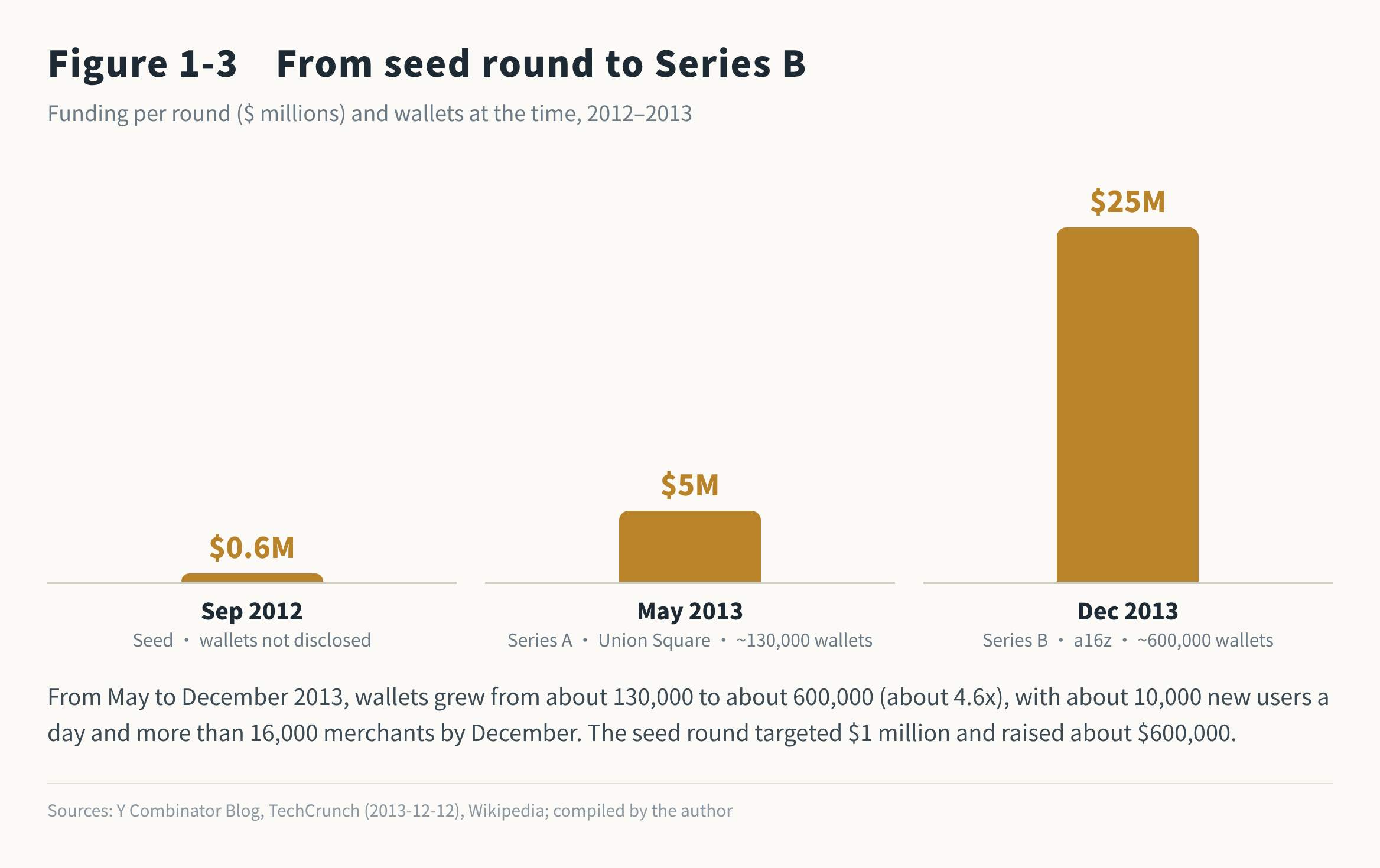
In 2012, mainstream investors saw bitcoin as something tied up with the dark web, money laundering and geek hobbies. Armstrong had hoped to raise $1 million and ended up with about $600,000.
Where that money came from says a lot. Part of it came through FundersClub, a young equity crowdfunding platform: 61 members put in about $268,700, slightly more than the $250,000 target. Coinbase was described as the first bitcoin company funded through crowdfunding. If institutions would not bet, a group of individual believers would each chip in a little.
Another early check came from Initialized Capital, a small fund just started by Garry Tan, a YC alumnus, and Reddit co-founder Alexis Ohanian. Tan later recalled writing the first check into Coinbase’s seed round on Demo Day itself. According to a 2021 Forbes report, Initialized invested about $300,000 in Coinbase across 2012 and 2013; by the time Coinbase went public, that stake was worth about $680 million.
Nobody in 2012 could have known it would end that way. Investing in Coinbase then was a bet on an odd idea: that bitcoin would one day need a front door that ordinary people could use.
The seed round closed in September 2012. In October, Coinbase launched its core feature: buying and selling bitcoin directly with a US bank account.
4. Custody: a choice it would be attacked for over a decade
Back to the original disagreement: who should hold the private keys?
To bitcoin purists, there was only one answer. Bitcoin’s core innovation was that you did not have to trust any intermediary. “Not your keys, not your coins” later became one of the crypto community’s slogans. A company holding users’ private keys was turning bitcoin back into a bank deposit.
Armstrong’s choice put Coinbase on the opposite side of that slogan.
Armstrong was betting on a different judgment: most ordinary people would rather trust a reliable company than carry all the risk themselves. Most people keep their money in a bank, not under the mattress. The mattress is more “self-sovereign,” but the bank is more convenient, safer, and someone is accountable when something goes wrong.
But “holding it for you,” for a startup of a few people, meant very concrete headaches.
Armstrong ran the numbers. In an average week, only about 13% of customer funds actually needed to be available for withdrawal. The other 87% did not need to sit on internet-connected servers. So Armstrong put the private keys for that portion onto three USB thumb drives and locked them in a safe deposit box at a bank.
It sounds primitive now, but it was an early version of what became cold storage: keep most assets physically cut off from the internet, so that even a hacker who breaks into the servers cannot take the bulk of them. Around the same time, a number of bitcoin exchanges kept most of their coins in online hot wallets, and within a few years one after another was robbed.
The custody choice brought a chain of unavoidable consequences:
- If you hold customers’ assets, you must prove you are secure enough. So from very early on, Coinbase kept the vast majority of assets in offline cold storage.
- If you connect to customers’ bank accounts, you must reassure the banks. So it had to verify identities, run anti-money-laundering checks and apply for licenses (the story of Chapter 2).
- If you want ordinary people to trust you, you must operate like a proper company, one that can be sued and is therefore accountable.
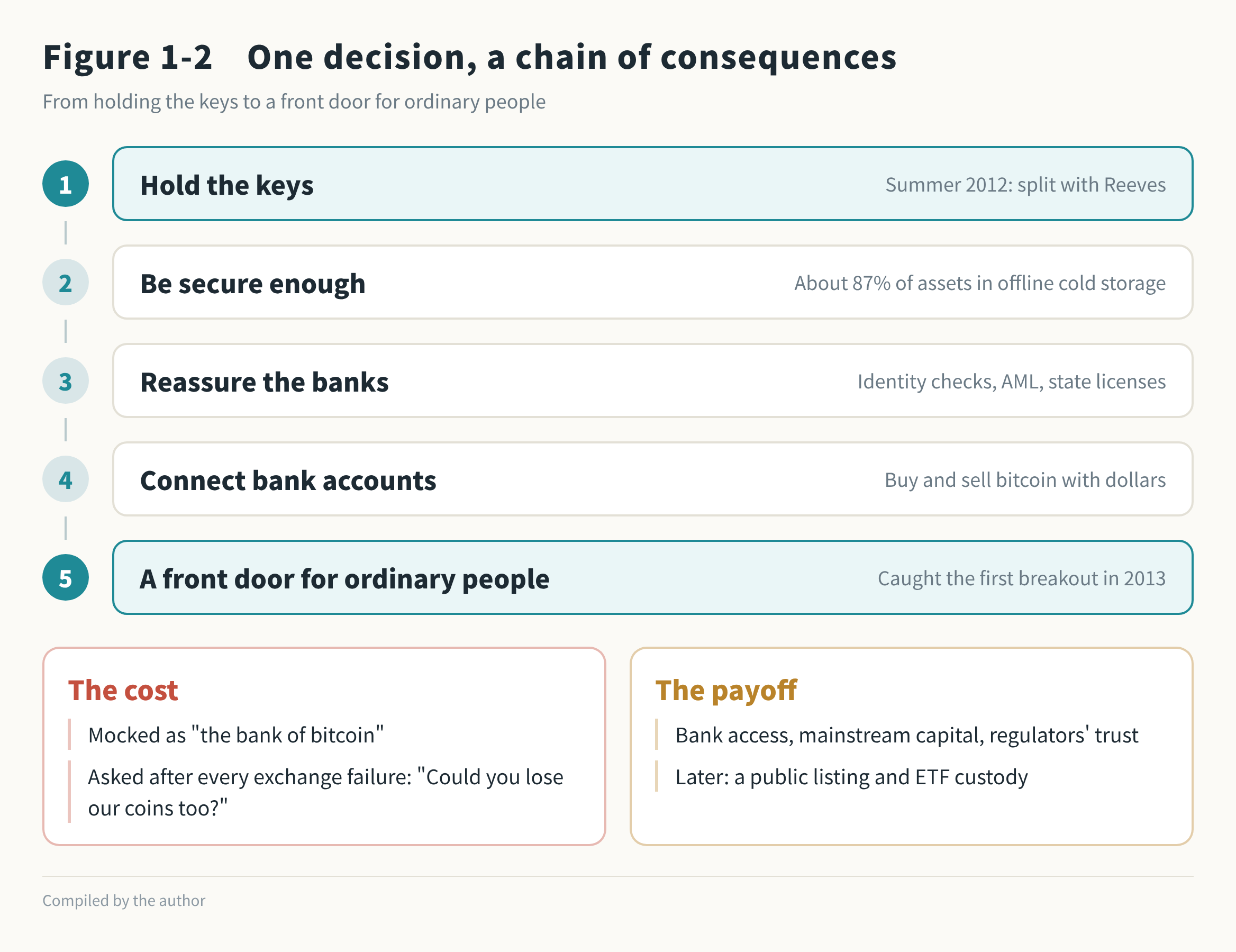
Custody led to compliance, compliance led to banking access, and banking access determined who the users would be. That chain of cause and effect was set in the summer of 2012.
The cost was just as clear. Coinbase would be seen by the community as “the bank of bitcoin,” criticized for betraying bitcoin’s spirit, and asked the same question every time an exchange failed: “Could you lose our coins too?”
5. The CEO as customer support
After launch, growth came faster than expected. Not long after users could buy directly with a bank account, Coinbase was handling about $1 million a month in bitcoin purchases and sales.
The company itself was tiny. The team worked out of an apartment on Bluxome Street in San Francisco. The first staff photos on the website were cropped from people’s social media profiles. Each of the first 20 employees did a two-week work trial before joining.
More users meant more complaints. Buying meant waiting for bank transfers to clear while the price swung wildly, and anxious users emailed the company directly. In early 2013, Armstrong was still personally handling customer complaints, answering them one by one. About three months later, support was handed to Olaf Carlson-Wee, Coinbase’s first employee, who would later leave to found the crypto fund Polychain Capital.
A company later worth over $100 billion once had a CEO whose job included replying to angry customers. That detail is more than startup color. It shows that from day one Coinbase understood that a custodial product doesn’t sell technology. It sells “someone will deal with it if something goes wrong.” Users who leave their coins with you are paying for that peace of mind.
The apartment office sometimes doubled as a community hub. In the summer of 2013, Armstrong and Ehrsam hosted a bitcoin meetup in that cramped apartment. Only a year later did the company move into a real office downtown.
6. What the competitors were doing
Zoom out and look at Coinbase’s competitors in 2012:
- Mt. Gox: the world’s largest bitcoin exchange, based in Japan, serving veterans who could wire money and manage their own wallets. It was plagued by security and management problems.
- BitInstant: a New York bitcoin exchange service selling “fast bitcoin.” Its founder Charlie Shrem was an industry star, but the company left huge compliance gaps.
- Bitstamp: an exchange founded in Slovenia in 2011. Relatively solid, but also built for professional users.
- Blockchain.info: the wallet Ben Reeves went on to build, following the “users hold their own keys” model and highly respected in technical circles.
They had one thing in common: they all served people who already understood bitcoin.
Coinbase was the only company that, from day one, defined its target user as “people who don’t understand bitcoin yet.” Its real competitor was not these exchanges but the thought in an ordinary person’s head: “This is too complicated, forget it.”
In 2012, this difference in positioning seemed almost meaningless. Few people understood bitcoin, and those who didn’t had no interest in it. But it decided one thing: when bitcoin first broke into the mainstream and ordinary people poured in, where they would go.
The answer came a year later.
7. Breaking out for the first time
In 2013, bitcoin had its first big bull market.
That year, Cyprus went through a banking crisis in which depositors’ savings were forcibly “haircut.” Bitcoin, an asset no bank controlled, made the mainstream news for the first time. Its price climbed from the low teens at the start of the year to over $1,000 by year-end.
Coinbase had quietly laid another road before this: letting merchants accept bitcoin. In February 2013, Reddit began accepting bitcoin for its paid membership, Reddit Gold, at $3.99 a month or $29.99 a year. The payment processor behind it was Coinbase. Before that, 4chan’s paid service was already using Coinbase’s merchant tools. At a time when bitcoin was still seen as “dark web money,” a mainstream site putting a price in bitcoin was news in itself.
Suddenly, “ordinary people who don’t understand bitcoin” wanted to buy it. They were not going to wire money to Mt. Gox in Japan, and they did not want to download a client that took days to sync. They typed “how to buy bitcoin” into a search engine and found a site where they could link a bank account and that looked like online banking.
The numbers recorded the shift. In May 2013, when Coinbase raised a $5 million Series A led by Union Square Ventures, it had about 130,000 wallets. By December, when it raised a $25 million Series B led by Andreessen Horowitz, it had about 600,000 wallets, was adding about 10,000 users a day, and more than 16,000 merchants had signed up for its bitcoin payments service, including OkCupid, Khan Academy and Reddit.
Growth also brought the first time Coinbase couldn’t keep up. In November 2013, as bitcoin raced past $1,000, buy orders came in faster than Coinbase could process them. It posted a notice on its site: because buy volume was far above normal, it could not give exact price quotes for now; rather than pause buying entirely, it would let users choose to buy at the market price a few days later, when their dollars arrived.
That notice says a lot about where Coinbase stood. It had caught the wave of newcomers, but its systems, bank rails and money flows were still built for a much smaller market. Four years later, the same problem would return on a much larger scale (see Chapter 4).
The $25 million Series B was the largest financing in the bitcoin industry’s history up to that point.
The a16z investment was especially symbolic. The Silicon Valley firm famous for “software is eating the world” had never invested in a bitcoin company. It did not pick Mt. Gox, the biggest by volume, or the wallet with the best reputation among technologists. It picked Coinbase, the one that looked most like a normal internet company. Partner Chris Dixon and Fred Wilson of Union Square joined Coinbase’s board.
Mainstream capital’s first big bet on bitcoin went to the path of “custody plus compliance plus ease of use.” A company that couldn’t raise $1 million at Demo Day a year earlier had become the most sought-after company in the industry.
8. Looking back: judgment or luck?
The judgment: Armstrong’s most important insight was seeing that bitcoin’s bottleneck was experience, not technology. In a circle where everyone was talking about decentralization, cryptography and “disrupting banks,” Armstrong asked a product manager’s question: “Could my grandmother use this?” The answer to that question shaped everything Coinbase later became.
The luck: Coinbase’s timing was excellent. Founded in summer 2012, it caught the first bull market of 2013 just as the product took shape. Two years earlier and it might not have survived to the first breakout; two years later and someone else might have owned the front door. Falling short of its $1 million seed target didn’t sink it, because the bull market came fast enough.
The contested part: Whether custody was the right path is still debated. “Not your keys, not your coins” was proven right again and again after Mt. Gox in 2014 and FTX in 2022: hand your coins to a centralized company and you can lose everything. But another fact also holds. Coinbase, a custodian, went more than a decade without a Mt. Gox-style mass loss of coins, and it served far more ordinary users than self-custody wallets ever did.
What if Armstrong had gone along with Reeves?
Coinbase would probably have become another Blockchain.info: a well-regarded wallet popular with technologists, but unlikely to become the main entrance for ordinary people into crypto, and with no licenses, IPO, ETF custody or Wall Street partnerships to come. Both paths worked, but they led to two completely different companies.
One more point is easy to miss: custody is not a choice where you get only the benefits. Choosing it means locking keys in a safe deposit box, having the CEO answer complaint emails, and explaining to users why you can’t quote a price when orders flood in. Those are exactly the headaches a self-custody wallet avoids. Coinbase’s strength came precisely from its willingness to take on the headaches others wouldn’t.
What this chapter really offers is not an answer to “custody or self-custody,” but this: when a new technology first appears, the biggest opportunity is often not in the technology itself, but in the layer that makes it usable for ordinary people. That layer looks the least exciting and is the easiest for technologists to look down on, yet it is often where the most users are.
Decision Card
| Situation | 2012: bitcoin was popular only among geeks; buying and storing it was extremely hard |
| Options | A: let users hold their own keys (self-custody) B: the company holds the keys and connects to bank accounts |
| Choice | B, at the cost of parting ways with the planned co-founder |
| Outcome | Short term: criticized for betraying bitcoin’s spirit; seed round fell short. Long term: caught a wave of ordinary users in the 2013 breakout and won backing from top investors including a16z |
| Lesson | The biggest opportunity in a new technology is often not the technology itself, but the layer that makes it usable for ordinary people |
Key line: Bitcoin’s bottleneck wasn’t cryptography. It was whether my grandmother could use it.
Sources
- The disagreement with Ben Reeves, Ehrsam joining via Reddit, the apartment office and two-week trials: CoinDesk: Coinbase, Before It Was Inevitable; ChainCatcher
- YC application date and custodial wallet positioning: Y Combinator Blog: Coinbase from YC to IPO
- One bitcoin at about $6: CNBC, 2021-04-14
- Armstrong’s early life: Wikipedia: Brian Armstrong; Tim Ferriss interview transcript; Benzinga
- Seed round and October 2012 launch: Wikipedia: Coinbase
- Series A, Series B and user numbers: YC Blog; TechCrunch, 2013-12-12; SiliconANGLE
- The white paper and Hacker News: Wikipedia: Brian Armstrong
- Demo Day pitch, the Hacker News post on law and anonymity, about $1 million a month after bank linking, 13%/87% and the three thumb drives, Armstrong handling complaints, Carlson-Wee taking over support, the Bluxome Street apartment and meetups: CoinDesk: Coinbase, Before It Was Inevitable
- Seed target of $1 million and about $600,000 raised; Initialized’s roughly $300,000 and about $680 million at IPO: Forbes Colombia (republishing Forbes), 2021-04-16; ForkLog
- Garry Tan’s “first check at Demo Day”: Yahoo Finance: This VC Gave Coinbase Its First Check
- FundersClub crowdfunding of $268,700 from 61 members: Private Internet Access Blog, 2012-09
- Reddit Gold accepting bitcoin; 4chan already using Coinbase’s merchant tools: TechCrunch, 2013-02-14; prices: PCWorld
- November 2013 buy volume and settling at market price after funds arrived: 99Bitcoins
- Zhao as Blockchain.info head of development, the Roger Ver connection, the four-person team, and the June 2014 move to OKCoin as CTO: CoinDesk, 2014-06-12; tenure December 2013 to May 2014 and the February 2015 exit from OKCoin: Cointelegraph, 2015-02-17; Binance founded July 2017: CryptoGlobe, 2018-05
- Reeves pausing the earlier wallet project to help, and the split: Crowdfund Insider; ChainCatcher