
Contents (8)

·
The Year the SEC Sued, Coinbase Launched Its Own Chain
2023 The SEC lawsuit, Base, the Circle restructuring and Binance’s guilty plea
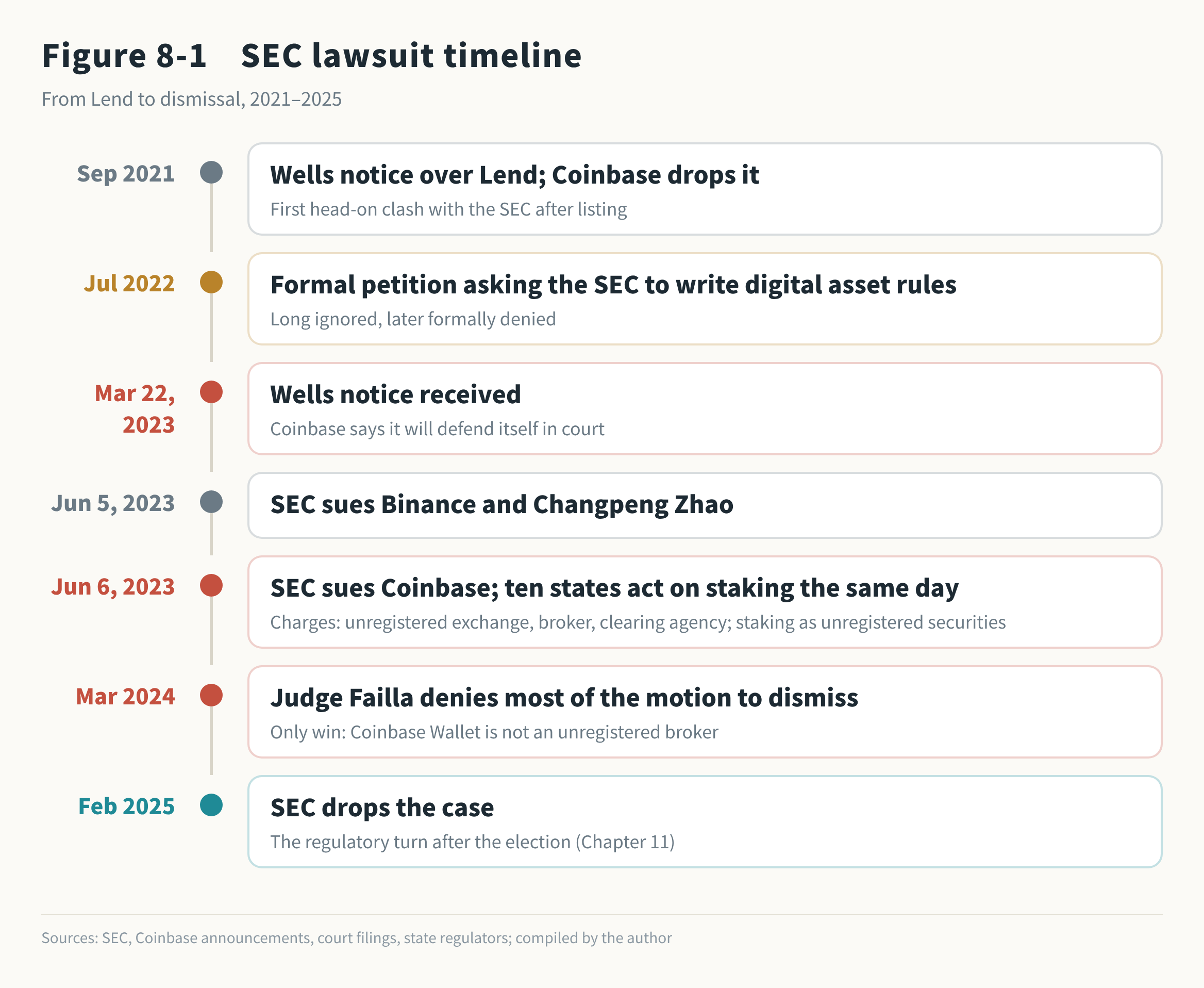
On June 5, 2023, the US Securities and Exchange Commission (SEC) sued Binance, the world’s largest crypto exchange, and its founder Changpeng Zhao.
The next day, June 6, the SEC sued Coinbase.
The charges were clear: Coinbase had operated as an unregistered national securities exchange, broker and clearing agency; some tokens traded on its platform were securities; and its staking service was an unregistered offering of securities.
That same day, pressure came from another direction too. Securities regulators in ten states, including Alabama, California and New Jersey, acted jointly against Coinbase’s staking service. Alabama gave it 28 days to show cause why it should not be ordered to stop; California issued a cease-and-desist order outright. Coinbase subsequently stopped accepting new staking from retail customers in four states: California, New Jersey, South Carolina and Wisconsin.
Federal and state regulators, two layers of oversight, came down together on the same day.
It was a deeply ironic moment. For a decade Coinbase had made compliance the core of its identity. It had applied for licenses state by state, connected to banks, submitted to audits, gone public and accepted the SEC’s scrutiny as a listed company. Now that same SEC was naming it as a defendant alongside Binance.
To many, this was the ultimate rejection of Coinbase’s path: you thought you were complying all along, but the regulator thinks you were breaking the law all along.
Yet this was also the year Coinbase made the most important turn in its history: it launched its own blockchain, Base, restructured its USDC partnership with Circle, and began changing from “an exchange” into “infrastructure for the on-chain economy.”
1. “Regulation by enforcement”
To understand the lawsuit, you first have to understand the fundamental disagreement between the crypto industry and the SEC.
The core question: which crypto assets are “securities”?
In the United States, whether an asset is a security is decided mainly by a 1946 Supreme Court case, the famous “Howey test”: if investors put money into a common enterprise expecting profits mainly from the efforts of others, the investment is an “investment contract,” and thus a security.
As the SEC read it, many crypto tokens fit this definition: project teams issue tokens to raise money, investors buy them, and they expect the team’s development work to make the tokens appreciate. If these tokens are securities, platforms that trade them must register as securities exchanges and be regulated much like the NYSE and Nasdaq.
Coinbase’s position was: we’re willing to register, but tell us how. Existing securities rules were designed for stocks and bonds, and many requirements (for example, that an exchange cannot also act as broker and custodian) simply didn’t fit how crypto trading works. In July 2022, Coinbase formally petitioned the SEC to write clear rules for digital assets. The SEC didn’t respond for a long time, then chose to sue; later it formally denied the petition.
Coinbase and the industry called this approach “regulation by enforcement”: instead of writing clear rules, drawing the boundaries one lawsuit at a time.
On March 22, 2023, Coinbase received a “Wells notice” from the SEC, formal notice that staff were preparing to recommend enforcement action. Coinbase responded publicly that it would defend itself in court. That spring Armstrong said at one point that Coinbase might move its business out of the US if regulation stayed unclear; by June, Armstrong said explicitly that Coinbase would not move offshore.
2. A tug-of-war in court
In March 2024, Judge Katherine Polk Failla of the federal court in the Southern District of New York ruled on Coinbase’s motion to dismiss.
The outcome was quite bad for Coinbase. The judge found that the SEC had adequately alleged that the tokens at issue and Coinbase’s staking service were securities, and that Coinbase had been operating as an unregistered broker, exchange and clearing agency. The judge rejected Coinbase’s “major questions doctrine” argument, that a question as major as regulating crypto assets should be decided by Congress rather than the SEC.
Its only win: the judge dismissed the SEC’s claim that Coinbase Wallet made it an unregistered broker.
The case headed toward trial.
In this tug-of-war, Coinbase faced a hard reality: it could not win quickly in court. The case could drag on for years, and the whole time its business would be clouded by uncertainty: investors would worry, partners would hesitate, and new products would be constrained.
Coinbase realized that court alone was not enough. It needed two other roads: one was politics, the other a business transformation.
3. Base: a chain of its own
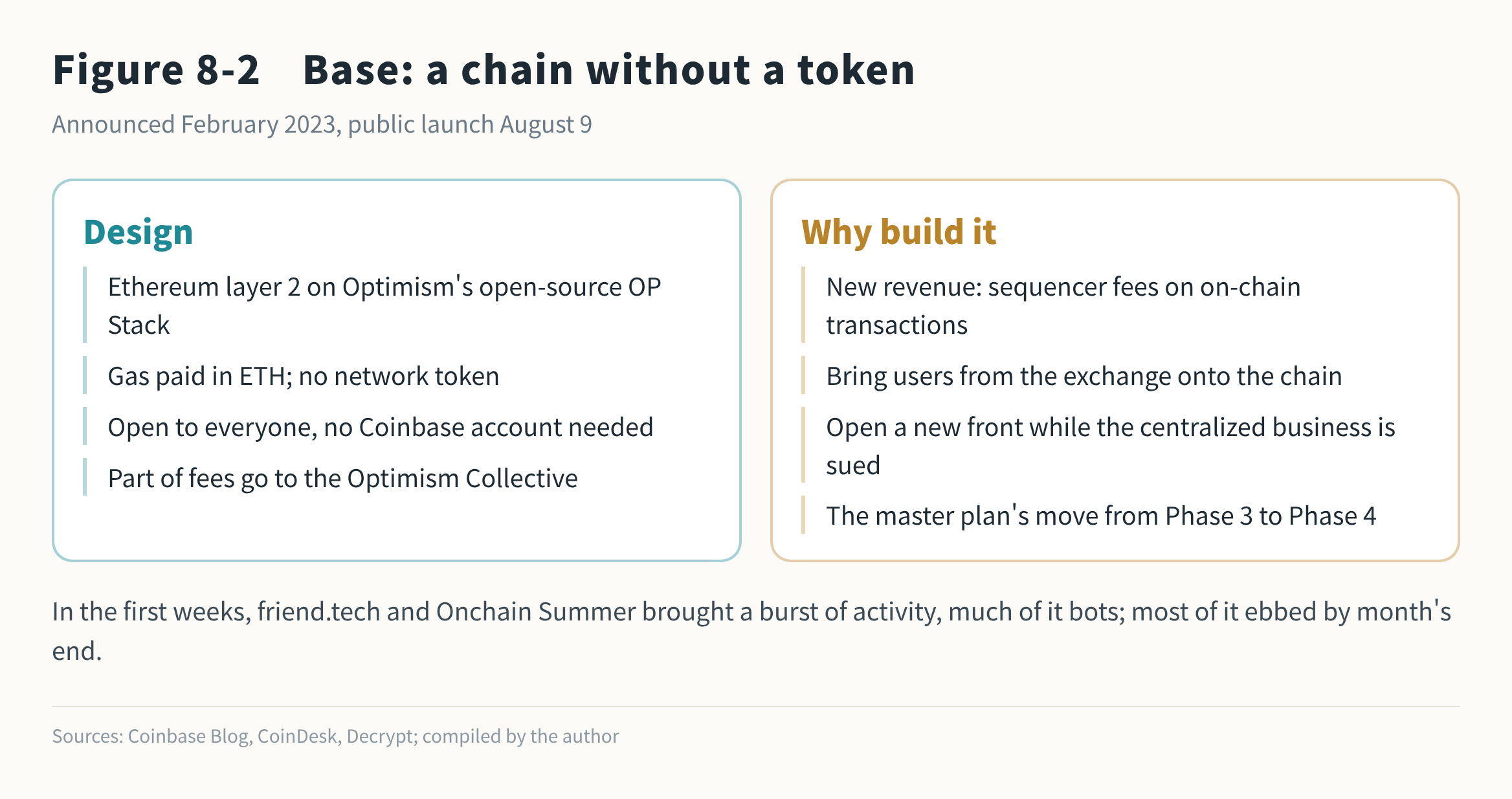
In February 2023, a month before the Wells notice, Coinbase announced a plan that surprised the industry: it would launch its own blockchain, called Base.
Base is an Ethereum “layer 2” network. Put simply, Ethereum’s main network is secure but expensive and congested; a layer 2 processes large numbers of transactions off Ethereum and then submits the bundled results back to it, keeping security while sharply cutting costs and increasing speed.
Some key design choices of Base:
- Built on the open-source OP Stack. Coinbase didn’t build from scratch; it used the open-source technology stack of another Ethereum layer 2, Optimism, and contributed part of its transaction fees to the Optimism Collective.
- No new token. Base used ether (ETH) for gas fees, and the team said it had no plans to issue a network token. That was extremely rare in crypto at the time, when nearly every new chain issued a token to raise money. With the SEC calling tokens securities, the choice had obvious compliance considerations.
- Open to everyone. Any developer could deploy apps on Base, and any user could use it, without a Coinbase account.
In July 2023, Base’s mainnet opened to developers; on August 9, Base launched to the public.
The first few weeks were unexpectedly lively. Coinbase ran a campaign called “Onchain Summer,” encouraging users to move assets to Base to mint commemorative NFTs and try apps. On August 11, a social app called friend.tech launched on Base, letting users buy and sell other people’s “keys” to get into private chat groups, and it took off overnight. Daily active users on Base quickly hit a record of about 136,000, and daily transaction counts at one point exceeded Ethereum’s main network.
But there was plenty of froth in the excitement. Many analysts pointed out that much of the activity came from bots; friend.tech’s transaction count peaked in early August and fell by about 90 percent by the end of the month. Whether a new chain can keep people depends not on its first month of buzz but on whether real applications and capital settle there over the following years. That answer would come two or three years later.
Why would Coinbase build its own chain?
First, to reduce dependence on trading fees. Every transaction on Base pays a gas fee, and as Base’s operator, Coinbase runs the “sequencer” that processes transactions and can earn revenue from it. This was a new kind of revenue that didn’t depend on coin prices or centralized trading volume.
Second, to bring users from the exchange onto the chain. Armstrong had long believed crypto’s future lay not in trading but in on-chain applications: payments, social, games, finance. Base gave Coinbase the chance to become infrastructure for this “on-chain economy,” not just a counter for buying and selling tokens.
Third, to open a new front under regulatory pressure. The centralized exchange business was being sued by the SEC, while an open, decentralized blockchain was a field with blurrier regulatory boundaries but much more room to grow.
It was a bold decision. In the same year it was sued by the SEC and its business faced its greatest uncertainty, Coinbase didn’t retreat. It opened an entirely new direction.
4. USDC: from partner to shared interest
On August 21, 2023, Coinbase and Circle announced a restructuring of their USDC partnership.
The Centre consortium the two had formed in 2018 was dissolved, and USDC’s governance and issuance passed entirely to Circle. In exchange, Coinbase received a small equity stake in Circle, and the two set new terms for sharing USDC reserve income.
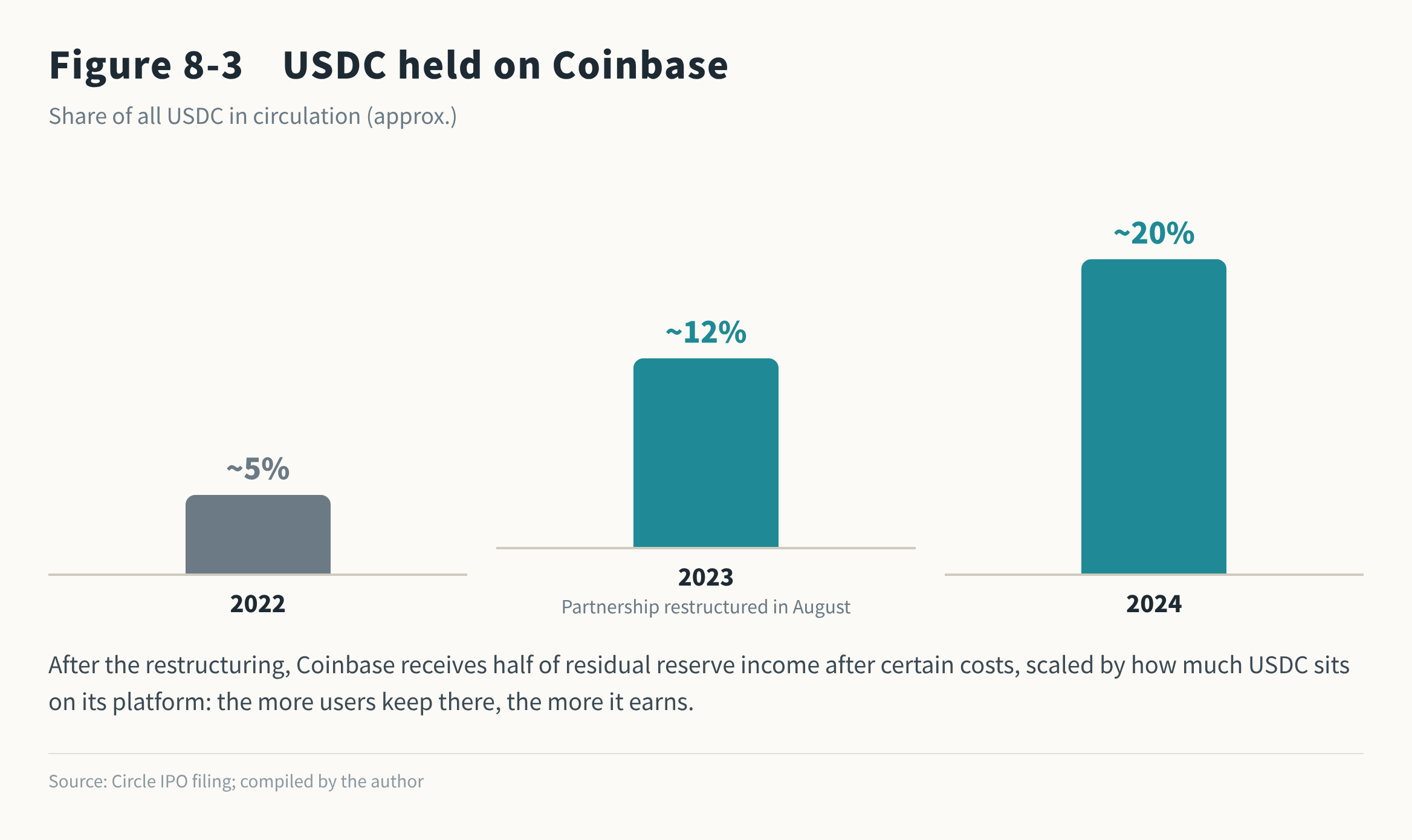
According to documents Circle later filed when it went public, Coinbase receives half of the residual USDC reserve income after certain costs, and the share is tied directly to how much USDC is held on Coinbase’s platform. USDC held on Coinbase grew from about 5 percent of the total in 2022 to about 12 percent in 2023 and about 20 percent in 2024.
The significance of this arrangement: Coinbase turned the size of its user base into bargaining power over stablecoin revenue. The more USDC users kept on Coinbase, the more revenue Coinbase got. So Coinbase had a strong incentive to promote USDC: offering rewards to users who held it on the platform, and making it the main payment instrument on Base.
In the high-rate environment of 2023, this arrangement quickly made stablecoin revenue one of Coinbase’s most important sources of profit. While trading revenue was under pressure from the bear market and the lawsuit, USDC held up Coinbase’s financial statements.
The turn began to show in the books at the end of 2023. In the fourth quarter of 2023, Coinbase earned net income of about $273 million, its first profitable quarter since 2021; full-year revenue was about $3.1 billion and full-year net income about $95 million. A year earlier, it had lost $2.6 billion and laid off a fifth of its staff. In the year it was sued by the SEC, it started making money again.
5. Binance pleads guilty
In November 2023, another thread of the story reached a milestone.
Binance reached a settlement with the US Department of Justice, the Treasury and other agencies, admitting violations of anti-money-laundering and sanctions laws and agreeing to pay about $4.3 billion, one of the largest corporate criminal settlements in US history. Changpeng Zhao personally pleaded guilty to one count of failing to maintain an effective anti-money-laundering program, stepped down as Binance’s CEO and paid a $50 million fine. In April 2024 Zhao was sentenced to four months in prison.
This was the payoff of the thread set up in Chapter 4: in 2017, Binance used a “fast, cheap, low-barrier” approach to overtake Coinbase in a little over six months and become number one in the world. Six years later, it paid for that approach with $4.3 billion and a founder in prison.
But it’s important to stress that Binance did not fall. It paid the fine, changed CEOs, kept operating, and remained the largest crypto exchange in the world by trading volume. That is entirely different from the endings of Mt. Gox and FTX.
This shows one thing: the payoff from compliance doesn’t always come as “the rival disappears.” Sometimes it comes only as “the rival paid a higher price.”
Also in 2023, Coinbase itself went “offshore.” In early May 2023, less than two weeks after receiving a license from the Bermuda Monetary Authority, it launched Coinbase International Exchange, offering bitcoin and ether perpetual futures to institutional clients outside the US, with up to 5x leverage and settlement in USDC. It was the first time Coinbase entered Binance’s home turf head-on, outside the US regulatory framework.
6. Looking back: judgment or luck?
The judgment: Launching Base in the same year it was sued was one of the most important strategic turns in Coinbase’s history. Rather than pouring all its resources into defense, it opened a new direction for growth. By 2026, Base was the top Ethereum layer 2 by spot trading volume and DeFi total value locked.
The judgment: Restructuring the USDC partnership, turning the size of its user base into bargaining power over revenue sharing, was a shrewd business arrangement.
The contested part: Should Coinbase have settled with the SEC sooner? Many companies facing regulatory lawsuits choose to settle, pay a fine and avoid long-term uncertainty. Coinbase chose to fight to the end. In 2023 and 2024, that choice looked extremely risky: the judge’s initial ruling went against it and a trial was far off. But it paid off in 2025, when the SEC dropped the case. Still, that payoff came largely from political change after the 2024 US election, not from a victory in court.
What if Coinbase had settled?
It might have paid a fine, agreed to stop some businesses (such as staking) for a period, and accepted that parts of its business fell under securities law. That would have brought short-term certainty, but it would also have fixed the interpretation that “crypto assets are securities,” affecting the whole industry. And after the regulatory turn of 2025, such a settlement might have looked far too costly.
The lesson of this chapter: in the biggest crisis, don’t think only about defense; a crisis is often the best time to open a new front, because that’s when you see most clearly where the old front ends.
Decision Card
- Situation: 2023: the SEC sued Coinbase as an unregistered exchange, broker and clearing agency, putting its core trading business under legal uncertainty
- Options: A: settle with the SEC in exchange for certainty B: fight in court while opening new business directions
- Choice: B: refused to settle, launched Base (with no token), and restructured the USDC partnership with Circle
- Outcome: Short term: a drawn-out lawsuit and an unfavorable initial ruling. Long term: Base became a leading layer 2, USDC became a pillar of profit, and the SEC dropped the case in 2025
- Lesson: In the biggest crisis, don’t think only about defense; a crisis is often the best time to open a new front
Key line: When regulators show you where the old battlefield ends, you know where to open the new one.
Sources
- The SEC lawsuit and court ruling: The Block; Blockworks; PYMNTS; JD Supra
- Base’s launch and design: Decrypt; The Block; Blockworks; The Defiant
- USDC revenue sharing: Decrypt; Coin Metrics
- Binance settlement and Zhao’s sentence: The Block; Decrypt; SiliconANGLE
- The petition and Wells notice: Blockworks; Bitcoinist; Cointelegraph
- Base’s public launch and Centre’s dissolution: CoinDesk, 2023-08-09; Bloomberg Tax
- International exchange: Fortune, 2023-05-02; Decrypt
- Ten states’ action against staking: Alabama Securities Commission order, 2023-06-06; CoinDesk, 2023-06-06; Cointelegraph
- Base’s launch, friend.tech and Onchain Summer: CoinDesk, 2023-08-11; Decrypt; 24/7 Wall St.; The Defiant
- Q4 and full-year 2023 results: Axios, 2024-02-16; Finance Magnates
From my new book Coinbase: On the Side of the Rules: https://pickful.ai/books/tqn4
Repost this post?
Share with your followers.
Reply