
Contents (6)

·
What Kind of Launchpad Will This Chain Need? Profiling Four With a Demand–Capability Matrix
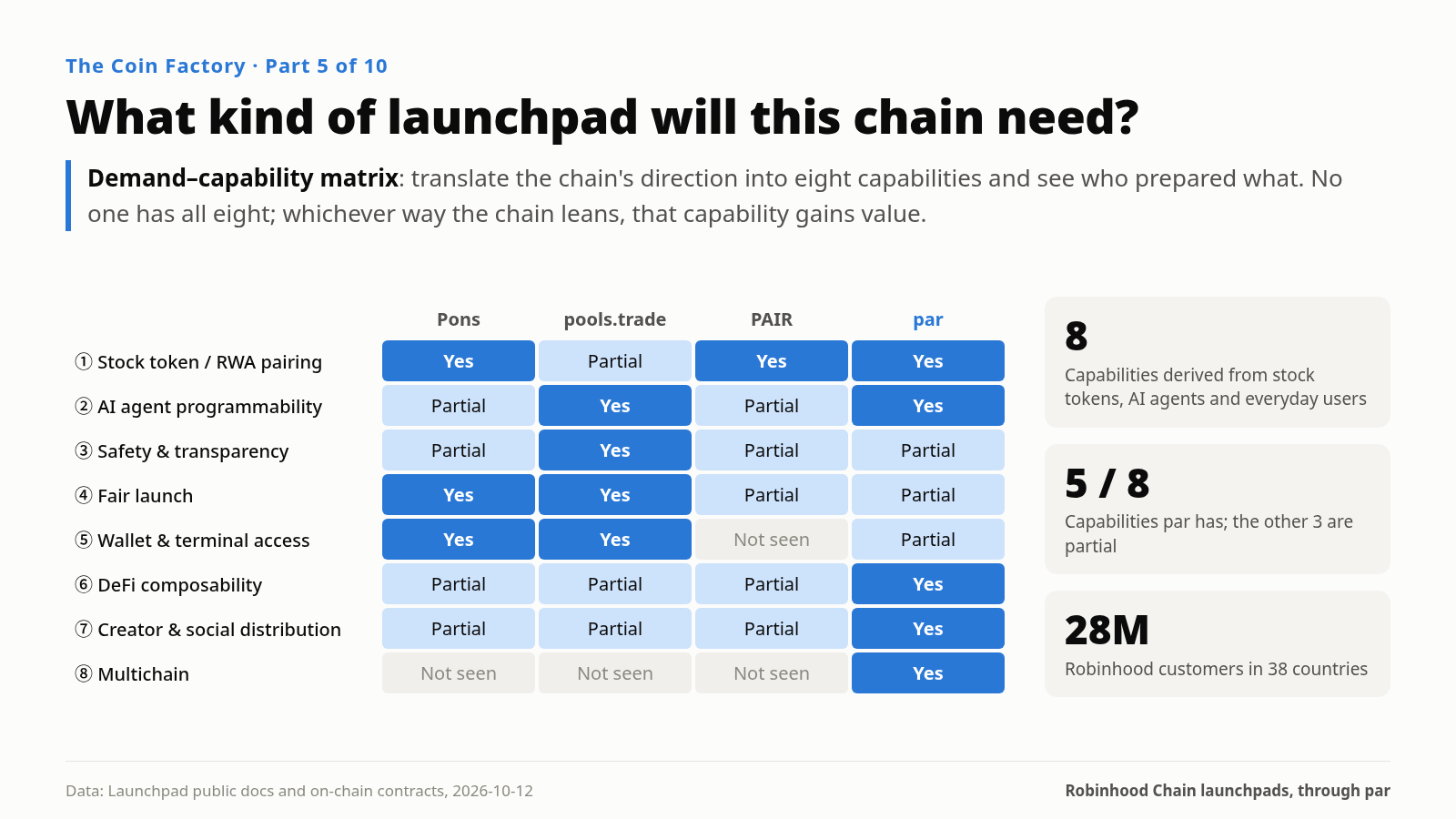
Robinhood Chain was built for stock tokens, AI agents and everyday users, but memes lit phase one. A demand–capability matrix scores Pons, pools.trade, PAIR and par on eight capabilities the next phase will need, and maps which wins under each scenario.
If you’re judging a launchpad’s long-term value, don’t just look at how much it earned in the meme boom. Look at whether its technology and product can handle what this chain needs next.
Start with two sets of facts that don’t line up.
On July 1, Robinhood defined Robinhood Chain as “AI-native, purpose-built for real-world assets.” The launch event was about stock tokens, AI agent trading, and lending and perps inside the wallet.
But for its first three months, the most profitable things on the chain were meme launchpads. DefiLlama shows the largest, Pons, collected about $63.7 million in fees over the last 30 days; per its docs, token creators get the larger share. On-chain stock token trading, meanwhile, is still early. FalconX’s July 20 report noted that the highest single-day spot DEX volume for stock tokens at that point was about $8.5 million.
Memes lit phase one. What the chain was designed to carry is three other things: stock tokens, AI agents and Robinhood’s own mass-market users. A launchpad’s long-term value depends on whether it becomes the issuance and trading tool for those.
Demand–capability matrix: translate the chain’s future direction into capabilities a launchpad must have, then see how far each one has gotten. It doesn’t answer “who’s winning now.” It answers “who has prepared what for the next phase.”
Where the chain is headed
| Direction | Official framing and current status |
|---|---|
| Stock tokens and RWAs | Offered via Robinhood Wallet to eligible users in 120+ countries, tradable 24/7, usable in lending pools and as trading collateral; Token Terminal counted about 1.3 million on-chain tokenized stock holders on September 25 |
| AI agent trading | Users can plug an AI model of their choice into Robinhood’s data and execution tools; Bankr’s chat, X and API token launches deploy to this chain by default; Virtuals has supported agent tokens here since day two of mainnet |
| On-chain yield and derivatives | USDG earns yield via Morpho lending; Lighter perps integrated in the wallet |
| Social | Robinhood Social, built around KYC’d real identities and system-verified trades and returns, went live September 29; it currently covers in-app assets, with no public word on including on-chain trades |
| User base | Nearly 28 million customers in 38 countries |
Eight capabilities
Working backward from those directions, the capabilities a launchpad needs fall into eight groups:
- Stock token and RWA pairing: new tokens can be quoted directly in stock tokens and can handle the weekend minting window and issuer powers.
- Programmability for AI agents: agents don’t use web pages. They need stable contract interfaces, predictable addresses, clear errors and public data endpoints.
- Safety and transparency for mass-market users: fixed supply, no admin, permanently locked liquidity, visible fees, public source code, an audit.
- Fair launches that survive sequencing changes: atomic protection that doesn’t depend on ordering rules, time-weighted auctions.
- Access to Robinhood Wallet and major terminals: correctly recognized by routers like Uniswap and 0x, with a fee model that doesn’t get stuck at router access.
- Composability with lending and yield: fees settle in stablecoins or quote assets and can be routed to different destinations, such as creators, holders, burns or a price floor.
- Creator and social distribution: fees can be paid straight to a social account, and the launch flow can be called by social platforms and agents.
- Multichain: users’ money isn’t necessarily on this chain, so the same launch logic needs to run across chains.
The four side by side
Compiled from public docs and on-chain contracts. “Partial” means there’s a related design but it’s incomplete; “Not seen” means we found no public material, not that it doesn’t exist.
| Capability | Pons | pools.trade | PAIR | par |
|---|---|---|---|---|
| ① RWA pairing | Yes: quotes in ETH, USDG, cbBTC, stock tokens and ETFs | Partial: mainly ETH | Yes: built for stock tokens, 1–5 stock token pools | Yes: quotes in any priceable asset, up to 5 markets |
| ② Agent programmability | Partial: contracts callable directly, no official API | Yes: Uniswap trading API | Partial: public read API | Yes: code samples, predictable addresses, named errors, public data endpoints, on-chain metadata |
| ③ Safety and transparency | Partial: fixed supply, locked liquidity; fees collected by hook, not in pool fields | Yes: fixed supply, permanent lock, standard pool fees, Uniswap brand | Partial: upgradeable launch contract, admin-run oracle | Partial: no admin on tokens, permanent lock, standard pool fees; contracts unaudited, factory admin is a personal wallet |
| ④ Fair launch | Yes: decaying sniper tax | Yes: time-weighted auction | Partial: 5-block limits | Partial: only the dev buy in the launch transaction |
| ⑤ Wallets and terminals | Yes: deep integration with major terminals | Yes: day-one access across Uniswap’s products and several terminals | Not seen | Partial: standard pools are routable; terminal display incomplete |
| ⑥ DeFi composability | Partial: holder revenue share, optional creator buyback-and-lock (reported) | Partial: fees auto-compound into locked liquidity | Partial: creator fees denominated in stock tokens | Yes: fees can go to the creator, holders, a burn, or a price-floor liquidity wall that only moves up |
| ⑦ Social distribution | Partial: creators get 70% of fees | Partial: creators can opt into 0.05% | Partial: 70% creator share | Yes: fees can go directly to an X, GitHub or fomo account |
| ⑧ Multichain | Not seen | Not seen | Not seen | Yes: live on Robinhood Chain, Arc, Base and BNB |
What the table says
No one fills all eight. Each has its own capability shape:
- Pons is ready on fair launches, terminal access and stock token quoting; it’s closest to high-frequency traders and terminals.
- pools.trade has natural advantages in safety, transparency and access, backed by Uniswap’s position in the rails and front-end layers.
- PAIR goes deepest on stock token pairing; it’s closest to the “RWA is the main story” narrative.
- par has prepared the most on programmability, DeFi composability, social distribution and multichain; it’s closest to “AI-native” and “creating uses for existing assets.” What it needs next is an audit, anti-sniping and terminal display, none of which requires changing its core design.
Whichever way the chain leans, that capability becomes more valuable. This isn’t a forecast, just conditional reasoning:
| If the chain leans toward… | The capabilities that matter more | Best prepared today |
|---|---|---|
| High-frequency meme trading staying active | ④ Fair launch, ⑤ terminal access | Pons, pools.trade |
| Stock tokens entering DeFi at scale | ① RWA pairing, ③ safety and transparency | PAIR, Pons, par |
| AI agents becoming the main issuers and traders | ② Programmability, ⑦ social distribution | par, pools.trade |
| Robinhood Wallet bringing mass-market users on-chain | ③ Safety and transparency, ⑤ wallet access | pools.trade |
| On-chain yield and lending going mainstream | ⑥ DeFi composability | par |
One more variable: new issuance channels are emerging. AI agent platforms like Bankr and Virtuals are token launch front ends in their own right; Bankr uses its own integrated launch solution. They could become the largest source of issuance down the road. For launchpads that’s both competition and opportunity: the cleaner the interface and the easier it is for agents to call, the more likely a launchpad becomes the layer underneath those platforms.
Evaluating a launchpad’s prospects
Profile it on the eight capabilities, not just volume. A hundred days of volume reflects phase-one demand; the capability profile reflects what it has prepared for phase two.
Find the one capability where it best matches the chain’s direction. It doesn’t need to do all eight, but its strongest one should ideally be what the chain needs most next.
Treat gaps as things to watch, not verdicts. Audits, terminal integration and anti-sniping can all be added. What to keep watching is whether the gaps are closing.
Closing
This chain’s first phase belonged to memes.
What it was designed to carry is stock tokens, AI agents and tens of millions of everyday users.
The launchpads that can carry those three will own the next phase.
Which second-phase demand do you think shows up first on this chain: stock tokens, AI agents or everyday users?
— Excerpted from Chapter 5 of The Coin Factory, “What Kind of Launchpad This Chain Will Need”
Repost this post?
Share with your followers.
Reply