

·
The Three Layers of Alpha: $29.87, 909x, and Why Everyone Misreads Presence as Insider Info
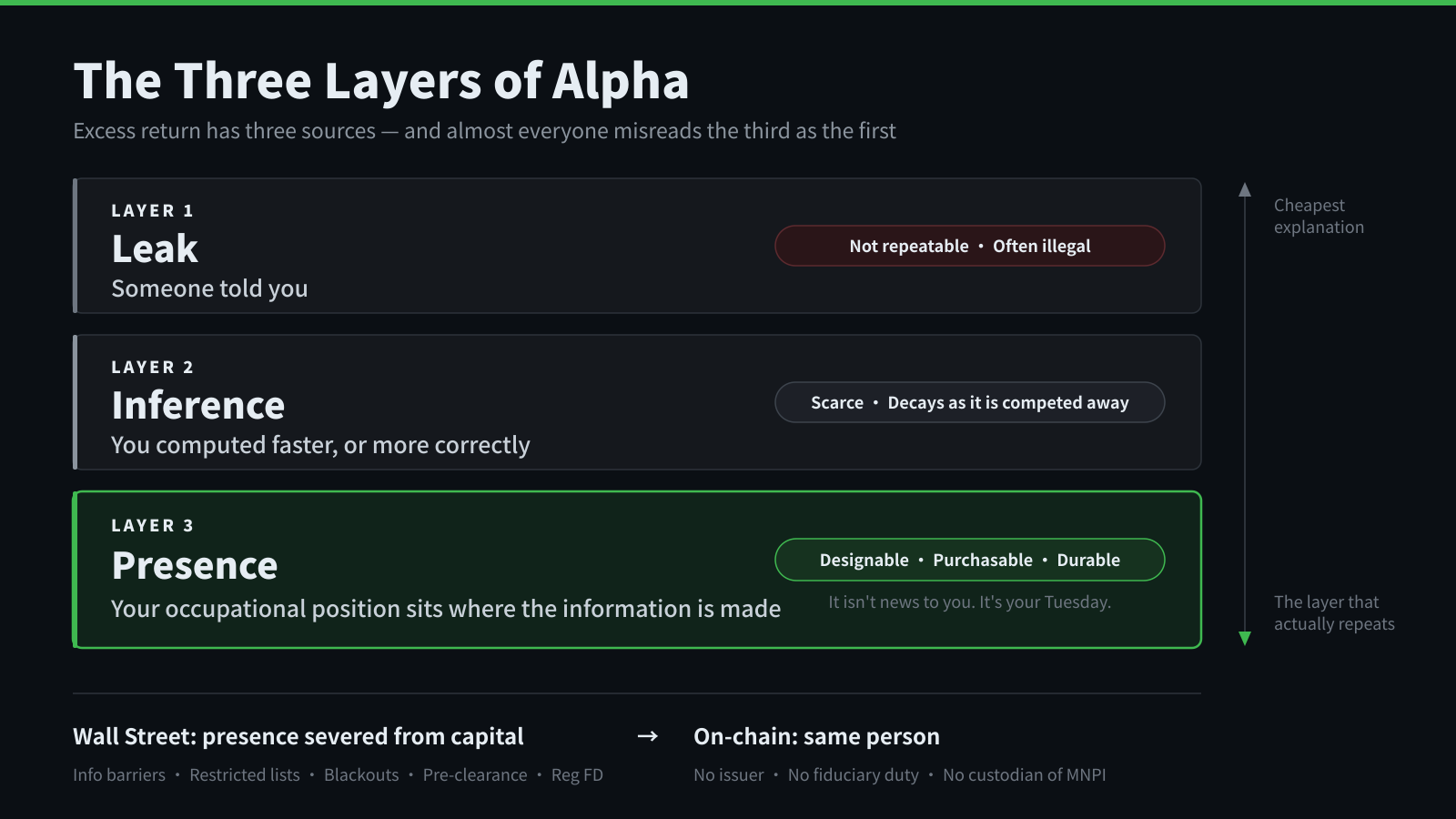
A wallet turned $29.87 into a position worth $2.01M in two months. Everyone's first instinct is "insider." Four publicly verifiable tests say otherwise. The framework: excess return decomposes into Leak, Inference, and Presence. Wall Street never criminalized presence — it severed the people who have it from the capital that could act on it. Permissionless markets welded them back together, and everyone misread the result as insider trading.
On 13 July 2026 at 4:43 PM, a wallet spent $19.91 on a token that had just launched. A minute later it spent $9.96 more. Total: $29.87, for roughly 10.4 million tokens — 1.04% of supply.
Two months later that position was worth $2,008,521.73 realized and unrealized combined.
Almost everyone who sees a screenshot like this reaches for the same word: insider.
This piece is not about the token, and it is not a “how to catch a 900x” story. It is about a more expensive problem: when you misattribute someone else’s excess return, you allocate your own resources against a false model.
If you deploy early-stage capital, design a research process, build products that depend on information advantage, or write rules for permissionless markets — this case is worth taking apart. Because its actual structure is the opposite of everyone’s first instinct.
1. Make the numbers reconcile first
The asset is PONS, the platform token of Pons, the dominant token launchpad on Robinhood Chain. Robinhood Chain went live in July 2026; Pons launched its token shortly after.
The wallet belongs to @0xnobi, who trades publicly on the social trading app fomo. All figures below come from his public profile, with unit prices derived from a 1 billion total supply:
Action |
Date |
Amount |
Tokens |
Valuation |
|---|---|---|---|---|
First two buys |
7/13 16:43–16:44 |
$29.87 |
~10.4M (1.04%) |
$2.8K / $3K |
Same-day adds (9 visible) |
7/13 18:43–21:00 |
~$1,157 |
~5.9M |
$83.8K → $399.4K |
5 transfers out |
7/14 00:48 – 7/17 20:15 |
$61,983.24 |
~15.95M |
$946.9K → $14.7M |
Still held as of 9/11 |
— |
— |
3.1M |
$628.5M |
Total deployed: $2,207.75. Average cost basis: $116.2K valuation.
Before any interpretation, one reconciliation — it decides whether everything downstream stands up:
Transferred out $61,983.24 + current holdings $1,948,746.24 − deployed $2,207.75 = $2,008,521.73
That matches the platform’s displayed P&L exactly, for a return of 909.76x. Three things are now confirmed: the transaction set reconstructed here is complete; the platform books transfers-out as realized; and the 1B-supply price derivation is correct — it independently reproduces the $116.2K average cost shown in the interface.
One precision note for anyone cross-referencing: fomo displays fully diluted valuation on 1B supply, while CoinGecko and most press cite market cap on post-burn circulating supply — roughly 29% of PONS supply has been burned. The two “market caps” can differ substantially on the same day. Do not mix them.
2. Why “insider” is the most comfortable explanation
Because it absolves you.
Attributing someone’s return to something you could never have obtained means you never have to explain why you weren’t there during the same window. It is the lowest-effort attribution available, and its cost is that you stop looking for the part that was actually reproducible.
So here is a framework you can test.
3. The three layers of alpha
Excess return decomposes cleanly into three sources.
Layer 1 — Leak. Someone told you. Information escaped a closed set. Characteristics: not repeatable, not scalable, and in regulated markets, often illegal.
Layer 2 — Inference. Same public information, but you computed faster or more correctly. This is the entire sell-side and quant business. Characteristics: scarce, hard to replicate, and it decays as compute and talent compete it away.
Layer 3 — Presence. Nobody told you, and you are not smarter than anyone. Your occupational position simply sits where the information is generated. What you are seeing is not news. It is your Tuesday.
Now the claim, stated carefully — because the sloppy version of it is wrong, and a serious reader will catch it.
The sloppy version: “Wall Street criminalizes Layer 3.” That is not accurate. US law explicitly rejected the parity-of-information theory in Chiarella v. United States (1980): merely possessing material nonpublic information is not fraud. Liability under Rule 10b-5 requires a breach of a duty of trust and confidence — refined through Dirks v. SEC (1983) on tippee liability and personal benefit, and United States v. O’Hagan (1997) on misappropriation. The SEC-recognized mosaic theory goes further still: an analyst may lawfully assemble an informational edge from nonmaterial nonpublic pieces. Peter Lynch noticing what his kids bought at the mall was never a crime.
The accurate version is more interesting:
Wall Street did not outlaw presence. It did something far more thorough — it separated the people who have presence from the people who can act on it.
Information barriers. Restricted lists. Blackout windows. Pre-clearance. Expert-network policies. Regulation FD on the issuer side. Most of this apparatus goes well beyond what case law strictly requires; it is prophylactic, built because the legal line is blurry enough that institutions do not want to litigate where it falls. The operating constraint on a real bank employee is drastically tighter than Dirks.
The net effect is structural: in traditional finance, the people with the deepest operating knowledge of a business are precisely the people most restricted from taking positions on it. Knowledge and capital are deliberately held apart. That separation is a feature — it is most of what “market integrity” means in practice.
Permissionless markets weld them back together. There is no issuer, no fiduciary duty, no custodian of MNPI, and no “inside” for you to be outside of. The operator and the speculator are the same person, and nothing prevents it.
On-chain, presence isn’t insider trading. It’s just going to work.
4. Four tests
How do you tell which layer a given result came from? Four questions, all answerable from public data. Their shared logic: an informed actor faces different behavioral constraints than an uninformed one.
Test 1 — Size. How much did he bet?
The first two buys: $29.87. Lifetime deployment: $2,207.75.
If you knew something was going up 900x, you would not bet thirty dollars. The obvious objection — “the curve was too early, size would have meant slippage” — is answered by Test 2.
Test 2 — Adding. Did he ever size up while it was still cheap?
Arkham tracked two other wallets: one deployed $44,300 at a $3.7M valuation for over 1% of supply; another put in $2,600 on day one at a $1.607M valuation. Four- and five-figure positions were plainly buildable in the same window. Slippage was not the constraint.
nobi added roughly $1,157 across all of 13 July. He never once actually pressed. That is not the bet-sizing curve of someone holding private information.
Test 3 — Exit. At what valuation did he let go of most of it?
At 00:48 on 14 July, with PONS at a $946.9K valuation, he moved out roughly 9 million tokens — essentially his entire initial position. Further transfers followed at $5.6M, $5.7M, $14.7M and $11.3M valuations.
Within four days he released about 84% of his tokens between $1M and $15M, locking in $62K. Those tokens would have been worth roughly $10 million by September.
What happened next: in early September, Pons generated $5.95 million in fees in 24 hours, ranking fourth across all protocols tracked by DefiLlama — behind only Tether, Uniswap and Circle, ahead of Pump at $4.64M, and ahead of the chain it runs on. Uniswap bought a stake in PONS.
If he had known any of that, he would not have dumped four-fifths of it at a $5.6M valuation. This is the hardest of the four tests, because it depends on no assumption about motive — only on arithmetic.
Test 4 — Identity. Does his occupational position independently explain his timing?
It does, and cleanly.
@0xnobi is not anonymous. The X account dates to May 2021 and has 21,000 followers. A bylined Bankless writer identifies him directly as one of the builders of Flaunch.
Flaunch is a token launchpad on Base — an aggressive set of Uniswap v4 hook mechanics: 100% of trading fees returned to creators and communities, an automated progressive bid wall, a fixed-price fair launch window, and fee streams tokenized as transferable NFTs. He is also building Slab, which brings physical Pokémon cards onchain, and runs a two-company angel fund.
His day job is building launchpads.
5. The timeline nobody mentions
One piece completes the picture, and it is the sharpest fact in the case.
The previous dominant launchpad on Robinhood Chain was Noxa. It earned an estimated $12 million in fees in about a week and minted roughly 60,000 tokens in ten days — then abruptly halted new launches on 11 July, and its website went dark two days later, on 13 July.
@0xnobi’s first PONS buy: 13 July, 4:43 PM. The same day.
The chain closes:
A hot L2 that went live in July → its largest launchpad walks away on 11–13 July, vacating what was then one of the best cash-flow positions in the industry → a person whose own job is building the equivalent product on another chain buys the successor’s token in its first minutes.
What he had on the market was not news. It was position. He did not need to be told PONS would win. He needed to know what “the biggest launchpad on a chain just disappeared” means, how much cash that seat throws off per day, and roughly what the next occupant looks like. That was his job, not his tip.
That is Layer 3 — pure, legal, and reproducible.
And Tests 1 through 3 establish something equally important: he did not know the ending either. He bet thirty dollars and released 84% within four days. He was not executing a sure thing. He was standing in the middle of a place he already worked, bought a very cheap lottery ticket, and then managed it with discipline.
6. Why Layer 3 is so rarely cultivated
The counterintuitive part: people who have presence usually cannot perceive that they have it.
To the person inside, it is not “information.” It is ambient noise. The technical constraint you argue about weekly, the operational problem you fix without thinking, the thing everyone in your niche considers obvious — a meaningful share of that is what the outside market will read in a research note months or years later. You do not treat it as an asset because it feels abundant to you.
Which produces a persistent mismatch: Layer 3 is invisible to its owner and illegible to the observer. The people who have it don’t know they do, and the people who want it can’t see it working — so everyone falls back on the cheapest explanation and calls it insider information.
7. What to do with this
If you allocate capital: stop buying only “smarter people.” Buy presence.
Layer 2 is where you bid against everyone, including institutions with more money than you. Layer 3 can actually be purchased and designed: which ecosystem your analyst lives in, whose developer calls they attend, whether they have ever shipped a contract themselves, whether anyone on the team is an operator rather than an observer. Someone who deploys tokens on Base every day understands launchpad economics better than ten sell-side reports. Seats are cheaper than IQ, and they compound.
If you write rules: your existing framework will idle here.
Insider trading liability needs an inside — an issuer, a duty, a custodian of MNPI. A permissionlessly launched token has none of the three. You can and should pursue manipulation, fraud and misrepresentation. But you cannot make “understood it earlier because of where they work” unlawful without also reaching reading public chain data. Treating Layer 3 as if it were Layer 1 is the most likely category of overreach in this area over the next several years.
Worth noting what this does not argue: the separation of knowledge from capital in traditional markets is not a mistake to be corrected. It is load-bearing. The interesting question is what a market looks like when that separation is structurally unavailable — which is the question permissionless venues are now running as a live experiment.
If you build products: presence can be packaged.
nobi’s fomo page gets attention not because he made money but because he published his positions and his reasoning. Turning an insider’s view — as opposed to an insider’s information — into a product is the entire business model of applications like fomo.
Finally, the counterexample, without which this becomes a motivational poster: presence does not make you win. It only lets you see.
Noxa’s users were present too; they were left staring at a website that wouldn’t load. The largest onchain short in PONS was present, and sat on millions in unrealized losses. Presence grants the right to see. It does not grant the discipline to bet. The genuinely scarce half of nobi’s performance is not 4:43 PM on 13 July — it is the next few hours, when he kept adding at 30x to 140x his own cost, deliberately diluting his average entry from a $2.9K valuation up to $116.2K, trading a lottery ticket for a position with real size against facts already confirmed; and then pulled 84% out within four days, taking principal and a few dozen multiples off the table and riding the rest as a free option.
Seeing comes from position. Betting comes from discipline. Remove either and this case does not happen.
This article has no financial interest in any project, token, or platform mentioned, and is not investment advice.
The one-line version
Leaks don’t repeat. Inference decays. Only presence can be designed. Wall Street never criminalized presence — it separated the people who have it from the capital that could act on it, and permissionless markets welded them back together. Then everyone misread the result as insider trading.
So: what is your current position generating for you every day that you’ve never thought to count?
Sources and open items
Verified / strong sourcing:
- Pons fees of $5.95M in 24h, ranking 4th across protocols by DefiLlama (ahead of Pump at $4.64M), ~25,000 tokens launched on 2 Sept, $544M daily volume, ~646,000 tokens from 167,000+ creator addresses since July, ~29% of supply burned: CoinDesk, 2026-09-03.
- $4.54B cumulative volume, 59% of chain launchpad volume on 1 Sept, 17,909 of 27,802 chain-wide tokens minted on 31 Aug, 106,488 active wallets, record high $0.49328, overtook Noxa in mid-July: BeInCrypto, 2026-09-02 (citing Dune / Bubblemaps).
- Flaunch mechanics (v4 hooks, 100% fee return, progressive bid wall, fixed-price fair launch): Flaunch whitepaper; Uniswap Foundation Builder Stories.
- nobi as a Flaunch builder: bylined Bankless reporting.
- Nobi Ventures portfolio (Collector Crypt and fomo only — Pons is not in it): nobi.vc.
- Case law as characterized: Chiarella v. United States, 445 U.S. 222 (1980); Dirks v. SEC, 463 U.S. 646 (1983); United States v. O’Hagan, 521 U.S. 642 (1997); Regulation FD (2000). Settled doctrine, characterized at the level of holdings rather than litigated nuance.
Secondary / single-source (flagged as such in the text):
- Noxa’s ~$12M in weekly fees, halt on 11 July, site offline two days later, ~60,000 tokens in ten days: TrustSwap, 2026-07-17.
- Uniswap’s stake in PONS, 29.34% burned, 80% of protocol fees funding buyback-and-burn: via Dealroom.
- The two other early wallets ($44,300 at a $3.7M valuation; $2,600 at $1.607M): PANews / Yahoo Finance, citing Arkham.
- Robinhood Chain mainnet date: consistently reported as July 2026; the specific 1 July date appears in only one secondary source, so the text says only “July.”
Explicitly unverified — the largest gap here:
- The destination addresses of those five transfers are unknown. fomo shows a single wallet. The tokens may have gone to an exchange and been sold, or simply to self-custody and still be held. If the latter, his real position and P&L far exceed the figures here — but no test above changes, because all four rest on the fact that he voluntarily released 84% of his tokens between $1M and $15M valuations, not on where those tokens ended up.
- Whether any onchain funding relationship exists between this wallet and the project was not independently checked. The correct way to falsify this piece is to check whether the counterparties to those five transfers were funded by the Pons deployer or team multisig before 13 July.
- All position data is taken from @0xnobi’s public fomo profile (captured circa 2026-09-11) and was not independently recomputed onchain — though as shown above, it reconciles to the cent.
转发此帖子?
与您的关注者分享。
回复