
Contents (5)

·
The Economics of 1%: A Platform Token Whose Burns Come Almost 90% From Its Own Pool's Fees
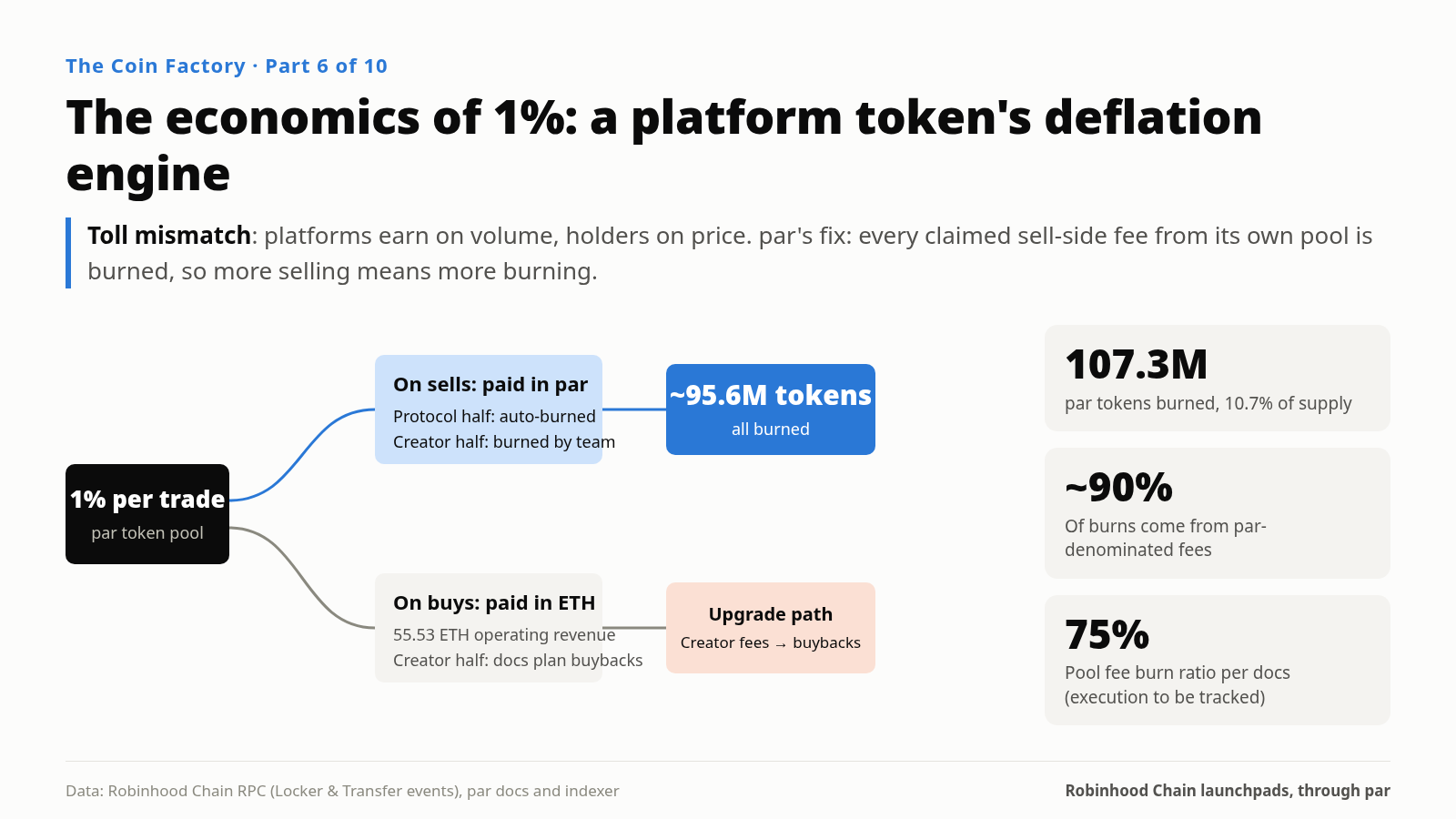
Where the 1% fee goes. par's platform token has burned 107.3M tokens, 10.7% of supply, nearly 90% of it from sell-side fees in its own pool, burned automatically by contract and manually by the team. Plus the ETH-side upgrade path and three questions for any platform token.
If you’re looking at a launchpad’s platform token, or trying to work out whether holders actually share in the platform’s earnings, start with a more specific question: where does the 1% taken from every trade end up?
Launchpads take a cut of volume, not of price. That’s a structure the whole sector shares:
Toll mismatch: the team gets paid on volume; holders get paid on price. When prices rise, the two move together and it looks like a flywheel. When prices fall, they decouple: holders absorb the price drop while the platform keeps collecting on volume. It’s a structural problem, and it can be designed around.
The fix is to send as much platform revenue as possible, as reliably as possible, back to the platform token. par.family on Robinhood Chain offers a concrete version. In its platform token’s own pool (call it the par token), every fee paid on sells that has been claimed so far has been burned. None of it went back into circulation. As of October 12, about 107.3 million par tokens had been burned, 10.7% of initial supply, and nearly 90% of that came through this one channel.
Four places the 1% can go
Major launchpad pools on Robinhood Chain charge about 1% per trade. That 1% has four possible destinations: the token creator; the protocol, meaning the operating team; platform token holders (via buybacks or burns); and third-party LPs who add extra liquidity (a small share).
| par | Pons | PAIR | |
|---|---|---|---|
| Pool fee | 1% (creators can add a 0–10% tax) | 1% | 1% |
| Creator / protocol | 50 / 50 | 70 / 30 (90 / 10 for tokens from the old factory) | 70 / 30 |
| Flow to platform token holders | Of the protocol share, the traded-token side is burned directly; 60% of the quote-asset side buys back and burns par (for tokens launched after September 7) | 80% of protocol fees go to buyback-and-burn | No buyback mechanism disclosed |
| How buybacks run | Buyback wallet executes hourly with a per-round cap; full record public | TWAP buybacks in batches, then burned | — |
Sources: par.family/docs and par’s official indexer; pair.fund/docs; the Pons column comes from Pons’s official docs (docs.ponsfamily.com), which state that the 80% is currently triggered manually and executed by TWAP, with plans to make it immutable and automated.
The thing to look at in this table isn’t the fee rate. It’s how the protocol share reaches platform token holders. par has two channels: buybacks and direct burns. The second is the most distinctive part of par’s design.
The par token’s own pool: every sell-side fee burned
par’s rule: 1% per trade, split evenly between creator and protocol. On buys, the fee is paid in the quote asset (ETH); on sells, in the token being traded.
Applied to the par token’s own pool:
| Fees from the par token pool | Destination | Amount |
|---|---|---|
| Paid in par tokens (collected on sells) | Protocol half burned automatically by the Locker contract; creator half claimed by the team and burned manually, in full | About 95.6 million tokens, all burned (another ~2.19 million pending claim) |
| Paid in ETH (collected on buys) | Both halves go to the team wallet as operating revenue | 27.76 + 27.76 = 55.53 ETH |
(Locker contract: 2,360 ProtocolShareBurned events totaling 47,329,000 tokens; FeesCollected events of 27.7627 ETH for each half; pending amount from reading pendingFees via smarts on October 12.)
Two points deserve their own mention.
First, the protocol half is burned automatically by the contract and doesn’t depend on anyone. Every time fees are collected, the Locker burns the protocol’s par tokens by rule: 2,360 burns so far.
Second, the creator half was the team’s to do with as it pleased. In the par token’s launch record, the creator fee recipient is the team wallet, and the 47.33 million par tokens it claimed from the escrow contract were an ordinary balance it could have sold. Instead, all of it went to the zero address. Including about 970,000 tokens received from the Locker and the splitter contract, the team wallet received about 48.3 million par tokens in total and sent out 31 transfers, every one of them a burn to the zero address, not a single sale (checked transfer by transfer against on-chain Transfer events; the current balance is about 0.3 tokens of dust).
Together, these mean that so far, every claimed sell-side fee from the par token’s pool has turned into a par burn, with about 2.19 million more waiting in the pool to be claimed. The protocol half is guaranteed by contract: the more people sell, the more gets burned. The creator half rests on the team’s consistent choice. For a platform token, this is about as thorough a way to narrow the toll mismatch as you’ll find: while holders bear selling pressure, the selling pressure itself keeps shrinking supply.
The buyback channel contributed the other ~11%: 11.72 million tokens across 359 executions, costing 7.49 ETH.
The ETH half: a timing gap, and an upgrade path already in place
The ETH-denominated half of the par token pool’s fees currently counts as team operating revenue. The reason is the order of events:
| Date | Event |
|---|---|
| 09-04 | par token launched from par’s own factory; fee recipient written into the launch record |
| 09-06 | First splitter contract deployed (80/20) |
| 09-07 | Replaced by a second version (60/40); for tokens launched after this, 60% of protocol quote-asset revenue buys back par |
par’s docs state that the splitter only applies to tokens launched afterward. The par token came two or three days earlier, so its own pool’s ETH revenue follows the rules in place at launch and goes to the team. That’s fully consistent with the contracts and the docs. On September 6–7 the team also voluntarily sent 1.08 ETH to the buyback wallet as seed money.
There’s an upgrade path here that doesn’t require any contract changes. par’s docs show the creator fee recipient can be transferred by the current recipient (transferCreatorFeeRecipient). Point it at the buyback contract, and half of the par token pool’s ETH-side revenue flows straight into buybacks. Based on the 55.53 ETH generated so far, the creator half alone is about 27.8 ETH, nearly four times total buybacks to date. par’s docs already describe this direction: the par token’s creator share is claimed daily and sent to the buyback wallet to buy back and burn; combined with direct burns on the protocol’s token side, 75% of fees collected in the par token pool get burned. As of October 12, no new claims under this flow had shown up on-chain (the creator share was last claimed on October 5), which makes it the signal most worth tracking next. Once it starts, ETH inflows to the buyback wallet will rise noticeably, and you’ll see it on-chain at a glance.
Three questions for any platform token
Where do the fees from the platform token’s own pool go? The platform token is usually the earliest and most-traded token on the platform, so where its fees go often determines where the largest chunk of platform revenue goes. Look at the platform-token side and the quote-asset side separately. par’s answer: the platform-token side is burned in full.
Are buybacks and burns executed by contract or by people? Automatic contract execution and a team’s promise to execute are two different levels of trust. The par token’s protocol burns are automatic; buybacks are executed on a schedule by a wallet, with every record public. Pons’s docs state that its buybacks are currently triggered manually too.
Can selling pressure become deflation? If a platform token’s sell-side fees are burned, the more selling there is, the faster supply shrinks. It’s the most direct self-correcting mechanism in platform token design.
Closing
The 1% a launchpad collects is a toll, and a tollbooth naturally only cares how much traffic goes through.
Good design routes the toll back to the platform token.
par’s version: every time a car heads out, it burns a little supply on the way.
When you look at a platform token, do you check where its own pool’s fees go?
— Excerpted from Chapter 6 of The Coin Factory, “The Economics of 1%”
Repost this post?
Share with your followers.
Reply