
Contents (5)

·
I priced one letter at $12,999 and kept bobdylan free
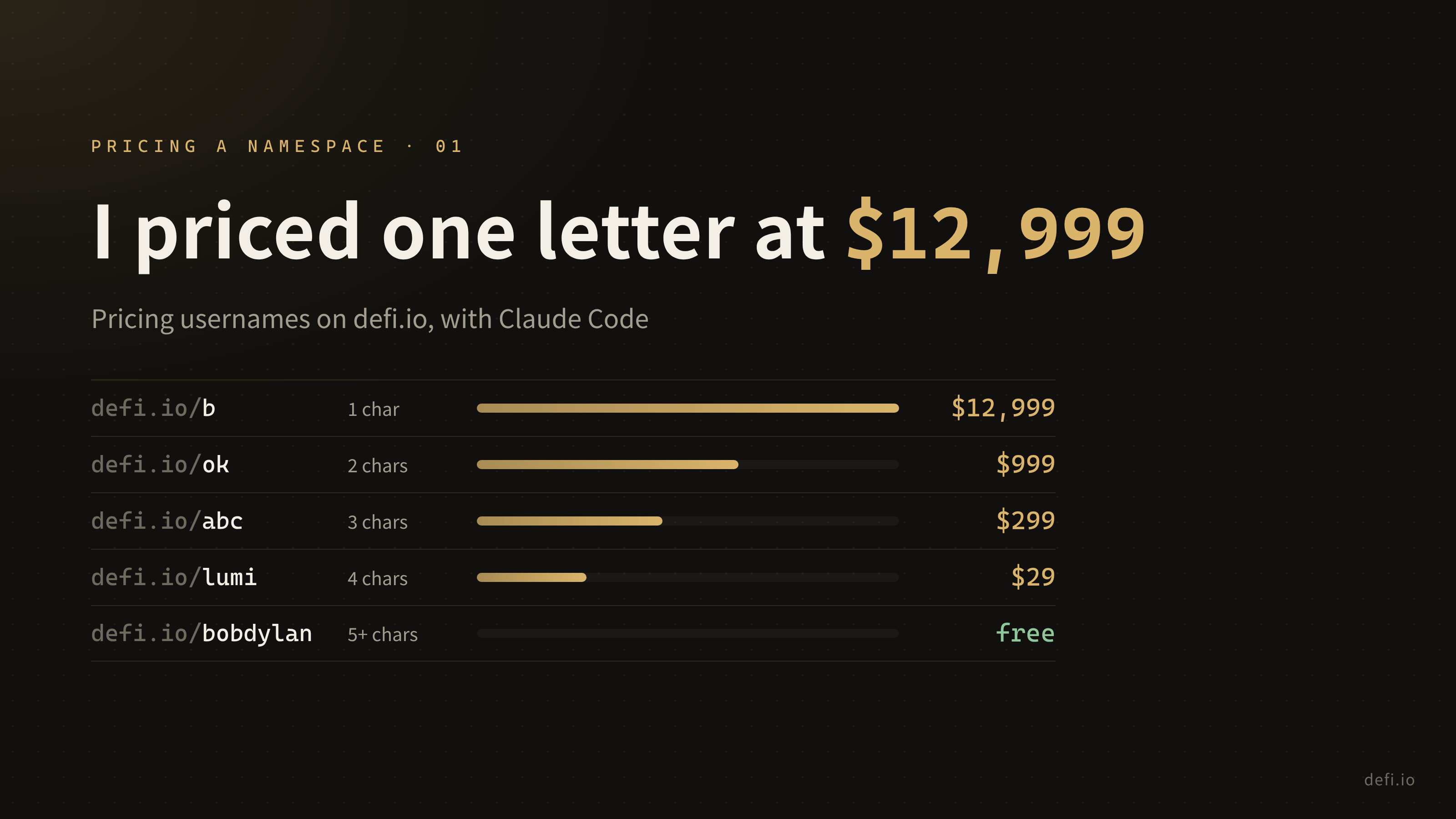
Pricing short usernames on defi.io: $12,999 for one letter, $29 for four, plus two premium tiers by meaning. The hard part wasn't the numbers. It was deciding which names shouldn't cost anything.
Everyone on defi.io gets a home page at defi.io/yourname. During the beta every username was free, with one rule: 5 to 20 characters.
Names with 1 to 4 characters stayed locked, and nobody could register them. Short names are scarce, and I hadn’t worked out how to sell them. Before the public launch I decided to finish the job: set the prices, wire up Stripe, start taking money. From the moment I asked “should I use Stripe?” to the first real payment landing took about five and a half hours, all of it back and forth with Claude Code in my terminal.
This series has three parts, and all of it happened that day. This first part is about pricing. People assume pricing means pulling a number out of the air. Doing it, I found the hard part wasn’t picking the numbers. It was deciding which names shouldn’t cost anything.
Start with length
Length prices came first. A username can use lowercase letters and digits, with hyphens in the middle: never at either end, and never two in a row. That gives 36 one-character names, 1,296 with two characters, 47,952 with three and 1,772,928 with four. Each extra character multiplies the supply by more than 30, so the price should fall just as fast.
Reserved words come off the top. Of the 36 single characters, x is X’s (Twitter’s) brand and isn’t for sale, which leaves 35.
| Length | For sale | Yearly | Lifetime | If all sold yearly |
|---|---|---|---|---|
| 1 | 35 | $12,999 | $79,999 | $455K |
| 2 | 1,288 | $999 | $4,999 | $1.29M |
| 3 | 47,911 | $299 | $1,499 | $14.33M |
| 4 | 1,772,855 | $29 | $149 | $51.41M |
| 5+ | — | free | free | — |
Lifetime is roughly 5 to 6 times the yearly price, on purpose. Too low and everyone buys lifetime, so the yearly tier is pointless. Too high and nobody buys lifetime, and I lose a way to get paid upfront. Five or six times means it pays for itself in five or six years: attractive if you plan to stay, without crowding out the yearly option.
I had Claude work out the ceiling. If every short name sold at the yearly price, that’s about $67.5M a year. It will never happen, but it showed me something: nearly all the revenue sits in three and four characters. Four characters alone is 76%, three is 21%, and all 35 single letters together come to $455K, under 1%.
What decides this business isn’t the most expensive names. It’s the cheapest tier, the one with the most names in it. So four-character names cost $29 a year, cheap enough to buy one on a whim.
Length alone misses the most valuable names
As soon as the length prices were written, the problem showed up. money, swap and gold have 4 or 5 letters, so by length they’d cost $29, or nothing. And pinyin words like qian (money), long (dragon) and facai (get rich) are obviously worth more to Chinese speakers than four random letters.
Length captures scarcity, not meaning. So we added a second price list: premium names, tiered by meaning.
| Tier | Names | Yearly | Lifetime | What’s in it |
|---|---|---|---|---|
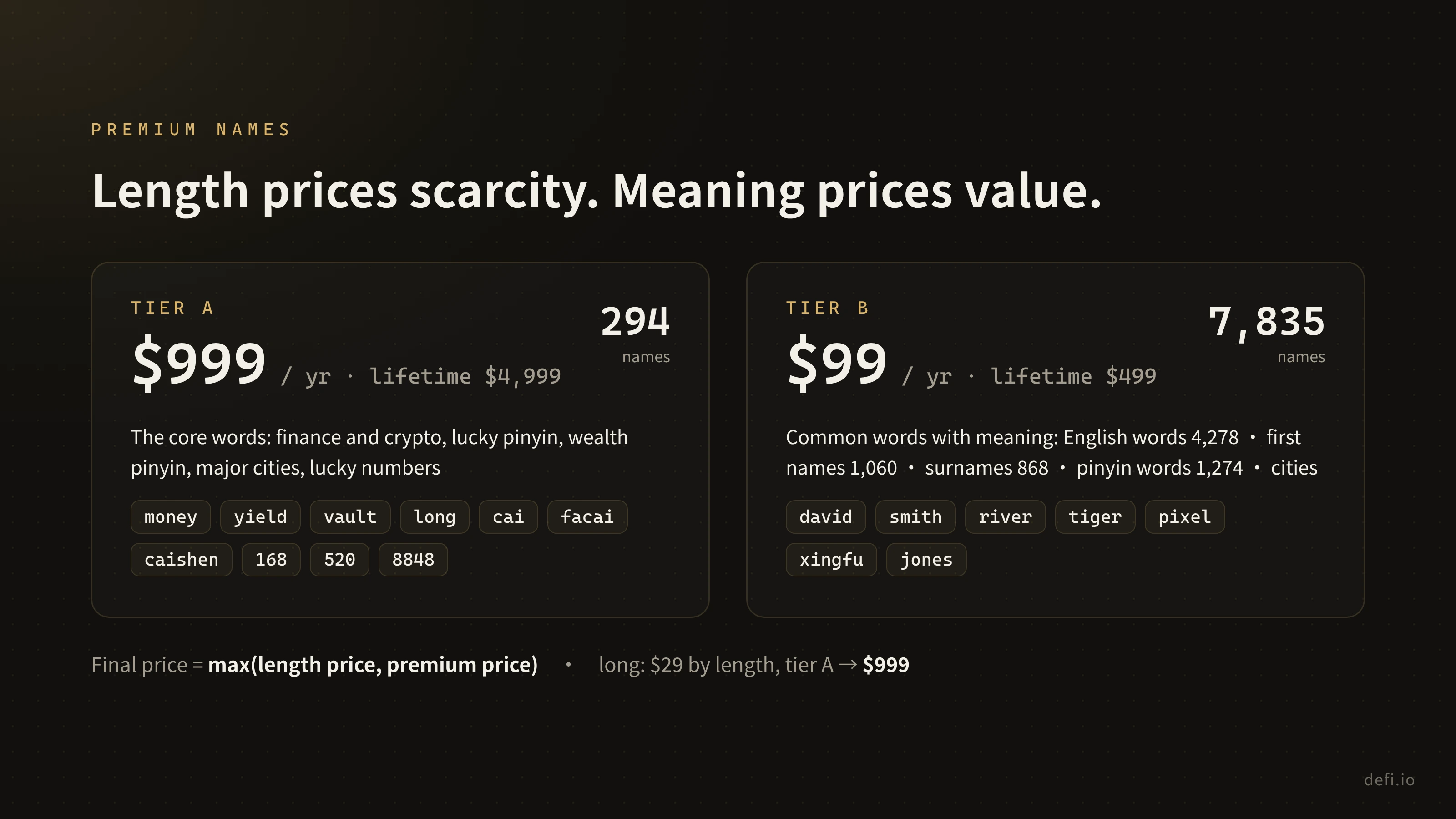
| A | 294 | $999 | $4,999 | Finance and crypto words (money, yield, vault), lucky one-syllable pinyin (cai, long), wealth pinyin (facai, caishen), major cities, numbers like 168, 520 and 8848 |
| B | 7,835 | $99 | $499 | Common English words (4,278), common English first names (1,060) and surnames (868), common pinyin words (1,274), other cities, two-character Chinese surnames |
Tier A uses the two-character price. Tier B has its own, and its lifetime price is also 5 times the yearly one.
The final price is whichever is higher, the length price or the premium price. long is $29 by length, but it’s in tier A, so it’s $999. money has 5 letters and would be free by length; tier A makes it $999 too.
To make sure the rules really work this way, I had Claude run 11 names through the same pricing code production uses, against my local database:
Claude and I built the list together, one group at a time: 8,129 names in the end. For pinyin it proposed a rule I agree with: only common syllables and words with a clear meaning, no gluing syllables together mechanically.
The tier I cut mattered more than the two I added
At first there was a tier C: common Chinese full names, spelled out in pinyin. Judging by search volume, people would definitely want them.
That’s where I cut it. Picture a guy named Bob Dylan (not that one) signing up for defi.io and finding out that bobdylan costs money. That isn’t selling a scarce resource. It’s charging ordinary people a toll. A premium name should be “I want a good name”, not “I want to use my own name”.
So the rule now is that full names are free.
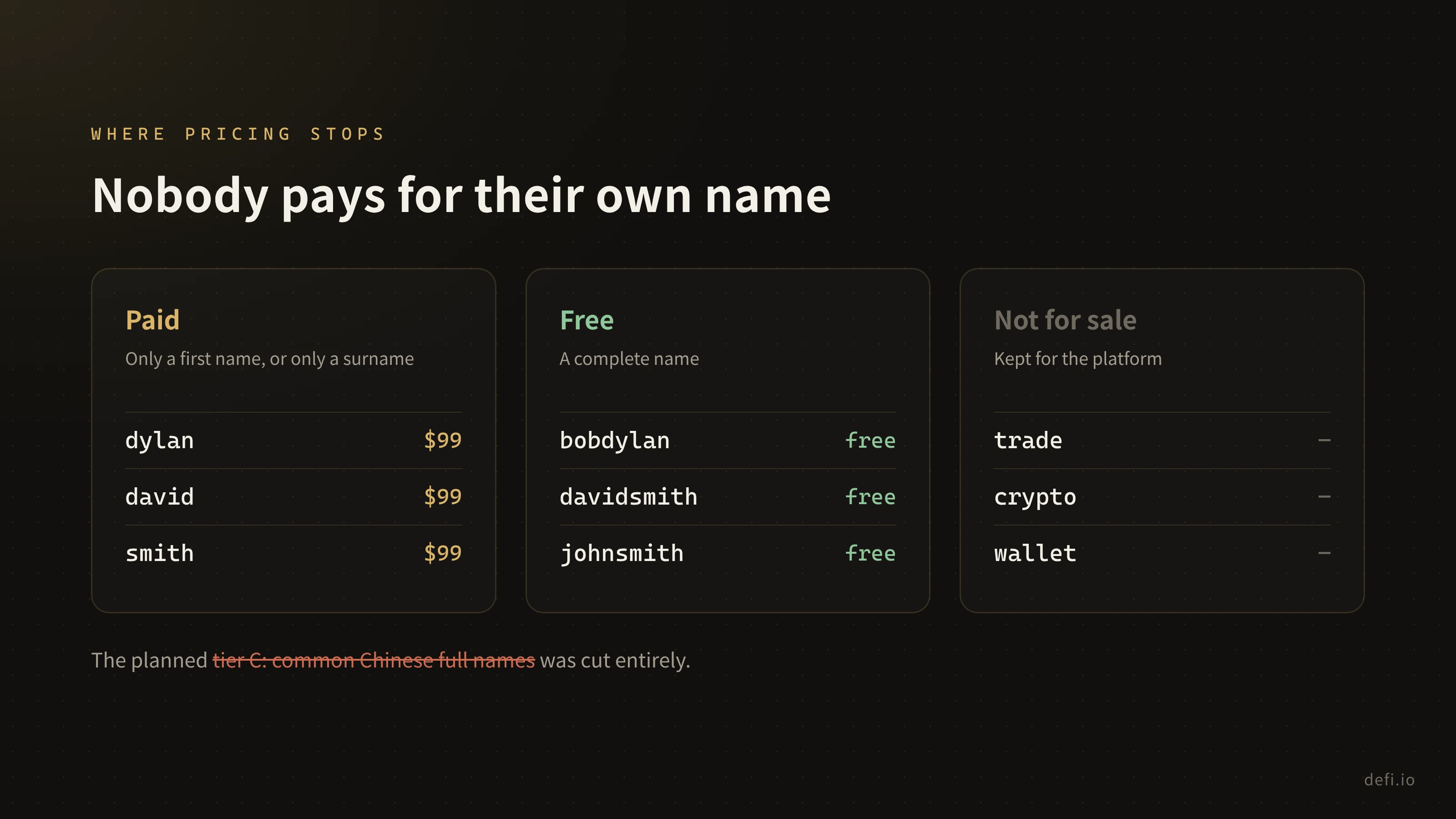
You might ask: aren’t first names and surnames in tier B? They are. dylan, david and smith cost $99 each. The difference is that each one is only a first name or only a surname. A full name like bobdylan or davidsmith is still free.
That was my biggest lesson from this pricing work: scarcity pricing stops where ordinary people would have to pay for their own names. Selling short names and good words is fine. Once ordinary people’s names end up on the list, the business turns into something else.
A few rules we settled along the way
- Reserved words aren’t for sale. Words like trade, crypto and wallet are kept for the platform and official projects. Reserved beats premium, and none of them are on the list.
- Nothing is priced twice. Tier A names with 1–2 characters and tier B names with 1–3 characters already cost more by length, so they stay off the list.
- Repeated and sequential characters are detected in code, not listed by hand. A name that’s one character repeated (8888, aaa), or a number made only of 6, 8 and 9 (688, 9898), is tier A. Sequences like abcde, 12345 and 54321 are tier B.
- Once the list is in the database, tiers can be changed in the admin panel, and re-importing never overwrites a manual change.
If you’re pricing a namespace too
My approach comes down to three steps:
- Price by length, based on supply. Each order of magnitude in supply gets its own price step. Most of the revenue tends to sit in the cheapest tier.
- Add premium prices for meaning. Length covers scarcity; meaning covers value. Charge the higher of the two. The rule stays simple and easy to explain.
- Draw the line on what stays free. Ordinary people’s names and the platform’s reserved words: list them explicitly. This step decides how your users see you.
Next up: wiring up Stripe, and the bugs that only show up once you actually go through checkout.
Right now four-character names on defi.io cost $29 a year, and five or more are still free. If you bought one, which four letters would you pick?
Repost this post?
Share with your followers.
Reply