
Contents (6)

·
Is Robinhood Chain Warming Up? The Money Is Back. Trading Isn't Yet.
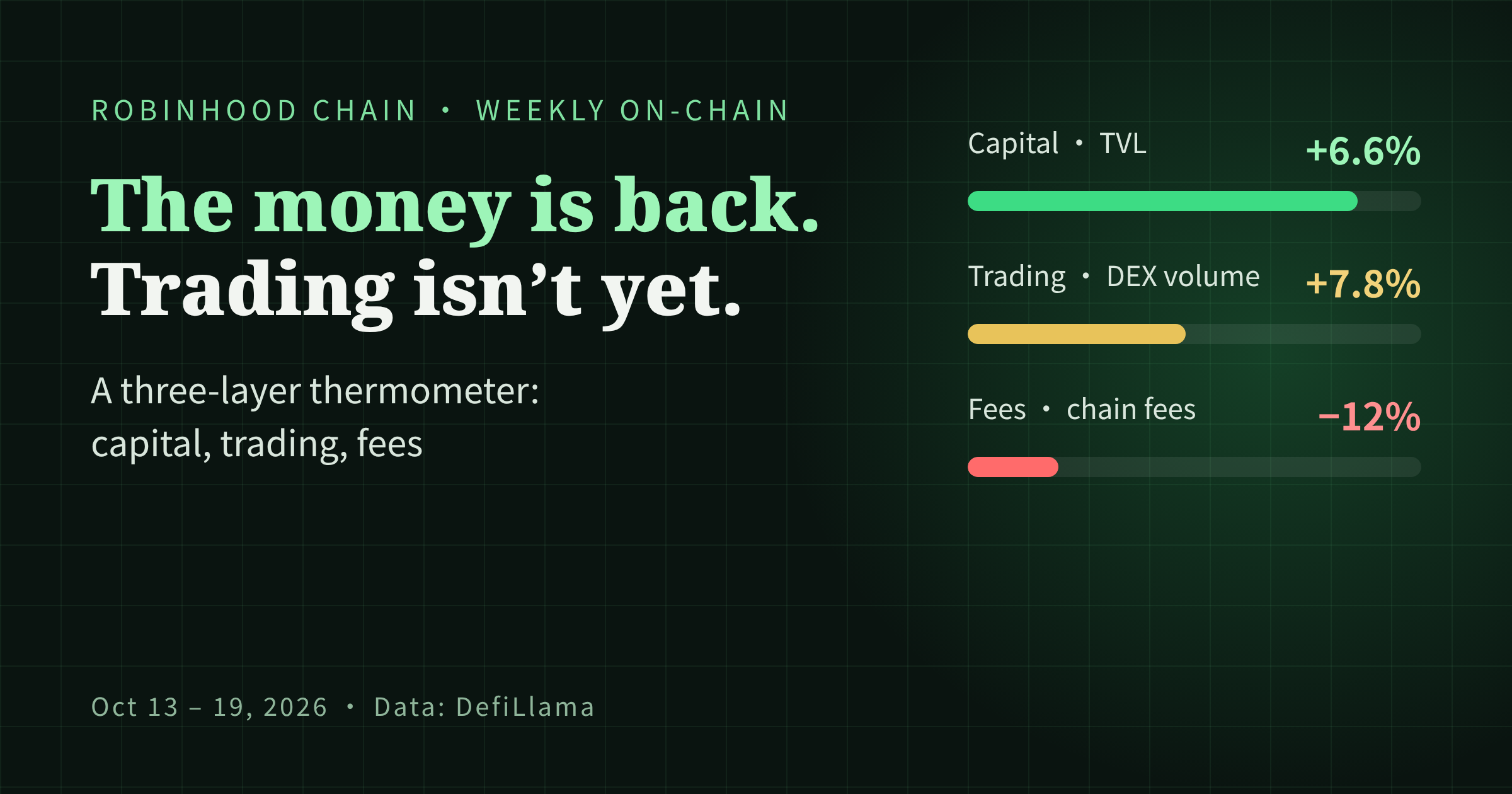
A three-layer read of Robinhood Chain's last week: TVL hit a new high (+6.6%), with new money flowing mostly into DEX liquidity pools; DEX volume is off the lows (+7.8%); but daily fees fell 12%, and fees per $10K traded halved in a month. The money is back. Trading isn't yet.
If you are watching Robinhood Chain to see whether a broker-built chain can become a template, last week’s question was not which meme coin pumped. It was whether the chain’s three layers of on-chain data turned at the same time.
The short answer: a floor is forming, but the “recovery” is only partial. Money is coming back, trading has stopped falling, and on-chain revenue is still sliding.
1. A three-layer thermometer
One headline number is easy to misread. I split the chain’s data into three layers:
- Capital layer: TVL and stablecoin supply. Does money want to stay on the chain?
- Trading layer: DEX volume. Do users want to trade on the chain?
- Fee layer: chain fees. Does that activity turn into revenue?
All three rising together is a recovery. Only one moving is a partial repair.
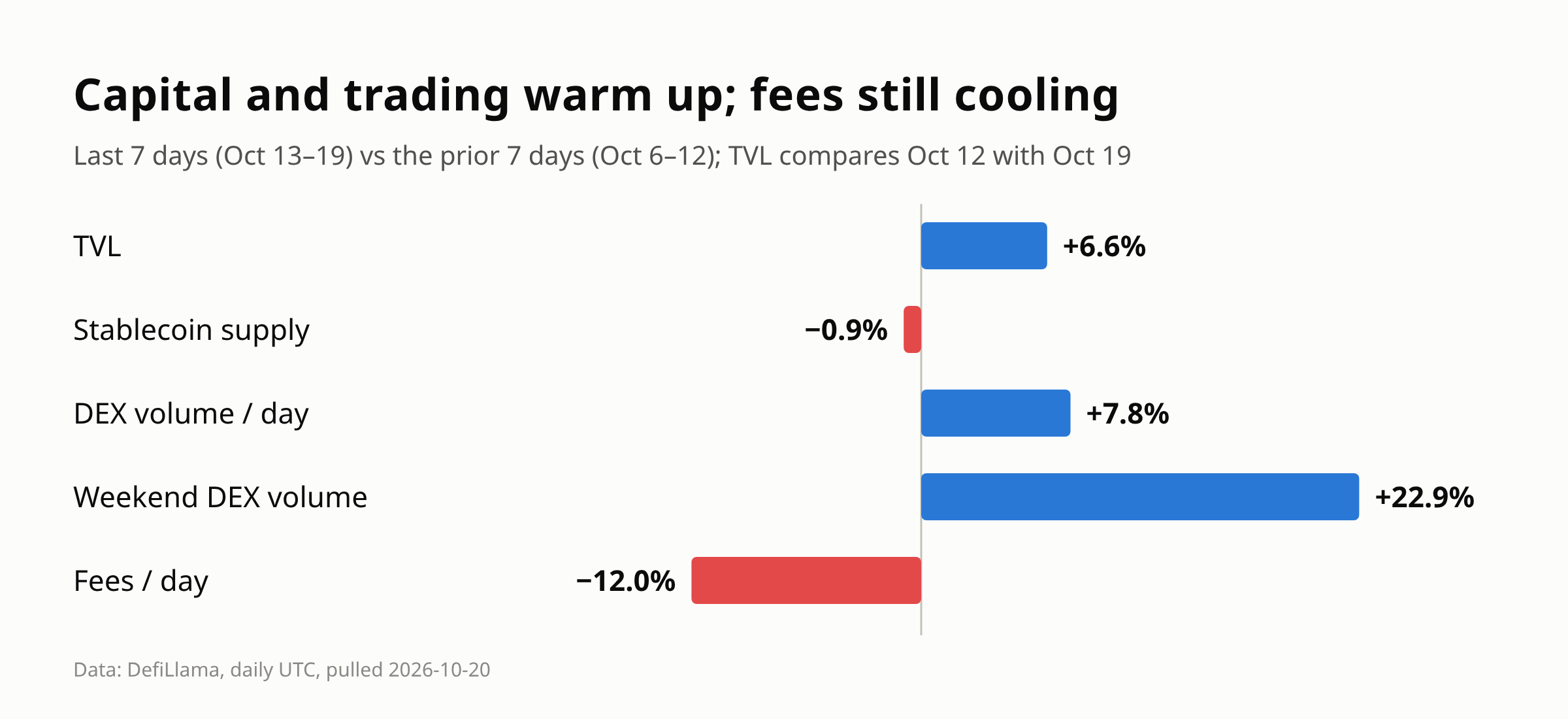
Last 7 days (Oct 13–19) vs. the prior 7 days (Oct 6–12):
| Layer | Metric | Prior 7 days | Last 7 days | Change |
|---|---|---|---|---|
| Capital | TVL | $1.058B (Oct 12) | $1.127B (Oct 19) | +6.6%, new high |
| Capital | Stablecoin supply (daily avg.) | ~$1.10B | ~$1.09B | −0.9%, roughly flat |
| Trading | DEX volume per day | $899M | $969M | +7.8% |
| Trading | Weekend DEX volume (2 days) | $1.16B | $1.42B | +22.9% |
| Fees | Fees per day | $2.75M | $2.42M | −12.0% |
2. Capital layer: the money came back, but not into deposits
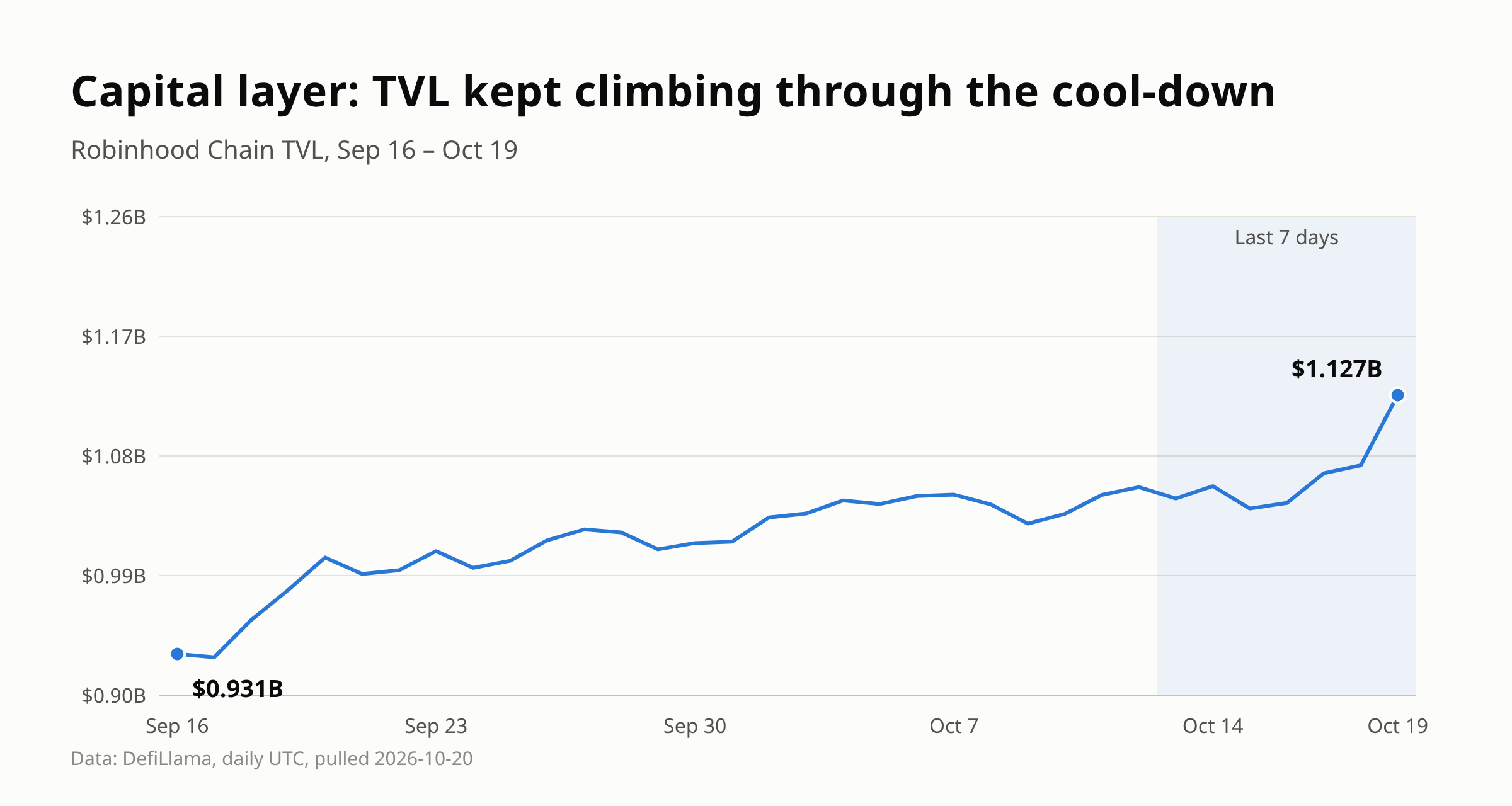
TVL climbed from $931M in mid-September to $1.127B, straight through the meme cool-down. The money never left.
Break the week’s ~$70M increase down by protocol, and the source is not what most people would guess:
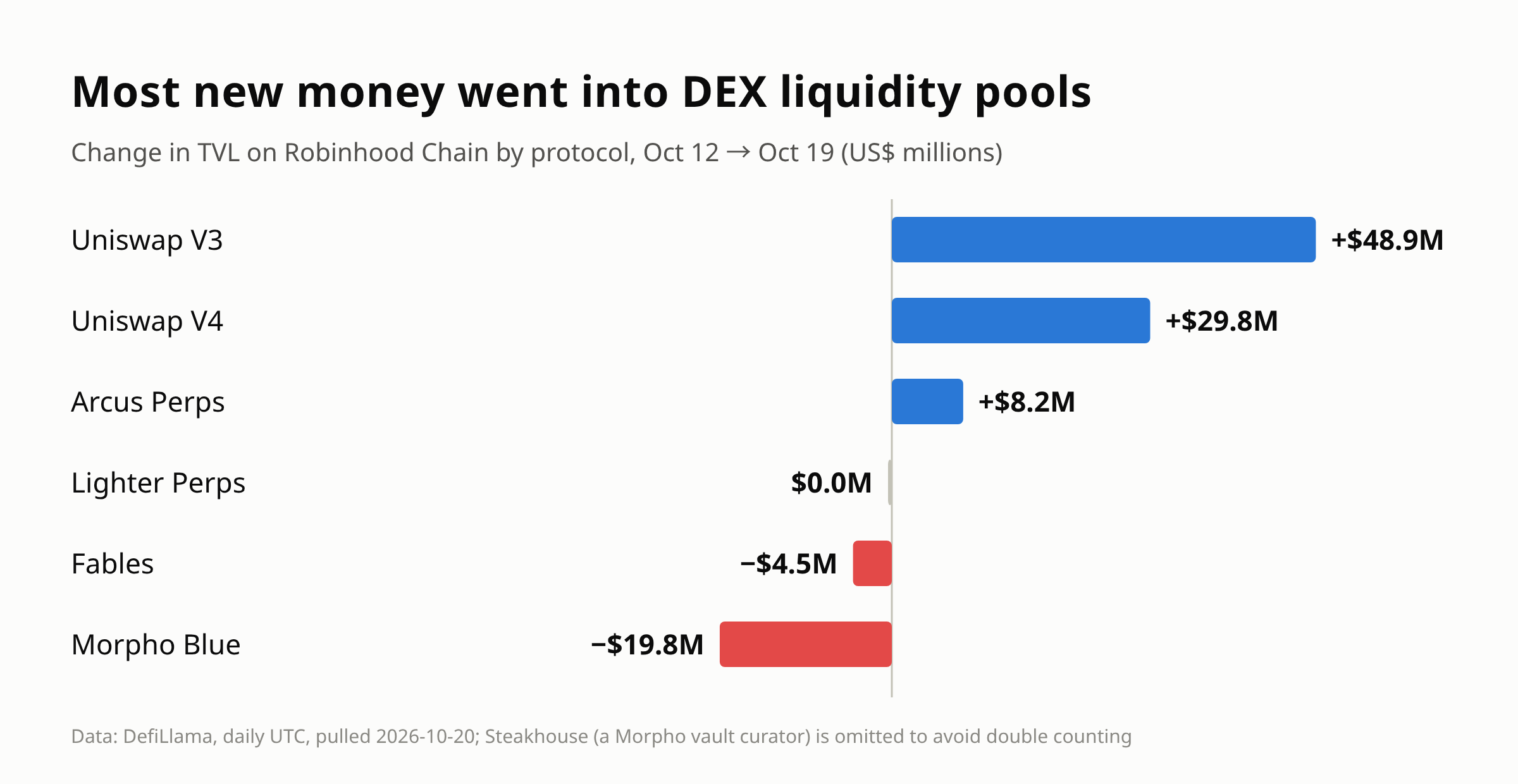
- Most of it went into DEX liquidity pools. Uniswap V3 and V4 together added about $79M, more than the chain’s entire net increase. Uniswap V3 alone nearly doubled in a single day, from $49.5M on Oct 18 to $102.5M on Oct 19.
- Morpho, the deposit base, actually lost about $20M. This is where most Robinhood Earn stablecoin deposits sit, and it saw net outflows this week.
- Perps are growing steadily. Arcus Perps went from $28.4M on Sep 30 to $61.5M, more than doubling in three weeks.
This mix says more than “TVL hit a new high.” When people add liquidity to pools, they expect volume to come and pay them fees. Market-making money arriving first is often a leading signal that trading will follow.
One caveat: V3 doubling in a day most likely reflects a few large positions, not thousands of retail users. Whether that liquidity stays is something to check next week.
3. Trading layer: off the lows, still far below September
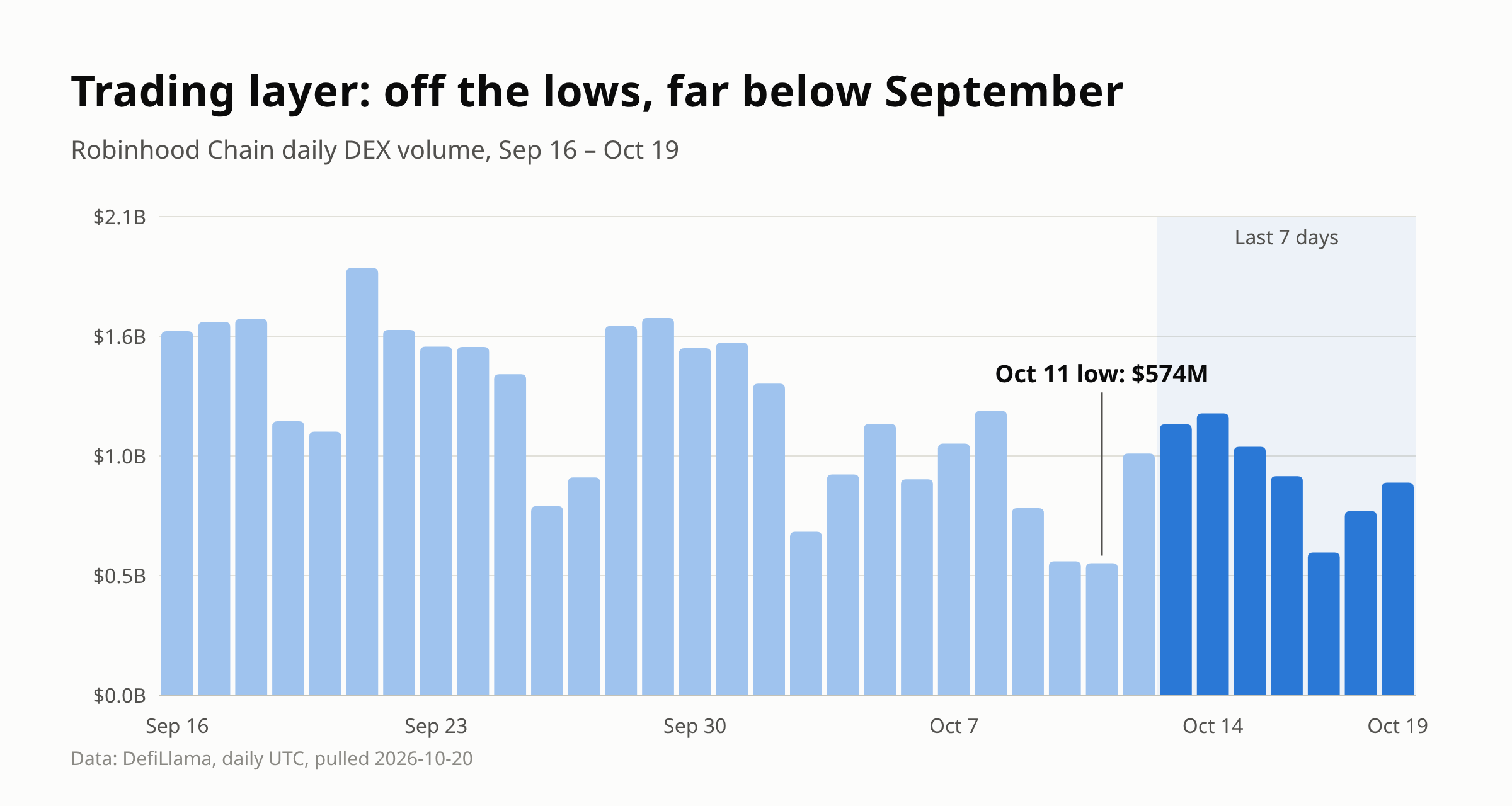
The Oct 10–11 weekend was the coldest point of this cycle, with daily volume of just $574–583M. This weekend came back to $620–800M a day, and weekdays held at $925M–$1.23B.
The floor is rising; that much is clear. But against $1.5–1.8B a day in mid-to-late September, volume has only recovered to about 60%. “Warming up” is fair. “Recovered” is premature.
4. Fee layer: volume up, revenue down
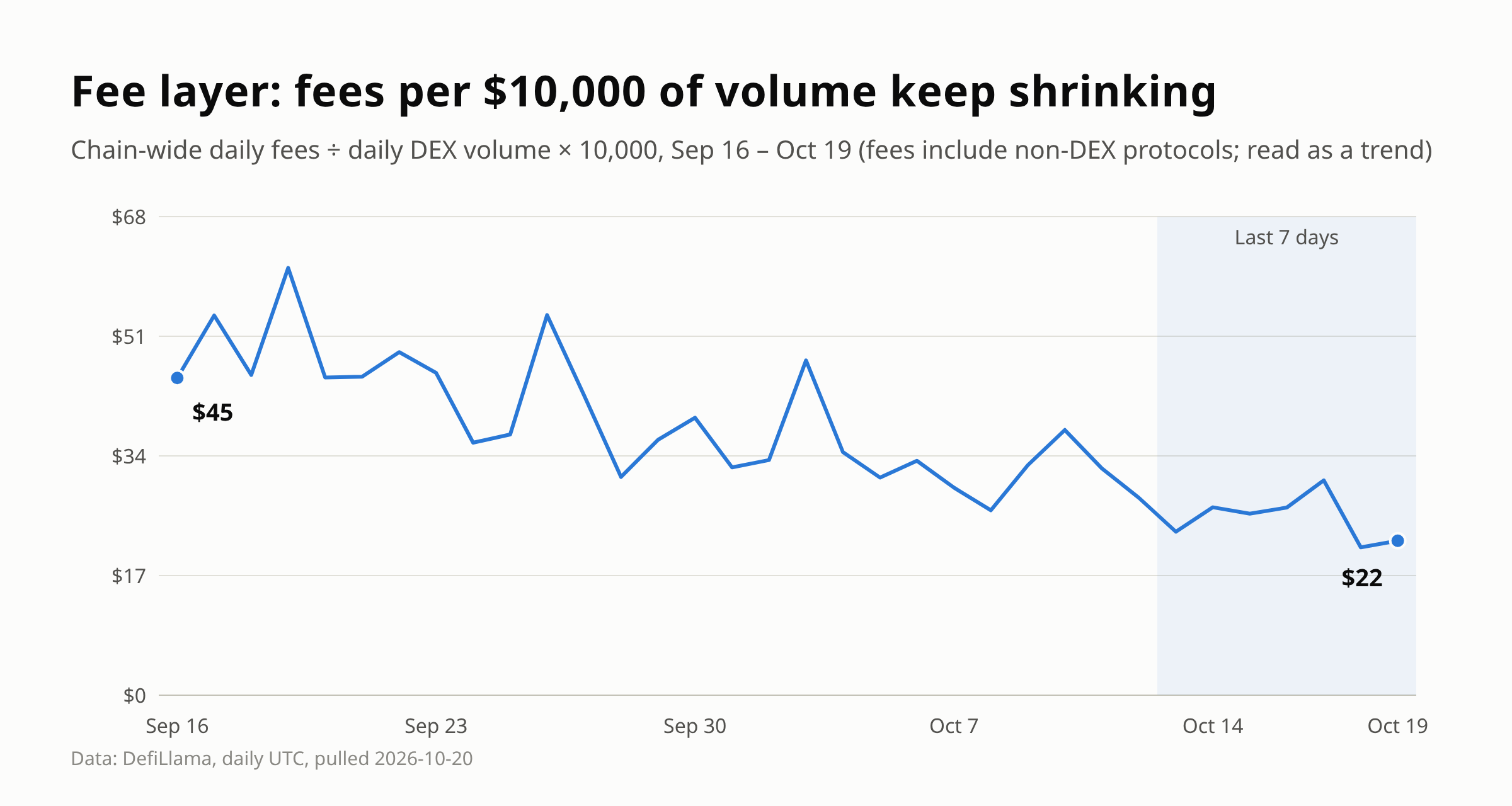
This is the chart worth staring at.
Divide chain-wide fees by DEX volume and you get a rough “fees per $10,000 traded.” It was about $45 on Sep 16, averaged $25 last week, and was just $22 on Oct 19. Half gone in a month.
Three likely causes, probably all at once:
- The trade mix changed. High-frequency, small, high-slippage meme trades are fading, while larger trades and stablecoin swaps are a bigger share. Hot money is turning into cold money.
- Pools got deeper. The DEX liquidity added in section 2 directly lowers slippage and priority fees per trade.
- The gas subsidy is still on. Robinhood extended gas subsidies on Wallet swaps above $0.50 through Dec 31, so the platform absorbs part of users’ costs.
For a chain, volume is scale; fees are the business. Some of the scale is back. The business isn’t yet.
5. What this means for you
If you are judging a chain’s commercial value, this week shows a clear sequence:
Capital stabilizes, market makers follow, trading recovers, revenue arrives last.
We are at step two. That is the difference between a chain backed by a parent company’s distribution and a purely speculative chain. On a speculative chain, TVL collapses when the hype fades. On Robinhood Chain, the hype has been fading for a month, the money is still here, and people are starting to add liquidity.
The other side: revenue per $10,000 traded has halved in a month. If that is structural, meaning the chain’s mainstream flow will be large, low-fee trades, its revenue model will look more like a broker’s low-commission, high-volume business than a meme chain’s high-fee one. That is familiar ground for Robinhood. It built its business on zero commissions.
Three numbers to watch next week
- Can weekday DEX volume hold above $1.2B?
- Can fees per $10,000 traded stabilize around $22–25?
- Is the $50M+ of new Uniswap V3 liquidity still there a week from now?
Hit all three, and it is a real recovery.
Is this hot money turning cold, or is the hype just stepping out for a while?
#RobinhoodChain #Onchain #DeFi
Data sources and notes
- TVL, DEX volume, fees, and per-protocol TVL: DefiLlama (Robinhood Chain chain page, protocol pages, and API), daily UTC, pulled 2026-10-20.
- Stablecoin supply: DefiLlama Stablecoins (Robinhood Chain).
- Steakhouse Financial is left out of the protocol breakdown: it is a vault curator on Morpho, so its funds double-count with Morpho.
- DefiLlama is missing Uniswap V4 data for Oct 17 and 18, so this piece compares only the Oct 12 and Oct 19 snapshots.
- “Fees per $10,000 traded” is a rough figure: chain-wide fees divided by DEX volume. Fees include non-DEX protocols, so read it as a trend, not a precise fee rate.
- Gas subsidy extension to Dec 31: CoinDesk / crypto.news.
- This piece does not cover transaction counts or active addresses (growthepie methodology); the activity layer is still to come.
Repost this post?
Share with your followers.
Reply