
目錄(5 節)

·
Where Did 324.8 Million PONS Go? Inside the Burn Race Between PONS, HOOKR, and PAR

PONS and HOOKR send tokens to a dead address, while PAR reduces totalSupply directly. Here is what the on-chain data really shows—and why burn mechanics matter less than the revenue that sustains them.
If you look only at totalSupply on a block explorer, PONS appears to have lost nothing. Its total supply is still one billion tokens.
But more than 324.8 million PONS now sit at another address. They were not accumulated by a whale or moved into a team treasury. They were sent to 0x000…dEaD, an address the market treats as permanently inaccessible.
In other words, the nominal supply remains one billion, but no more than roughly 675.2 million PONS remain outside the dead address. By that measure, 32.48% of the original supply has left effective circulation.
That leads to a deceptively simple question: why do PONS and HOOKR keep the same total supply after a burn, while PAR’s totalSupply falls?
The answer is that these projects use two different forms of “burning.”
A Snapshot From the Chain
The following figures were read from Robinhood Chain at block 90,115,547, timestamped October 16, 2026 at 13:31 UTC. All three tokens began with a supply of one billion.
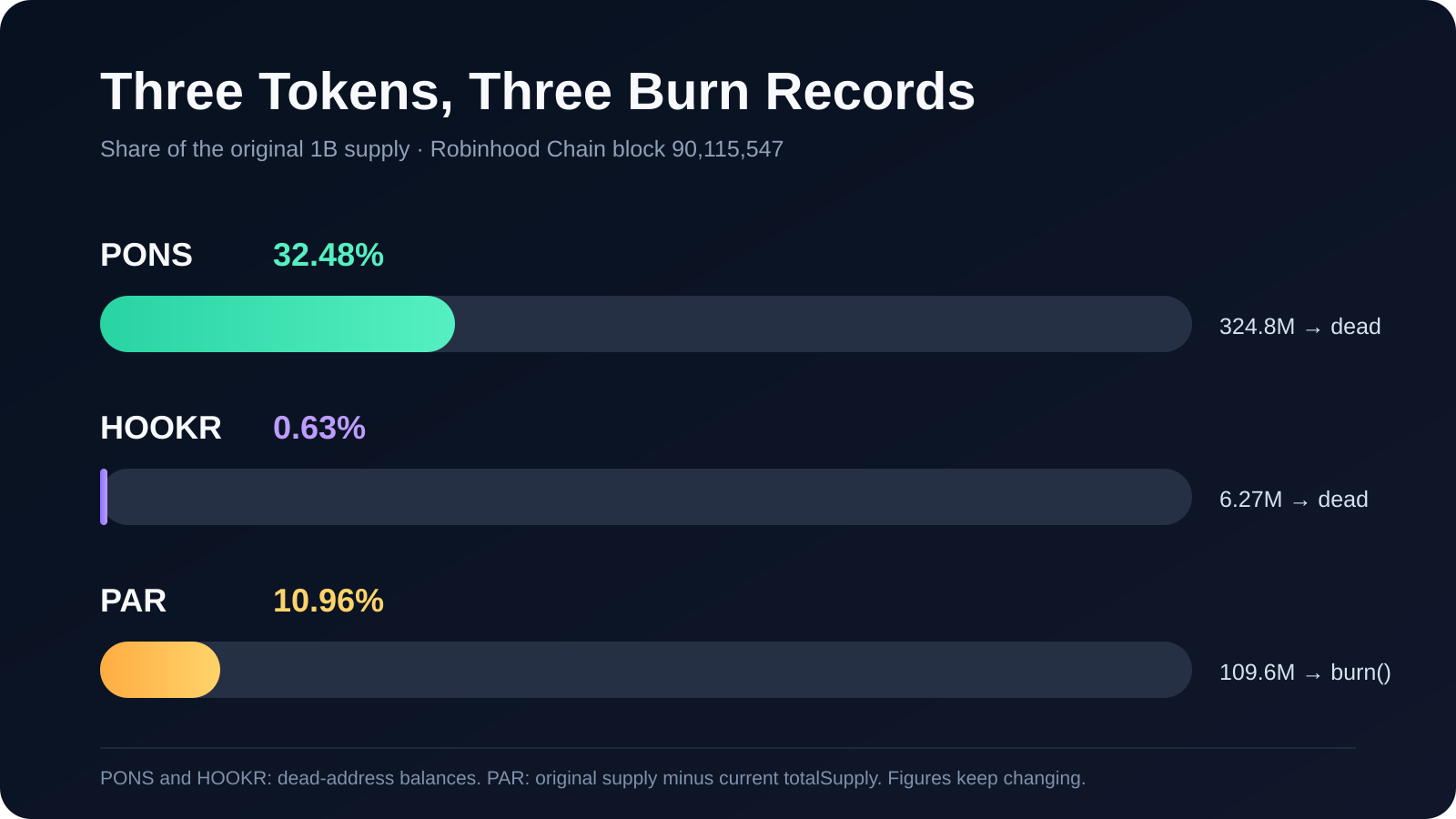
| Project | Reported total supply | Dead-address balance | Burned as share of initial supply | Primary accounting method |
|---|---|---|---|---|
| PONS | 1 billion | 324,801,114 | 32.48% | Transfer to 0x…dEaD
|
| HOOKR | 1 billion | 6,271,014 | 0.63% | Transfer to 0x…dEaD
|
| PAR | 890,400,799 | 193,086 | 10.96% | Reduce supply through burn()
|
PAR’s 10.96% figure is not calculated from its dead-address balance. It is the difference between the original one billion tokens and the current totalSupply. Roughly 109.6 million PAR have been removed from the contract’s supply accounting.
There is one important qualification: the dead address also holds about 193,000 PAR, likely sent there through historical transactions or voluntary holder transfers. It would therefore be inaccurate to say that no PAR has ever entered the dead address. The more precise statement is that PAR’s main burn mechanism does not park tokens at 0x…dEaD; it directly reduces supply.
Two Types of Burn: Lock It Away or Delete It From the Ledger
Think of a token contract as a ledger.
PONS and HOOKR move tokens from market accounts into a warehouse that is generally considered impossible to unlock. The tokens remain recorded on the ledger, but the market assumes nobody can retrieve them. As a result:
- the dead-address balance keeps rising;
-
totalSupply()continues to report one billion; - data providers must recognize and subtract the dead address to calculate adjusted supply.
PAR takes a different route. The address holding the tokens calls burn(). The contract reduces that address’s balance and totalSupply at the same time. The chain still records a Transfer(from, 0x0, amount) event, but the zero address does not accumulate a conventional token balance.
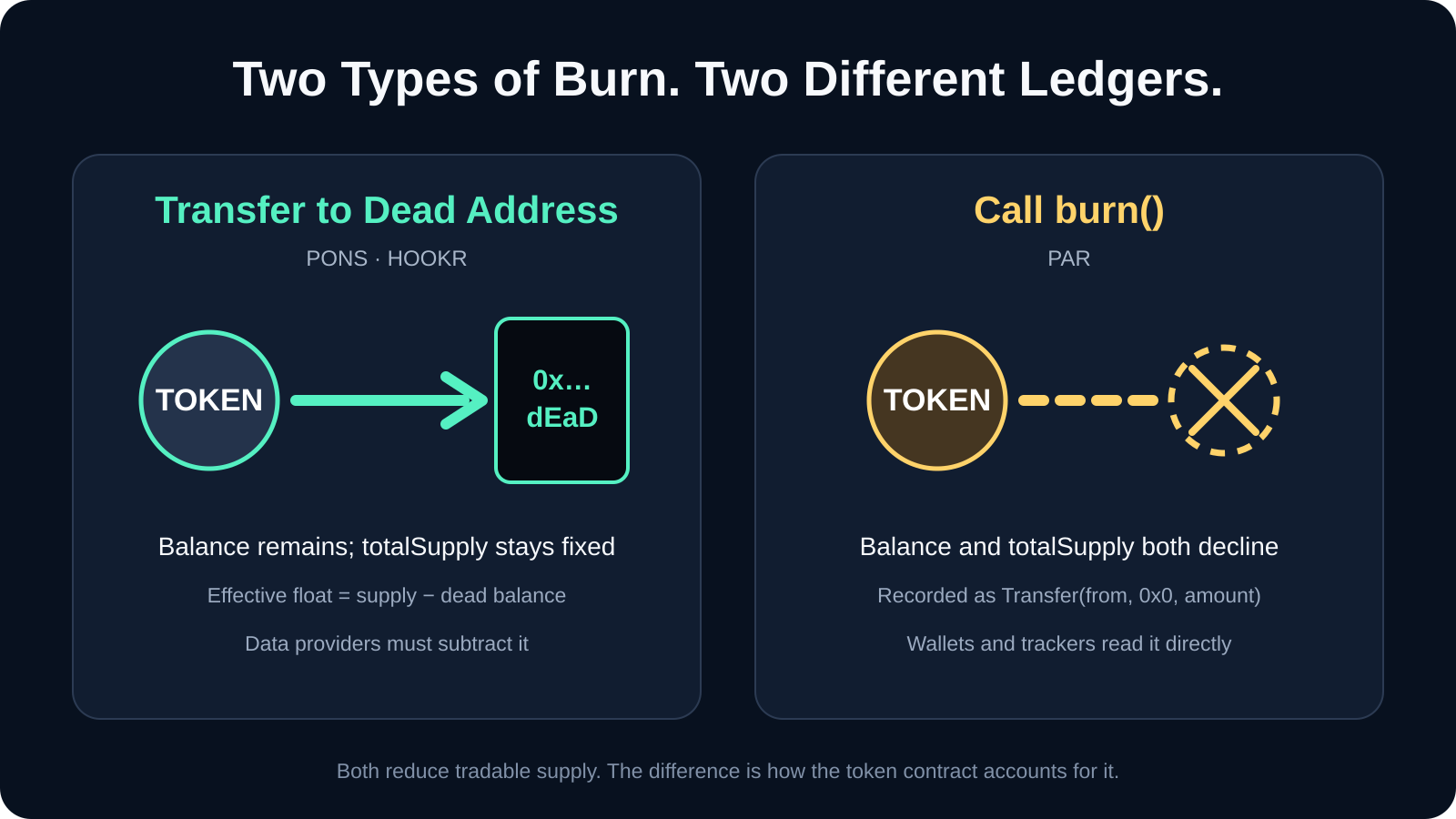
PONS and HOOKR are therefore closer to permanent sequestration, while PAR is closer to cancellation. In strict ERC-20 accounting terms, PAR actually reduces total supply. In market-supply terms, however, both methods remove tokens from trading—as long as the dead address truly cannot be controlled.
The main difference appears in how data is reported.
If a market-data provider calculates FDV by multiplying price by totalSupply, PONS and HOOKR will still be valued against one billion tokens. PAR’s FDV, by contrast, naturally falls as tokens are burned. To represent the first two accurately, a provider has to use an adjusted figure that subtracts the dead-address balance. PONS documents this explicitly, defining burn-adjusted market capitalization as:
Price × (total supply − burned supply)
This is why the same project can show different supply or valuation figures across different data platforms.
Why Does 32.48% Stand Out?
The PONS figure is undeniably large: more than three-tenths of its original supply has entered the dead address. But “highest burn percentage” does not automatically mean “strongest value capture.”
The three projects launched at different times and operate with different volumes and fee models. Their cumulative burn percentages are not a clean measure of efficiency. The more important question is: where did the money used to buy these tokens come from?
According to the PONS documentation, 80% of protocol fees currently fund an automated TWAP buyback that sends purchased PONS to the burn address. The remaining 20% supports infrastructure and team expansion. PONS also notes that this allocation is not yet fully immutable, with further automation and decentralization planned for a future release.
HOOKR follows a similar pattern. Protocol revenue from different Hook Blocks, partner launchers, and earlier-generation flat fees is swept into its treasury, used to buy HOOKR on the market, and then sent to the dead address. HOOKR’s own token page explicitly defines its cumulative burn figure as the dead-address balance.
PAR creates two burn paths. A portion of quote-asset protocol fees flows to a buyback wallet, which buys PAR and calls burn(). Protocol fees paid in a launched token can also be burned directly. For PAR itself, the outcome appears as a declining totalSupply.
All three projects are trying to build the same loop:
Platform activity generates fees → part of the revenue becomes market demand → the platform token is repurchased → the tokens leave circulation.
The meaningful difference is not whether a website shows a burn animation. It is whether the loop produces real, recurring revenue—and whether the rules governing that revenue are transparent, stable, and verifiable.
Three Questions That Matter More Than the Burn Count
First, did the burn come from genuine market purchases?
A team can send reserved tokens directly to a dead address and produce an impressive burn percentage without creating any new demand. A buyback funded by protocol revenue is different: it creates market buying pressure while shrinking available supply. Those two events have very different economic meanings.
Second, does the burn rate depend on short-lived trading activity?
Value capture for all three projects is connected to platform usage. Higher trading volume generally produces more fees and more buybacks; lower activity slows the burn. A cumulative figure tells us what happened in the past, but it cannot prove that the same pace will continue.
Third, is execution enforced by code or dependent on the team?
An immutable onchain split that executes automatically carries a different risk profile from a team-controlled wallet performing periodic buybacks. Even if both ultimately send tokens to the same dead address, their execution dependencies, administrative powers, and transparency should be evaluated separately.
The Burn Race Is Not Ultimately About the Biggest Number
From a storytelling perspective, 324.8 million PONS is the number that grabs attention. It means more than 32% of the original supply has been isolated at the dead address—and the onchain balance continues to grow.
But once we move from the headline to the mechanism, a more useful picture emerges:
- PONS has removed the largest share of its initial supply from effective circulation, although nominal supply remains one billion;
- HOOKR uses the same dead-address method on a smaller scale, with its burn capacity tied to usage of its hook infrastructure;
- PAR uses
burn()directly, causing onchain total supply to decline and making the accounting easier for wallets and market-data services to interpret.
This is not a simple contest between “real burns” and “fake burns.” A more accurate distinction is that PONS and HOOKR permanently sequester tokens within total supply, while PAR cancels tokens out of total supply.
For holders, the next figure worth watching is not merely how many more tokens arrive at the dead address. It is how much external activity each platform attracts, how much real fee revenue it generates, and how much of that revenue can consistently become open-market demand.
The burn is the outcome. The business capable of funding it over time is the real story.
Methodology and Sources
- Onchain snapshot: Robinhood Chain public RPC at block 90,115,547;
totalSupply()and the balance of0x000000000000000000000000000000000000dEaDwere read for all three tokens. - PONS contract:
0x39dBED3a2bd333467115dE45665cC57F813C4571; official PONS documentation. - HOOKR contract:
0x18E674231A58c239Dc7DaeDcffE15Ec3A24cff5c; HOOKR tokenomics. - PAR contract:
0x507B6F349a80114097A67B8b4677367acC15b220; official PAR documentation and PAR contract repository.
This article examines onchain accounting and token mechanics. It is not investment advice. Burn balances, supply figures, and protocol parameters may continue to change after publication.
轉發此貼文?
與您的關注者分享。
回覆