
目錄(7 節)

·
A Chain Built for Stocks Got 646,000 Memecoins First
A chain built for stock tokens got about 646,000 memecoins first, while identifiable Robinhood app users made only 1–2% of trades. The two-curves framework explains why, what the first settlers left behind, and why weekly unique buyers of the NVIDIA token are the signal to watch.
If you run ecosystem growth for a new chain, handle new-chain listings at an exchange or wallet, or value projects with onchain data, the first hundred days of Robinhood Chain are worth taking apart line by line.
At its July 1, 2026 launch, Robinhood talked about stock tokens, lending and AI agents. The first applications to reach scale after mainnet were token launchpads: tools that let anyone issue a token and start trading it in about a minute.
A few numbers:
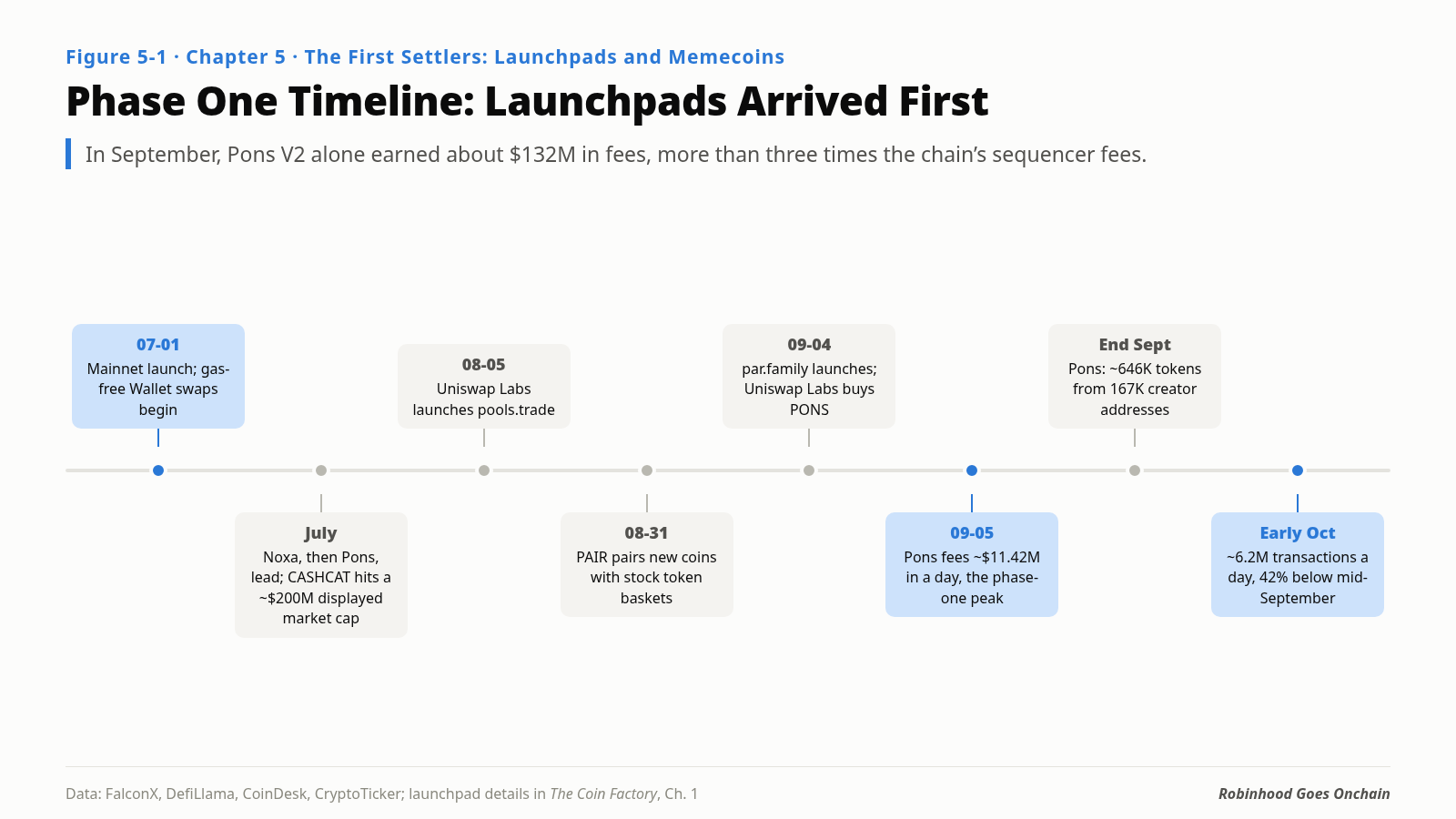
- By the end of September, users had created about 646,000 tokens on Pons, the largest launchpad, from more than 167,000 creator addresses (CoinDesk, CryptoTicker).
- On September 5, Pons took in about $11.42 million in fees in a single day, the peak of the first phase.
- In September alone, Pons V2 generated about $132 million in fees, more than three times the chain’s roughly $35.93 million in sequencer fees.
Now the other side. CoinDesk Research estimated that trades identifiable as Robinhood app users made up only about 1–2% of onchain activity in its observation window. The estimate depends on identity heuristics, the denominator and the period, so it is good for scale, not precise projection. The scale is clear enough: most of the chain’s early noise was not made by Robinhood’s customers.
What July 1 Delivered Was an Account
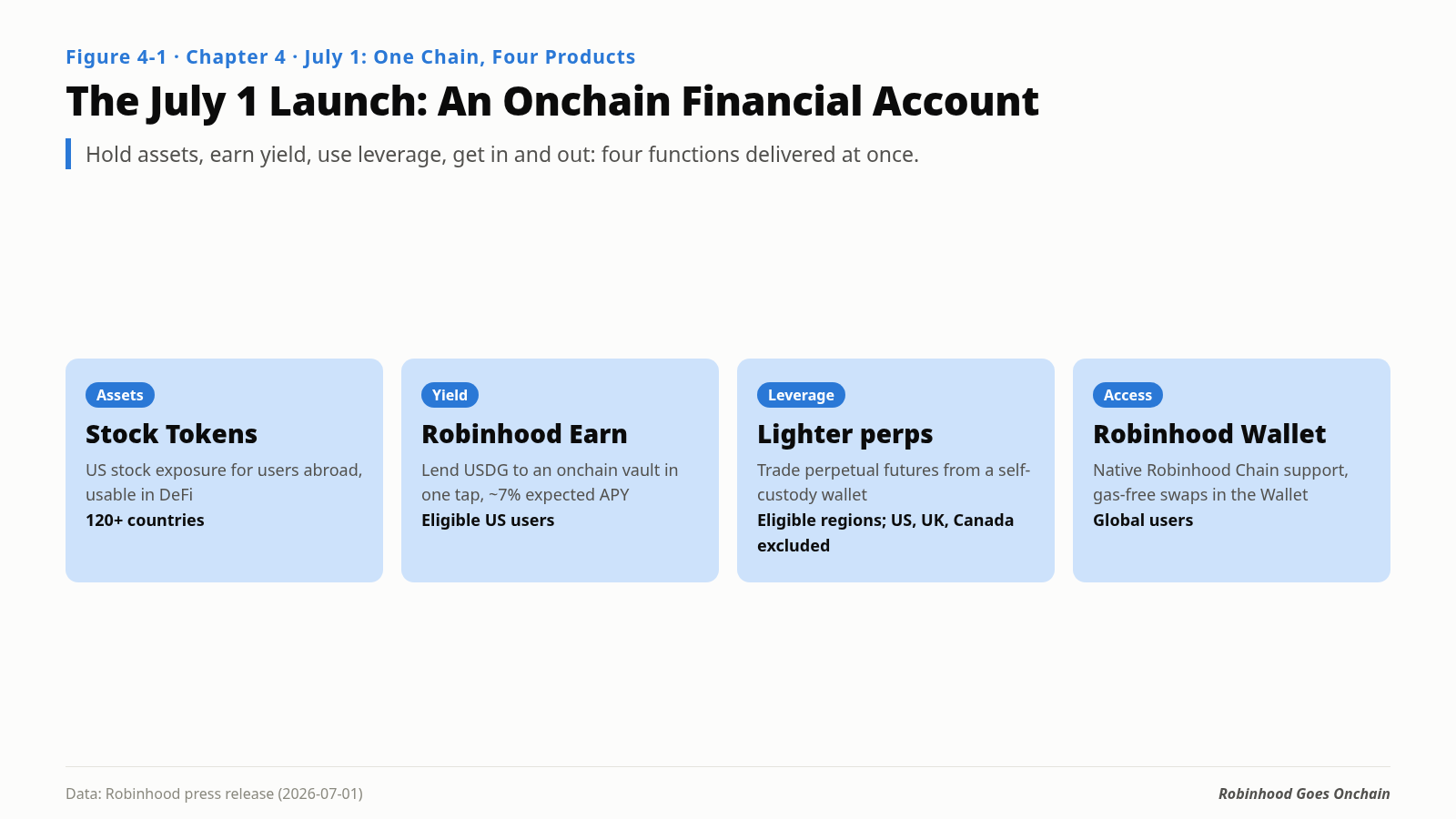
First, what Robinhood itself shipped. Four products launched with the chain. I call them the four-piece stack:
| Function | Product | For whom |
|---|---|---|
| Assets | Next-generation Stock Tokens | Eligible users in 120-plus countries (not the U.S.) |
| Yield | Robinhood Earn: lend USDG to an onchain vault in one tap | Eligible U.S. users |
| Leverage | Lighter perpetuals inside Robinhood Wallet | Users in eligible jurisdictions |
| Access | Robinhood Wallet, with gas-free in-wallet swaps | Global users |
Hold assets, earn yield, use leverage, move in and out: the four basic functions of an onchain financial account went live at once. Robinhood was not launching an empty chain. It was launching an account people could use.
The chain’s own parameters are restrained. It is built on Arbitrum, uses ETH for gas and has no native token. Skipping a chain token spares Robinhood the securities-law, market-structure and conflict-of-interest questions a new token would raise. That narrows product risk; it is not a regulatory exemption.
Why Memecoins Came First
This is not Robinhood Chain going off course. It is what new chains do. Solana had pump.fun; Base had its social token tools. Three structural reasons:
- The lowest barrier. A stock token needs authorized-participant subscriptions, custodial shares and compliance review. A memecoin needs one transaction.
- Ready-made distribution. Trading terminals such as GMGN, Axiom and fomo already served cross-chain users hunting for early opportunities, and they moved in as soon as the chain opened.
- Subsidies amplify it. Gas-free swaps made issuing and high-frequency trading almost free, while launchpads took a fee on every trade.
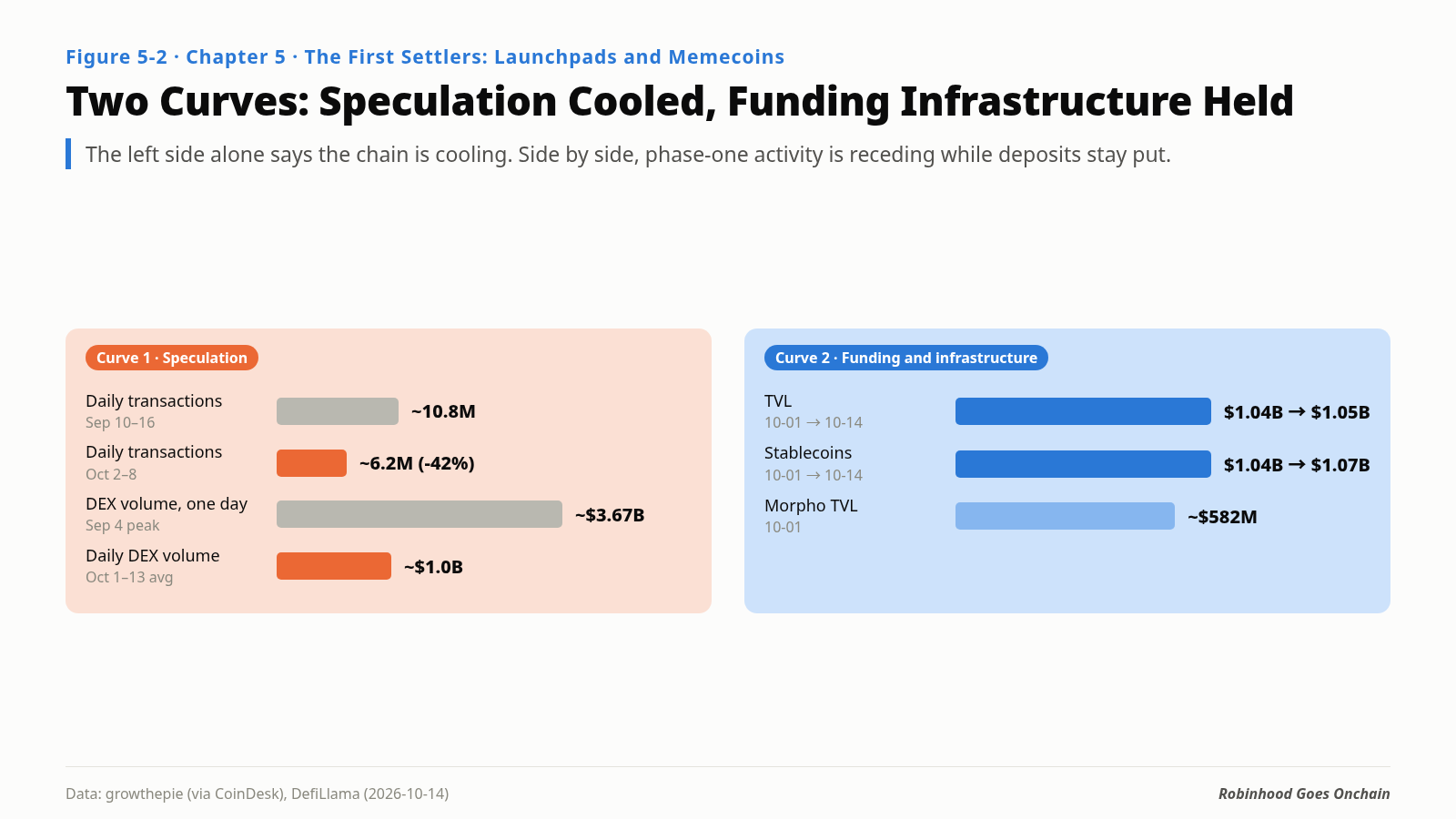
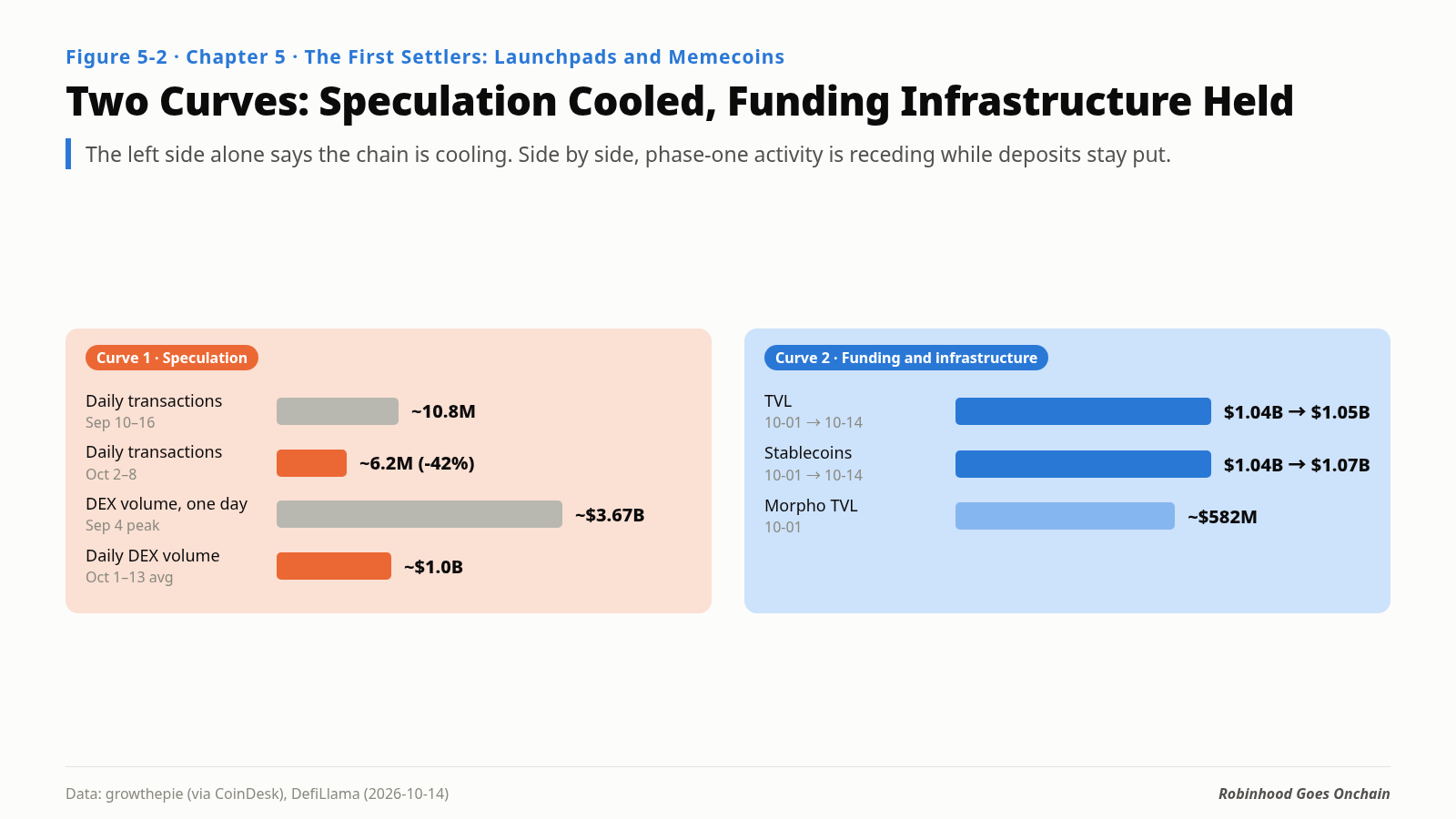
I read this period through the “two curves” framework from the companion book, The Coin Factory: the first phase of a new chain is driven by the easiest available use; the second by the use the chain was designed for. Memecoins and launchpads are the first curve. Stock tokens, lending and AI agents are the second.
What the First Settlers Left Behind
The first curve dropped sharply after mid-September. CoinDesk’s calculations from growthepie data show average daily transactions falling from about 10.8 million (September 10–16) to about 6.2 million (October 2–8). Daily Pons fees fell more than 90% from the peak.
Watch only the decline and you miss what was built:
| What remained | Evidence |
|---|---|
| Wallets and users | About 320,000 daily active addresses in early October |
| Liquidity | The chain at one point supplied more than half of Uniswap’s volume across all chains (CoinDesk Research) |
| Trading terminals | GMGN, Axiom and fomo integrated, and can route stock tokens too |
| Data tooling | DexScreener, DefiLlama, Dune and Bitquery added support |
| A real stress test | The early-September peak put the chain under genuine load |
The first settlers matter not because they will necessarily stay, but because they turned an empty chain into one with roads, power and water. Much of the path stock tokens and lending later used was paved by memecoin traders.
The Signal Worth Watching
The two curves are not fully separate on this chain. PAIR paired new tokens directly with stock-token baskets, and Pons and par supported stock-token quote assets. Stock tokens themselves drew high-frequency trading.
One Bitquery dataset stands out. From mid-September to mid-October, Robinhood Chain’s NVIDIA token traded about $656 million, more than any other onchain version of NVIDIA. When circular trading stopped in October, volume fell about 98%.
Yet over the same stretch the token still drew 1,200–2,900 unique buyers a week, with an average trade of roughly $620, about 6.5 times that of a comparable Solana token.
Bot volume arrives fast and leaves fast. The count of real buyers stayed comparatively steady, and they traded bigger. That may be one of the earliest signs of the second curve.
A Methodology Trap
There are at least two figures for stock-token “holders”: Robinhood’s roughly 200,000, and about 1.3 million addresses counted by Token Terminal and cited secondhand.
The definitions are not published in enough detail to reconcile them; the larger count may double-count addresses across tokens or include contracts. When I discuss users I use Robinhood’s disclosure; when I cite onchain addresses I state the method’s limits. The same word can describe very different populations, and that is the easiest trap in reading new-chain data.
If You Build on a New Chain
- Do not value an app or a chain on first-phase volume. It tells you how many people will try, not how many will stay.
- Track the channels the first settlers install: terminals, data tools, liquidity protocols. They are ready-made pipes for second-phase products.
- Replace daily volume with weekly unique buyers and average trade size.
The Takeaway
Memecoins were this chain’s first settlers. They may not stay, but they built the roads. The next thing to watch is when Robinhood’s own customers start walking down them.
When you evaluate a new chain, do you look at volume first, or at unique buyers?
— Adapted from Robinhood Goes Onchain: A Broker’s First Year, Chapter 4, “July 1: One Chain, Four Products,” and Chapter 5, “The First Settlers: Launchpads and Memecoins”
The full book (17 chapters, 48 figures, first 3 chapters free to read): https://pickful.ai/books/qx7q
轉發此貼文?
與您的關注者分享。
回覆