
目錄(6 節)

·
Who Pays the 7%: 77,600 Depositors, 48 Borrowers and Two Companies' Marketing Budgets
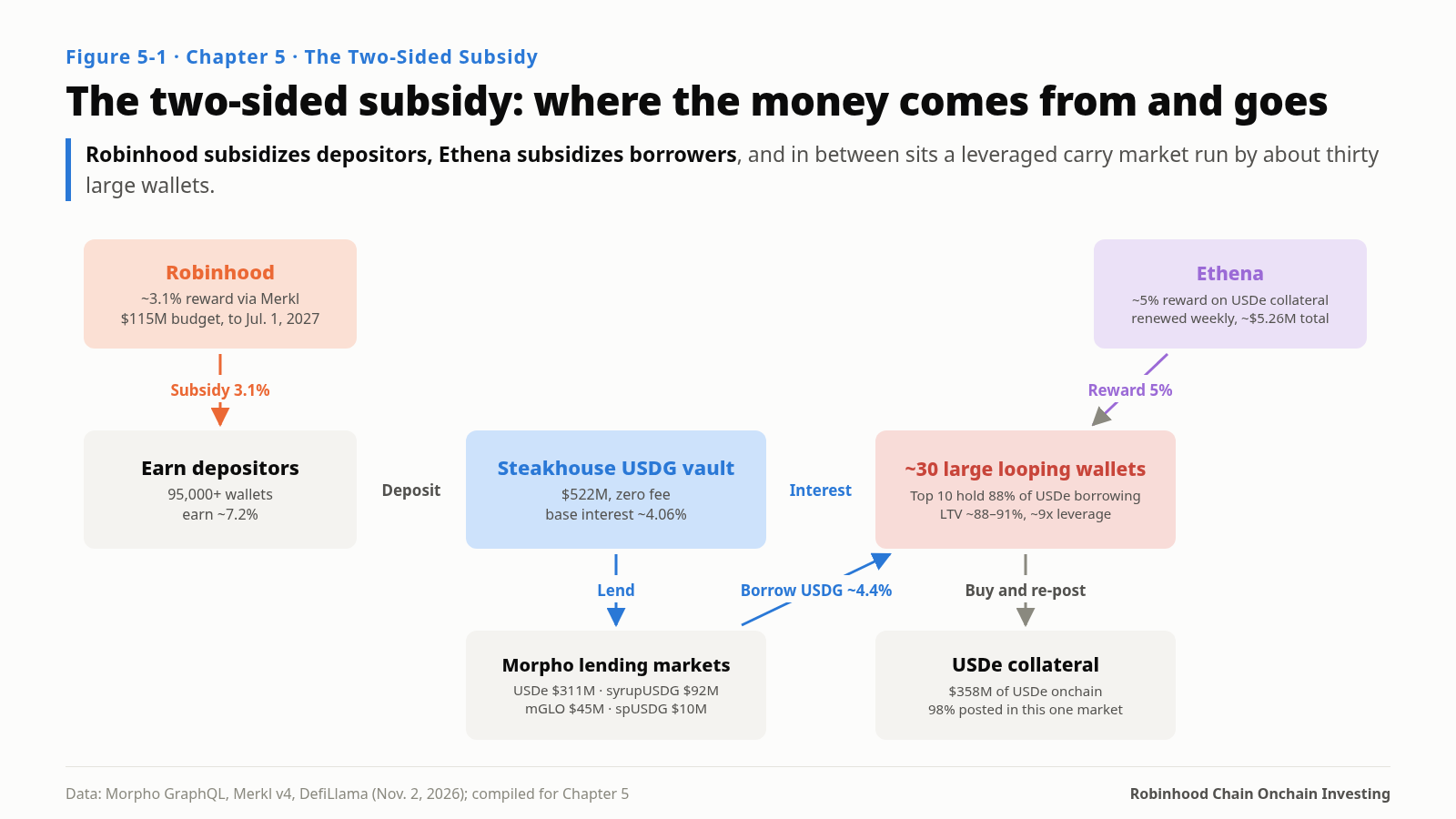
The vault behind Robinhood Earn holds about $522 million from 77,594 addresses, lent to just 48 borrowers, with the top 20 taking 91%. This piece explains the two-sided subsidy: Robinhood pays depositors about 3.1%, Ethena pays USDe collateral 5%, and loopers at about 9x sit in between. It also covers the three risks depositors actually carry: a 16-hour oracle buffer, 10.7% instant liquidity, and weekly renewals.
If you deposited USDG through Robinhood Earn, or you are thinking about putting stablecoins into a lending vault on Robinhood Chain, this piece answers three questions: who pays your interest, who is on the other side of your deposit, and when your money might not come out.
Follow $10,000 through the system. A U.S. user taps a few times in the Robinhood app, converts $10,000 to USDG and deposits it in Earn, which shows an expected yield of about 7%. The money leaves the app for its built-in self-custody wallet and goes into a USDG vault on Morpho curated by Steakhouse, about $522 million in size. The vault splits it across four lending markets, lending to people who post USDe, syrupUSDG, mGLO or spUSDG as collateral.
The largest market takes USDe as collateral and has lent about $311 million. Sort its borrowers by size: the two largest addresses borrowed about $62 million each; the top 5 hold 64.8% of the borrowing and the top 10 hold 88.2%; 83% of the borrowing sits at a loan-to-value above 88%, against a liquidation threshold of 91.5%.
An LTV of 89.6% means $1 of equity is controlling about $9.60 of USDe. These addresses are looping: post USDe, borrow USDG, buy USDe, post it again, round after round.
77,594 Against 48
Count both sides.
Depositors. On November 2, the vault had 77,594 holding addresses. The headcount is retail; the money is not. The top 1,000 addresses hold 63.9% of the vault’s assets; 968 positions are above $100,000 and 48 above $1 million. The roughly 66,600 addresses after the 11,000th hold about $15 million combined, an average of about $230 each.
Borrowers. Across the four looping markets, only 48 addresses borrowed more than $100,000, together about $458 million. The top 10 hold 73.2% and the top 20 hold 91.0%. The largest single address borrows against both USDe and syrupUSDG, about $85.8 million in total, roughly 16% of the vault’s assets.
I checked the four largest borrowers: all are ordinary wallets, not smart-contract vaults, with 52 to 827 transactions each. This leverage is run directly by a few individuals or firms, not by a product anyone can audit.
Seventy-seven thousand depositors think they are dealing with a vault. In practice they are dealing with about twenty wallets.
The Two-Sided Subsidy
Why would anyone hold a synthetic dollar that pays no interest with 9x leverage?
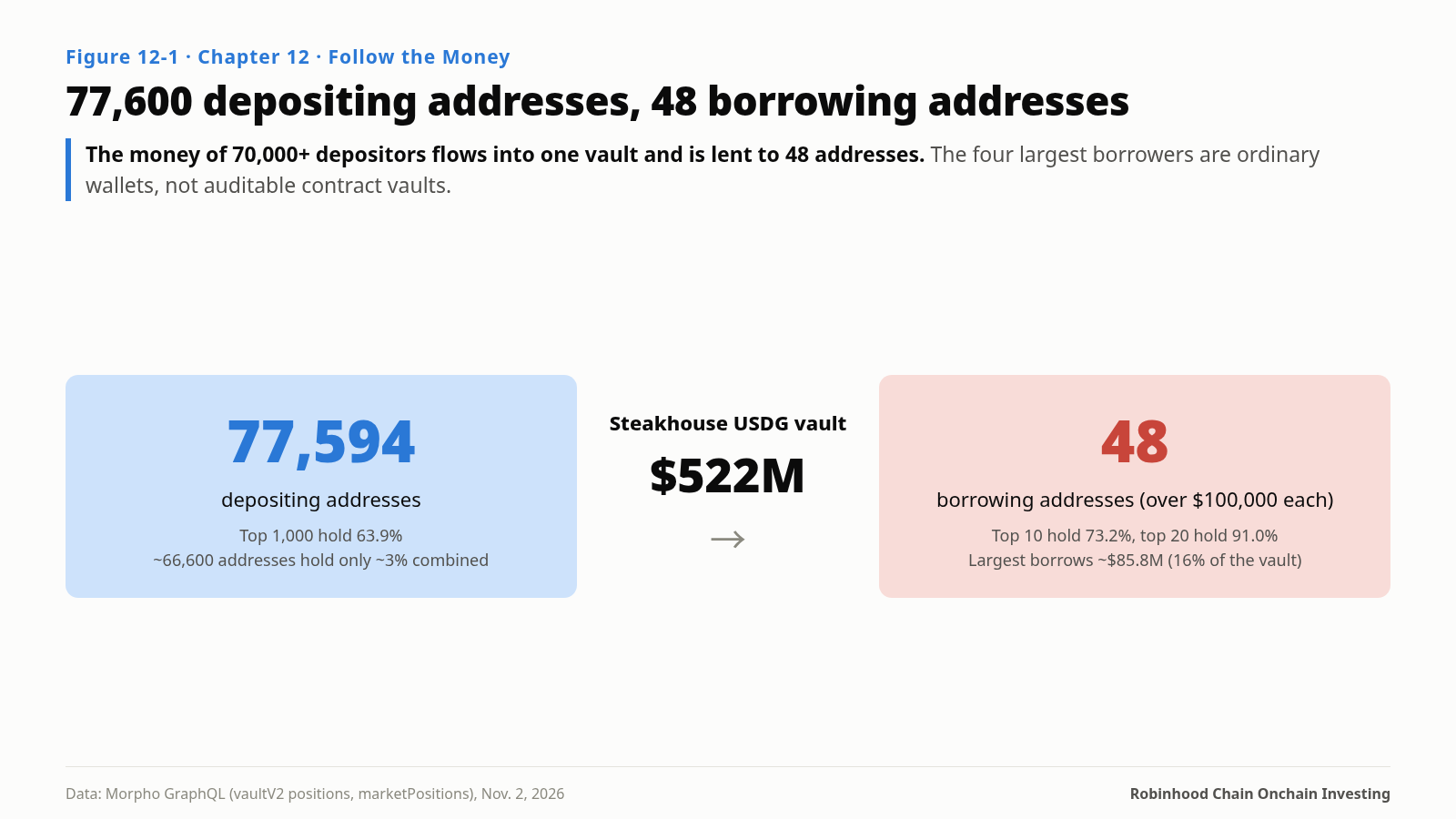
The answer is on Merkl. Since the day after mainnet launched (July 2), Ethena has paid a weekly reward on this market’s USDe collateral, currently 5% a year. It is paid on collateral, so borrowers earn it on their entire 9x position. On the depositor side, Robinhood runs a separate campaign that pays an extra 3.1% or so to users who deposit through Robinhood.
The two-sided subsidy: Robinhood subsidizes the depositors, Ethena subsidizes the borrowers, and in between sits a leveraged spread market run by a few dozen large players.
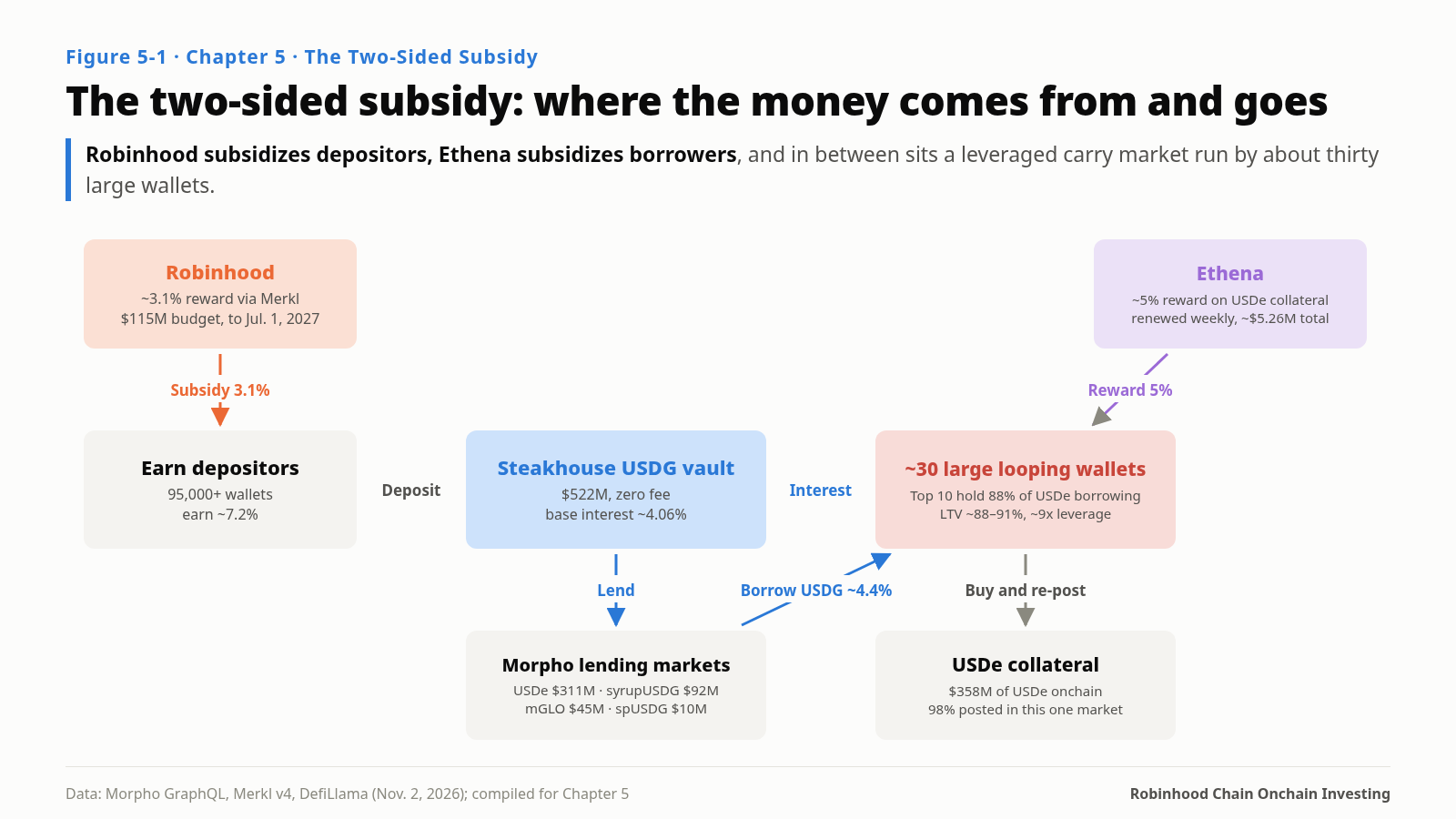
Everyone knows what they are buying. Robinhood is buying distribution, getting app users to put money on its own chain for the first time. Ethena is buying a use for USDe: 98% of the roughly $358 million of USDe on this chain sits in this one market. Borrowers earn the gap between reward and borrowing rate, times leverage. Steakhouse and Morpho get scale; the vault charges a 0% curator fee.
Borrowers Earn the Least
A loop’s equity return is roughly: leverage × reward rate − (leverage − 1) × borrowing rate. On November 1, with a 5.00% reward and a 4.54% borrowing rate, 9x leverage gave an equity return of about 8.6% a year.
Run the daily data since late July and the picture changes. The reward rate minus the borrowing rate averaged −0.06 percentage points. Equity returns at 9x averaged about 4.2% a year, with a low of −25% and a high of +17%. The negative days clustered when utilization spiked, in late August and late September.
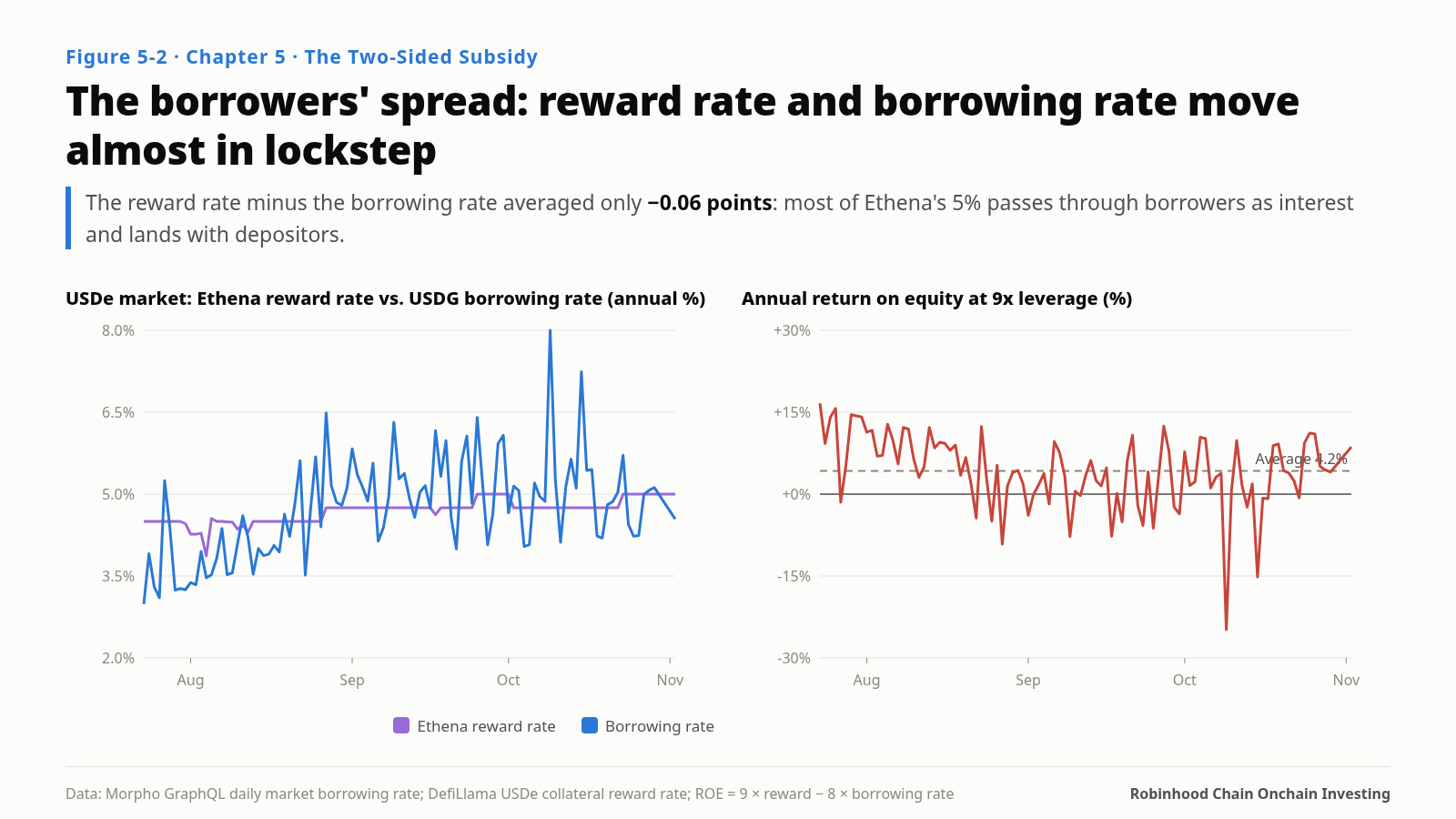
That is Morpho’s rate model at work: when utilization passes its target of about 90%, the rate climbs fast, forcing some borrowers to cut back, and the rate falls again. The spread swings around zero.
So in the two-sided subsidy, borrowers earn the least. Most of Ethena’s 5% passes through them as interest and lands with depositors. Borrowers are a pipe, collecting an unstable toll.
Split all the way down, the vault’s 7.17% on November 2 was about 3.10% Robinhood’s subsidy, about 2.7% Ethena’s subsidy passed through borrowers, and about 1.4% real borrowing demand from Maple’s institutional credit, Midas’s fund returns and Spark’s savings rate.
The same vault pays three kinds of user very differently: about 7.2% to U.S. users depositing through Earn; about 4.1% to anyone depositing directly from a wallet; about 4% on average, ranging from −25% to +17%, to a 9x looper in the USDe market. The only difference is who you are and which door you came in through.
Three Risks Depositors Actually Carry
Depositors get the steadiest money in the structure, but not a risk-free one.
1. A USDe depeg meets a 16-hour buffer. I read this market’s oracle contract. Normally it uses a primary price fixed at 1.0, with a market price as backup. If the two diverge by more than 0.5%, anyone can open a challenge; only if the gap persists for 16 hours does the oracle switch to the market price. The design prevents brief wobbles from triggering cascading liquidations. The cost is that during those 16 hours, borrowers cannot be liquidated even if the market price has fallen hard.
The two largest positions sit at an LTV of about 89.6%. If USDe’s real price fell below about 0.896 and stayed there until the oracle switched, the collateral would no longer cover the loans. Whatever liquidation fails to recover becomes bad debt in the vault, shared by all depositors. That requires a deep, sustained depeg of more than 10%, which Ethena has never had. But no part of the 7% is priced for it.
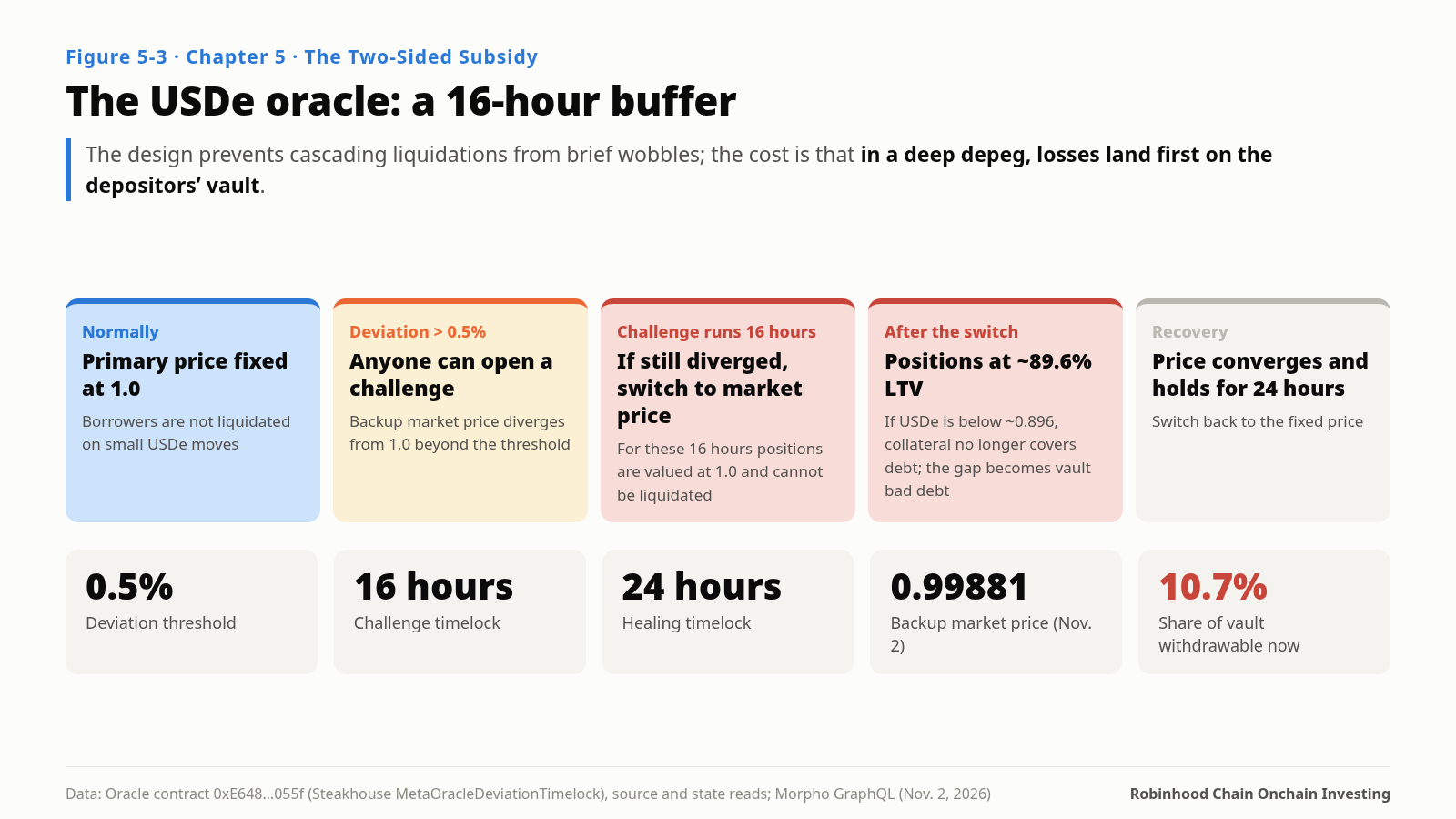
2. A run. On November 2, the five markets the vault uses held about $514 million of supply and $459 million of borrowing. Only about $55.2 million, or 10.7% of deposits, could be withdrawn immediately. “Withdraw anytime” is true in normal times. When everyone wants out at once, the first 10% get out and the rest wait for borrowers to repay or be liquidated.
3. The subsidies taper. Robinhood’s reward budget is $115 million, valid until July 1, 2027; at the current pace it will not run out, so a taper is more likely to be a rate cut. Ethena’s reward is renewed weekly, so its certainty horizon is seven days. If Ethena stopped, about $311 million of borrowing would be repaid within days, vault utilization would fall from about 90% to around 30%, and base interest would drop from about 4% to below 1%.
The two-sided subsidy is a balance, and two companies’ marketing budgets hold its two ends. If either end pulls out, the other has to reprice.
Was It Worth It?
Estimated from daily TVL and reward rates, Robinhood paid about $3.49 million in Earn subsidies from launch to November 2; Ethena budgeted about $5.26 million for the USDe market over the same period. Robinhood booked $26 million of onchain net revenue in the third quarter alone.
For less than a tenth of its onchain revenue, Robinhood bought a $500 million deposit pool and 95,000 onchain wallets. As a distribution expense, that is cheap.
One side finding: many onchain analysts treat net stablecoin inflows as a leading indicator of trading activity. On this chain, the correlation between the 7-day change in stablecoins and the next week’s change in DEX volume was −0.05, essentially zero. The reason follows from everything above: the stablecoins here sit in lending vaults to earn interest, not to trade. Apply another chain’s playbook here and you will misread it.
If You Are Thinking About This Vault
- Check which door you are using. Through Earn, about 7%. Directly into the same vault, about 4%, close to Spark Savings’ 3.8% but with the looping structure’s risks on top.
- Treat USDe as your real exposure. About two-thirds of your interest comes indirectly from Ethena, and in the tail case your principal depends on USDe too.
- Watch four numbers: whether the oracle has been challenged; the share of the vault you can withdraw immediately (below 5% means very high utilization); whether Ethena renews weekly; the largest borrowers’ LTVs and position changes.
- If you want to be a borrower, remember it is a pipe business: the average spread is near zero, and the biggest risk is a rate spike while you are fully levered.
Depositors think they are earning borrowers’ interest. Borrowers think they are earning Ethena’s reward. In fact, two companies are paying for the same market, and each participant sees only half of it.
If Ethena did not renew next week, what would you do first?
—Adapted from Where the Yield Comes From: An Investor’s Handbook for Robinhood Chain, Chapter 5, “The Two-Sided Subsidy,” and Chapter 12, “Follow the Money”
The full book (15 chapters, 42 figures): https://pickful.ai/books/dgpy
轉發此貼文?
與您的關注者分享。
回覆