
Contents (5)

·
€200 Took 8 Steps: Where Do Cross-Border Payment Steps Go With Stablecoins?
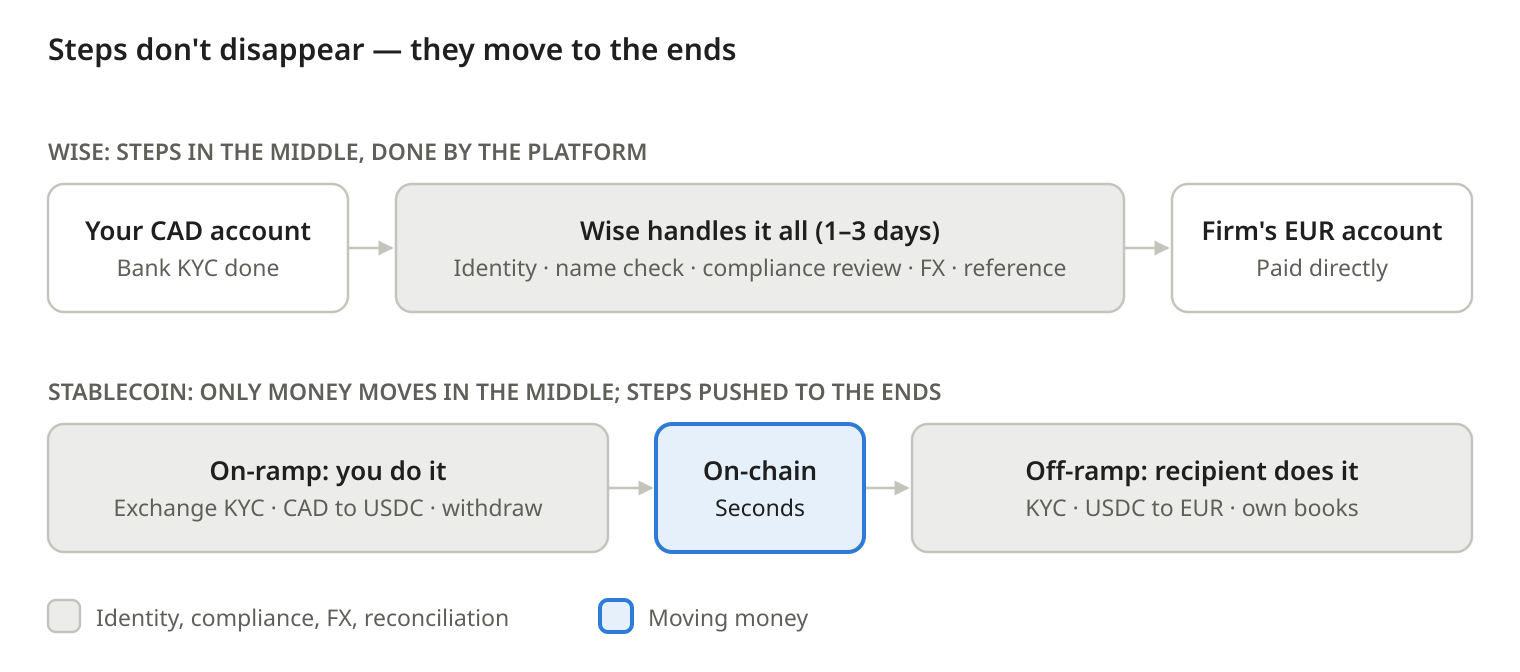
Of the 8 steps in a Wise transfer to a European law firm, only 1 moves money. Stablecoins shrink that step to seconds but push identity, compliance and reconciliation to the two ends: in cross-border payments, steps are conserved. They just move.
If you regularly pay institutions abroad — law firms, schools, suppliers — you know the feeling: small amount, long process.
I recently used Wise to send €200 from a Canadian-dollar account to a law firm in Portugal. It took seven or eight screens, and at the end Wise told me to expect a 1–3 day manual review. The same amount in USDC would be one address, one signature, settled in seconds.
But “stablecoins are faster and simpler” is only half right. Break the transfer down step by step and a pattern appears: in cross-border payments, steps are conserved. They don’t disappear — they move. Wise puts the steps in front of you; stablecoins push them out to the two ends of the chain.
Where Wise’s steps go
Sort every screen of this transfer by what it is for, and the answer is stark: of 8 steps, only 1 moves money. Five are identity checks and compliance.
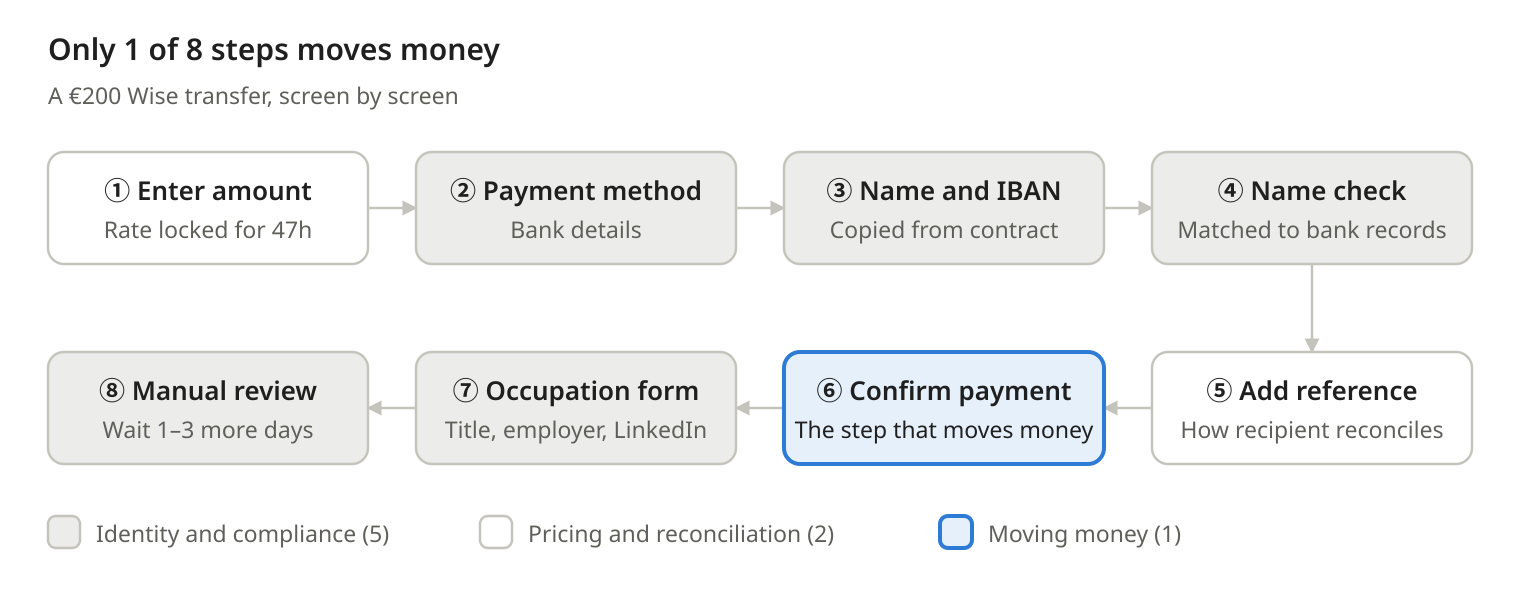
None of this is Wise being difficult. Each step absorbs risk for someone:
- Name verification protects the payer. The EU’s Verification of Payee compares the name you type with the name the receiving bank has on file. The contract used the law firm’s full name; the bank had an abbreviation. Wise flagged it and only let me continue after I confirmed. A wrong account, or a swapped account number, gets caught right here.
- Occupation details and manual review protect Wise. As a licensed institution, it has to show it knows whose money this is and why it is moving.
- The payment reference protects the recipient. A single line of text is how the law firm matches €200 to the right client.
Fees, ironically, are the most transparent part: a 3.50 CAD fee, the rate guaranteed for 47 hours, and the recipient gets every cent. The friction isn’t moving the money. It’s proving the money should move.
What stablecoins win — and what they lose
Stablecoins compress step ⑥ to the limit. One address, one signature, final in seconds to minutes. No business hours, no correspondent banks, no “rate guaranteed for 47 hours,” because there is nothing to wait for. On the major low-fee chains, the transfer cost is usually negligible.
But they also delete step ④. An on-chain address has no name. Nothing pops up to say “the owner of this address doesn’t match your contract.” Mistype one character, or act on a spoofed email with a swapped address, and the money belongs to someone else — irreversibly. Issuers can freeze tokens, but that power exists for sanctions and court orders, not customer support.
The name-check pop-up that felt like friction in Wise is exactly what confirmed this IBAN really belonged to the law firm. The step that keeps bank transfers slow is also the step that keeps them safe.
The steps that moved
Those five identity and compliance steps don’t vanish in a stablecoin world. They move from the middle to the two ends.
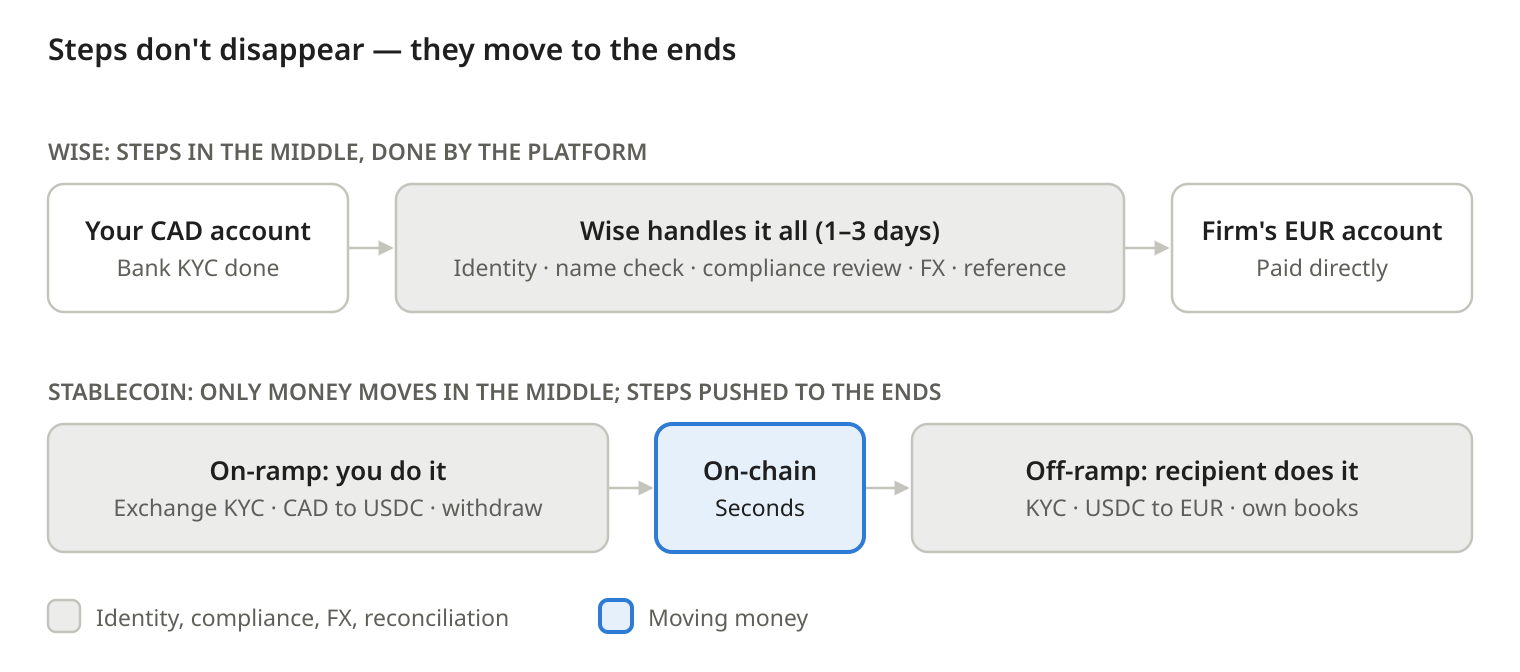
- On-ramp: Canadian dollars have to become USDC first. That means opening an exchange account, passing KYC, depositing, buying, withdrawing — any of which can trigger its own review.
- Off-ramp: the bigger problem is the recipient. A Portuguese law firm’s finance team almost certainly has no wallet, and won’t open one for €200. Even if they accepted USDC, they would have to convert it back to euros, explain where the funds came from, and do their own bookkeeping.
- Regulation is filling in the gap: the EU’s MiCA and its funds-transfer rules are carrying the bank-style “know where money comes from and where it goes” requirement over to crypto service providers. The pipe in the middle can be a blockchain; the doors at both ends are still licensed institutions.
So for the payer, what stablecoins save is not steps but waiting. The price is that the steps shift from “the platform does them for you” to “you and the recipient each do them yourselves.”
Side by side
| Dimension | Wise | Stablecoin (e.g. USDC) |
|---|---|---|
| Speed | Seconds at best; 1–3 days if reviewed | Seconds to minutes, 24/7 |
| What the payer does | Fill forms, verify name, cooperate with review | Open an exchange account, convert, manage keys |
| What the recipient does | Nothing — uses their bank account as usual | Needs a wallet, must accept, converts back to fiat |
| Mistakes and fraud | Recipient name verification | Address has no name; mistakes are irreversible |
| Fee transparency | Fee and rate shown upfront | Cheap on-chain; costs hide in on/off-ramp spreads |
| Reconciliation | Reference field; bank statement books directly | Transaction hash plus each side’s own records |
| Best for | Paying traditional institutions that only take bank transfers | Both sides already on-chain; frequent, small, cross-timezone |
The row that matters most is “what the recipient does.” Which rail you use is usually decided by the other side.
Bottom line
For paying a European law firm €200, Wise is still the better choice. Not because it is faster, but because the recipient can only receive a bank transfer.
The real opportunity for stablecoins isn’t replacing Wise. It’s pulling the steps at both ends back into one place: on-chain addresses that can be name-checked, on- and off-ramps the user never notices, a recipient who simply sees euros arrive. Whoever gets there first sells users the speed of a blockchain and the safety of a bank at the same time.
The hard part of cross-border payments was never moving money. It’s proving the money should move. Stablecoins solved the first half; the second half is still in the queue.
Where did your last cross-border payment get stuck? Would the recipient have accepted stablecoins?
Repost this post?
Share with your followers.
Reply