
Contents (5)

·
The Charter Wall: One word from Anthropic cut a token 45%. It still trades
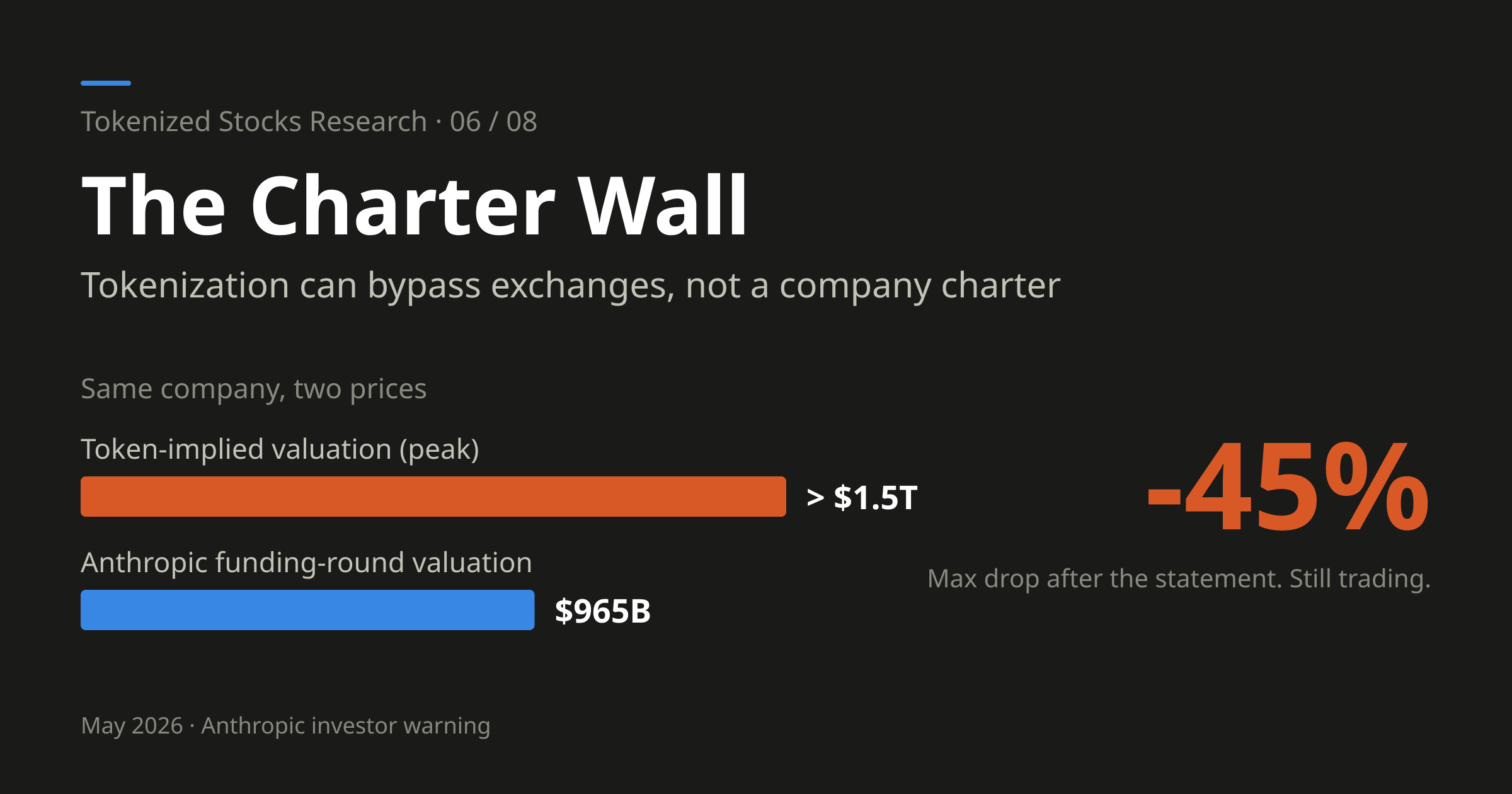
Anthropic called transfers to SPVs void, and a pre-IPO token fell 45%. It still trades. Tokenization can get around exchanges, brokers and clearinghouses, but not a company's charter.
If you’re working on tokenizing private equity, or thinking about buying pre-IPO tokens, this is the final verdict on the category.
Strictly speaking, what’s being sentenced here are structures that weren’t approved by the issuer and try to get around transfer restrictions. Issuer-approved SPVs, direct onchain registration by the company, and compliant crowdfunding still work. But nearly every pre-IPO token on the market today falls into the first group.
Between May 11 and 13, 2026, Anthropic updated its investor warning page to say:
SPVs are not permitted to acquire Anthropic shares, and any transfer of shares to an SPV is “void” under its transfer restrictions. Any third party claiming to sell exposure to its shares through “direct sales, forward contracts, tokenized securities or other mechanisms” is “likely engaged in fraud, or offering an investment that may be worthless.”
It named eight platforms, including Forge Global (a Nasdaq-listed, regulated private secondary market) and Hiive (known for its compliance). OpenAI published a nearly identical statement the same day.
PreStocks’ ANTHROPIC token fell as much as 45%. Its OPENAI token fell 46%.
The charter wall
That’s my name for this barrier, and it’s the fundamental difference between public and private markets when it comes to tokenization.
Public shares trade freely. Once a company is listed, third parties can in principle build products around its stock (in the US since September 2026, after notifying the company and allowing a 30-day objection period). Unsponsored ADRs have worked this way for decades. Robinhood’s Tenev publicly sparred with AMC’s CEO about exactly this in September 2026, and his argument holds up in public markets: “A company controls the rights and obligations of the shares it issues. That doesn’t mean it controls everything about them.”
Private shares don’t trade freely. Who may hold them is a right the company reserves through its charter: transfers need board approval, there’s a right of first refusal, and there are explicit transfer restrictions.
So the same action has completely different legal consequences in the two markets:
| Public shares | Private company equity | |
|---|---|---|
| Can a third party wrap them? | ✅ Yes (unsponsored ADR precedent; since Sep 2026 subject to a 30-day objection) | ❌ The charter can void the transfer outright |
| Where the company’s veto comes from | Granted by the SEC from Sep 2026 (30-day objection) | Always there, written into the charter |
| Can tokenization get around it? | Structurally, yes | Structurally, no |
Tokenization can get around exchanges, brokers, clearinghouses and time zones. It can’t get around a company’s charter.
The most ironic part
After Anthropic’s statement, the token didn’t go to zero. It kept trading, still far above the $254.57 retail reference price on Forge.
Look at the token’s path: ANTHROPIC went from about $235 in 2025 to an all-time high of $1,409 in early May 2026, implying a valuation above $1.5 trillion at one point. Anthropic’s actual funding round, closed on May 28, 2026, valued it at $965 billion.
The token’s implied valuation was more than 1.5x the company’s own latest round.
Then the company said “this may be worthless,” the token fell 45%, and it went on trading at several times the Forge retail price.
Speculative premium in crypto markets is more stubborn than a legal statement. That doesn’t refute the argument. It proves it: if price discovery were working, the token should have gone close to zero the day the statement came out.
Structurally void and priced at zero are two different things
This is the part I think is most often misread. Plenty of people see “the token is still going up” and conclude “Anthropic’s statement doesn’t matter.”
Wrong. They happen at two different levels:
- The legal level: if the transfer really is void, the SPV never acquired any shares, and token holders’ claims point at an empty shell. At an IPO or acquisition, you get nothing.
- The market level: as long as someone is willing to take the next trade, the price holds. The moment the truth comes out is pushed back to the moment of exit.
The risk in this category isn’t that the price falls. It’s that on the payout date there’s nothing there. Until that day comes, the price can keep rising.
Four due-diligence questions
If you still want to touch this category, here are four questions you can answer before placing an order.
-
Has the target company made a public statement? Search “[company] + SPV + tokenized shares” or “[company] + pre-IPO token warning.” Anthropic’s and OpenAI’s warning pages are public. Anyone who ran that search before May 11 had warning before the crash.
-
Is the issuer an independent firm or something the platform set up itself? Bitget’s preSPAX is issued by Republic (an independent entity with its own regulatory record, which filed a Form C with the SEC for rSPAX, searchable on the SEC website). A token issued by the exchange itself has a completely different risk structure.
-
Can the SPV documents be independently verified? A compliant structure should have a verifiable registration, a breakdown of holdings and regular proof of assets. PreStocks has never published its proof-of-holdings report, which is the core reason its credibility is questioned. Compare Jarsy: onchain-verifiable proof of reserves, a Delaware LLC structure, a $10 minimum. It’s the most transparent in the category.
-
Is the ratio of implied market cap to assets held reasonable? Total token supply × current price = implied market cap. Compare that with the assets the platform says it holds. If implied market cap is dozens of times the assets held, then even if every asset is real, there won’t be enough to pay out when most holders try to exit at once.
Three lines to close
Tokenization can get around exchanges, brokers, clearinghouses and time zones, but not a company’s charter.
In private markets, who may hold the shares is a right the company reserves, not a freedom the holder has.
And the real risk in this category isn’t a falling price. It’s that on the payout date, your claim points at an empty shell.
What do you think: is there still a compliant path for tokenized private equity?
Repost this post?
Share with your followers.
Reply