
Contents (6)

·
Only Three Things Raise Your Odds: Time, Labor, Showing Up (Why 100x Is Hard 4/4)
Penny prediction contracts, high leverage and far OTM options look like shortcuts to 100x but aren't. A small account can't control insight; it can control labor, showing up and time, among the few sources that push the expected multiple above 1.
If you work in finance or run a company and keep a pot of money you could lose without flinching, the first three articles have probably cooled you down: 100x odds cap out near 1%; 100x moves cluster in a new platform’s first month; diversification cannot rescue a 100x.
This one answers the last question: under such a low ceiling, what can an ordinary participant actually control?
My view:
A small account cannot control insight. It can control three things: time, labor and showing up. They are among the few sources that push the expected multiple above 1.
Before getting to them, let me rule out three roads that look like shortcuts and are not.
Three roads that look like shortcuts
One: penny contracts on prediction markets.
Pay 1 cent for a “yes” at 100-to-1. It sounds like exactly what we want. But prediction markets have a phenomenon studied for decades, the favorite-longshot bias: longshots are systematically overpriced.
On October 24, 2026, I scanned the crypto-related longshots on Polymarket. Take “CLARITY Act signed into law in 2026,” priced at 3.7 cents with $24.47M traded. The bill failed a Senate procedural vote on September 15, no new vote has been scheduled, and it dies automatically when this Congress ends on January 3, 2027. On those facts, 3.7 cents is not cheap. It is expensive.
The scan’s result: not a single contract was both priced at 100-to-1 and clearly underpriced.
Two: high-leverage perpetuals.
100x leverage means a 1% adverse move liquidates you. “Rolling a position to 100x” stories come from survivors; the ones who failed don’t post.
Three: far out-of-the-money options.
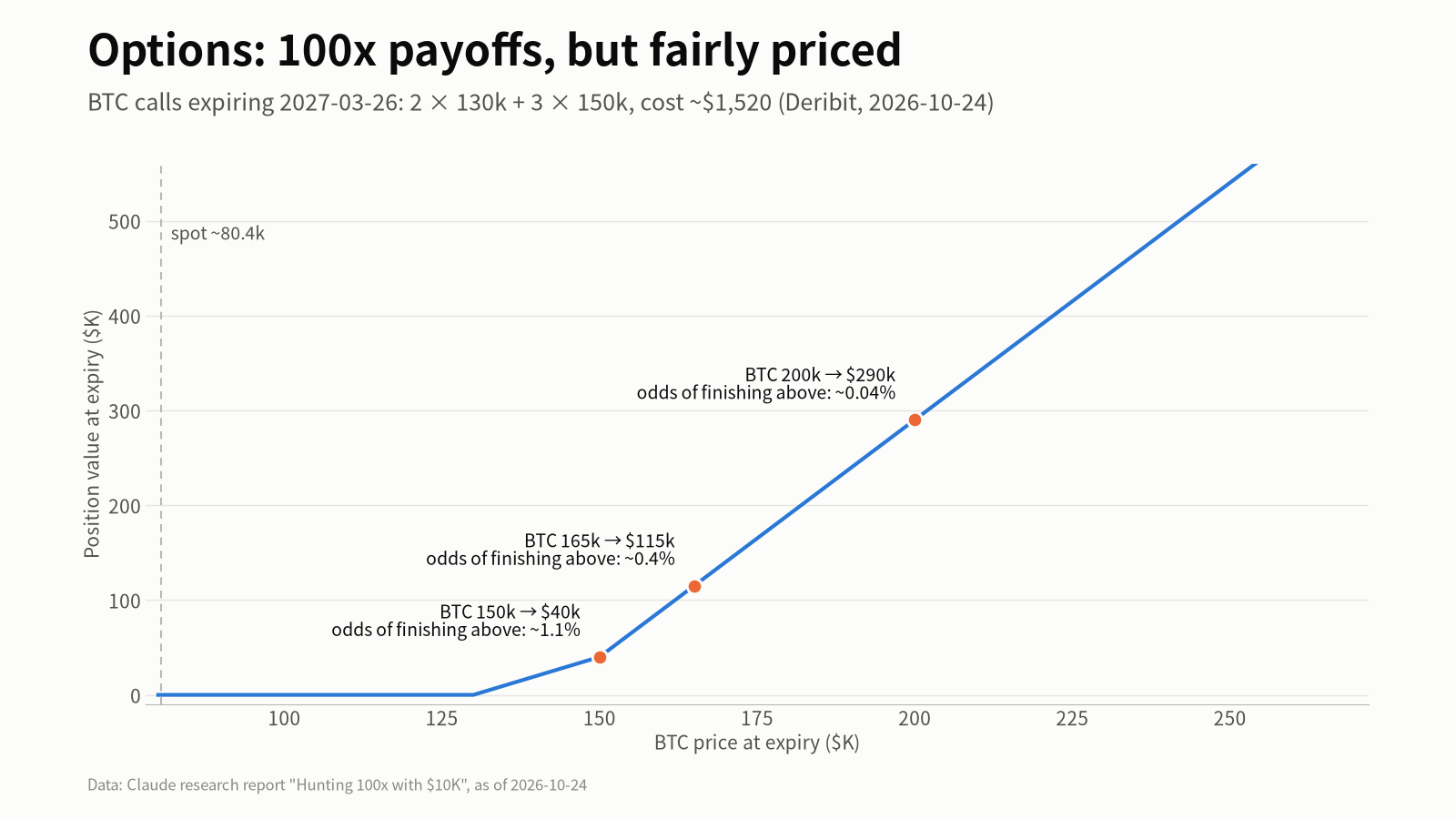
This one is not a scam, but it is not a shortcut either. Deribit quotes on October 24, with BTC near $80,000:
| Call expiring 2027-03-26 | Cost per contract | Return if BTC reaches $200K |
|---|---|---|
| $120K strike | $764 | ~105x |
| $130K strike | $442 | ~159x |
| $150K strike | $212 | ~236x |
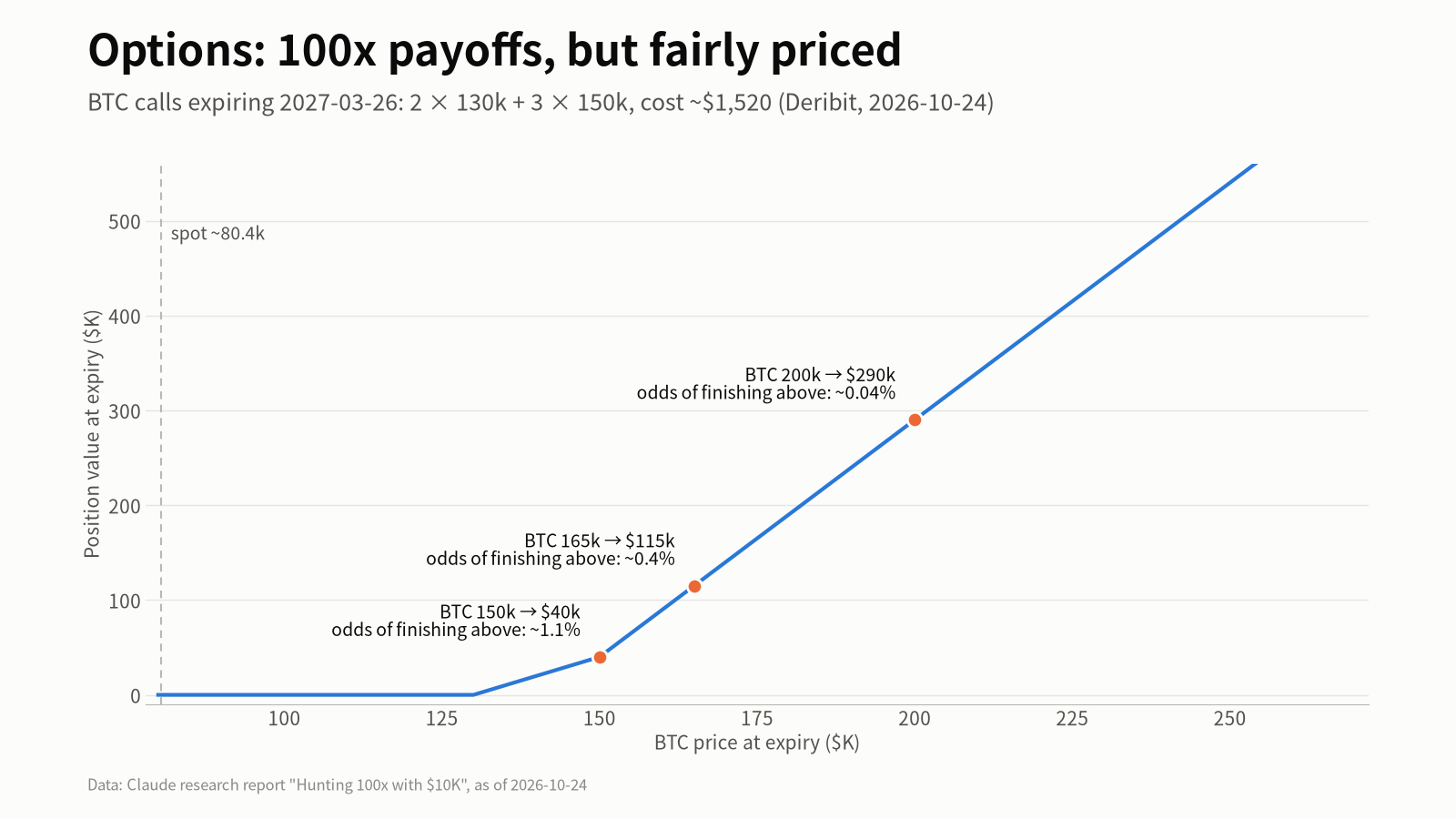
The payoff is big enough. But at roughly 42% implied volatility, the chance BTC finishes above $200K by expiry is about 0.04%. Options markets are broadly fair; buying the option does not by itself push your expected multiple above 1.
Its real value lies elsewhere: the maximum loss is the premium, and it is weakly correlated with crypto-native lottery tickets. It works as a convexity floor, not as the main attack.
One: labor
At the level of capital, airdrops are the only systematic source I can find where the expected multiple may exceed 1. The reason is simple: you contribute real usage and time, not a purchase at market price.
Hyperliquid is the clearest example. On November 29, 2024, it airdropped 31% of supply, 310 million tokens, to early users in one go, with no allocation to VCs. The launch price was $3.90, valuing the airdrop at about $1.2B. By September 23, 2026, the token had peaked at $97.96, about 25 times the launch price. For genuine early users, the capital they put in was far smaller than what they received.
There are live examples inside this window too. Variational has officially confirmed a token launch in Q4 2026, with 32% of supply airdropped pro rata to points holders and fully unlocked on day one. It has raised more than $60M from investors including Dragonfly, Bain Capital Crypto and Coinbase Ventures.
But labor only pays under two conditions:
- Real usage, not farms of fake accounts. Sybil detection keeps getting stricter, and mass farming has a low expected value now.
- Accept the uncertainty. In 2026 some projects have already cancelled token launches and shut down; Abstract closes on December 15.
Two: showing up
The previous article covered the First-Month Window: the 175x and 40x moves on Robinhood Chain all happened in roughly the first month after launch.
Showing up does not mean buying now. It means being ready, so that when the next qualifying platform launches you can make a call within 72 hours. Three tests for whether it is a “Robinhood moment”:
- Mass retail distribution (a ready-made pool of tens of millions of users);
- Low-friction token creation;
- First-24-hour volume that is large, say over $100M.
Preparation means burner wallets and bridge routes set up in advance so funds can land on the target chain within 10 minutes, and a diligence checklist written in advance: is liquidity locked, what is the deployer’s history, how concentrated are holders, can you actually sell.
Three: time
Every number in the first three articles was computed for a six-month horizon. The horizon is itself a variable.
A structure where every failure is small can be run three to five times over 24 to 36 months. Each failure is survivable, and each success funds a bigger next round. Add consistent labor and the expected multiple can be pushed above 1. That is the only way to raise the 100x Ceiling itself.
Using time as leverage is far cheaper than using money as leverage.
Putting the three together
| What you can control | What it changes | What it costs |
|---|---|---|
| Labor | Can push the expected return on capital above 1 | Lots of time; uncertain results |
| Showing up | Puts you in the window with the best odds | Long preparation and waiting |
| Time | Lets the same structure repeat so odds accumulate | Patience |
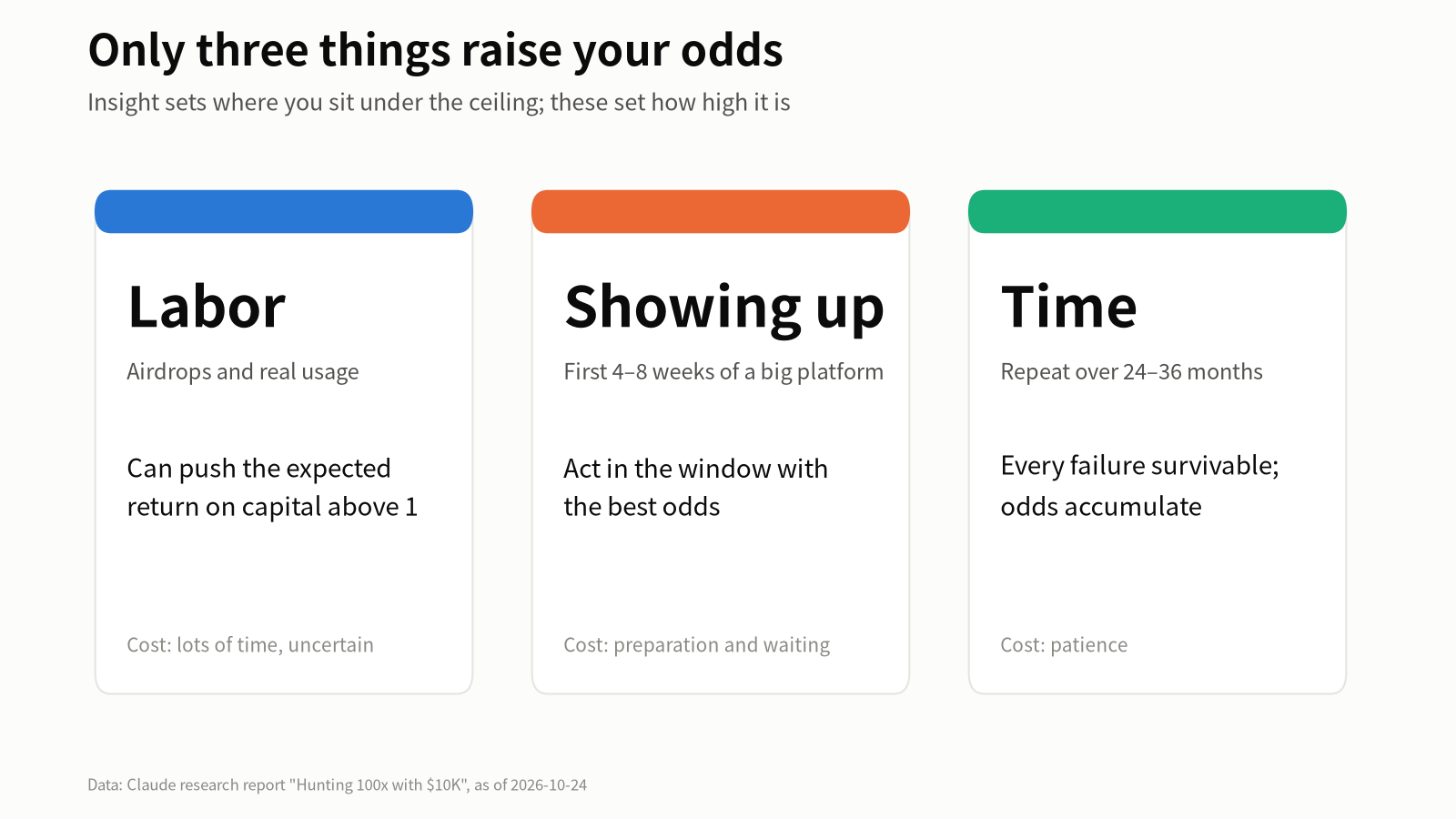
They share one trait: none of them requires you to be smarter than others. They only require you to be more willing to pay costs others won’t.
One line
Insight decides where you sit under the ceiling. Labor, showing up and time decide how high the ceiling is.
One last question: if “one 100x shot” became “a survivable attempt every six months for three years, plus steady real early participation,” would you still want it? If yes, 100x is no longer a lottery ticket. It is a long project with costs, discipline and post-mortems.
Sources
- Polymarket longshot quotes: Polymarket Gamma API, pulled 2026-10-24
- CLARITY Act Senate procedural vote failed on Sept 15 and expires when this Congress ends: Baker Botts, CryptoTicker
- BTC option quotes and implied volatility: Deribit public API, pulled 2026-10-24; expiry probabilities estimated with a risk-neutral lognormal model
- Hyperliquid airdrop of 310M tokens, $3.90 launch price, ~$1.2B value: TradingView citing Cointelegraph; $97.96 peak on Sept 23: CoinGecko
- Variational Q4 launch, 32% airdrop, over $60M raised: Crypto Briefing, Datawallet
- Abstract shutdown on Dec 15: Bloomingbit
Why 100x Is Hard, part 4 of 4.
Repost this post?
Share with your followers.
Reply