
目录(6 节)

·
AMC Asked Robinhood to Stop Its Stock Token. Two Weeks Later, the SEC Gave Issuers 30 Days to Object
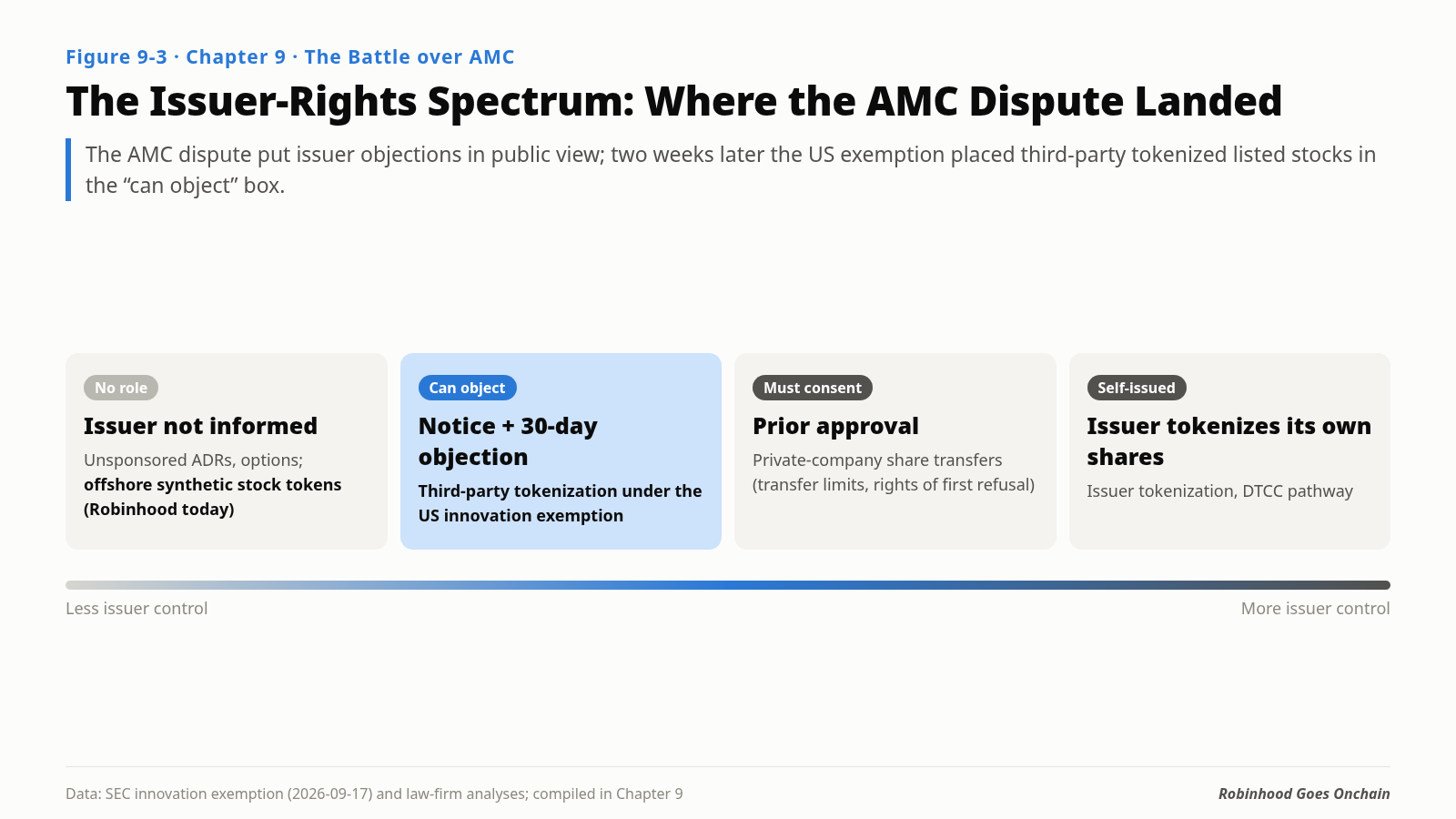
AMC asked Robinhood to stop its AMC Stock Token; Robinhood refused, then promised redemption and voting. Two weeks later the SEC's innovation exemption gave issuers written notice and 30 days to object. The spectrum of issuer rights, from no participation to issuer-sponsored.
If you are a corporate secretary, run investor relations at a listed company or work in tokenization, the public fight between AMC and Robinhood in September 2026 answered a question that will reach your desk sooner or later: does a public company have a veto over products someone else builds on its stock?
On September 3, AMC chief executive Adam Aron publicly criticized the AMC Stock Token Robinhood offered outside the United States. Vlad Tenev replied: “What’s the concern?”
The next day, CoinDesk reported, Aron escalated, calling the tokens “synthetic equity.” They could impair AMC’s ability to raise capital, he argued, they denied investors shareholder rights, and they built a parallel market on the company’s name without its consent. He asked Robinhood to halt trading voluntarily and said he would raise the matter with the SEC. Robinhood chief legal officer Dan Gallagher, a former SEC commissioner, publicly rejected the arguments and said the product would stay.
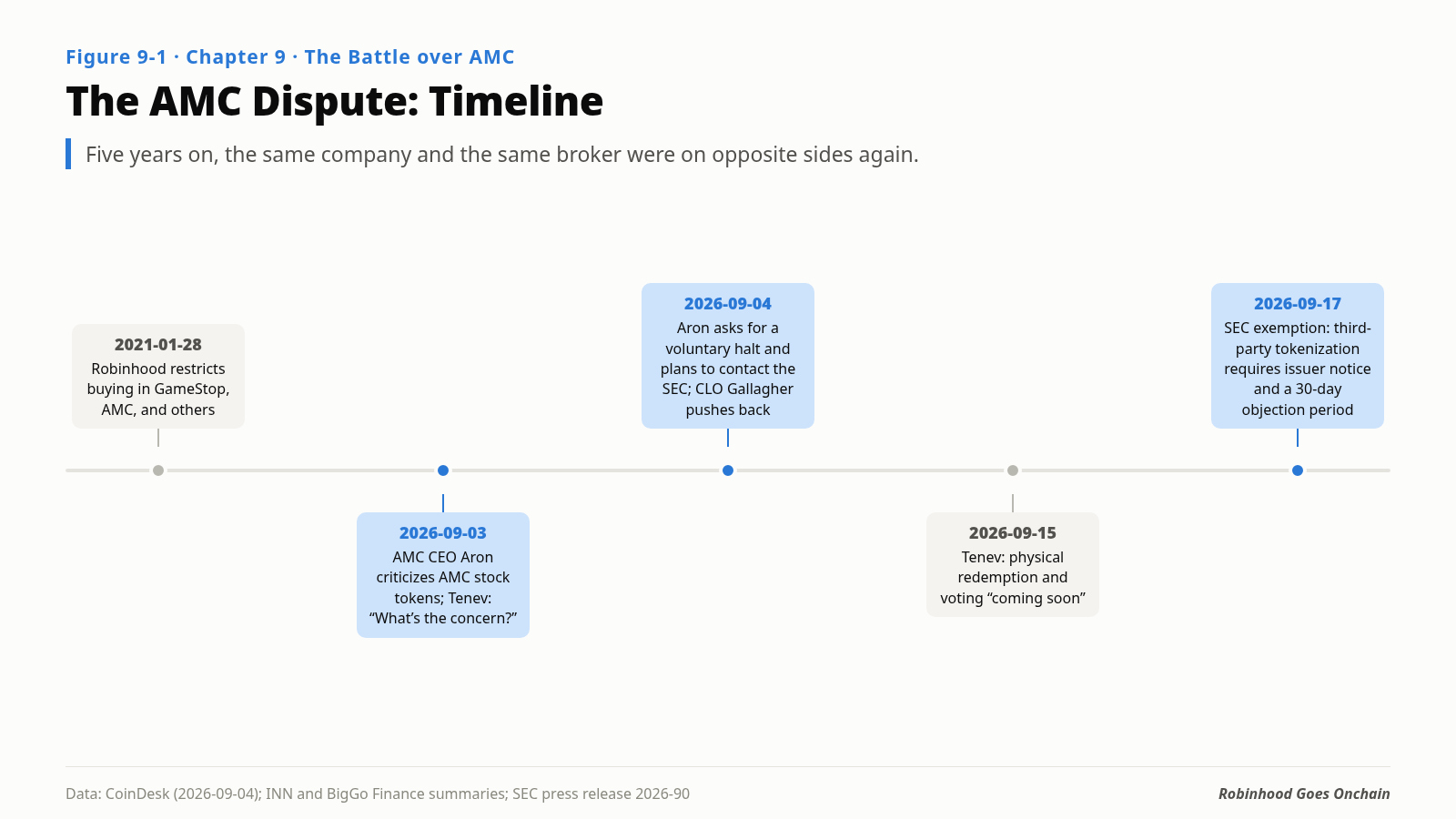
AMC is no ordinary issuer. In January 2021 it was one of the stars of the retail squeeze, and one of the stocks Robinhood restricted that day. Five years on, the same company and the same broker were on opposite sides again.
Both Sides Had a Point
Strip out the rhetoric:
| Issue | AMC (the issuer) | Robinhood (the tokenizer) |
|---|---|---|
| Rights | Holders get no votes and no shareholder status, yet trade something called AMC | The token is a claim on a Robinhood subsidiary and never claimed to be a share; redemption and voting can close the gap |
| Control | A parallel market uses the company’s name without consent | Companies control the rights attached to shares, not every lawful use investors make of them |
| Precedent | Tokenization is new and should involve the issuer | Unsponsored ADRs, options and structured products reference stocks without issuer approval |
| Backing | Does 1:1 hold if the shares are lent out? | Custodial shares fully back the tokens, initially 1:1, then adjusted by a multiplier |
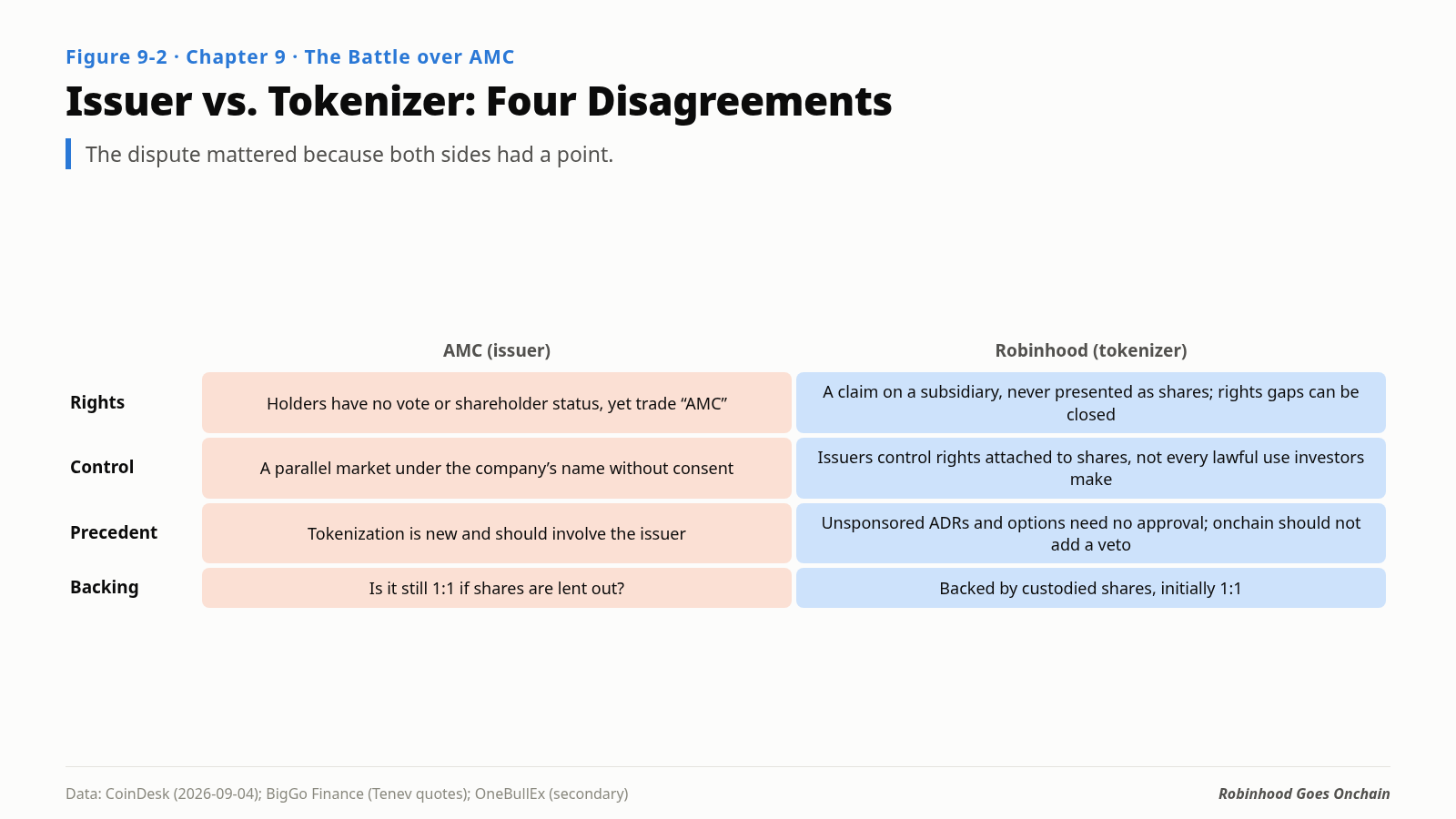
The dispute matters because each side was partly right. The issuer’s worry is real: its name and share price have entered a market it can neither see nor manage. The tokenizer’s argument is also real: finance has long been full of instruments that reference a stock without the issuer’s approval. Tenev’s line was that going onchain should not hand issuers a veto they never had offchain.
Robinhood’s Concession
The fight ended not in court but in a product promise. On September 15, Tenev announced that in-kind redemption and voting were “coming soon” to Robinhood Stock Tokens. Crypto chief Johann Kerbrat added that 1:1 share redemption was in development and that voting might use Say, Robinhood’s shareholder-engagement platform, as infrastructure. The same week, Coinbase’s Brian Armstrong said voting rights were coming to Coinbase’s tokenized stocks. As of mid-October, neither feature had a launch date.
Note the direction of the concession. Robinhood did not accept an issuer veto, but it accepted the argument beneath it: token holders should be able to get shareholder rights. It answered “no rights” by adding rights, not “no consent” by seeking consent.
Two Days Later, the Rules Were Written
On September 17, the SEC published its innovation exemption. On the core question of the AMC fight, it gave the U.S. a clear answer:
- Third-party-tokenized U.S. listed shares must trade on a venue that qualifies under the exemption, and the venue must notify the issuer in writing and give it 30 days to object.
- The token must preserve the same economic and voting rights as the underlying share.
- Third-party securities offering synthetic exposure are outside the exemption.
SEC Chair Paul Atkins summed up the two principles as “No Synthetics” and “Issuers Can Object.” Coinbase had argued in a March submission that third-party tokenization should not need issuer approval; the final text did not adopt that view.
Public material does not show that the AMC dispute caused or shaped the order. But the outcome is this: in the United States, issuer objection is now in the rules. Outside the United States, Robinhood’s current structure is not bound by the exemption. Its Stock Tokens keep trading abroad; to enter the U.S., they would need a different structure.
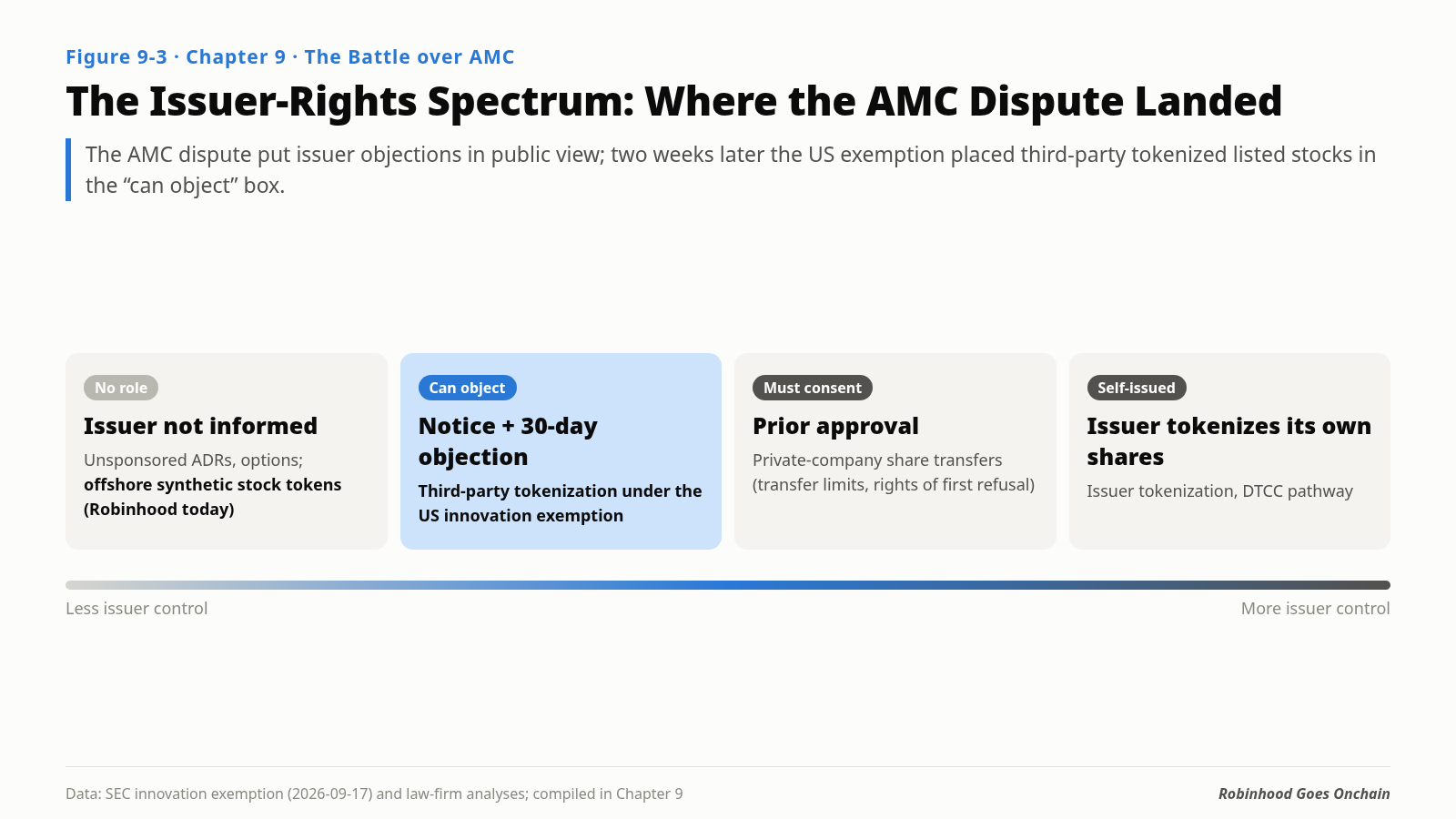
The Framework: The Spectrum of Issuer Rights
Put the AMC fight in a wider frame and a spectrum appears:
| Position | The issuer’s role | Examples |
|---|---|---|
| No participation | Does not know, cannot object | Unsponsored ADRs, options, offshore synthetic stock tokens |
| Right to object | Gets notice and can object within a set period | Third-party tokenization under the U.S. innovation exemption |
| Consent required | Must approve in advance | Private-company share transfers (usually with transfer limits and rights of first refusal) |
| Issuer sponsored | Tokenizes its own shares | Issuer tokenization, the DTCC path |
AMC put issuer objection on the table. Two weeks later, the exemption placed third-party tokenization of U.S. listed shares in the “right to object” box. Private companies start at “consent required,” which is why Robinhood’s private-company tokenization has to go through issuer partnerships.
If You Work at a Listed Company or a Tokenizer
- Listed companies: find out how many tokenized versions of your stock already exist, on which chains and in what legal form. Under the U.S. framework you will get notice from venues, so prepare your position in advance.
- Tokenization firms: treat issuer relationships as an asset to build, not a risk to dodge. Issuer-supported products will get a wider path in the U.S.
- Investors: before buying a stock token, find its place on the spectrum. It decides what you get in corporate actions, mergers and insolvency.
The Takeaway
AMC did not make Robinhood stop. Two weeks later, the U.S. framework let issuers object, within a notice period, before third-party-tokenized shares enter an exempt venue. Issuers went from invisible to able to say no. The next step is for tokenizers to learn to build with them.
If you were a listed company’s corporate secretary, what would you do with your first tokenization notice: object, stay silent, or negotiate?
— Adapted from Robinhood Goes Onchain: A Broker’s First Year, Chapter 9, “The Battle over AMC”
The full book (17 chapters, 48 figures, first 3 chapters free to read): https://pickful.ai/books/qx7q
转发此帖子?
与您的关注者分享。
回复