
Contents (8)

·
What the S-1 Revealed: Wall Street Prices a Crypto Company for the First Time

2020–2021 The S-1, the direct listing and the top of the cycle
April 14, 2021. Nasdaq, New York.
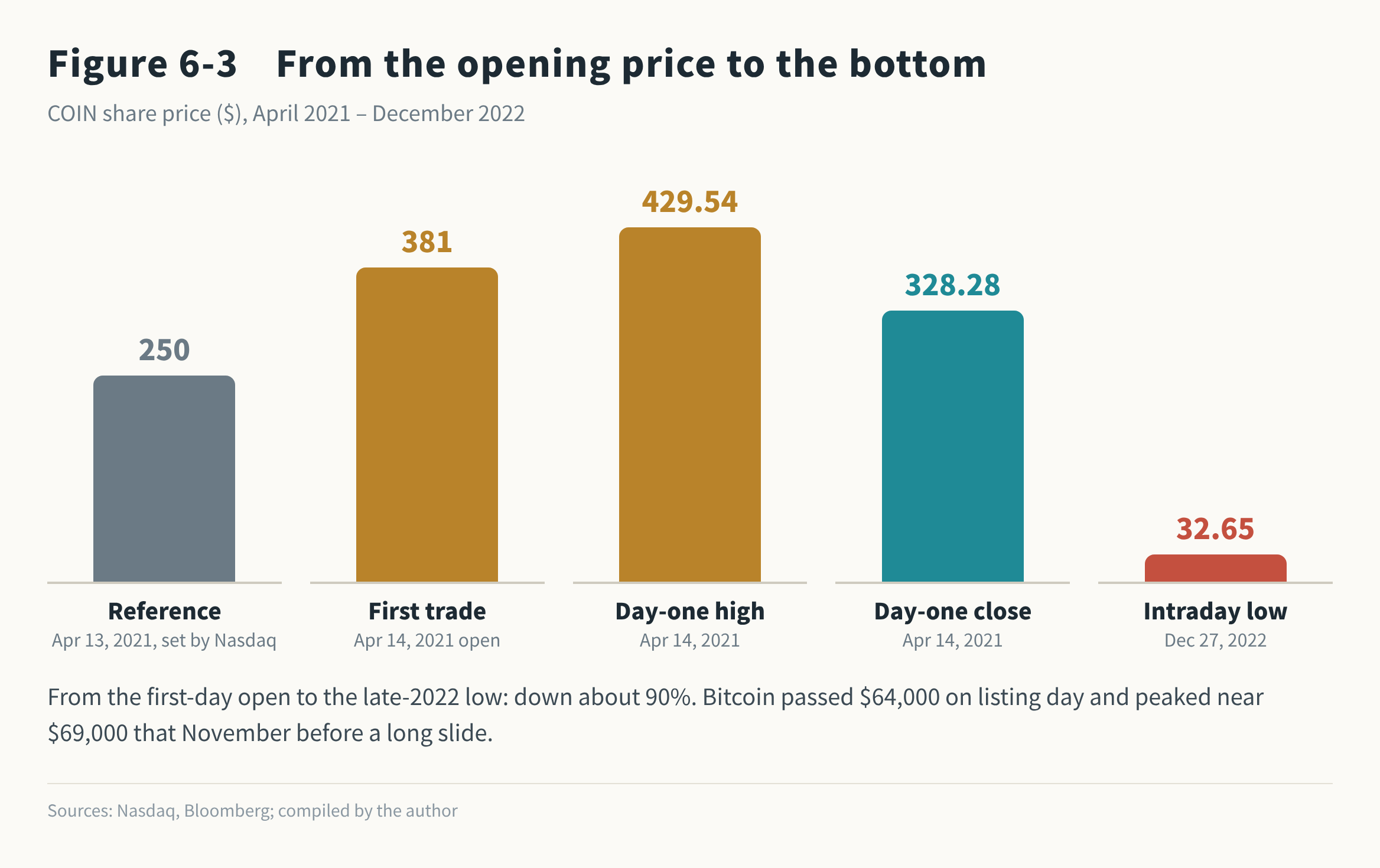
A stock with the ticker COIN began trading. The day before, Nasdaq had set a reference price of $250. At the open, the first trade printed at $381. On a fully diluted basis, the company was worth close to $100 billion at that moment.
During the day the stock touched $429.54. It closed at $328.28, a fully diluted market value of about $85.8 billion.
That same day, bitcoin rose above $64,000, close to its all-time high.
It was a historic moment for the crypto industry. Nine years earlier, one bitcoin was worth $6 and Coinbase was squeezed into an apartment in San Francisco. Seven years earlier, Mt. Gox had gone bankrupt and the mainstream press had declared bitcoin dead. Now a crypto company had arrived on America’s mainstream capital markets at a valuation close to Ford and General Motors combined.
Many commentators called it a watershed for the industry. Wall Street had put a formal price on crypto for the first time.
But inside this moment of glory was a problem that would only show itself later: Coinbase chose to go public at the hottest point of the cycle, and the price the market gave it was a peak-of-the-cycle price.
1. From winter to frenzy
The winter of 2018 lasted into early 2020. Then a global pandemic nobody had foreseen changed everything.
In March 2020, Covid triggered a crash in global financial markets, and bitcoin briefly fell below $4,000. To rescue markets, the Federal Reserve cut rates to near zero and launched massive quantitative easing; the US government sent several rounds of cash payments to households. A flood of liquidity poured into markets, and people stuck at home started trading stocks and crypto on their phones.
More importantly, institutions bought bitcoin at scale for the first time. In August 2020, the listed company MicroStrategy announced it was putting its corporate cash reserves into bitcoin; in February 2021, Tesla said it had bought $1.5 billion of bitcoin. Insurers, hedge funds and family offices piled in.
What did these institutions need to buy bitcoin?
A regulated exchange to execute trades, a qualified custodian to hold the assets, and a platform that fit into their compliance processes. In the United States, there was almost only one company that could meet all of these at once.
The custody seed planted in the 2018 winter began to sprout in 2020. In December 2020, Coinbase disclosed that MicroStrategy’s bitcoin purchases that August and September, totaling $425 million in two batches, had been executed through Coinbase Prime. To minimize market impact, the orders were split by algorithm into about 200,000 fills over several days.
By the end of 2020, Coinbase was ready for something it had been preparing for years: going public.
2. Secrets in the S-1
In February 2021, Coinbase made its registration statement, the S-1, public. It was the first time outsiders saw Coinbase’s books in full.
A few key numbers:
- 2020 total revenue of about $1.28 billion and net income of about $322 million (net revenue after transaction costs was about $1.1 billion), compared with a loss of about $30 million in 2019.
- About 43 million verified users, with about 2.8 million monthly transacting users.
- In 2020, about 96 percent of net revenue came from transaction fees, and about 95 percent of transaction revenue came from retail users.
That last figure is the most telling. The custody, venture and stablecoin bets made in the 2018 winter were still a tiny share of revenue in 2020. Coinbase was still, at heart, an exchange, a company whose revenue was tightly tied to coin prices and trading volume.
The risk factors section of the S-1 contained an item that was later widely shared: Coinbase listed the possible unmasking of Satoshi Nakamoto, bitcoin’s creator, as a risk factor. The reasoning was that Satoshi was believed to hold a large amount of bitcoin, and if the identity were revealed or the coins sold, it could shock the market.
The detail says something: even a company about to list on Nasdaq still had its fate tied to an anonymous figure who has never appeared in public. That is what makes the crypto industry different.
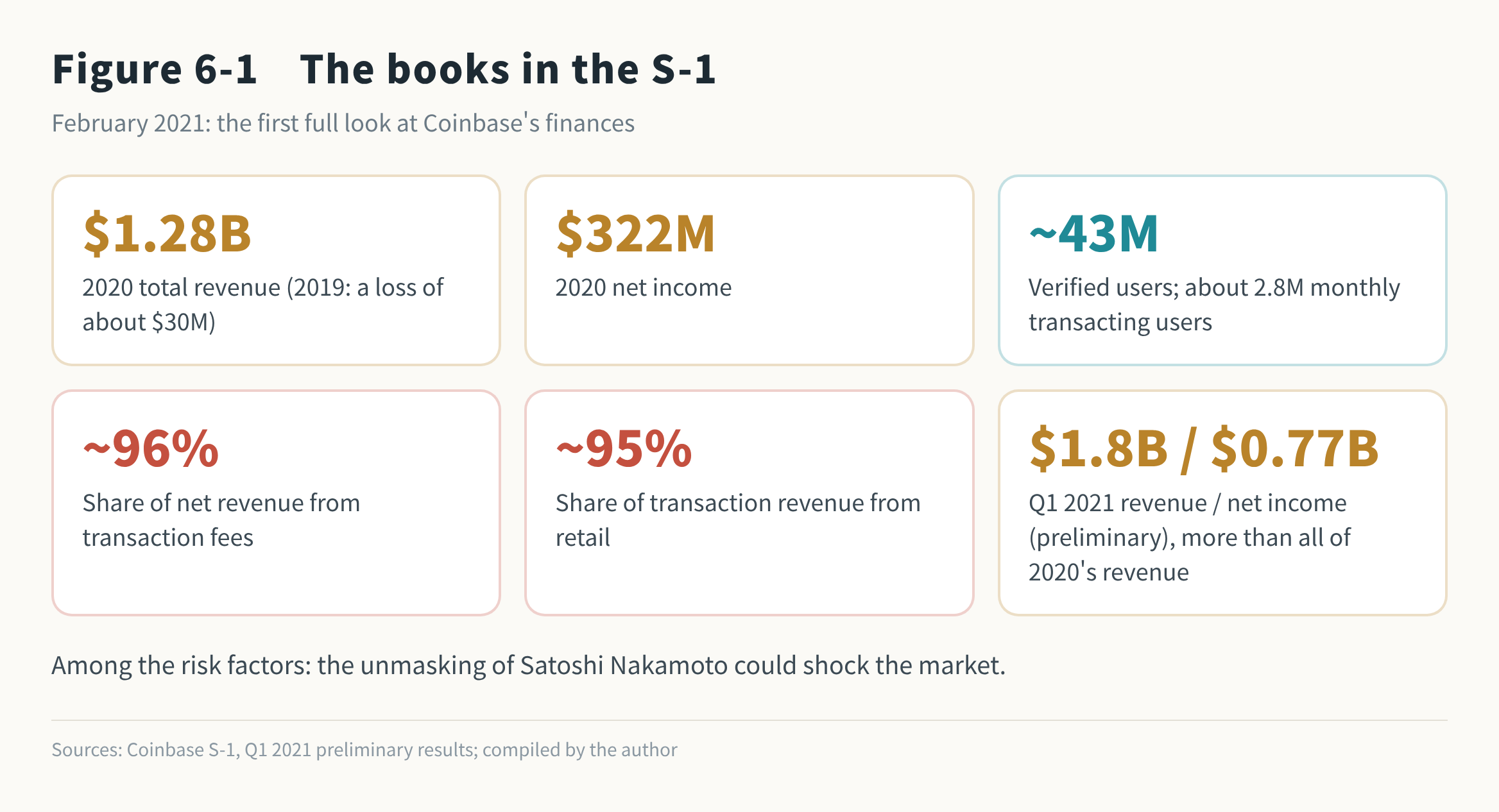
In early April 2021, Coinbase announced preliminary first-quarter results: about $1.8 billion in revenue and about $770 million in net income for the quarter. One quarter’s revenue exceeded all of 2020.
3. Why a direct listing
Coinbase didn’t do a traditional IPO. It chose a direct listing.
What’s the difference?
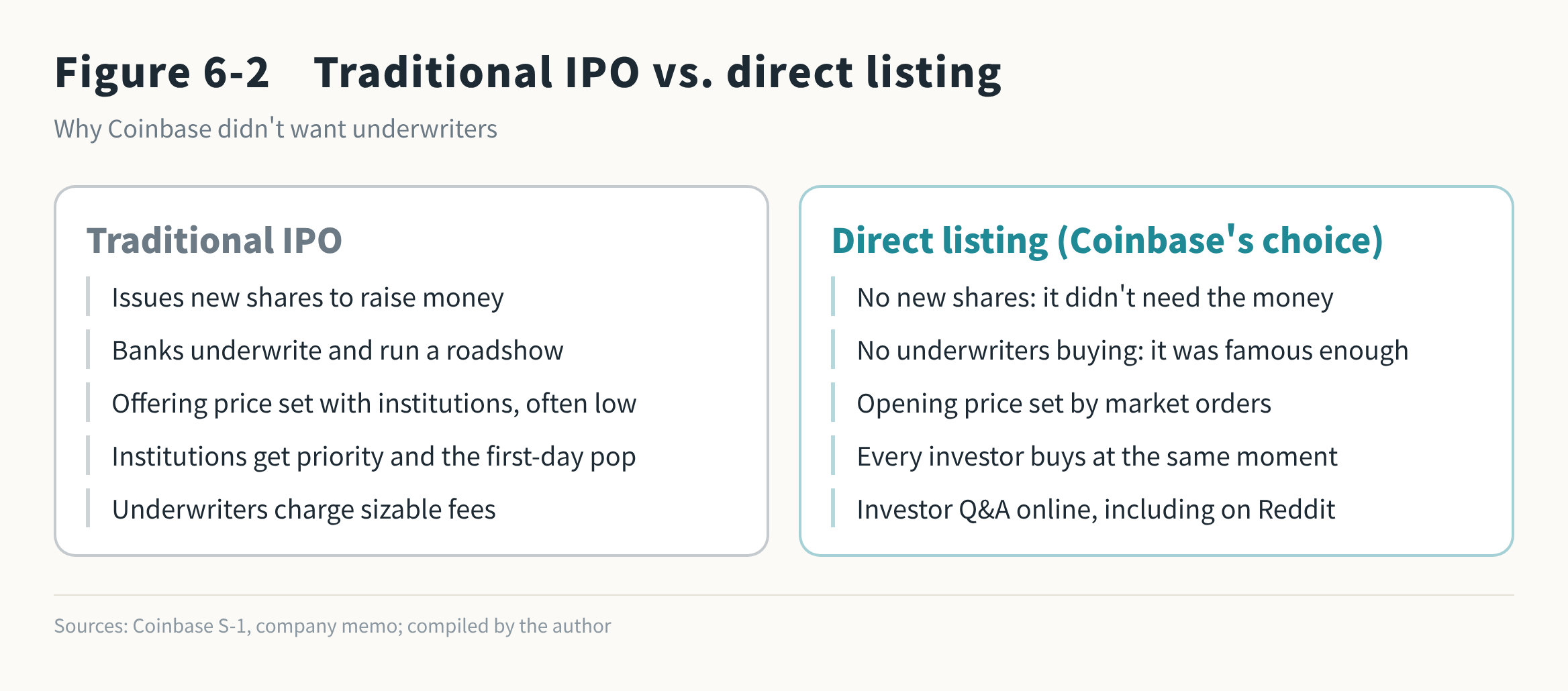
In a traditional IPO, the company issues new shares. Investment banks act as underwriters, run a “roadshow” for institutional investors, set an offering price, sell the shares to those institutions, and then the stock starts trading on an exchange. Underwriters charge sizable fees, and the offering price is often set low so institutions enjoy a “first-day pop.”
In a direct listing, no new shares are issued and no underwriter buys shares. Existing shareholders’ stock simply begins trading on the exchange, and the opening price is set by the market’s buy and sell orders.
Coinbase chose a direct listing for several reasons:
- It didn’t need money. Profits in 2020 and the first quarter of 2021 were already very large; it didn’t need to raise capital by going public.
- It was famous enough. After the bull markets of 2017 and 2020, Coinbase was a household name in America; it didn’t need bankers to “tell its story” to find buyers.
- It fit the spirit of crypto. Coinbase’s chief financial officer said in a memo that the decision “follows the ethos of crypto and Coinbase because it provides equal access for all investors.” No middlemen, no institutional priority allocation; everyone buys at the same moment in the same market.
It even skipped the traditional roadshow, moving part of its investor outreach online, including answering questions on community platforms such as Reddit.
The choice carried an attitude of its own: we don’t need Wall Street to price us; let the market decide.
The irony is that the price the market set was driven by Wall Street.
4. After the listing
On listing day, Armstrong and Ehrsam both became billionaires. Coinbase became one of the most valuable fintech companies in the United States overnight.
But going public also brought new constraints:
- Financial data had to be disclosed every quarter. Falling volume or users leaving would show up immediately in the stock price.
- Regulatory pressure grew. As a public company, Coinbase now also faced scrutiny from the Securities and Exchange Commission (SEC) as its listed-company regulator, and the SEC was precisely one of the regulators least friendly to the crypto industry.
- Employee and shareholder expectations. A high valuation meant high expectations; any slowdown in growth would be seen as failure.
The new constraints soon turned into real conflict.
In June 2021, Coinbase announced a product called Lend: users would lend USDC to the platform and earn about 4 percent a year. Hundreds of thousands signed up for the waitlist. In early September, Coinbase disclosed that the SEC had sent it a “Wells notice,” formal notice that it intended to sue, on the grounds that Lend was an unregistered security.
Coinbase’s first reaction was fierce. On September 7, Armstrong posted a series of tweets calling the SEC’s conduct “really sketchy behavior”: the company had gone to the regulator to engage, yet the agency wouldn’t explain why it considered this a security, only that it planned to sue. Chief legal officer Paul Grewal also protested publicly.
Ten days later, on September 17, Coinbase quietly added an update at the bottom of the June blog post: Lend would not launch, and the waitlist was closed. No press release, and no separate notice to the users who had signed up.
This was Coinbase’s first head-on clash with the SEC after going public, and Coinbase backed down. But each side now saw the other’s position clearly. The SEC believed many crypto products were simply securities, to be handled under existing rules. Coinbase believed the rules themselves were unclear and should be spelled out first. Two years later, that disagreement became a formal lawsuit.
And the most damaging problem was timing.
The day Coinbase listed was almost one of the peaks of this bull market. After bitcoin set a new high of about $69,000 in November 2021, it began a long decline. In 2022 the crypto market went through a chain of collapses, and Coinbase’s stock fell from over $300 on its first day to an intraday low of $32.65 on December 27, 2022, a drop of about 90 percent.
For investors who bought at the $381 opening price on the first day, it was a painful lesson.
Looking at the full-year 2021 books makes the word “peak” even weightier: total revenue of about $7.8 billion and net income of about $3.6 billion; monthly transacting users reached 11.4 million in the fourth quarter, compared with 2.8 million in 2020. It was the best year in Coinbase’s history, and one it would not come close to again for several years.
5. What the competitors were doing
In 2021, Coinbase was not the only one in Wall Street’s spotlight.
Robinhood: the broker that built itself on “zero commissions” had launched commission-free crypto trading back in 2018, striking directly at Coinbase’s high-fee model in the US retail market. In July 2021, Robinhood also listed on Nasdaq. In the role of “retail front door,” Coinbase for the first time faced a rival that was equally regulated and equally focused on ordinary people, but cheaper.
Kraken and Gemini: these two US exchanges, also on the compliance path, chose to stay private.
Binance: it led global trading volume by a wide margin but had no possibility of listing. Its business spanned the world, but it had no clear headquarters and complex regulatory relationships. The transparency a listing requires was exactly what it lacked most.
FTX: founded in 2019 by Sam Bankman-Fried, it rose at astonishing speed. It didn’t go public, instead raising from venture investors, and by early 2022 was valued at $32 billion. It lobbied hard in Washington, ran Super Bowl ads and bought naming rights to an arena. It looked like one of Coinbase’s strongest competitors.
In this landscape, going public was a differentiator in itself. It set Coinbase apart from opaque offshore rivals: quarterly public financial statements, an audited balance sheet, disclosures regulated by the SEC. In a bull market these were burdens; in the 2022 crisis they would become its most important assets.
6. Looking back: judgment or luck?
The judgment: Going public was itself the right strategic decision. It gave Coinbase enormous legitimacy and made its finances transparent and checkable. When FTX collapsed in 2022 and the whole industry fell into a crisis of trust, Coinbase was one of the few companies able to point to audited financial statements showing customer assets were safe.
The luck: The timing of the listing. Coinbase listed near the top of the bull market and got a very high valuation, a huge win for existing shareholders and early employees. But the timing was less a careful calculation than a coincidence of the SEC’s review schedule and market conditions.
What’s open to question: The high valuation at listing partly masked a fundamental problem: Coinbase’s revenue still depended heavily on trading, with about 96 percent of net revenue from transaction fees. The valuation rested on the assumption that the bull market would continue, and that assumption broke a year later.
What if it hadn’t gone public?
Coinbase might, like Kraken, have stayed private, avoiding the public-market crash of 2022 and the quarterly grilling from investors. But it would also have lost one of its most important weapons: the trust that comes with transparency. After FTX collapsed, “can you prove my money is safe?” became a question every exchange had to answer, and Coinbase’s answer was written in its quarterly public filings.
The lesson of this chapter: in an opaque industry, transparency is itself a competitive advantage; and going public is how you turn transparency into an institution.
Decision Card
- Situation: The 2020–2021 bull market: institutions arriving, Coinbase’s profits soaring, but about 96 percent of net revenue dependent on trading
- Options: A: stay private and avoid public-market volatility and scrutiny B: go public, through a direct listing with no new money and no underwriters
- Choice: B, listing on Nasdaq via direct listing in April 2021
- Outcome: A first-day market value of about $85.8 billion and enormous legitimacy; but it coincided with the top of the cycle, and the stock later fell nearly 90 percent
- Lesson: In an opaque industry, transparency is itself a competitive advantage; going public is how you turn transparency into an institution
Key line: Go public at the top of a bull market and you get the highest price, along with the highest expectations.
Sources
- Listing-day prices and market value: CNBC, 2021-04-14; TechCrunch; The Block; Forklog
- S-1 financials and user numbers: The Block; Crowdfund Insider
- Reasons for a direct listing: CNBC, 2021-01-28; Blockworks; CoinDesk; Decrypt
- Q1 2021 results: Coinbase Q1 2021 shareholder letter; CNBC
- MicroStrategy purchases: CoinDesk, 2020-12-01; The Block
- Satoshi risk factor: S-1 filing; CoinDesk
- 2022 stock low: The Block
- Lend, the Wells notice and the decision not to launch: Fortune, 2021-09-20; CoinDesk, 2021-09-20; ThinkAdvisor, 2021-09-08; Bloomberg, 2021-09-20
- Full-year 2021 results and Q4 monthly transacting users: Coinbase 2021 10-K; Q4 2021 shareholder letter
From my new book Coinbase: On the Side of the Rules: https://pickful.ai/books/tqn4
Repost this post?
Share with your followers.
Reply