
Contents (6)

·
Blocks Never Stopped, Apps Stalled for 40 Minutes: Who Controls Robinhood Chain?
On September 4, Robinhood Chain kept producing blocks while apps stalled for about 40 minutes. The operator holds five controls: upgrades, ordering, filtering, asset freezes and terms of service. Permissionless to deploy, with rules that can change unilaterally, and six indicators to track its maturity.
If you work at a custodian, a fund or an asset manager and you are assessing whether a company-operated chain can carry institutional capital, September 4, 2026 on Robinhood Chain is a ready-made case.
That afternoon, social media said Robinhood Chain had “halted for about 14 minutes.” Independent measurements later split the picture apart:
- Glass Hull, which keeps its own full record of the chain, counted 854,255 blocks and about 13.98 million transactions that day. No gap between blocks exceeded two seconds. In the minute the alleged halt began, the chain produced 592 blocks.
- What did pause was publication of chain data to Ethereum: 12:29–12:38 and 12:42–12:48 UTC, about 14 minutes in total.
- Users really did feel a disruption. Walnut measured successful transactions on busy applications falling to roughly a fifth of normal from about 12:37 to 13:20 UTC, and QuickNode reported connection problems with the sequencer feed.
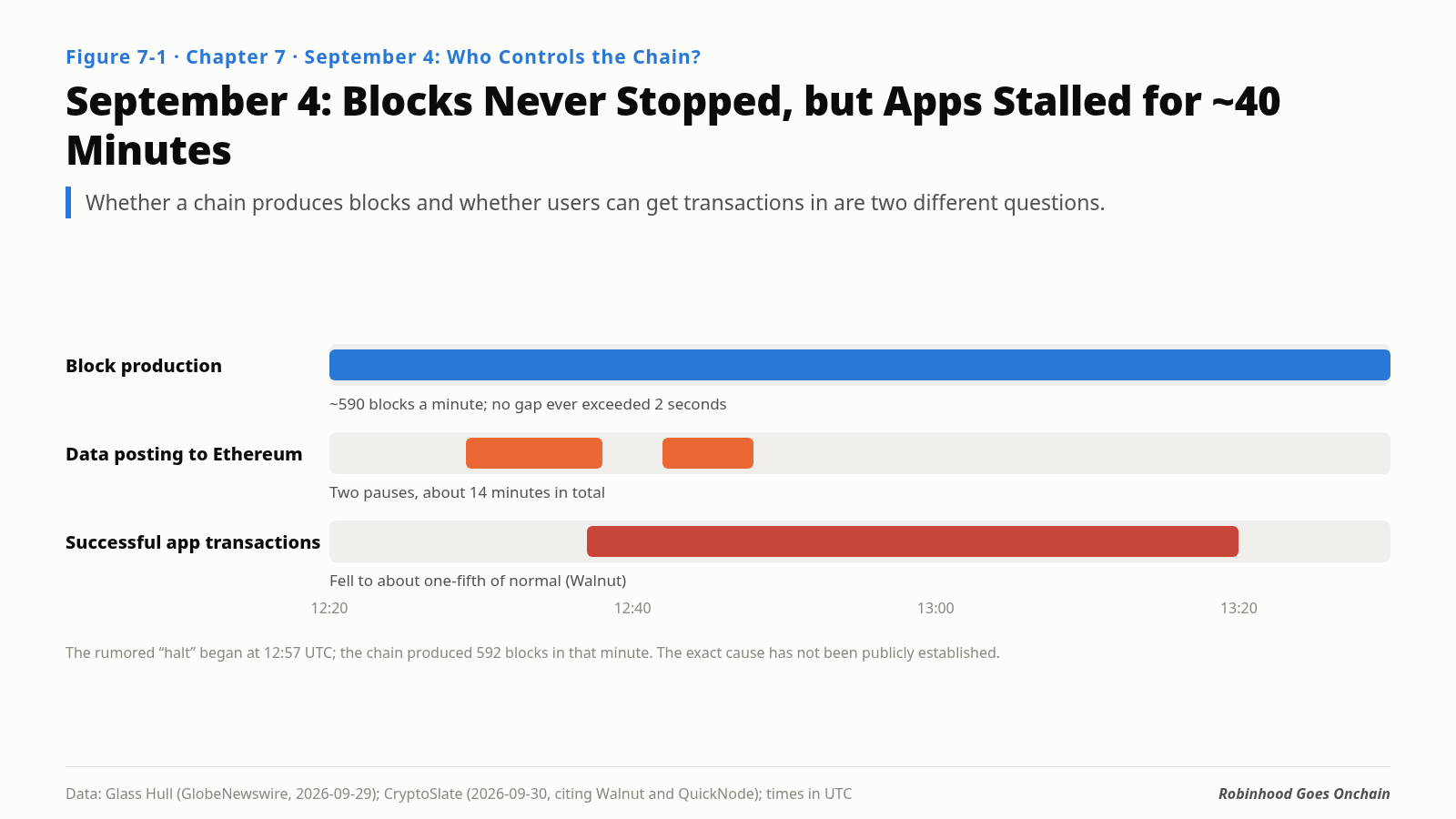
Blocks did not stop, but apps did. Both can be true at once: whether a chain produces blocks and whether users can get transactions in through RPC providers, data feeds and terminals are two different questions. No definitive cause has been made public.
For many people, the day raised a serious question for the first time: who actually controls this chain?
Five Controls in the Operator’s Hands
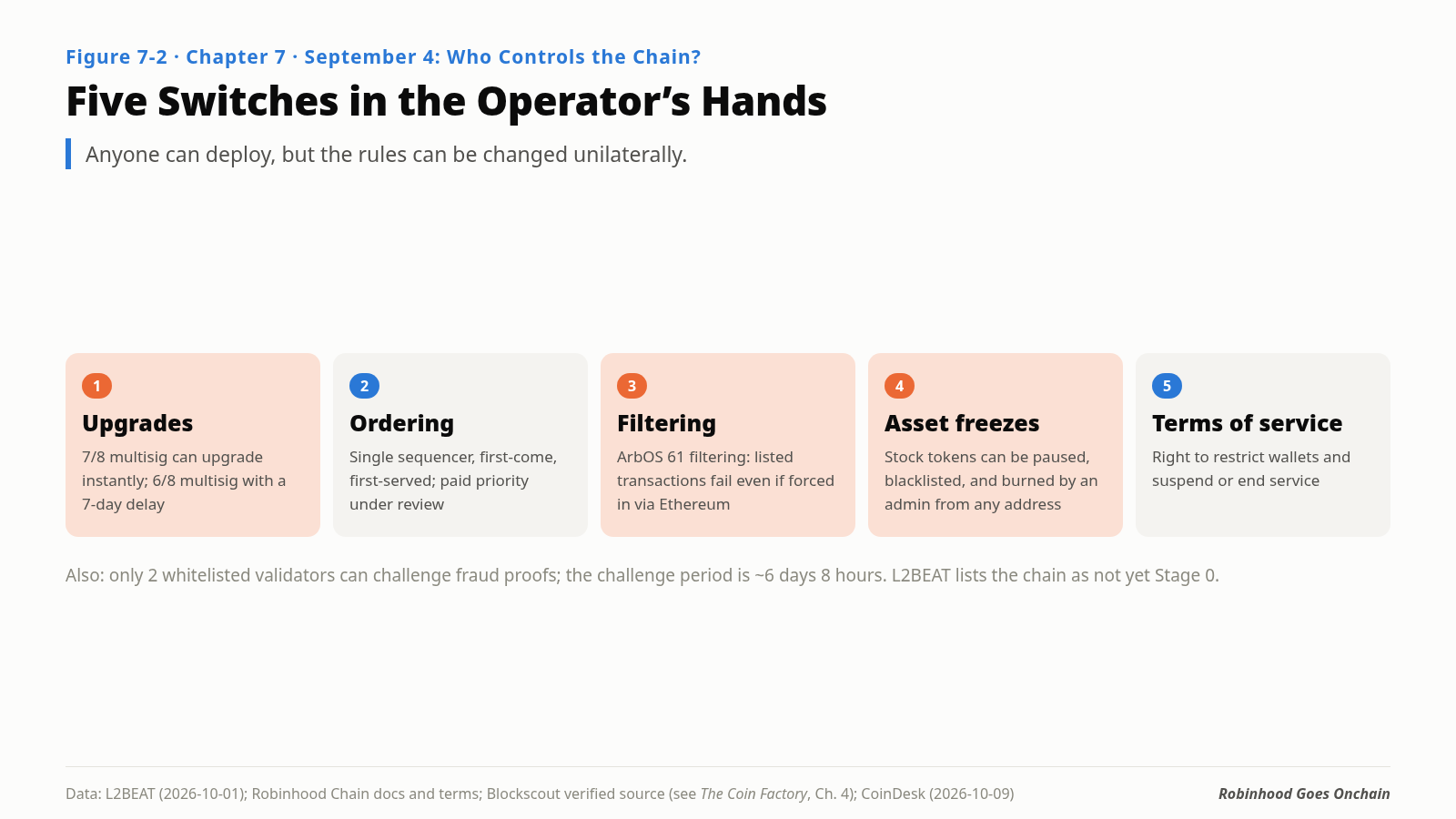
Based on public information from L2BEAT, Robinhood Chain’s documentation and its terms of service, Robinhood as operator holds five controls:
| Control | Current position |
|---|---|
| 1. Upgrades | A 7-of-8 multisig can upgrade core contracts with no delay; a separate 6-of-8 multisig can upgrade after seven days |
| 2. Ordering | A single centralized sequencer, documented as first come, first served; paid priority under evaluation, per CoinDesk |
| 3. Filtering | Transaction hashes the operator registers fail even when forced through Ethereum |
| 4. Asset freezes | Stock-token contracts can pause, blacklist addresses and let an administrator burn tokens from any address |
| 5. Terms of service | Robinhood reserves the right to restrict wallets and suspend or terminate service |
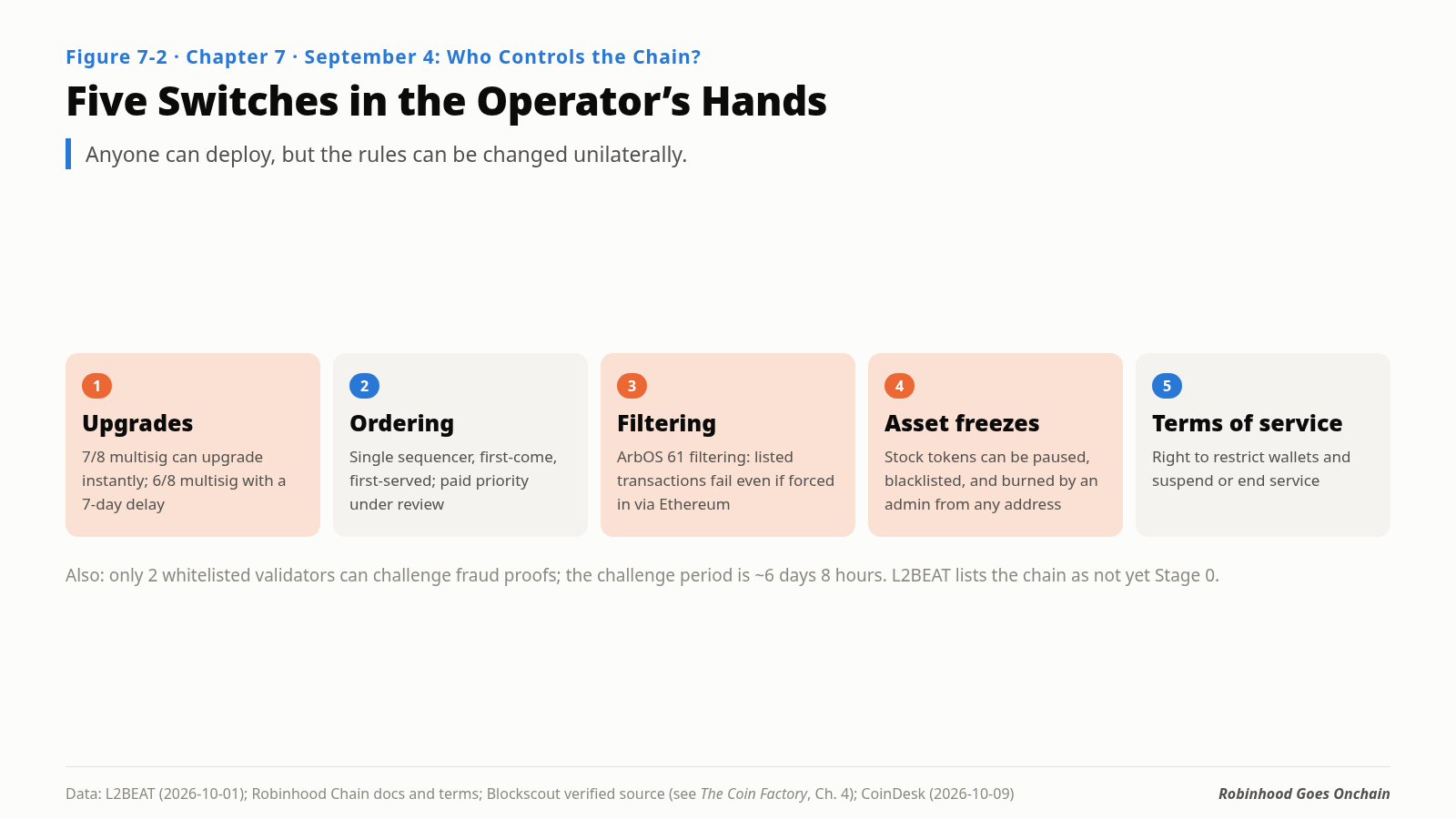
On state validation, fraud proofs are deployed, but only two allowlisted validators can challenge, with a challenge period of about six days and eight hours. L2BEAT currently lists the chain as not yet at Stage 0, citing available node software as the unmet requirement and listing allowlisted validators, instant upgrades and transaction filtering as risks.
The Framework: Permissionless to Deploy, Rules That Can Change Unilaterally
Robinhood’s documentation calls the chain permissionless: anyone can deploy contracts and issue tokens. The five controls say it is also controlled.
These do not contradict each other, because they live on different layers:
| Layer | Permissionless or controlled |
|---|---|
| Deployment | Permissionless: anyone deploys or issues a token, no KYC |
| Transactions | Mostly permissionless, but the operator keeps a filter |
| Assets | Depends on the issuer: memecoins usually have no admin; Stock Token issuers keep pause, blacklist and burn powers |
| Protocol | Controlled: the operator runs upgrades, ordering and validators |
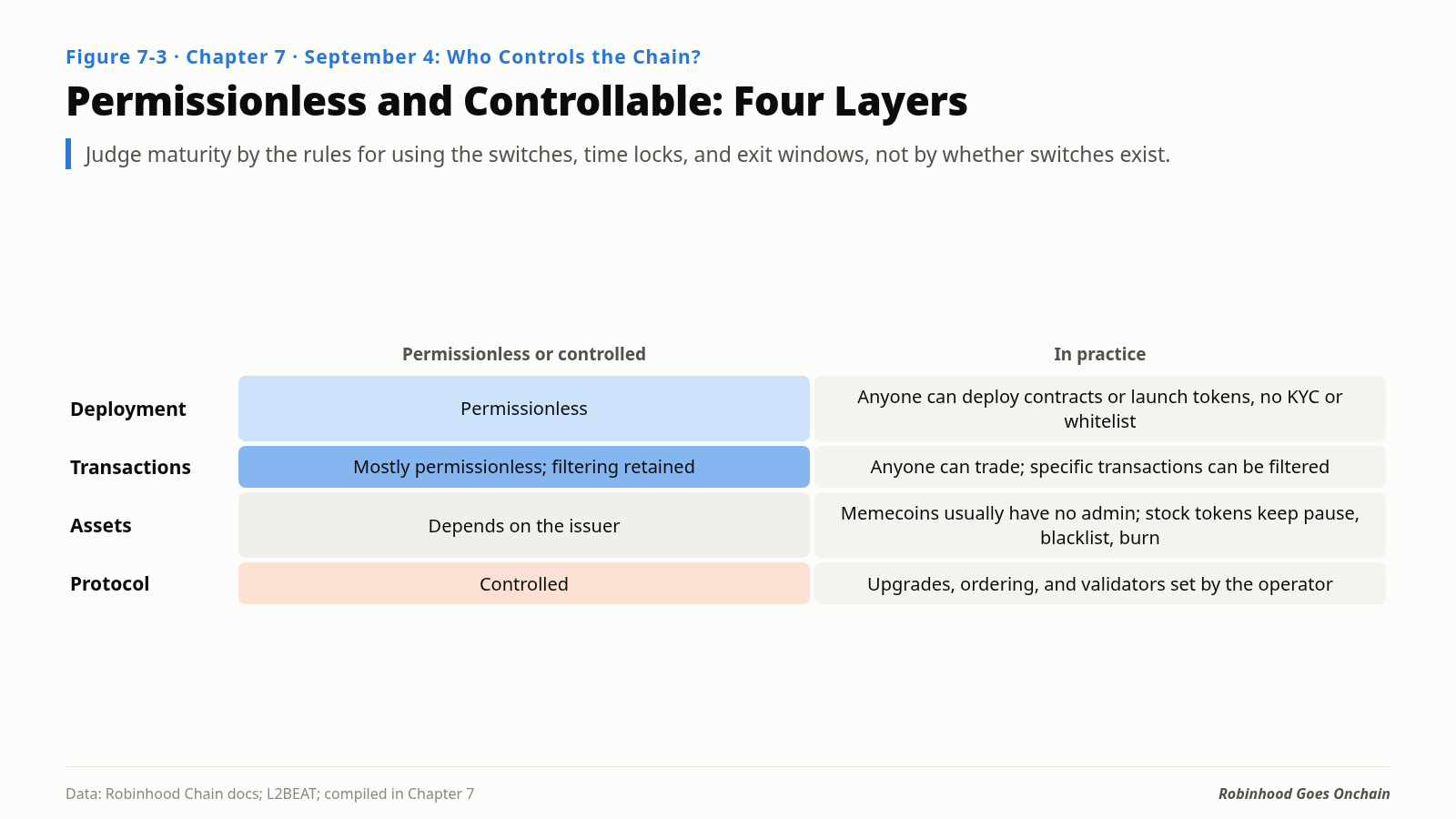
I call this structure operator power: deployment needs no permission, but the rules can change unilaterally.
So assessing this chain takes more than asking “Is it permissionless?” You also have to ask who can change the rules, and whether users get an exit window before they do.
Why a Broker Would Design It This Way
By the Ethereum community’s standards, all five controls are centralization risks. From Robinhood’s seat, most have reasons, but the reasons need separating:
- Filtering and freezing can enforce sanctions, court orders and anti-money-laundering duties. Chain-level filtering is done by the chain operator; Stock Token freezes are done by the token’s issuance and admin contracts. Different parties, different powers. Public material does not show that regulation requires this exact set of technical powers.
- Fast upgrades are genuinely useful for a newly launched chain that must fix problems quickly. Almost every new L2 starts here.
- First-come, first-served ordering can reduce some public-mempool front-running. How fair it is in practice depends on gateways, timestamps and the sequencer’s execution.
The issue is not whether the controls exist, but whether their use is transparent, time-locked and paired with an exit window. Most Ethereum L2s have walked this road: from full operator control, to Stage 1 with a security council and exit windows, to Stage 2, where contracts enforce the constraints.
Six Indicators of Maturity
Rather than argue over whether the chain is “decentralized enough,” track what can be observed:
| Indicator | Now | Signal of maturity |
|---|---|---|
| L2BEAT stage | Not yet Stage 0 | Stage 0, then Stage 1 |
| Upgrade delay | 7-of-8 multisig can upgrade instantly | Time locks on routine upgrades, with an exit window |
| Validators | Two allowlisted validators | More validators, or permissionless validation |
| Filtering | Capability exists, policy undisclosed | Published conditions and records of use |
| Ordering | First come, first served; paid priority under review | Changes announced in advance, with analysis |
| Incident disclosure | No official September 4 report | Public incident reports and a status page |
For institutional capital, this table matters more than TVL or volume. Before allocating to assets on this chain, custodians, funds and asset managers have to spell out these controls in their risk disclosures. How fast they improve will decide whether the chain’s long-term options can be exercised.
If You Do Business on This Chain
- Put the five controls in your risk assessment. How does your product degrade if the operator upgrades, reorders, filters or freezes?
- Do not treat “blocks are fine” as “the service is up.” Redundant RPCs, feed monitoring and incident records are paid needs that really exist on this chain.
- Products that depend on Stock Tokens, as quote assets or collateral, need a separate assessment of issuer freeze powers.
The Takeaway
Deploying on this chain needs no permission, but its rules can change unilaterally. Judge its maturity by the rules governing the controls, not by whether the controls exist. Every cell that improves in that table brings institutional capital a step closer.
When you assess a chain, which control do you care about most?
— Adapted from Robinhood Goes Onchain: A Broker’s First Year, Chapter 7, “September 4: Who Controls the Chain?”
The full book (17 chapters, 48 figures, first 3 chapters free to read): https://pickful.ai/books/qx7q
Repost this post?
Share with your followers.
Reply