
Chapter 2 Who Collects This Chain's Money
If you’re evaluating apps on a new chain, or trying to decide whether a launchpad can make money over the long run, don’t start with its fee rate. This chapter splits Robinhood Chain into seven layers to answer a more basic question: every time a user trades on this chain, which layers take a cut, and who holds the pricing power?
A counterintuitive fact: almost no one trades on par’s own website
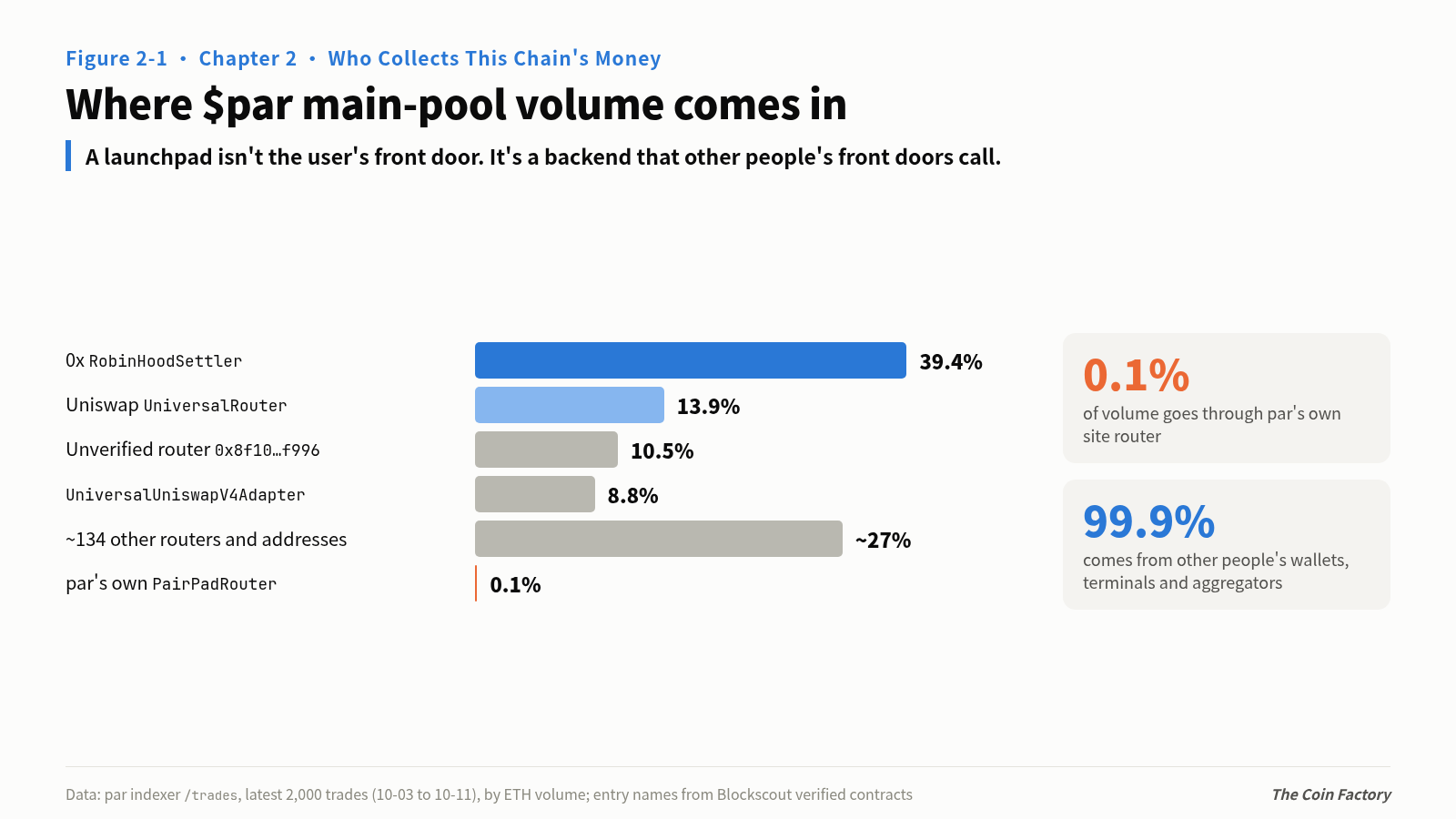
par’s website has a full trading interface and its own router contract, PairPadRouter. Yet of the latest 2,000 trades in the $par main pool (October 3–11, par’s official indexer), here is where the volume came in, by ETH value:
| Entry contract | Share of volume | What it is |
|---|---|---|
RobinHoodSettler 0x6aa8…326e
|
39.4% | 0x’s general-purpose settlement contract on Robinhood Chain (from the open-source 0x-settler repo, src/chains/RobinHood, built from the same template as BaseSettler), not a contract dedicated to Robinhood Wallet. 0x has provided swap routing for Robinhood Wallet since 2023 (0x announcement), so Robinhood Wallet swaps pass through here, as do swaps from any other app using the 0x API; 39.4% is an upper bound on Robinhood Wallet’s share |
Unverified router 0x8f10…f996
|
10.5% | Identity unconfirmed |
UniversalUniswapV4Adapter 0x36dc…2bc2
|
8.8% | Some aggregator’s v4 adapter, identity unconfirmed |
Uniswap UniversalRouter (two deployments) |
13.9% | Uniswap’s official router, covering its web app, wallet and API |
| ~134 other routers and addresses | ~27% | |
par’s own PairPadRouter |
0.1% | The launchpad’s official router |
(Entry contract names come from Blockscout verified contracts. Scope: par’s indexer returns at most the latest 2,000 trades and only covers the $par/ETH main pool created at launch. $par also trades in third-party pools such as a Ramses v3 pool and a Uniswap v4 USDG pool; on DexScreener’s 24-hour data for October 11, the main pool accounted for about 73% of $par’s total volume and 58% of its trades. The table therefore reflects how volume enters the main pool.)
For a launchpad’s own platform token, 99.9% of volume never touches the launchpad’s own interface. That tells you something: on this chain, a launchpad isn’t the user’s front door. It’s a backend that other people’s front doors call.
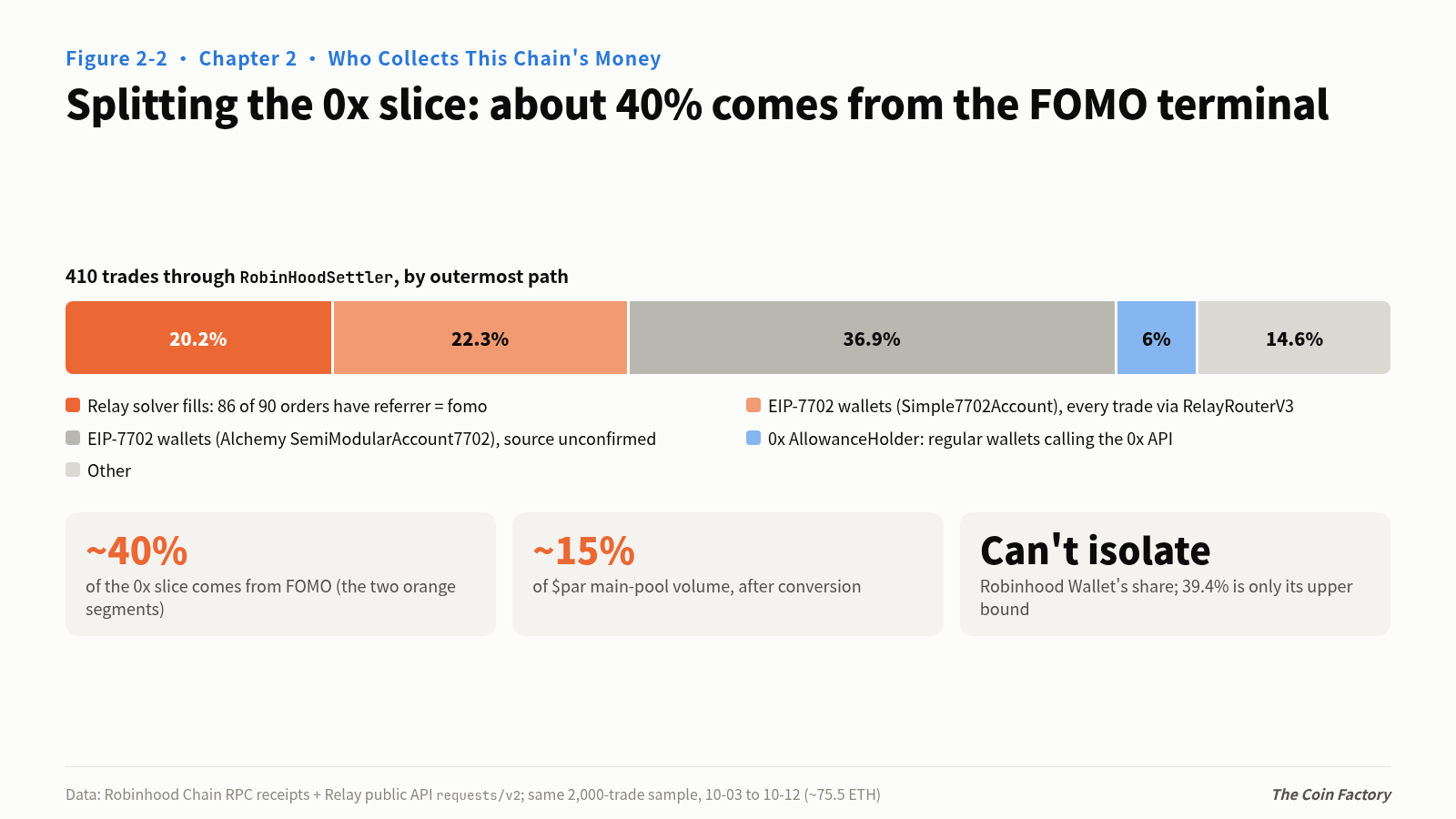
Take the 0x 39.4% one layer further. Using the same kind of 2,000-trade sample for October 3–12 (about 75.5 ETH, 38.4% of it through 0x), each of the 410 trades routed through RobinHoodSettler was traced to its outermost layer (Robinhood Chain RPC receipts plus Relay’s public API):
| Outermost path | Share of the 0x slice | Attribution |
|---|---|---|
Relay solver fills (RelayApprovalProxyV3) |
20.2% | 90 orders found via the Relay API; 86 have referrer set to fomo, about 89% by value; the orders almost all originate on Solana and are paid in USDC |
EIP-7702 wallets (delegated to Simple7702Account, EntryPoint v0.8), every trade via RelayRouterV3 and RelayDepository
|
22.3% | 71 accounts with identical traits; 20 of them are the receiving addresses of the FOMO orders above |
EIP-7702 wallets (delegated to Alchemy SemiModularAccount7702, EntryPoint v0.7) |
36.9% | 13 accounts, no overlap with FOMO addresses; source unconfirmed |
0x AllowanceHolder (regular wallets calling the 0x API directly) |
6.0% | |
| Other | 14.6% |
Altogether, about 40% of the volume through 0x comes from the FOMO trading terminal, or about 15% of the main pool (at least about 8% directly confirmed). Every FOMO trade is Relay calling 0x; none of the main pool’s trades were initiated directly by a Relay contract. Robinhood Wallet’s share can’t be separated out onchain.
The framework this chapter puts forward:
Fee stacking: every trade passes through several tollbooths at once: a wallet or terminal, a router, an AMM, a hook or launchpad. The launchpad thinks it’s the tollbooth. It’s just one of them, and the one farthest from the user.
Seven layers: from asset to user
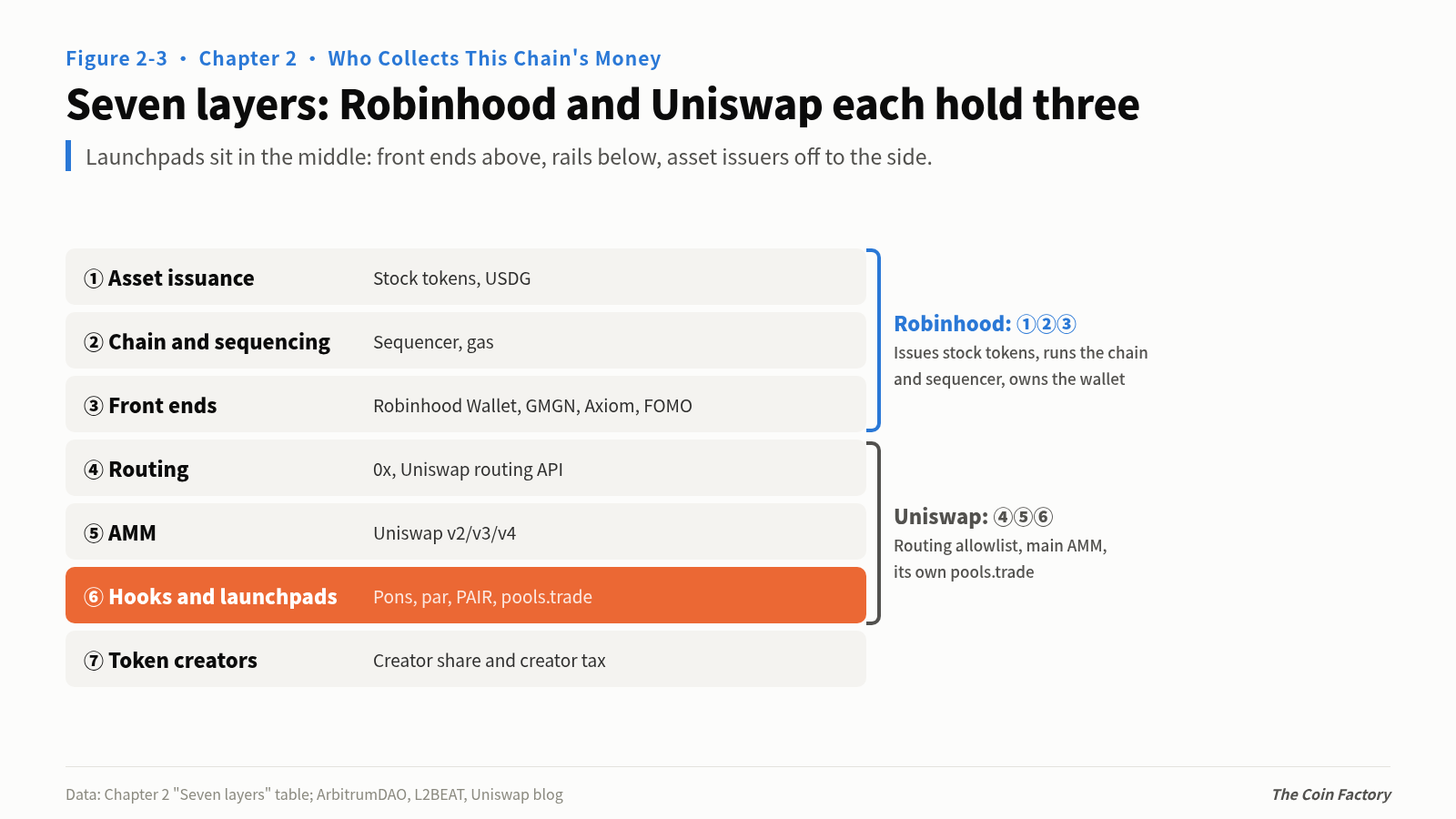
Line up everyone involved in a meme-token trade on Robinhood Chain, from the bottom of the stack to the user:
| Layer | Who | What they collect | What power they hold |
|---|---|---|---|
| ① Asset issuance | Stock tokens: Robinhood Assets (Jersey) Limited; stablecoin USDG | Revenue from issuance and redemption | Stock token contracts can be paused, can blocklist addresses, and let an admin burn tokens from any address (see Chapter 4) |
| ② Chain and sequencing | Robinhood (sequencer); Arbitrum (technology license) | Gas; under the Arbitrum license, Robinhood Chain passes 10% of net protocol revenue to the Arbitrum side (ArbitrumDAO materials) | Transaction ordering; contract upgrades are controlled by Robinhood multisigs, one of which can upgrade with no delay (L2BEAT) |
| ③ Front ends | Robinhood Wallet; trading terminals such as GMGN, Axiom, FOMO | Terminal trading fees of about 0.44%–1.03% (openchainbench estimate, secondhand) | Decide which tokens users see and which pools they can trade |
| ④ Routing | 0x (behind Robinhood Wallet); Uniswap routing API; terminals’ own routers | Some routers take a spread or a fee | Decide which pool an order goes to; Uniswap has routing-allowlist power over certain hooks (see Chapter 4) |
| ⑤ AMM | Uniswap v2/v3/v4 (day-one partner, the chain’s main AMM) | The protocol share of pool fees (Uniswap governance voted in late July to extend the protocol fee to Robinhood Chain, effective July 27, with proceeds used to burn UNI; per The Block and others) | All v4 pool assets are held in a single PoolManager contract |
| ⑥ Hooks and launchpads | Pons’s hook; par and PAIR pool fees; pools.trade | About 0.25%–1% per trade | Launch rules, fee splits |
| ⑦ Token creators | Whoever launches the token | Creator share, creator tax (par allows up to an extra 10%) | Their own token’s narrative and community |
Two things in this table stand out.
First, Robinhood holds three layers. It issues the stock tokens, runs the chain and the sequencer, and owns Robinhood Wallet. It doesn’t currently run a launchpad of its own.
Second, Uniswap also holds three layers. It’s the chain’s main AMM, it decides which hooks get into its routing, and on August 5 it launched its own launchpad, pools.trade.
Launchpads are squeezed in the middle: front ends above, rails below, asset issuers off to the side.
Fee stacking: what a meme trade actually costs
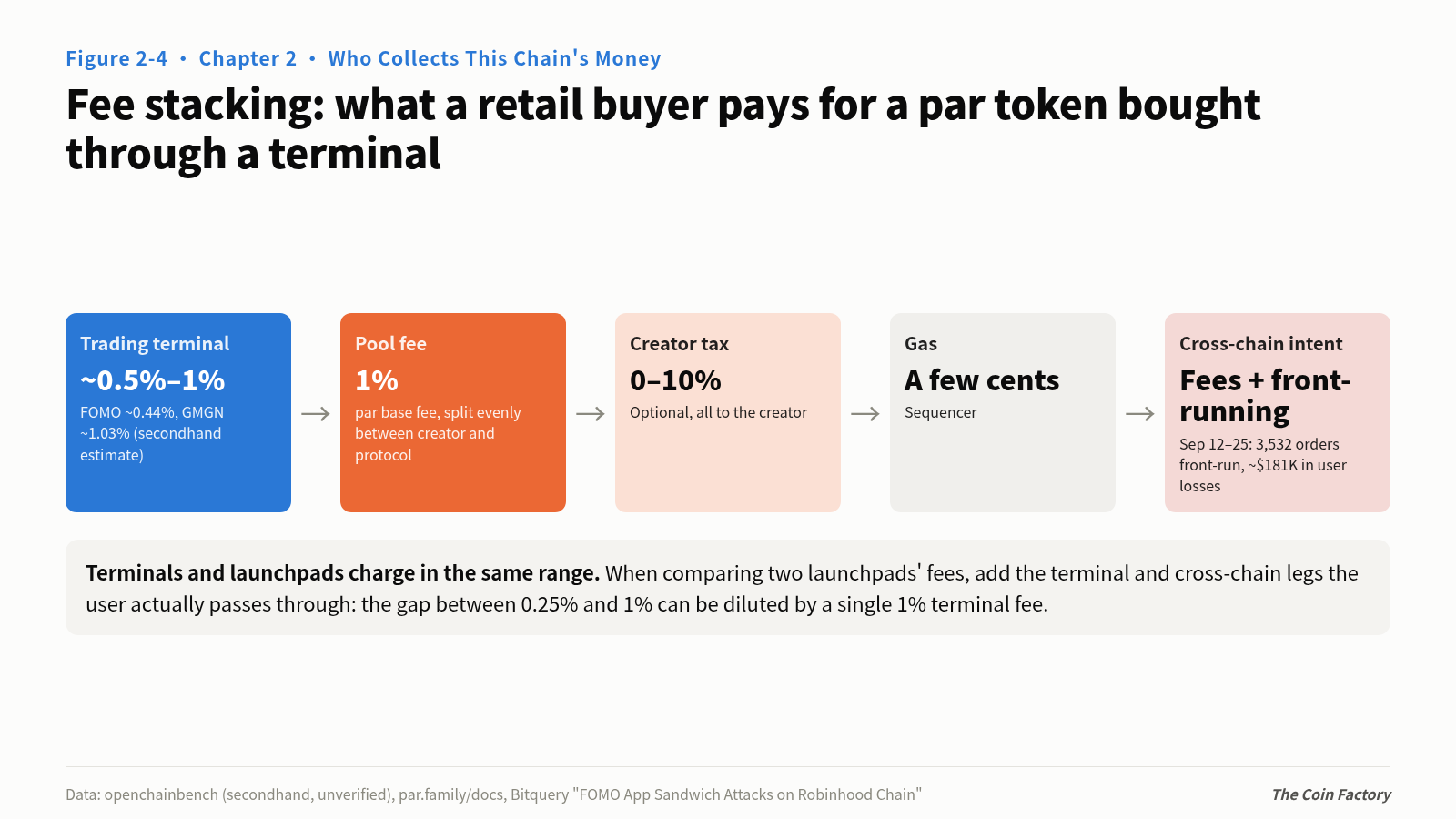
Take a retail trader buying a meme token launched on par through a trading terminal. In order, they pay:
| Tollbooth | Rate | Who gets it |
|---|---|---|
| Trading terminal | About 0.5%–1% (estimates: FOMO ~0.44%, GMGN ~1.03%) | The terminal |
| Pool fee | 1% (par base fee) | Split evenly between par’s creator and protocol |
| Creator tax (optional) | 0–10% | The creator |
| Gas | A few cents | Robinhood (sequencer) |
| Cross-chain (if the terminal uses cross-chain intents, as FOMO does via Relay) | Bridging fees, plus front-running risk | Bridges and solvers |
What the terminal charges is in the same range as what the launchpad charges. Without a creator tax, a user may pay the terminal as much as the launchpad, or more.
Cross-chain intents add another cost. Bitquery found that between September 12 and 25, three groups of bots bought in the window after Relay had recorded FOMO users’ orders but before they were filled, then sold into the price those orders pushed up. They front-ran 3,532 orders involving $6.5 million; measured against Relay’s quotes to users, users lost about $181,000. That money isn’t any layer’s “fee,” but it leaves users’ pockets all the same.
Who holds the pricing power
In a stack of layers, pricing power belongs to the layer that can’t be replaced. Layer by layer:
- Launchpads are the most replaceable. Robinhood Chain has about 30 of them, most of their contracts are open source (par’s code is adapted from Pons V2), and par and pools.trade both issue standard Uniswap v4 pools that any terminal can trade directly. Switching launchpads costs a user almost nothing.
- Front ends are the hardest to replace. Users’ funds, habits, friends’ activity and trading history all live in their wallet or terminal. About 40% of par’s recent volume goes through 0x’s settlement contract, with Robinhood Wallet swaps as part of it. The contracts can’t tell which app each trade came from, but wallet-type front ends carry far more volume than the launchpad’s own website.
- The rails are almost irreplaceable. There’s one sequencer, run by Robinhood; the chain’s main AMM is Uniswap, and every v4 pool shares one PoolManager.
That’s why pools.trade can cut fees to 0.25% and charge no launch fee: Uniswap doesn’t need to make money at the launchpad layer. It already makes money at the AMM and routing layers. Decrypt said as much: zero fees are a choice few teams can make; Uniswap can earn elsewhere, other launchpads can’t.
Where par sits
Place par in the seven layers:
| Layer | par’s position |
|---|---|
| Front ends | Open to all of them: 99.9% of volume comes from other people’s wallets, terminals and routers; FOMO alone accounts for about 15% of $par main-pool volume, with no special integration from par |
| Routing | No-hook pools enter every router automatically, with no one’s approval; the V2 fee upgrade waits on hook approval (see Chapter 4) |
| AMM | Standard no-hook Uniswap v4 pools, liquidity locked forever |
| Launchpad | The most features of any comparable launchpad: any-asset quoting, multiple markets, five fee destinations, payouts to social accounts |
| Assets | Any token can be a quote asset, which can give existing tokens a use; in return, tokens inherit the risk of the quote asset chosen, and the docs say so plainly |
par built layer ⑥ deeper than anyone, and chose the most open way to plug in: every token it issues can be traded directly by every wallet, terminal and aggregator without anyone’s approval. The upside of that path is that more front ends mean more places to trade par’s tokens. The room to grow is just as clear: deeper integration with the front-end layer, and turning any-asset quoting and the programmable interface, things others can’t easily offer, into the default tools of other communities and AI agents (Chapters 5 and 11).
If you’re evaluating apps on a new chain
- Start by asking where users come in. Check which router contracts a token’s or platform’s volume comes from. If most comes from other people’s wallets and terminals, the platform has little bargaining power.
- Add terminal fees to the user’s cost. When you compare two launchpads’ fees, add the terminal and cross-chain legs the user actually goes through. The gap between 0.25% and 1% can be diluted by a single 1% terminal fee.
- Find the players that hold several layers. On Robinhood Chain that’s Robinhood and Uniswap. Any move either makes into the launchpad layer will change competition there. pools.trade was the first.
If you’re designing a launchpad
- Either own a front end or get integrated by one first. The first means building your own wallet or terminal; the second means getting your tokens correctly recognized, displayed and routed in Robinhood Wallet, GMGN, Axiom and FOMO. par’s docs note that GMGN shows social links only for launchpads it has integrated, so par’s tokens appear there with a logo and no links. That detail is what front-end power looks like.
- Don’t compete with the rails on fees. Uniswap can cut launchpad-layer fees to 0.25% because it doesn’t live on that layer. Competing with it on fees means fighting someone’s marketing budget with your only source of revenue.
The bottom line
On Robinhood Chain, money passes through seven layers on its way from the user’s pocket into the chain. Launchpads stand in the middle and can see all of it; their long-term position depends on which front end they connect to.
Sources for this chapter
- par official indexer
api.par.family/trades(firsthand): thesenderfield of the latest 2,000 trades in the $par main pool ($par/ETH, Uniswap v4), aggregated by ETH volume; the endpoint caps at 2,000 trades - DexScreener API: 24-hour trade counts and volume for each $par pool (main pool ~$13,355 / 160 trades, Ramses v3 USDG pool ~$3,510 / 98 trades, Uniswap v4 USDG pool ~$1,351 / 15 trades)
- Blockscout (firsthand): verified names of entry contracts (
RobinHoodSettler,UniversalUniswapV4Adapter,UniversalRouter,PairPadRouter) - 0x announcements and PR Newswire release (firsthand): 0x provides swap routing for Robinhood Wallet and RFQ liquidity for stock tokens (market maker Tokka Labs)
- Post by X user @LorenzoARK: Robinhood Wallet swaps go through the 0x Settler contract (secondhand, consistent with 0x’s announcement)
- ArbitrumDAO Factsheet: Robinhood Chain returns 10% of net protocol revenue under its license (8% to the ArbitrumDAO treasury, 2% to the Arbitrum Developer Guild)
- L2BEAT Robinhood Chain page: centralized sequencer; contract upgrades controlled by Robinhood Multisig 1 (no delay) and Robinhood Multisig 2 (7-day delay)
- Robinhood press release (2026-07-01): stock token issuer
- openchainbench (secondhand): FOMO and GMGN fee estimates. To be verified
- Bitquery, “FOMO App Sandwich Attacks on Robinhood Chain, Measured”: number of front-run orders, amounts, user losses
- Decrypt / Yahoo Finance, “Uniswap Enters the Launchpad Wars on Robinhood Chain”: commentary on pools.trade’s zero launch fee
- par.family/docs (firsthand): GMGN shows only a logo, not social links, for launchpads it hasn’t integrated
- The Block (2026-07-18) and others: governance votes to turn on the protocol fee for Uniswap v2/v3 on Robinhood Chain and extend the v4 protocol fee (Proposal 100), effective July 27
- To be verified: which terminals own
0x8f10…f996andUniversalUniswapV4Adapter