
Chapter 3 Three Technical Forks
If you need to tell what really separates two launchpads that look alike, or you’re designing your own launch mechanism, this chapter breaks a launchpad into three technical choices and lays out the business consequences of each. The sample is four launchpads on Robinhood Chain: Pons, pools.trade, PAIR and par.
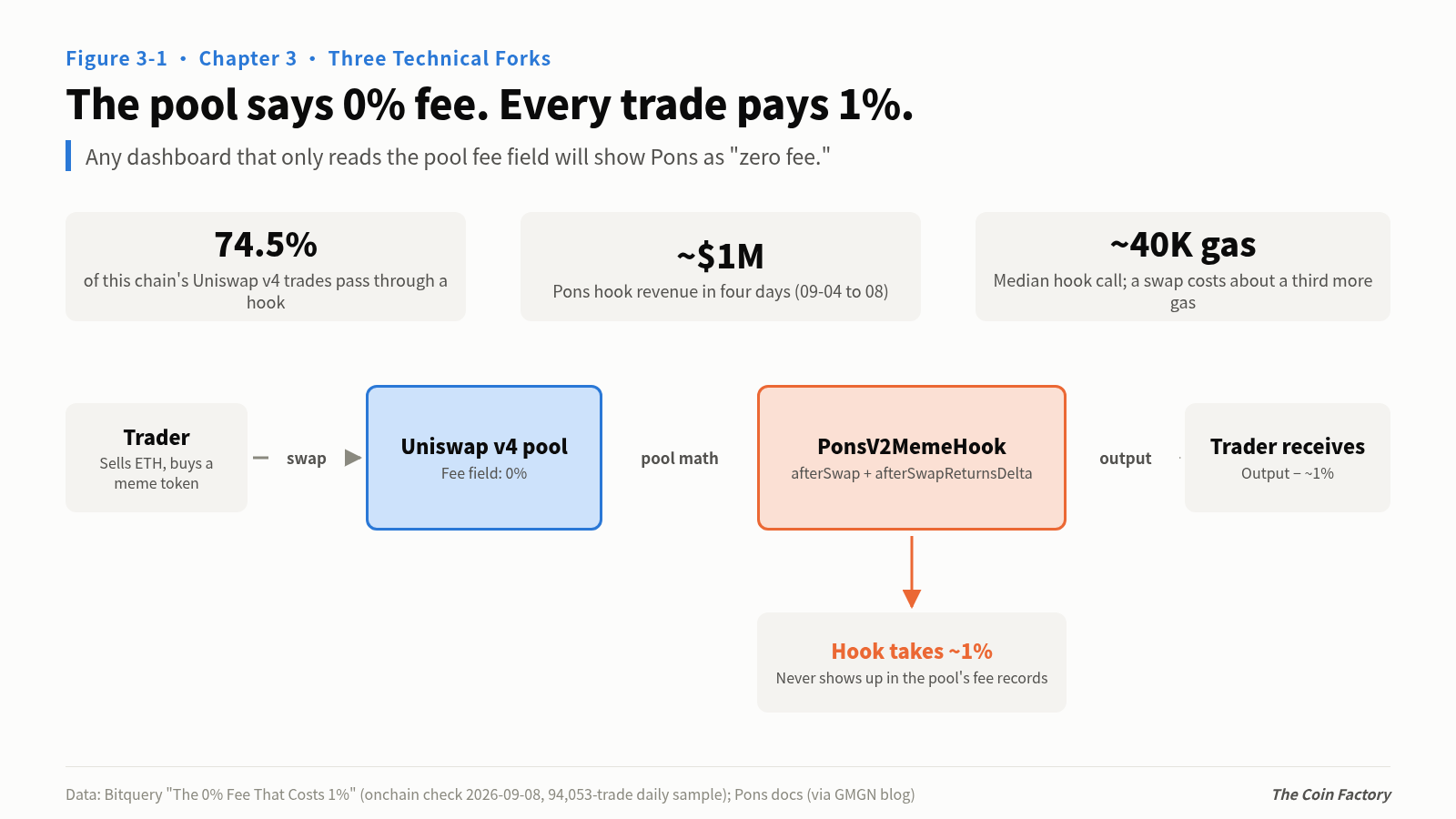
A counterintuitive fact: the pool says 0% fee, and every trade pays 1%
Trade a meme token that graduated from Pons on Robinhood Chain, and the Uniswap pool records a fee of zero.
The money is still collected. Bitquery read four days of onchain logs from September 4 to 8 and found that 74.5% of Uniswap v4 trades on this chain pass through a hook, and that a single contract handles nearly three-quarters of those hook trades. That contract is Pons’s PonsV2MemeHook. After the pool has done its math, it cuts a slice from the output the trader was due. In a one-day sample of 94,053 trades, the median cut was 1% per trade; the pool’s own records show the trade paid nothing. Bitquery estimates the hook earned about $1 million in those four days.
Pons’s own docs acknowledge the design: the pool itself charges no fee, and the hook collects the swap fee instead (per Pons docs quoted on the GMGN blog). Nothing is hidden, but it means that any dashboard that only reads the pool’s fee field will show Pons as “zero fee.”
The example shows that the most important differences between launchpads often aren’t in the interface. They sit in a few low-level technical choices, which this chapter boils down to:
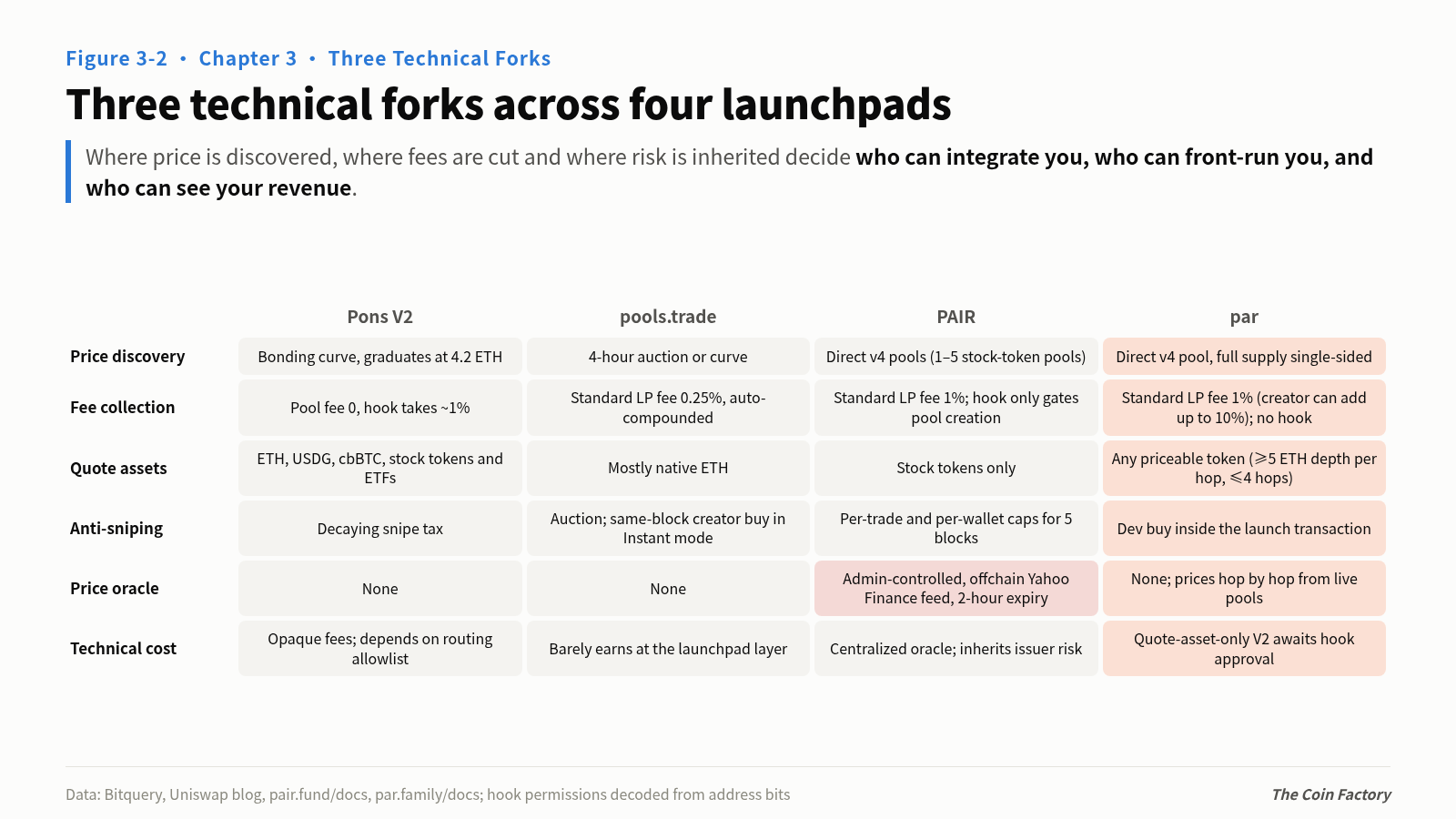
Three technical forks: how price is discovered, how fees are collected, and what asset tokens are quoted in. Each fork decides three things at once: who can integrate you, who can front-run you, and who can see your revenue.
The four launchpads’ choices at a glance
| Pons V2 | pools.trade | PAIR | par | |
|---|---|---|---|---|
| Price discovery | A standalone bonding-curve contract per token; graduates after collecting 4.2 ETH (when quoted in ETH) and migrates to Uniswap v4 | Two modes: Crowd Launch, a 4-hour continuous clearing auction (refunded if it misses a $10,000 FDV); Instant Launch, a bonding curve | Direct v4 pools (1–5 stock-token pools), no curve | Direct v4 pool, full supply placed single-sided, no curve |
| Anti-sniping | Decaying snipe tax | The auction itself resists bundling; in Instant mode the creator buys first in the same block | For 5 blocks after launch: no single buy over 5.5%, no wallet holding over 5% | None; only a dev buy to take the first trade |
| Fee collection | Pool fee set to 0, collected by the hook (~1%); tickSpacing 200 | Standard LP fee of 0.25%, auto-compounded into the locked position; creator can opt for 0.05%; no hook | Standard LP fee of 1%; the hook has only beforeInitialize (controls pool creation) and doesn’t touch trades |
Standard LP fee of 1% (creator can add up to 10%); no hook |
| Quote assets | ETH, USDG, cbBTC, stock tokens and ETFs | Mainly native ETH | Stock tokens only | Any priceable token on the chain (at least 5 ETH of depth per hop, up to 4 hops) |
| Price oracle | None | None | An admin-controlled onchain oracle, updated by an offchain program pulling from Yahoo Finance; launches fail if the price is more than 2 hours stale | No external oracle; prices hop by hop from live Uniswap pool prices |
Sources: Bitquery’s Pons API docs and pools.trade comparison (citing public Pons and Uniswap materials); Uniswap blog; pair.fund/docs; par.family/docs. Hook permissions decoded from the trailing bits of the contract address.
Fork one: where price is discovered
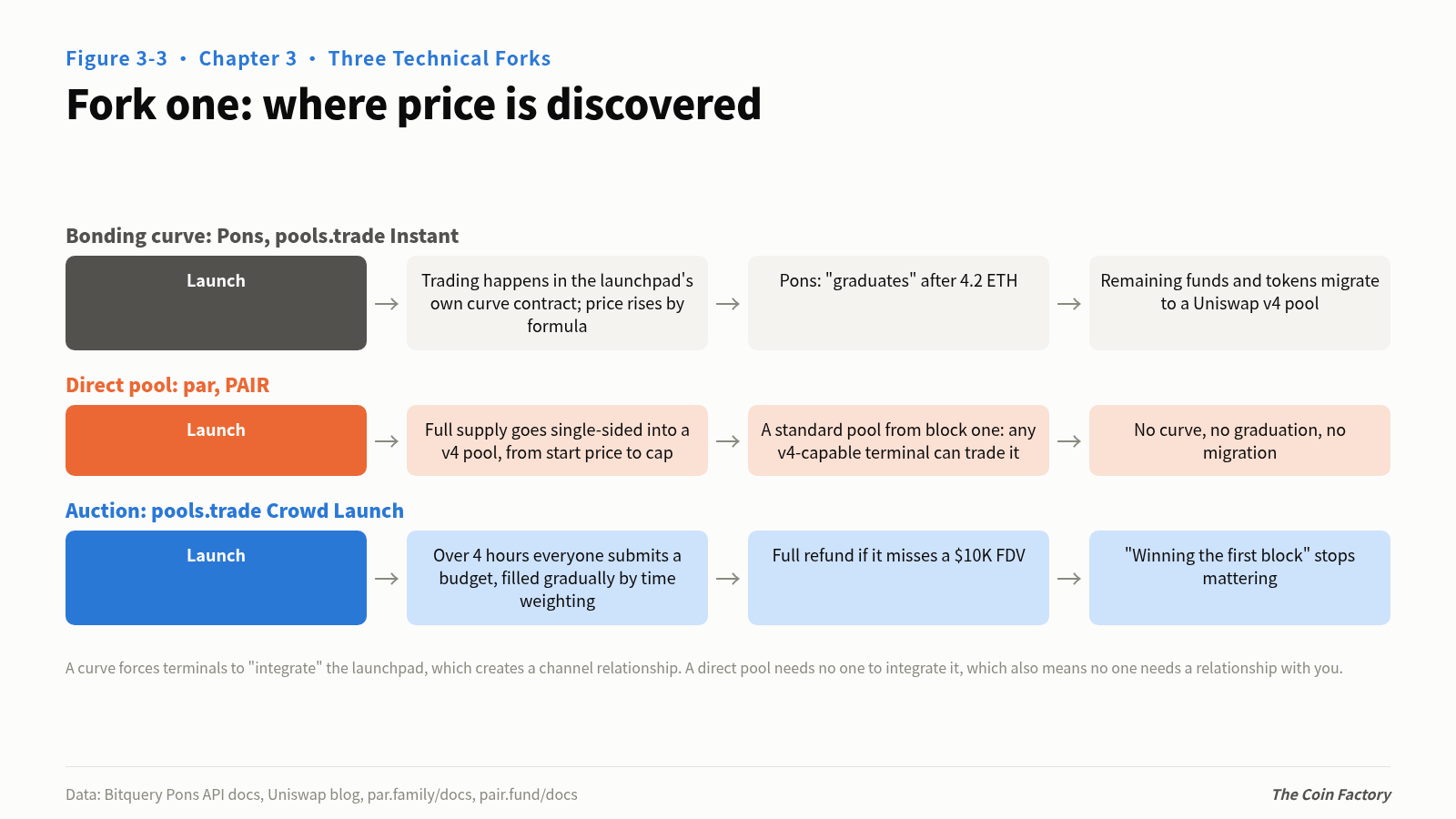
Three mechanisms
- Bonding curve (Pons, pools.trade’s Instant mode): tokens first trade inside a dedicated curve contract, with price rising by formula as people buy. At a threshold the token “graduates,” and the remaining funds and tokens move into a DEX pool. Pons V2’s supply split is fixed: 5/7 is sold to buyers on the curve, and 2/7 is pulled at graduation, of which 10/49 goes into the v4 pool and 4/49 is locked forever.
- Direct pool (par, PAIR): at launch the entire supply goes into a Uniswap v4 pool as single-sided liquidity, spread from the starting price up to a price cap. No curve, no graduation, no migration.
- Auction (pools.trade’s Crowd Launch): over 4 hours everyone submits a budget, filled gradually with time weighting, so earlier bids get better prices; if it misses the minimum valuation, everyone is refunded in full.
Business consequences
Consequence one: who can integrate you. During the bonding-curve phase, trading happens in the launchpad’s own curve contract, not on a DEX. A trading terminal has to build a specific integration to show and trade pre-graduation tokens. Pons has managed this: Axiom’s interface has dedicated Pons columns for new, about-to-graduate and graduated tokens, and GMGN’s source filter lists Pons and Pons V2 separately. Tokens from a direct-pool launchpad, by contrast, are standard Uniswap v4 pools from block one. Any terminal that can trade v4 can trade them immediately, with no specific integration.
It’s a trade-off between openness and lock-in. A curve forces terminals to “integrate” the launchpad, and once they do, there’s a channel relationship. A direct pool needs no one to integrate it, which also means no one needs a relationship with you.
Consequence two: who can front-run you. Robinhood Chain’s sequencer processes transactions in order of arrival and doesn’t let you pay to cut the line (a Robinhood Chain docs principle, per GMGN). Under that rule, front-running is a race on network latency, not on bids. So:
- Direct pool plus a dev buy inside the launch transaction (par): the creator’s first buy and the launch complete in the same transaction, guaranteeing the first fill. That’s atomic protection unaffected by ordering rules. After that block, it’s open to everyone, as par’s docs say clearly.
- Curve plus snipe tax (Pons): early buys pay more tax, squeezing front-running profits.
- Auction (pools.trade): 4 hours of time-weighted filling makes “winning the first block” pointless.
- Block-window caps (PAIR): limits per trade and per wallet for 5 blocks after launch.
Consequence three: graduation is a tradable event. Under the curve model, “about to graduate” is itself a signal. Terminals show it separately and traders bet on it. Direct pools have no such event, so they lack a natural focal point. On the other hand, a direct-pool token sits in a standard pool from block one, so there’s no migration step and no migration risk.
Fork two: how fees are collected
Two methods
- Standard LP fees (par, PAIR, pools.trade): the fee is a parameter of the Uniswap pool itself, plainly visible in the pool’s records. It’s distributed to all LPs pro rata, and the launchpad’s locked position is usually the biggest LP, so it takes the bulk.
-
Hook fees (Pons): the pool fee is set to 0, and a hook with
afterSwapReturnsDeltapermission cuts a portion of the output at the end of each trade.
Business consequences
Consequence one: whether revenue is visible. LP fees are a public field any dashboard can count. Hook fees don’t show up in the fee field of trade records; Bitquery’s headline literally calls it “0% that costs 1%.” For users that’s less transparency; for the launchpad, it means looking “cheaper” on comparison dashboards.
Consequence two: whether you go through a gatekeeper. Uniswap Labs’ published rule: hooks with beforeSwapReturnsDelta, afterSwapReturnsDelta or dynamic-fee permissions must be submitted for review before they can enter Uniswap’s own routing algorithm, and Uniswap Labs “retains sole discretion to reject or later remove” them. Hooks without those permissions, and pools without hooks, enter routing automatically. So the hook-fee model is more powerful but has to pass Uniswap’s gate; the LP-fee model is weaker but needs no one’s approval. Chapter 4 is about that gate.
Consequence three: whether you have to sell the tokens you collect. LP fees are charged by trade direction: buys pay in the quote asset, sells pay in the token being traded. So a launchpad ends up holding half its fees in “meme tokens it launched itself,” which it has to sell or burn. par chose to burn the token portion of its protocol share, and the Chapter 9 ledger shows the team used a trading terminal to sell the assorted quote assets it received. A hook can collect only the quote asset and never touch the token itself, which is exactly what par’s developer says V2 will change: collect only quote assets, so buybacks and burns actually mean something. But that requires a hook with returnsDelta permission, which means passing Uniswap’s gate.
Consequence four: gas. Bitquery measured a median of about 40,000 gas for post-trade hook calls, adding roughly a third to a swap’s gas; and pre-trade hook calls rejected more than 1% of trades outright. That never happened in older Uniswap versions: as long as a pool had liquidity, a trade went through.
Fork three: what tokens are quoted in
Three strategies
- ETH only (mainly pools.trade): the simplest, with the most concentrated liquidity.
- A curated list (Pons: ETH, USDG, cbBTC, stock tokens; PAIR: stock tokens only): every quote asset is screened by the platform.
- Any asset (par): any token can be a quote asset, including meme tokens from other launchpads, as long as it can be priced to ETH hop by hop through Uniswap pools with at least 5 ETH of depth per hop.
Business consequences
Consequence one: composability, which is to say “foundation” capability. Any-asset quoting lets par give any existing token a use (Chapters 10 and 11). Of the three strategies, it’s the only one that can make a platform “a tool for other communities.”
Consequence two: inherited risk. A token inherits all the risk of whatever it’s quoted in. par’s docs put it bluntly: a token quoted in another launchpad’s token is worthless if that token goes to zero. Stock-token quoting brings a special kind of inherited risk:
- Issuer powers: stock token contracts can be paused, can blocklist addresses, and let an admin burn tokens from any address (Chapter 4 goes through each).
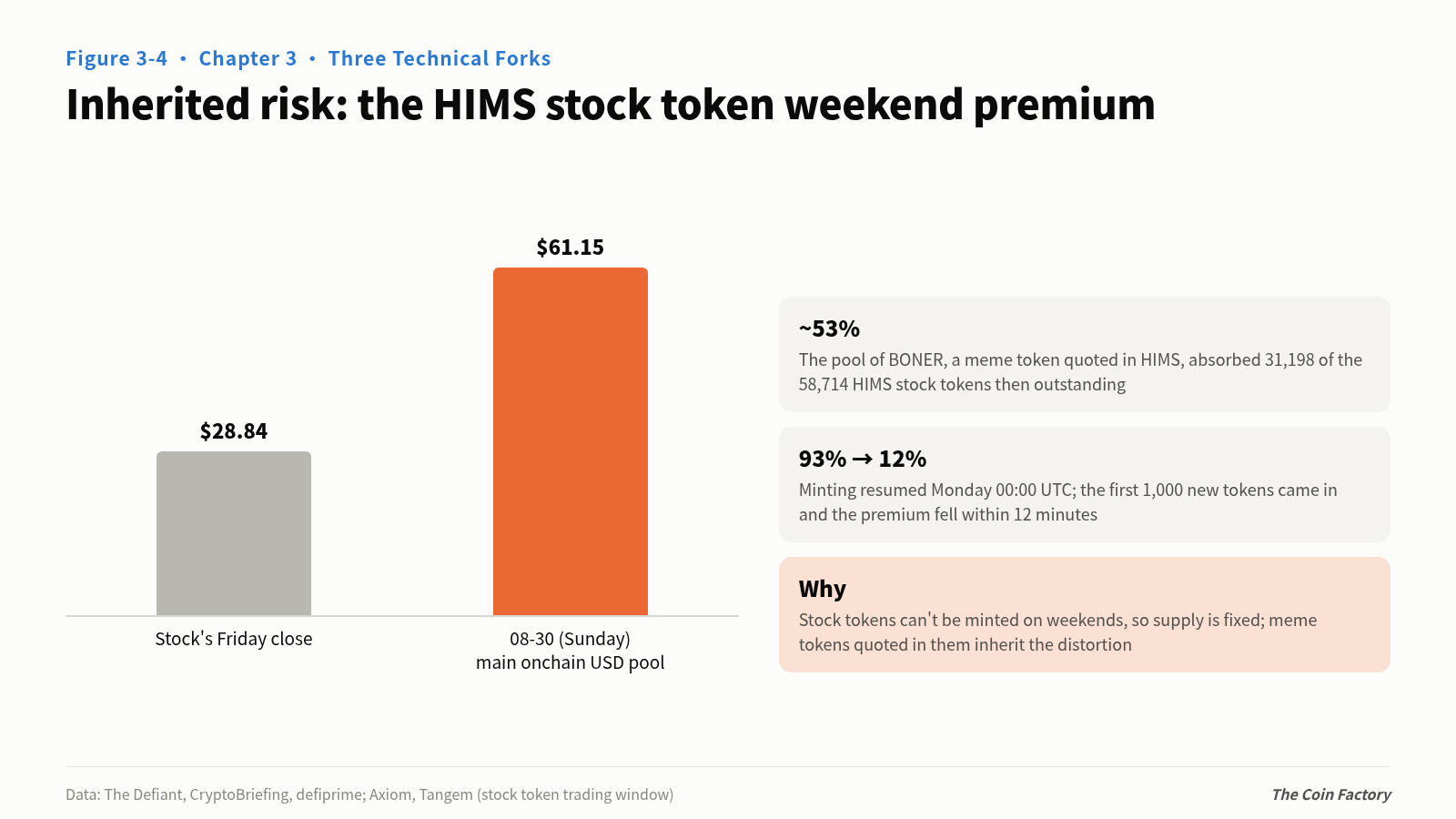
- Minting window: stock tokens trade from 2 a.m. Monday to 2 a.m. Saturday (Central European Time). On weekends no new tokens can be minted, so supply is fixed, and stock tokens can drift far from the last close onchain. On August 30 (a Sunday), the pool of BONER, a meme token quoted in the HIMS stock token, had absorbed 31,198 of the 58,714 HIMS stock tokens then outstanding (about 53%). The HIMS stock token printed at $61.15 in the main USD pools, while the stock had closed at $28.84 on Friday. Minting resumed at midnight UTC on Monday; the first 1,000 newly minted tokens came in, and within 12 minutes the premium fell from 93% to 12% (The Defiant, CryptoBriefing). Meme tokens quoted in such assets passively inherit that price distortion.
Consequence three: oracle dependence. PAIR has to combine prices from several stock-token pools into one market cap, so it relies on an admin-controlled oracle fed by an offchain program pulling from Yahoo Finance. If the price goes more than 2 hours without an update, new launches fail. par’s any-asset quoting uses no external oracle and prices hop by hop from live pools. Its docs also spell out the limits of that design: a launcher can move the reference pool’s price within the same transaction so their token opens at a market cap different from what the interface shows. That only affects that one launch, and the 5 ETH-per-hop depth requirement sets a minimum cost for doing it. The docs explain that live prices were chosen over time-weighted prices to avoid a half-hour wait and a keeper that must run constantly. Writing the trade-off into the docs is a form of transparency in itself.
Consequence four: the launchpad becomes a seller of quote assets. Half the fees it collects are quote assets, which it eventually has to convert into what it needs to operate. par’s team wallet sold dozens of quote assets through a trading terminal (Chapter 9). For the community behind a quote asset, being used as a quote asset on par brings buying pressure, along with a small, steady stream of selling.
Technical profiles of the four
Put the three forks together and the four launchpads’ technical profiles come into focus:
| Technical profile | Best-fit scenario | Biggest technical cost | |
|---|---|---|---|
| Pons | Curve + hook tollbooth + curated quote assets | High-frequency speculation, deep terminal integration | Opaque fees; depends on Uniswap’s routing allowlist |
| pools.trade | Auction or curve, standard pools, low fees, ETH quoting | “Fair launches” with brand backing | Barely earns at the launchpad layer; relies on Uniswap’s earnings in other layers |
| PAIR | Direct pools + stock-token baskets + oracle | RWA narrative | Depends on a centralized oracle; inherits stock-token issuer risk |
| par | Direct pools + standard pools + any-asset quoting | Giving existing tokens a use; open integration | Anti-sniping limited to a dev buy inside the launch transaction; the quote-asset-only V2 waits on hook approval |
If you’re comparing two launchpads
- Check the pool’s hook field, not just its fee field. A pool with a 0 fee isn’t necessarily free. Look up the pool’s hook address in an explorer; its trailing bits encode its permissions.
- Ask whether terminals need a specific integration. If they do, the launchpad’s distribution depends on its relationships with terminals; if not, any terminal can trade its tokens, but no terminal has a reason to promote them.
- Ask what the quote asset’s risks are. Especially for meme tokens quoted in stock tokens, factor in the issuer’s powers and the weekend minting window.
If you’re designing a launch mechanism
- Anti-sniping is a function of the ordering rules. On a chain that orders by arrival, the race is on latency, and auctions and block-window caps work better than snipe taxes. If the ordering rules move to bidding (Chapter 4), anti-sniping design has to change with them.
- If you want to collect only quote assets, be ready to pass a gatekeeper. On Uniswap v4 that’s a technical fact, not a choice.
The bottom line
Launchpad interfaces all look alike. The real differences lie in three choices you can’t see: where price is discovered, where the money is cut, and where the risk is inherited.
Sources for this chapter
- Bitquery, “Uniswap v4 Hooks on Robinhood Chain: The 0% Fee That Costs 1%” (onchain data checked 2026-09-08): hook share of trades 74.5%, largest hook’s median fee 1% (94,053-trade sample), gas cost, pre-trade hook rejection rate 1.174%, ~$1 million in four days
- Bitquery Pons API docs: Pons V2 contract addresses (
PonsV2MemeHook0xe5e702641ea86f4ae6cc3cdaed2b886f976be044), 4.2 ETH graduation threshold, supply split, pool fee 0 and tickSpacing 200; pools.trade pool fee 2500, no hook - GMGN blog: Pons docs on hook fees; Robinhood Chain docs on first-come-first-served ordering
- Uniswap blog, “Pools.trade: A New Way to Launch on Robinhood Chain”: Crowd Launch and Instant Launch, 0.25% fee, 0.05% creator option, same-block creator buy
- Uniswap Developers, “Uniswap v4 Hooks Routing Allowlist”: hook permission types requiring review and the discretion language
- pair.fund/docs (firsthand): multi-pool launches, 5-block protection window, oracle and 2-hour staleness rule,
PairV4Hookaddress0x16D1560630Ce74af4478d9b8AD46548A092A2000 - par.family/docs (firsthand): direct pools, no hook, any-asset pricing rules, no anti-sniping, reference-pool manipulation note, risk of quoting in meme tokens
- Axiom’s Robinhood Chain page, Tangem Learning Center: stock token trading window; HIMS stock token weekend premium (secondhand)
- The Defiant, CryptoBriefing, defiprime: BONER absorbing the HIMS stock token float, the weekend premium and the drop after Monday minting resumed
- Hook permission decoding: Uniswap v4 encodes 14 permission bits in the last 14 bits of the hook address (
0x…e044maps to beforeInitialize, afterSwap, afterSwapReturnsDelta;0x…2000maps to beforeInitialize)