
目錄(8 節)

·
On a Saturday With Markets Closed, One Address Minted $276,000 of Tesla Tokens

Saturday, November 14, 2026. The US stock market had been closed for 20 hours. At 16:12 UTC, an address on Ethereum did three things in a single transaction: it sold 129.49 TSLAon, Ondo's Tesla token, into a pool for 49,988.59 USDC; it handed that USDC to Ondo's minting contract, GMTokenManager, and minted 129.60 new TSLAon; and it used the freshly minted tokens to settle the sale, keeping the extra 0.11 for itself.
Saturday, November 14, 2026. The US stock market had been closed for 20 hours. At 16:12 UTC, an address on Ethereum did three things in a single transaction: it sold 129.49 TSLAon, Ondo’s Tesla token, into a pool for 49,988.59 USDC; it handed that USDC to Ondo’s minting contract, GMTokenManager, and minted 129.60 new TSLAon; and it used the freshly minted tokens to settle the sale, keeping the extra 0.11 for itself.
That day the same address ran 14 transactions with the same structure, minting about 717 TSLAon, worth roughly $276,000. At the same moment, nobody could do this with the Tesla tokens issued by xStocks, bStocks or Robinhood: their creation/redemption doors were closed for the weekend.
That door is the subject of this piece. Someone will move the price gap only if they are eligible to walk through the door and the gap is wide enough to cover the cost. When the door is closed, the price lacks an anchor that can be converted into the underlying stock on the spot. The decision this piece asks you to make: can you, or your market maker, mint and redeem directly with the issuer? If so, when, in what size and at what cost? If not, what anchors your price while the door is closed?
1. How the door closes the gap
A tokenized stock tracks the underlying share not because the issuer “maintains” the price, but because of arbitrage:
- The token trades above the stock. An eligible party brings dollars or stablecoins to the issuer and mints; the issuer buys the underlying share, holds it in custody and issues new tokens. The minter sells the tokens on the secondary market and pockets the difference. The selling pressure pushes the token price back down.
- The token trades below the stock. Someone buys the token on the secondary market and hands it to the issuer for redemption; the issuer sells the underlying share and pays back dollars or stablecoins. The buying pressure lifts the token price back up.
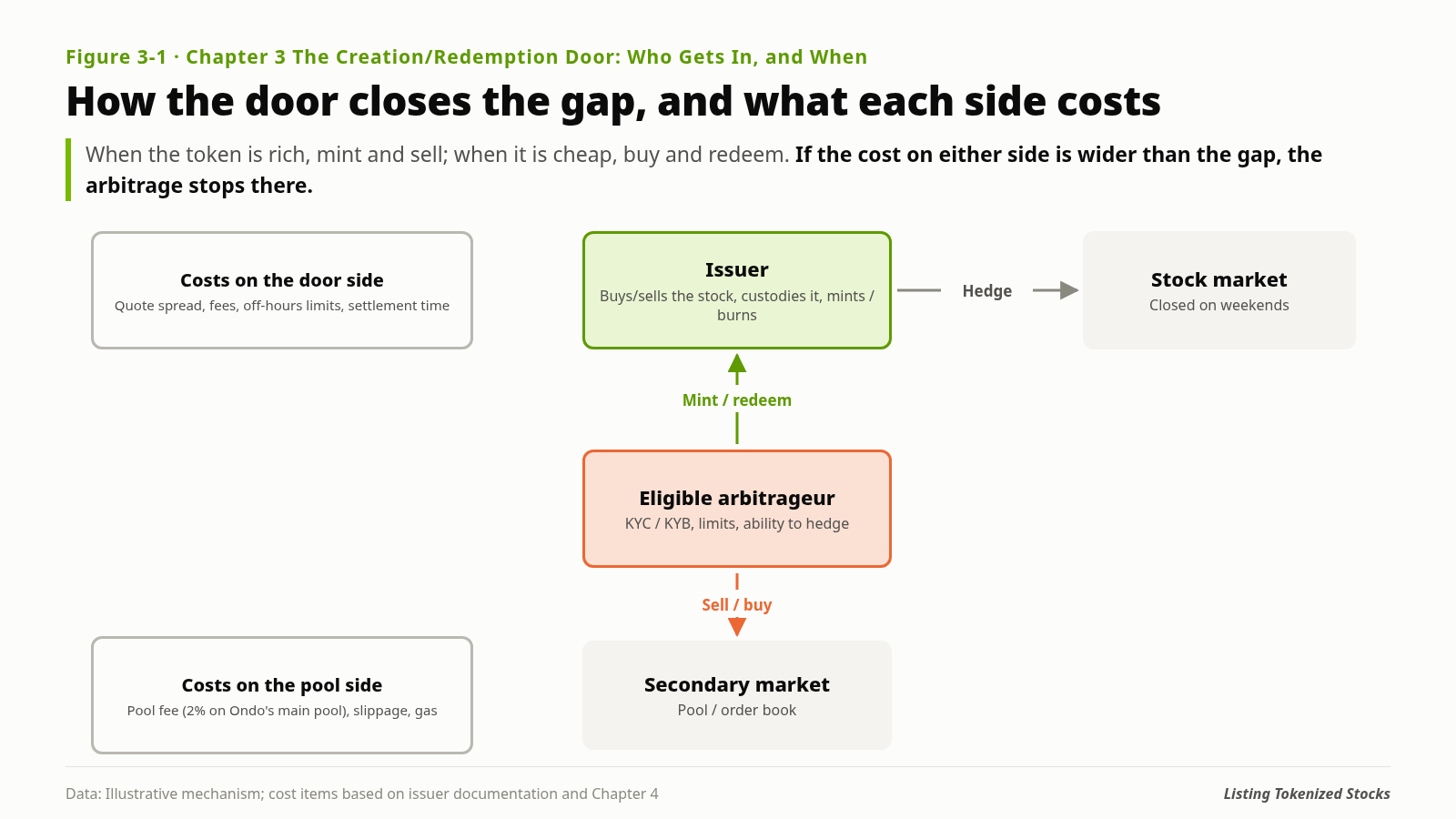
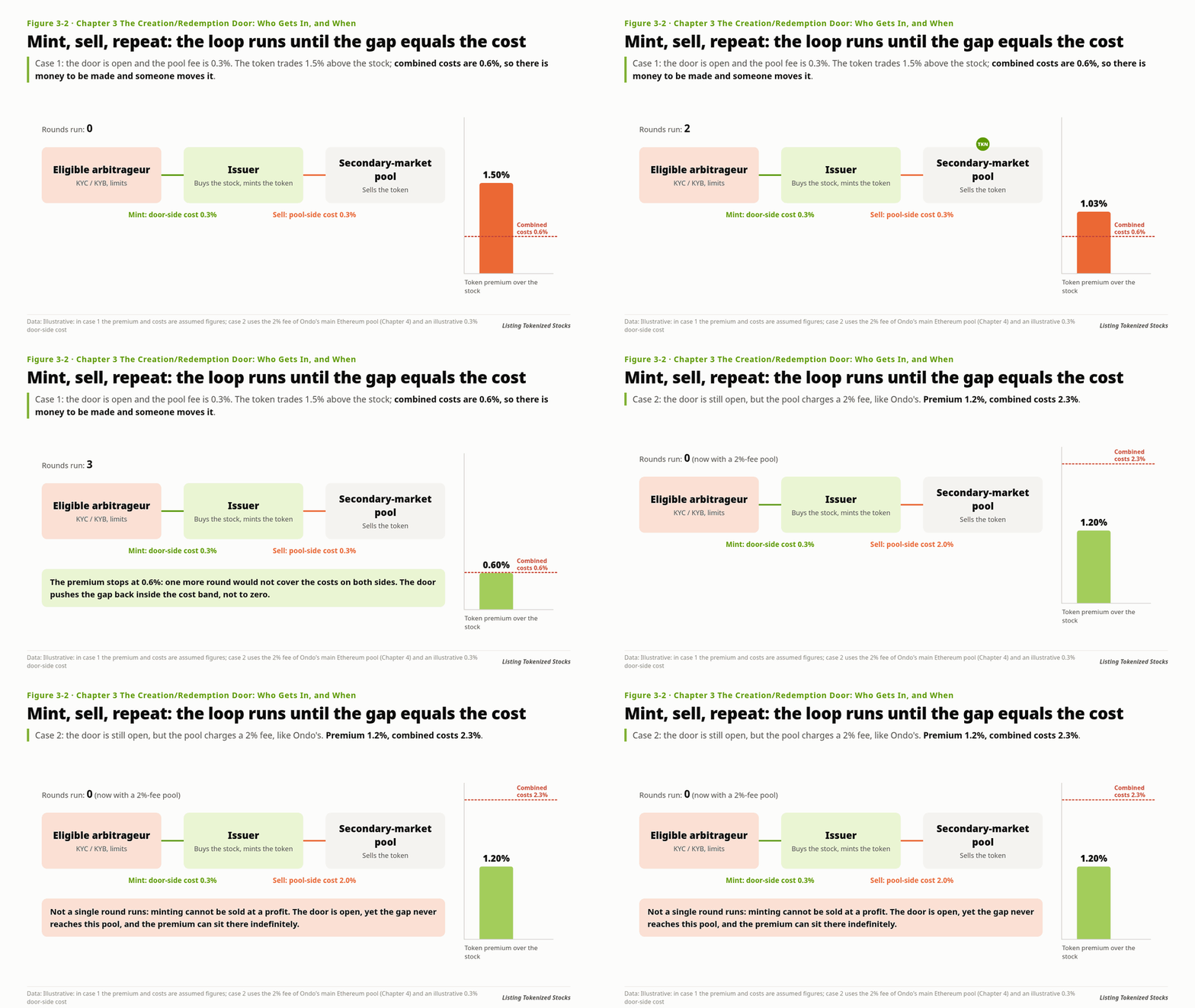
For this loop to run end to end, four things must all be in place:
- Eligibility: the minter has passed the issuer’s KYC/KYB and is in a permitted jurisdiction;
- Timing: the door is open and the issuer is accepting orders right now;
- Hedging: the issuer (or the minter) can complete the trade in the underlying stock market; otherwise someone carries the price risk in the meantime;
- Cost below the gap: the issuer’s quote spread, fees and on-chain costs, plus the costs on the secondary-market side (pool fee, slippage), must add up to less than the gap, or the arbitrage does not pay.
The fourth point is the easiest to miss. The piece on price sources looks at Ondo’s TSLAon pools on Ethereum: the largest charges a 2% fee, the second largest 1.5%. The door may be open, but if the pool’s fee is wider than the gap, the door’s effect never reaches the pool. Section 3 of this piece uses Saturday’s 14 transactions to show this.
2. Four doors: who gets in, and when
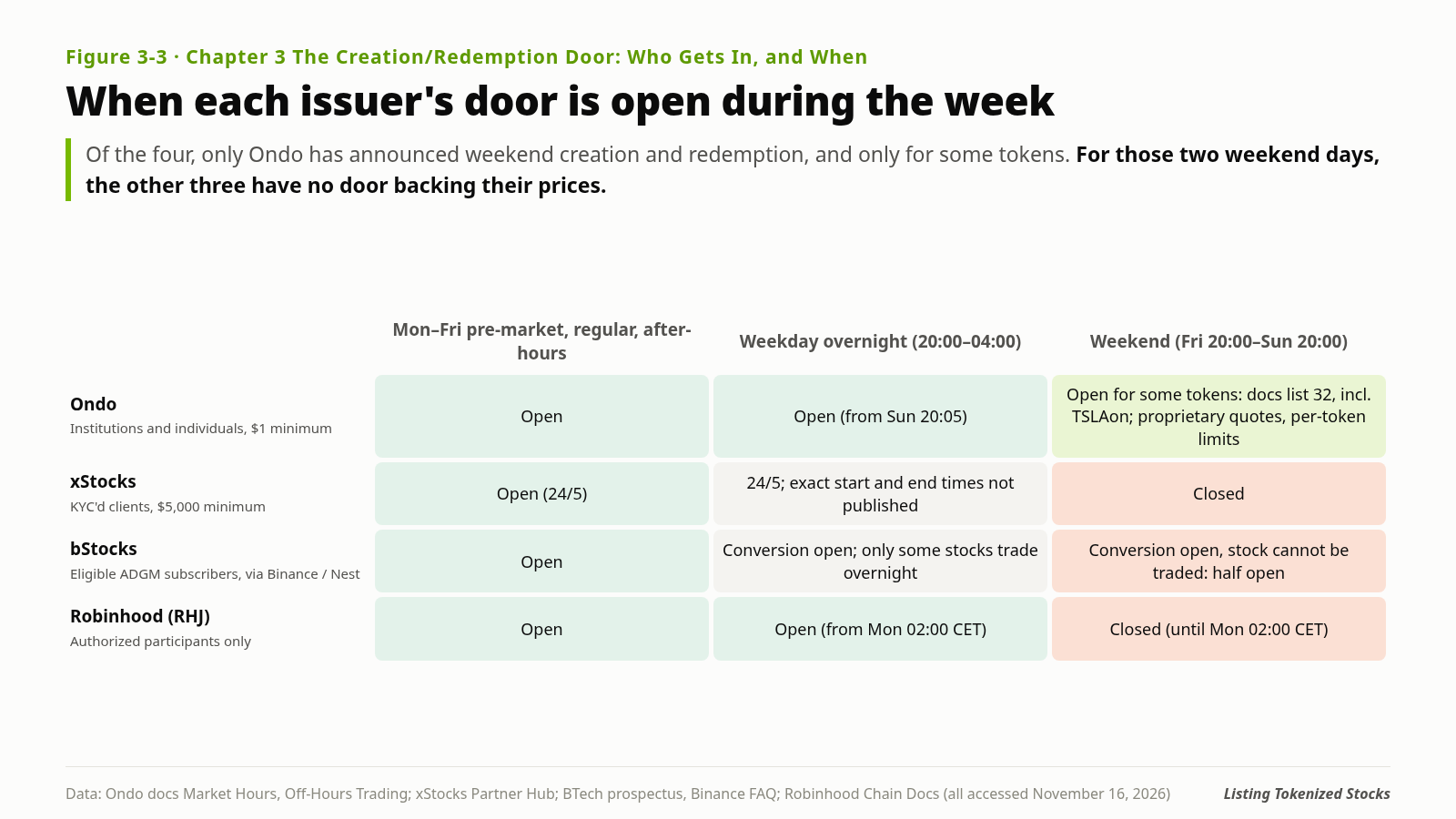
The short answer first: whether an individual can mint and redeem directly depends, issuer by issuer, on identity, jurisdiction, minimums and hours. Ondo is open to individuals who have passed KYC in supported jurisdictions, with a qualified-investor threshold in some of them, and a $1 minimum. xStocks is open to clients who have passed KYC, with a $5,000 minimum. Only Ondo has announced weekend creation and redemption. Robinhood’s door is open only to authorized participants. bStocks’ “conversion” works on weekends, but the cash side is closed.
- Issuer: Ondo Global Markets: Ondo Global Markets (BVI) Limited; xStocks (Backed): Backed Assets (JE) Limited; bStocks (BTech): BTech Holdings Ltd (ADGM); Robinhood (RHJ): Robinhood Assets (Jersey) Limited
- Who can mint/redeem directly: Ondo Global Markets: Institutions and individuals in supported jurisdictions, with KYC/KYB; some jurisdictions require qualified-investor status; xStocks (Backed): Clients who have passed KYC, including individuals; plus authorized participant Payward Digital Solutions; bStocks (BTech): Minting: eligible ADGM subscribers; redemption: eligible subscribers and some eligible secondary investors, via Nest Trading; Robinhood (RHJ): Authorized participants only (at launch, one: Bitstamp Global Ltd, BVI)
- US persons: Ondo Global Markets: Excluded (Reg S); xStocks (Backed): Excluded; bStocks (BTech): Excluded; Robinhood (RHJ): Excluded
- Minimum: Ondo Global Markets: $1; xStocks (Backed): $5,000; bStocks (BTech): Underlying can be bought in fractions, from $5; Robinhood (RHJ): Not published
- Hours: Ondo Global Markets: 24/5: Sunday 20:05 to Friday 19:59 (ET); some tokens also open off-hours (weekends, holidays), list below; xStocks (Backed): 24/5, following US equity trading hours; bStocks (BTech): Conversion described as “24/7, zero fee”; but buying and selling the underlying is at most 24/5; Robinhood (RHJ): Monday 02:00 to Saturday 02:00 (CET)
- Settlement: Ondo Global Markets: Minting is instant; redemption into USDon is instant, into USDC depends on the conversion pool’s balance; xStocks (Backed): On-chain quoted trades settle atomically; under the prospectus process, next business day after payment; bStocks (BTech): Settled with the issuer in USDC only; Robinhood (RHJ): Not published
- Cost: Ondo Global Markets: Built into the spread; spreads widen off-hours, with per-token limits; xStocks (Backed): Quote is the execution price; the spread is the only cost; bStocks (BTech): Conversion is free; spot trading fees apply; Robinhood (RHJ): Authorized participants may charge fees
(Sources and access dates at the end of this piece. “Not published” means we could not find it in public documentation on November 16, 2026.)
A few points need expanding.
Ondo’s weekend creation and redemption is described differently in different documents. This is the point in this piece that platforms most need to verify for themselves, so we set the statements side by side:
- Ondo blog, June 25, 2026: the first tokens with 24/7 minting and redemption are six: SPYon, QQQon, CRCLon, NVDAon, TSLAon and GOOGLon;
- The Q&A on the Ondo Stocks product page (undated, accessed November 16, 2026) still says “six tokens 24/7”;
- Ondo blog “What Sets Ondo Stocks Apart”, October 21, 2026: “25+” tokens support 24/7 minting and redemption, including Apple, NVIDIA and Tesla;
- Ondo documentation, “Off-Hours Trading” (undated, accessed November 16, 2026): lists 32 tokens tradable off-hours, including TSLAon, and says the authoritative list is on status.ondo.finance and the Ondo Stocks API;
- Ondo documentation, “Market Hours”: the regular window is 24/5, Sunday 20:05 to Friday 19:59; off-hours availability is “enabled token by token”, quotes use a “proprietary pricing methodology”, spreads may be wider, and each token has its own off-hours limit, which may lead to a pause once used up.
Part of the difference is chronology (6, then 25+, then 32: the list is growing), and part is pages that were never updated. Blogs and product pages are not contracts. What a platform should obtain is the clauses on creation/redemption hours, off-hours quotes and limits in the OGM Sales Terms, which Ondo provides after KYC, plus the current status of each token in the API. This series does not pick one of these statements as the definitive answer for you.
Robinhood’s door is narrower than it looks. RHJ’s base prospectus states that investors who are not authorized participants can redeem directly only in two cases: if all authorized participants have been in insolvency proceedings for 90 days without resolution, or have resigned or been terminated with no successor within 30 days; or if the issuer announces on its website that direct redemption is permitted. Robinhood’s user-facing Q&A says holders “can redeem directly with the issuer when there are no authorized participants”; that refers to this fallback clause. In normal times, only one institution can walk through the door. As Chapter 8 of Robinhood Goes Onchain noted, when there is only one authorized participant, creation/redemption efficiency and premiums/discounts all depend on that single firm.
bStocks’ door is “half open”. On Binance, the user first buys the underlying share through Nest Trading and then converts it 1:1 into bStocks, or the other way round. Officially, the conversion itself is 24/7 and free. But on weekends the underlying cannot be bought or sold (Binance’s US stock trading runs at most 24/5, with overnight sessions for only some stocks), so on a weekend you can turn your bStocks back into the stock but cannot sell the stock for cash: the cash leg of the arbitrage is cut. The prospectus also states that the issue price of newly issued certificates is set from the reference price on the previous regulated-exchange business day.
xStocks’ door is open to individuals, with a $5,000 threshold. The Q&A on the xStocks website says individuals can mint and redeem directly, subject to KYC and a $5,000 minimum; it also says that “in practice most users get liquidity on the secondary market”.
3. A weekend with the door open: Ondo’s on-chain record
The introduction and the piece on price sources both use a set of Sunday numbers: at 21:48 UTC on November 15, 2026, Ondo’s TSLAon was only +0.06% away from Friday’s close of $390.22, while xStocks (Solana, Ink), bStocks and Robinhood were between −0.31% and −0.54%. The most natural reading: Ondo’s door is open on weekends, and arbitrage pinned it near the closing price.
That reading does not hold, or at least these numbers cannot prove it. The piece on price sources established that the pool behind the Ondo reading had its last trade at 02:23 UTC on November 15: about 19.5 hours before the Sunday snapshot, and about 36 hours before 14:35 UTC on Monday. The reading was a frozen price. We then read every trade in that pool over the weekend, and every TSLAon mint and burn event (Ethereum, 01:00 UTC November 14 to 01:00 UTC November 16, i.e. the entire period when the other issuers’ doors were closed). The picture is more specific than “frozen”:
- The door was actually used. Over the weekend TSLAon saw 33 mints totaling about 933 tokens and 17 burns totaling about 23. The mints were concentrated on Saturday; the burns were mostly small, scattered amounts on Sunday.
- Almost every trade in the pool was “mint, then sell”. The largest pool had 19 trades over the weekend, all of them selling the token for USDC; 14 of them minted from Ondo and sold into the pool within the same transaction, the structure described at the start of this piece.
- The transaction amounts imply Ondo’s own weekend quote. In each transaction, the USDC spent on minting equals the USDC received from the sale; dividing it by the number of tokens minted approximates the unit price the minter actually paid: about $385.71 at 16:12 UTC on Saturday, and about $383.15 at 22:12 UTC. This assumes all of that USDC went into minting, with no deduction for the cost of the USDC-to-USDon route or for intermediate balances, so it is only an estimate, not Ondo’s quote itself. On this estimate, Ondo’s weekend quote was roughly 1.2%–1.8% below Friday’s close, and 0.4%–1.0% below the last after-hours trade of $387.11.
- The arbitrage stopped at the fee boundary. What the arbitrageur actually received on each sale fell from $386.05 to $383.19, net of the pool’s 2% fee. After the last mint, the pool’s marginal price was about 383.2 ÷ 0.98 ≈ $391, i.e. Ondo’s quote plus 2%. Selling any further would have yielded less than the cost of minting, so the arbitrage stopped at 22:12 UTC on Saturday, and the pool did not trade again after 02:23 UTC on Sunday.
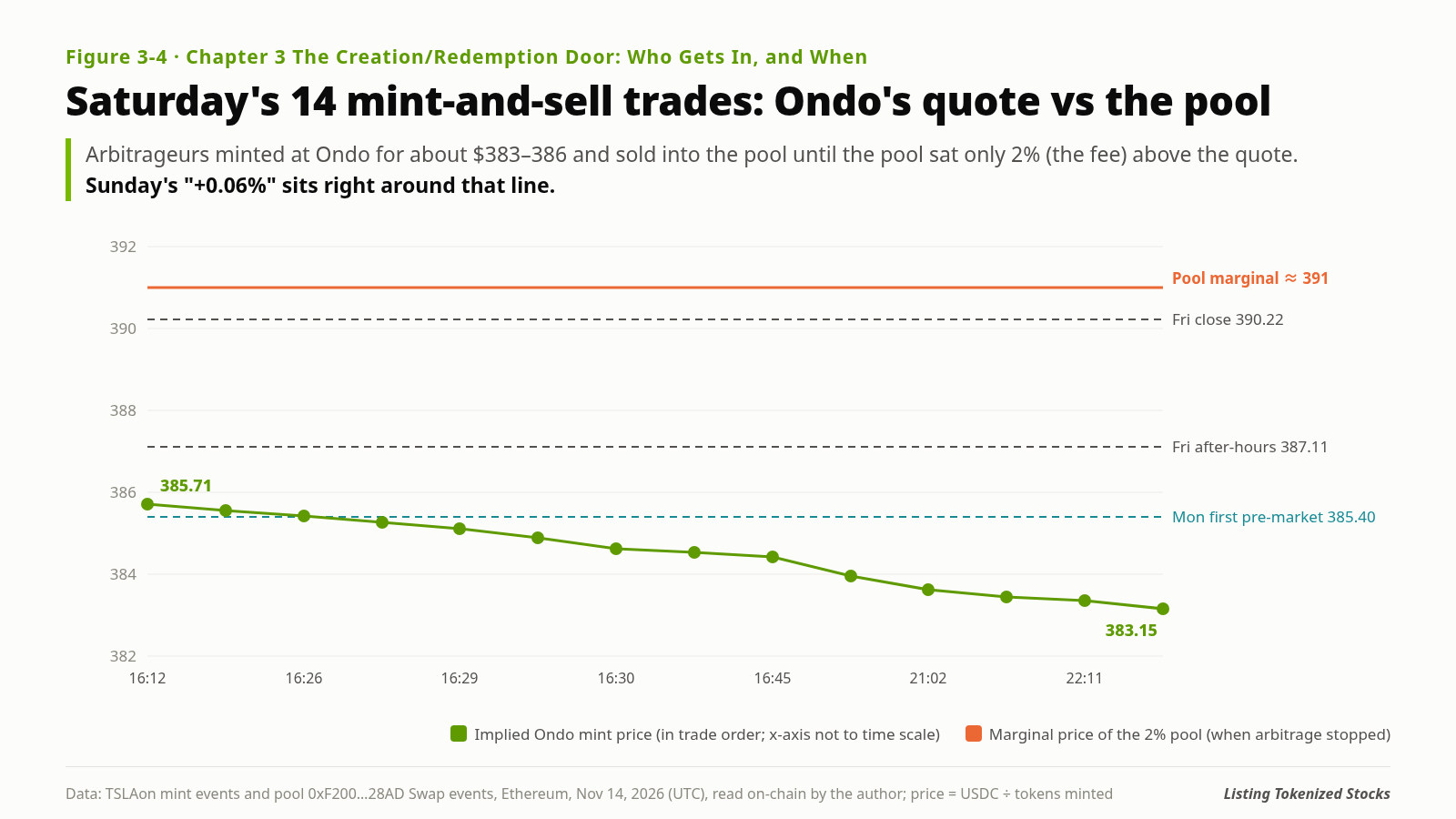
So Sunday’s +0.06% has two layers of meaning, and neither is “the price was hugging Friday’s close”:
- It was a last-trade price that had been stale for about 19 and a half hours (as of the 21:48 UTC snapshot);
- It happened to sit about 2% above the implied Ondo quote, exactly where the “mint, then sell into the 2% pool” arbitrage stops paying.
The door was open, and people were using it: in this sample, whenever the pool rose about 2% above Ondo’s quote, someone minted and sold, pushing the price back to that line. But this only verifies the upper edge. The opposite direction (buy from the pool when it is cheap, then redeem) has to cover the pool fee plus the redemption cost. There was not a single buy in this sample, so where the lower edge lies cannot be verified. For a platform reading a DEX price, this means that even with the door open, the price you see can sit about 2% away from the issuer’s quote.
One more detail worth noting: Ondo’s Saturday quote of $383–386 was close to $385.40, the first pre-market trade in the underlying at 4 a.m. ET on Monday. This is one set of trades on one weekend and does not show that Ondo’s off-hours quotes are consistently accurate, but it does suggest they are not simply pinned to Friday’s close.
Three kinds of data could genuinely test whether “24/7 creation and redemption makes prices track more tightly”. The book’s monitoring will add them next:
- The issuer’s own quotes: prices and available limits from Ondo’s quote API during off-hours, logged over time;
- Mint and burn events: the count, size and timing each weekend, and whether they share a transaction with a pool trade (the method used in this section);
- Trade timing in each pool: attach “minutes since the last trade” to every snapshot, and exclude readings above a threshold from comparisons.
4. When the door is closed, what holds the price?
The other three issuers’ weekends can be examined with monitoring data from the same period. In the 7 snapshots between 19:54 UTC Sunday and 00:00 UTC Monday (when the xStocks, bStocks and Robinhood doors were all closed; Robinhood’s window does not open until 01:00 UTC Monday), their deviation from Friday’s close swung between −0.54% and +0.62%, with all four sources rising and falling together. The piece on price sources also shows that around 19:00 ET on Sunday they rose together above the closing price and then fell back together. At such times there is no creation/redemption anchor that can be cashed in immediately: the only forces pulling the price toward any level are market makers’ quotes and their hedges in perpetual futures and the overnight session, and where the price sits depends on where market makers are willing to quote and how much risk they will carry.
But no creation/redemption anchor does not mean blind guessing. The piece on price sources records that at 3 a.m. ET on Monday, before the underlying had any quote, these four tokens were between $384.85 and $385.27; an hour later the first pre-market trade was $385.40, a gap of less than 0.15% for all of them. While the door is closed, the secondary-market price is the market makers’ estimate of where the market will reopen. This time the estimate was good, most likely because they were following stock perps or the overnight session that starts Sunday evening.
So during the hours when the door is closed, the real risk to a platform is not that “the price will be wrong”, but that:
- Nobody is obliged to pull the price back. However large the deviation, it can only wait for the door to open. Robinhood’s own disclosure standard for price deviations is “a deviation of more than 5% for 7 consecutive trading days”, which shows how wide a band the issuer tolerates;
- Thin pools are easier to push. Without creation/redemption as a backstop, a pool that a large order blows through has to wait until the door opens on Sunday evening and the arbitrageurs return;
- The price will jump when the door opens. Around 01:00 UTC on Monday, several issuers resume creation and redemption at once, and prices have to converge toward the overnight session and pre-market. This is the opening problem discussed in the piece on price sources.
5. Your options
Option A: become a direct creation/redemption client yourself. Open accounts with Ondo and xStocks (bStocks goes through Binance and Nest Trading; Robinhood only works through authorized participants). The upside is that you can move the gap yourself when it widens, including on weekends for the tokens Ondo supports. The cost is KYC/KYB, each issuer’s limits and spreads, the ability to hedge the underlying, and the compliance question of “on whose behalf are you minting”.
Option B: rely on market makers who have creation/redemption access. Most platforms will take this path. The key is to make market makers prove it: which issuers they have accounts with, what their limits are, whether they can transact on weekends, and how much they minted and redeemed over the past month. “We have a channel” does not count.
Option C: nobody can get through the door; accept secondary prices. Then, while the door is closed, your displayed price should be labeled “off-hours reference”, your price bands should be widened, and liquidations and large loans should be haircut or paused as described in the pieces on price sources and collateral.
Option D: choose issuers, or trading hours, according to when the door is open. If your users trade mostly on weekends, the risk of the Ondo tokens that can be minted and redeemed off-hours is of a different order from tokens that can only be minted and redeemed 24/5. But you also have to assess whether the door’s effect reaches the venue you actually connect to (the 2% pool in Section 3 is a counterexample).
Whichever you choose, remember: assess the creation/redemption door together with the pool or order book you connect to. The door sits with the issuer; the price is executed on your side.
Creation/redemption questions to ask the issuer before listing
Eligibility
- Which entities can mint and redeem directly: individuals, institutions, or authorized participants only? Which category do we (or our market maker) fall into, and how long does KYC/KYB take?
- Which countries and regions cannot mint or redeem, and which require qualified-investor status? How is the exclusion of US persons enforced (wallet, IP, account)?
- How many authorized participants are there? If there is only one and it exits or fails, how do holders redeem (e.g. RHJ’s “90 days / 30 days” fallback clause)?
Timing
- What are the exact start and end times of the creation/redemption window (to the minute, with time zone)? How are daylight saving time, US market holidays and early-close days handled?
- During off-hours (weekends, holidays), which tokens can be minted and redeemed? Where can that list be queried in real time? Which binding document contains it?
- Is creation/redemption paused during corporate actions, earnings or system maintenance? How much notice is given?
Price and limits
- How is the creation/redemption price set: the live price of the underlying, the previous business day’s close, or the issuer’s proprietary quote? What is the off-hours quote based on?
- How long is a quote valid? What are the per-transaction, per-day and per-token limits? What are the off-hours and regular limits, and what happens once they are used up?
- Fee structure: what are the explicit fees, quote spread, on-chain costs, and currency or stablecoin conversion costs?
Settlement
- How long after payment do we receive tokens on a mint, and how long after a redemption do we receive cash? In what currency is settlement made (USDC, USDon, fiat), and what happens if the conversion pool’s balance is insufficient?
- Who bears the price risk during settlement? Does the issuer hedge immediately in the underlying market?
- Is there an on-chain record of creation and redemption (mint and burn events, the corresponding contract addresses) so that we can monitor for ourselves whether the door is being used?
Conclusion
Whether a tokenized stock’s price tracks the underlying does not depend on what the issuer says. It depends on whom this door is open to, when it is open, and what it costs to go through.
When the door is open, arbitrage pushes the gap inside the fees; when it is closed, the price is the market makers’ estimate of where the market will reopen. To know which kind of price you are reading, check the door first, then the pool.
Sources
On-chain data (read directly by the author, November 16, 2026):
- All mint and burn events of Ondo TSLAon (Ethereum 0xf6b1…103f) between 01:00 UTC November 14 and 01:00 UTC November 16, 2026 (ERC-20
Transferfrom / to the zero address), blocks 26,409,792–26,424,154, via public RPCeth_getLogs: 33 mints totaling about 933.0 tokens, 17 burns totaling about 23.4 tokens. - All 19
Swapevents in the largest USDC pool 0xF200…28AD (fee()= 20000, i.e. 2%) over the same period, all selling TSLAon. Per-transaction receipts show that 14 of them were in the same transaction as a mint; minting went through Ondo’s GMTokenManager (0x2c15…5c8c, contract name verified via smarts), with USDC first converted to USDon and then minted; last trade at 02:23 UTC on November 15, 2026. The second-largest pool, 0x49b7…E988, had 14 trades over the same period. Implied unit price = USDC in the transaction ÷ tokens minted. - Price monitoring: the author’s
tsla_spread.csv(DexScreener last-trade prices; stablecoin quotes, liquidity ≥ $1,000, pools deviating more than 3% from the liquidity-weighted median removed, liquidity-weighted), 7 snapshots from 19:54 UTC November 15 to 00:00 UTC November 16, 2026; reference prices: Friday close $390.22, after-hours $387.11 (Yahoo Finance). The xStocks/Mantle column’s address is not in the official xStocks API and was not used.
Issuer documents (accessed November 16, 2026; primary excerpts kept in review/sources/):
- Ondo: blog “Ondo Launches First 24/7 Minting and Redemption for Tokenized Stocks” (June 25, 2026) https://ondo.finance/blog/real-24-7-trading-for-tokenized-stocks ; blog “What Sets Ondo Stocks Apart” (October 21, 2026) https://ondo.finance/blog/what-sets-ondo-stocks-apart ; product page https://ondo.finance/ondo-stocks ; documentation “Market Hours & Trading Availability”, “Off-Hours Trading” (32 tokens), “Investing & Redeeming” ($1 minimum, instant minting, USDon/USDC), “Token & Quote Pricing” (quotes valid about 30 seconds), “Eligibility”, “Onboarding & KYC”, “Legal & Regulatory” (Reg S), https://docs.ondo.finance/ondo-stocks/
- xStocks: Partner Hub “Learn” https://xstocks.fi/partners/learn (individuals can mint/redeem directly, $5,000 threshold, 24/5, spread is the only cost, not available to US persons); xStocks Docs https://docs.xstocks.fi/docs ; Backed base prospectus (issuance process: collateral bought and tokens activated the business day after payment; definition of authorized participant)
- bStocks: BTech Holdings prospectus (eligible ADGM subscribers, Nest Trading as minting and redemption agent, settlement with the issuer in USDC, issue price based on the previous business day’s reference price); Binance “Frequently Asked Questions on bStocks” and the bStocks landing page (24/7 zero-fee conversion, paused during corporate actions); Binance US stocks page (trading at most 24/5); Binance press release of June 12, 2026 (fractional shares from $5)
- Robinhood: Robinhood Chain Docs “Stock Tokens” https://docs.robinhood.com/chain/stock-tokens (tokenization window Monday 02:00 to Saturday 02:00 CET; only authorized participants can mint); RHJ base prospectus Condition 9.6 (investor redemption option and conditions for direct redemption; authorized participant Bitstamp Global Ltd); RHJ “Price Deviations” https://docs.robinhood.com/rhj/price-deviations (disclosure at 5% deviation for 7 consecutive trading days); Q&A at robinhood.com/rhj/stocktokens
- Cross-references: The piece on price sources (Ondo pool fees, about 36 hours without a trade, DexScreener missing pools); the piece on price sources (weekend price action, the four tokens at 3 a.m. Monday vs the first pre-market trade); Robinhood Goes Onchain, the piece on compliance (impact of having a single authorized participant)
Not yet confirmed (questions for issuers):
- The binding list of Ondo tokens that can be minted and redeemed off-hours: the blog (6 tokens, 25+ tokens), the product page (6) and the documentation (32) disagree. The OGM Sales Terms and the live API status should govern; we did not obtain the Sales Terms (provided only to investors who have completed KYC).
- The basis and limits of Ondo’s weekend quotes: the documentation mentions only a “proprietary pricing methodology” and “conservative per-token limits”, with no figures. The $383–386 in this piece is inferred from transaction amounts, not a quote published by Ondo.
- The exact start and end times of xStocks’ 24/5 window (opening time, closing time, time zone): the website says only “follows US equity trading hours”.
- Robinhood authorized participants’ creation/redemption fees, minimums and settlement times: the prospectus allows authorized participants to charge fees; specific figures are not published.
- The actual weekend availability of bStocks conversion and the list of stocks covered by Nest Trading’s overnight session: the official line is “24/7 conversion”, but restrictions on trading hours in the underlying need to be confirmed stock by stock.
- Who initiated the 17 small burns on Sunday, and why (individual redemptions or market-maker rebalancing): this piece only counted the events and did not trace each one.
— Excerpted from Listing Tokenized Stocks, Chapter 3: The Creation/Redemption Door: Who Gets In, and When
Full book: https://pickful.ai/books/kspm

Este contenido puede resultar interesante para quienes desean conocer más sobre el bienestar masculino. En https://saludmasviajes.mx/vitalidad-masculina/eroferon/ se puede consultar una explicación organizada y revisar los detalles del artículo.
轉發此貼文?
與您的關注者分享。
回覆