
Contents (5)

·
Fourteen Years Later: Are Rules a Burden or a Moat?
Back to the question
At the start of this book, we asked a question:
In an industry without rules, is choosing to stand on the side of the rules a burden or a moat?
After following Coinbase through fourteen years, from 2012 to 2026, the answer seems to be: both, depending on when you look.
In a bull market, rules are a burden. They made Coinbase slower to list coins, more expensive, harder to expand; they left it far behind Binance in global volume and made it the target of the bitcoin community’s mockery as “the bank of bitcoin.”
In a crisis, rules are a moat. When Mt. Gox went bankrupt and FTX collapsed, users needed a place where “money doesn’t disappear,” banks and Wall Street needed a partner “we can work with,” regulators needed a counterpart “we can talk to,” and standing in that spot, every time, was Coinbase.
And by 2026, when the rules were finally clear and everyone had started following them, rules were neither a burden nor a moat any more. They had become the price of admission. Coinbase had to go find its next moat.
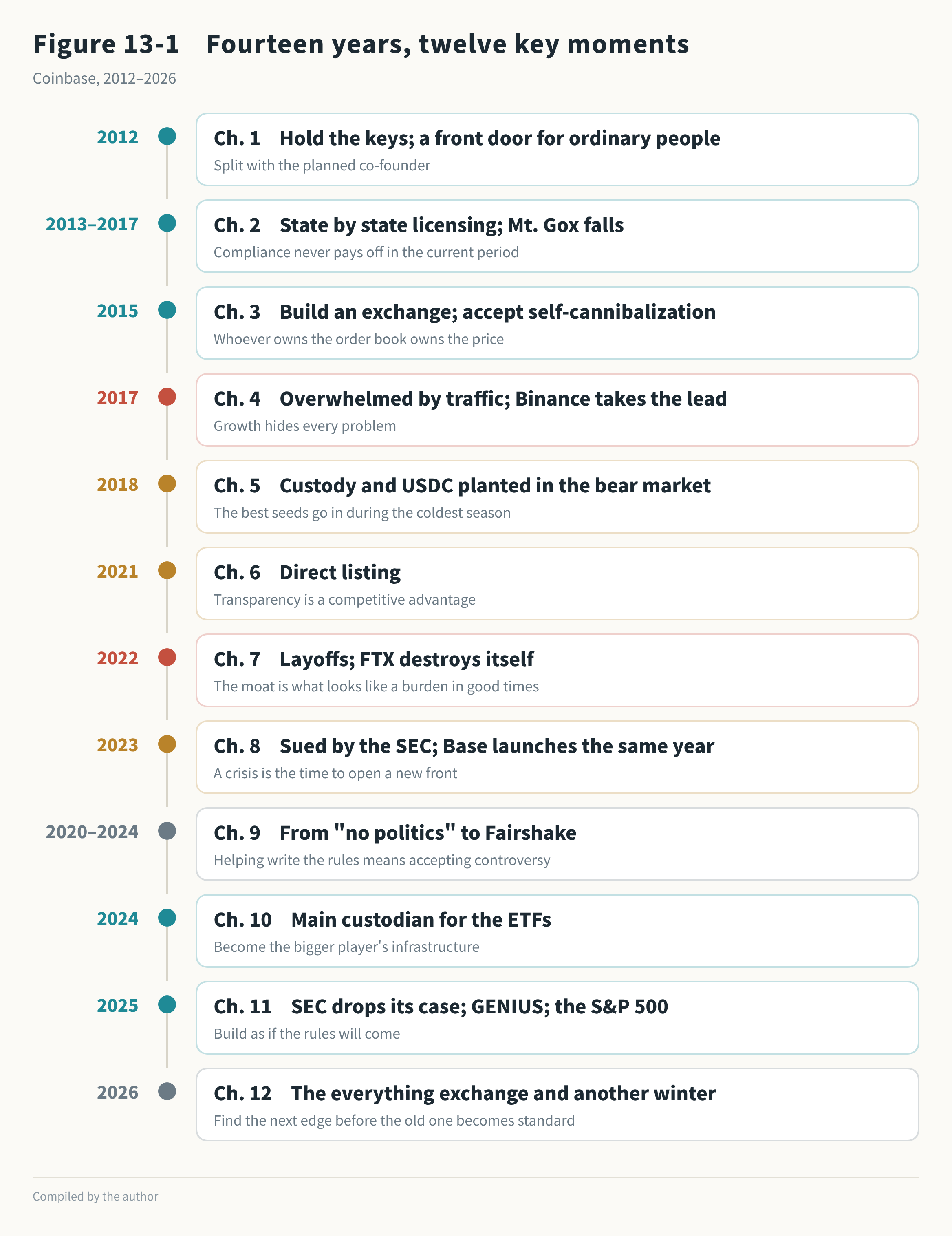
Fourteen years of books
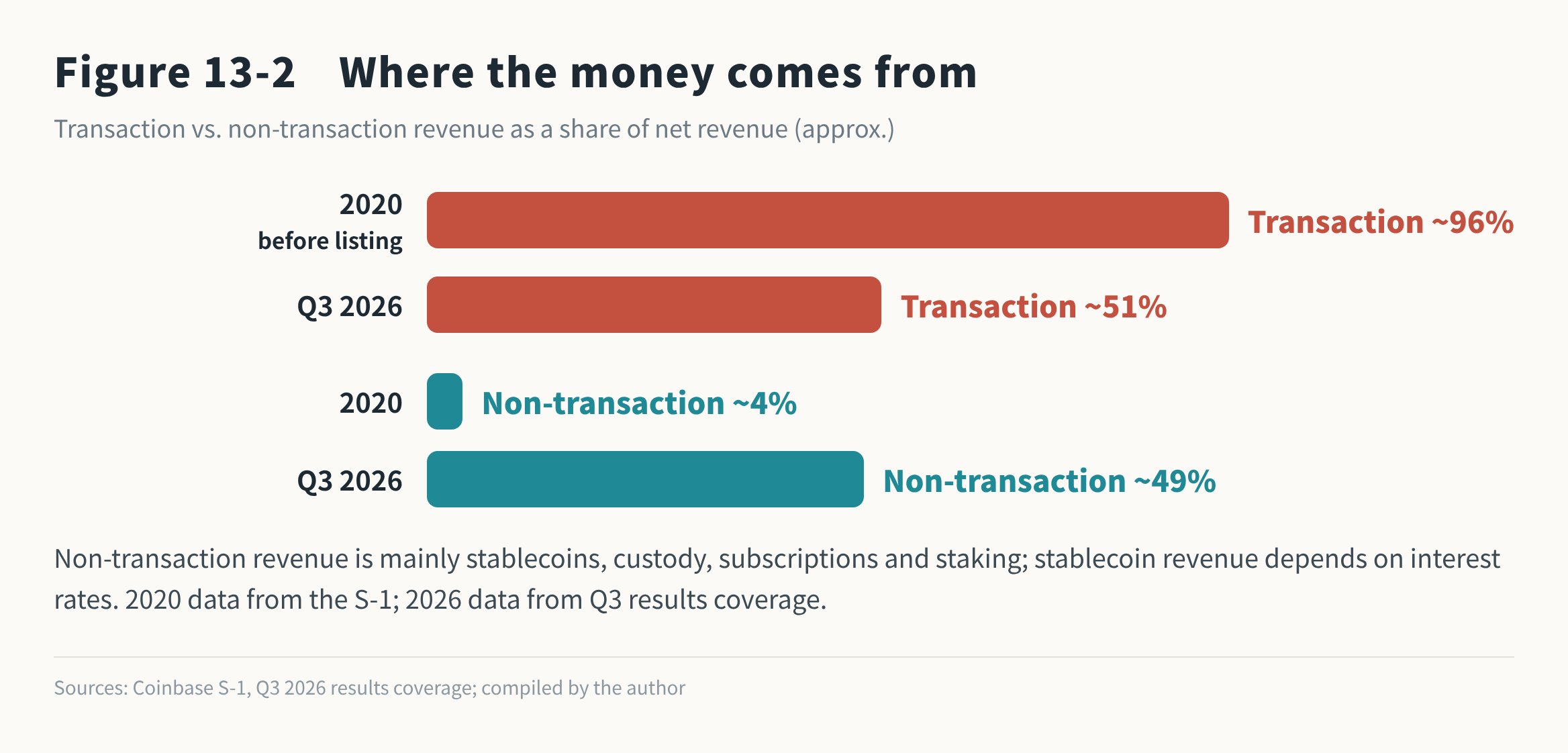
If you could look at only one thing to judge whether Coinbase has changed, it would be where its money comes from.
In 2020, as Coinbase prepared to go public, about 96 percent of its net revenue came from transaction fees. It was an exchange through and through: when prices rose and trading picked up, it made money; when prices fell and trading slowed, it lost money. It earned about $3.6 billion in 2021 and lost about $2.6 billion in 2022.
In the third quarter of 2026, transaction revenue fell sharply year over year, yet subscription and services revenue made up about 49 percent of net revenue. Stablecoins, custody, subscriptions and staking, seeds planted in the 2018 bear market that only sprouted in 2023 and 2024, held up half the company for the first time.
But that half isn’t steady enough yet. Stablecoin revenue depends on interest rates, and rates are set by the Federal Reserve, not by Coinbase. Going from “the coin price decides everything” to “the coin price and interest rates decide together” is progress, but it isn’t independence.
Who fell and who survived
Again and again in this book, Coinbase came out ahead as its rivals fell. The table below records the rivals around it that fell, were wounded, or are still standing.
- 2014: Rival: Mt. Gox; Path chosen: Grew wildly, weak security and management; Outcome: Lost about 850,000 bitcoin, bankrupt
- 2014: Rival: BitInstant; Path chosen: Fast exchange, ignored compliance; Outcome: Founder arrested, pleaded guilty, imprisoned
- 2016: Rival: Bitfinex; Path chosen: Offshore operation; Outcome: About 120,000 bitcoin stolen, survived
- 2022: Rival: Terra/LUNA; Path chosen: Algorithmic stablecoin; Outcome: Went to zero within days
- 2022: Rival: Three Arrows Capital, Celsius, Voyager; Path chosen: Highly leveraged lending; Outcome: Bankrupt one after another
- 2022: Rival: FTX; Path chosen: Misused customer assets, compliant on the surface; Outcome: Bankrupt, founder sentenced to 25 years
- 2023: Rival: Binance; Path chosen: Rapid expansion, offshore operation; Outcome: Pleaded guilty and paid about $4.3 billion, founder imprisoned four months, survived
- 2026: Rival: Binance; Path chosen: —; Outcome: Hacked for about $6.3 billion, covered with its own funds, survived
- —: Rival: Coinbase; Path chosen: Compliance, custody, public listing, transparency; Outcome: Joined the S&P 500 in 2025, still standing
Twelve operating principles
Each chapter ended with a lesson to take away. Put together, they are the twelve principles Coinbase’s fourteen years leave for founders and operators.
- The biggest opportunity in a new technology is often not the technology itself, but the layer that makes it usable for ordinary people.
- First figure out who your users are, then accept the full cost of serving them.
- When your core capability is in someone else’s hands, take it back early, even if it hurts your existing business.
- In a bull market, growth hides every problem; a company’s real foundation shows at the moment traffic overwhelms it.
- The most important seeds are planted in the coldest season; new businesses should complement the existing one, not rise and fall with it.
- In an opaque industry, transparency is itself a competitive advantage.
- The real moat is the things that look like burdens in good times.
- In the biggest crisis, don’t think only about defense; a crisis is often the best time to open a new front.
- When your industry has no rules, you must sooner or later decide whether to wait for them or help write them; taking part means accepting the controversy that comes with it.
- When a bigger player enters, don’t stand in its way; become its infrastructure, and move quickly to do what it can’t.
- When the rules change, the biggest winners are those that always built themselves to the standard that “the rules will eventually come.”
- When your differentiator becomes industry standard, you must find the next advantage before the old one disappears.
A final reminder
This book leans toward positive lessons, but throughout we have tried to separate three things: good judgment, luck, and being wrong but correcting quickly.
Luck plays no small part in Coinbase’s story. It caught bitcoin’s first breakout in 2013, the pandemic bull market of 2020 and the electoral turn of 2024; of its two biggest rivals, one died of its own security failures and the other of its own fraud.
To credit all of this to Armstrong’s foresight would be to reason backward from the outcome.
What is truly worth learning is not what Coinbase got right, but how it made choices under uncertainty: first figure out whom you serve, accept the full cost of that choice, plant seeds while others are partying, stay standing while others fall, and when you are wrong, admit it and correct quickly.
All of this applies just as well in any new industry that doesn’t yet have rules.
From my new book Coinbase: On the Side of the Rules: https://pickful.ai/books/tqn4
Repost this post?
Share with your followers.
Reply