
Contents (9)

·
The Tesla Token With the Most Reported Liquidity Charges 2% to Sell $1,000

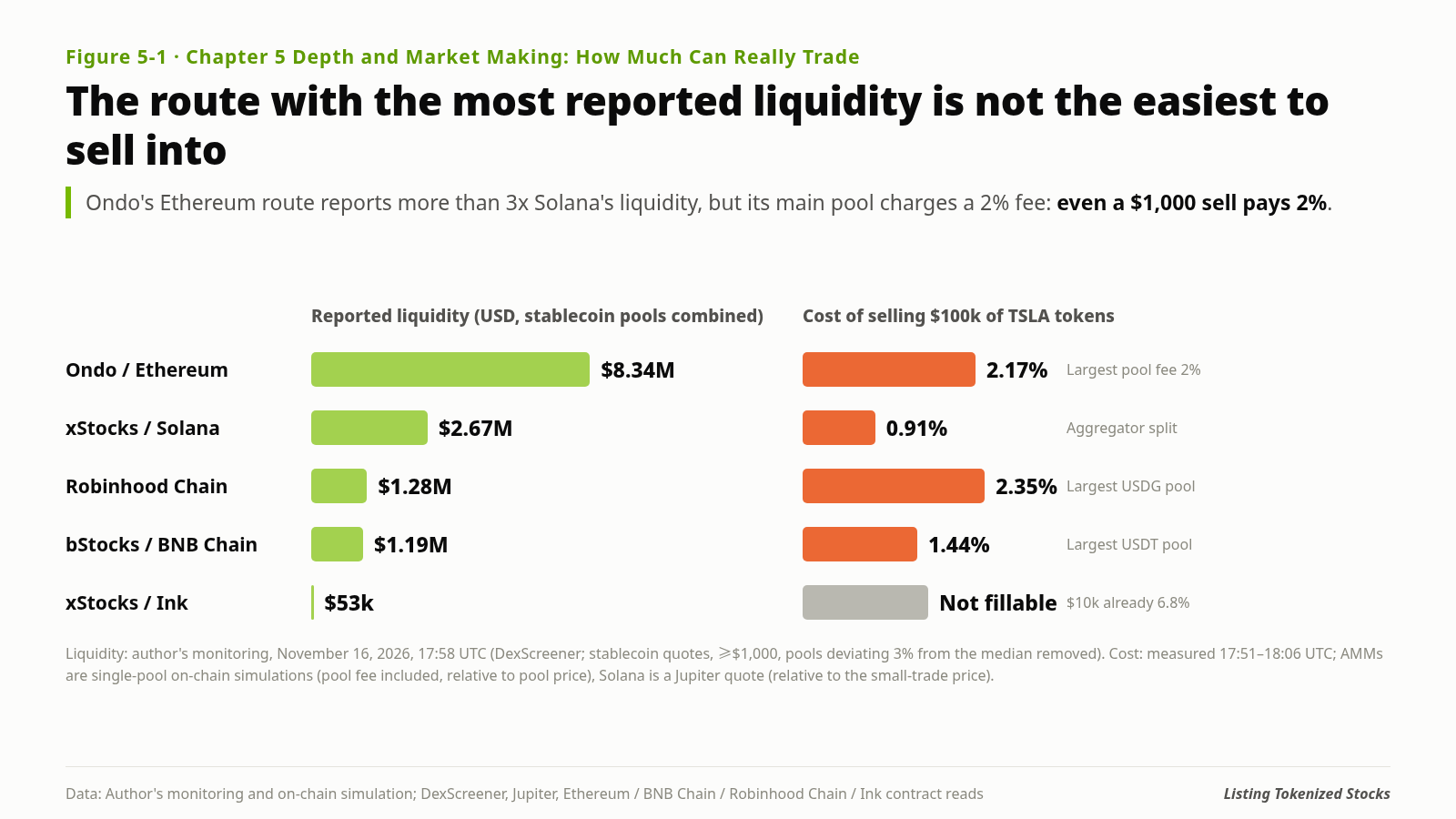
At midday ET on Monday, November 16, the author's monitoring showed Ondo's Tesla token on Ethereum, TSLAon, reporting $8.34 million of liquidity: more than three times the xStocks version on Solana ($2.67 million), and the most of any Tesla token. At the same moment, selling $1,000 into its largest pool cost 2.0%; selling $10,000 on Solana through an aggregator cost only 0.08%.
At midday ET on Monday, November 16, the author’s monitoring showed Ondo’s Tesla token on Ethereum, TSLAon, reporting $8.34 million of liquidity: more than three times the xStocks version on Solana ($2.67 million), and the most of any Tesla token. At the same moment, selling $1,000 into its largest pool cost 2.0%; selling $10,000 on Solana through an aggregator cost only 0.08%.
The decisions this piece asks you to make: on your platform, how large can a single tokenized-stock order be; where is that order routed for execution; should you sign a market maker, and what goes into the contract; and should you connect an aggregator? Before making these decisions, you have to take the “liquidity” figure apart and replace it with “what does it cost to sell $10,000, $100,000 and $1 million”.
First, the limits of the sample: the depth data in this piece come only from a window of about 15 minutes during US trading hours on November 16. The “dividing lines” and “cliffs” described below are readings from this one sample. Depth during off-hours, in the first half hour after the open, and on other trading days was not measured; the second edition will update the figures with multiple time points.
1. What reported liquidity is
The “liquidity” shown by DexScreener, GeckoTerminal and most market-data sites is the combined market value of the two assets in a pool. It answers “how much money is in the pool”, not “how much can I sell”. Three things stand between the first question and the second:
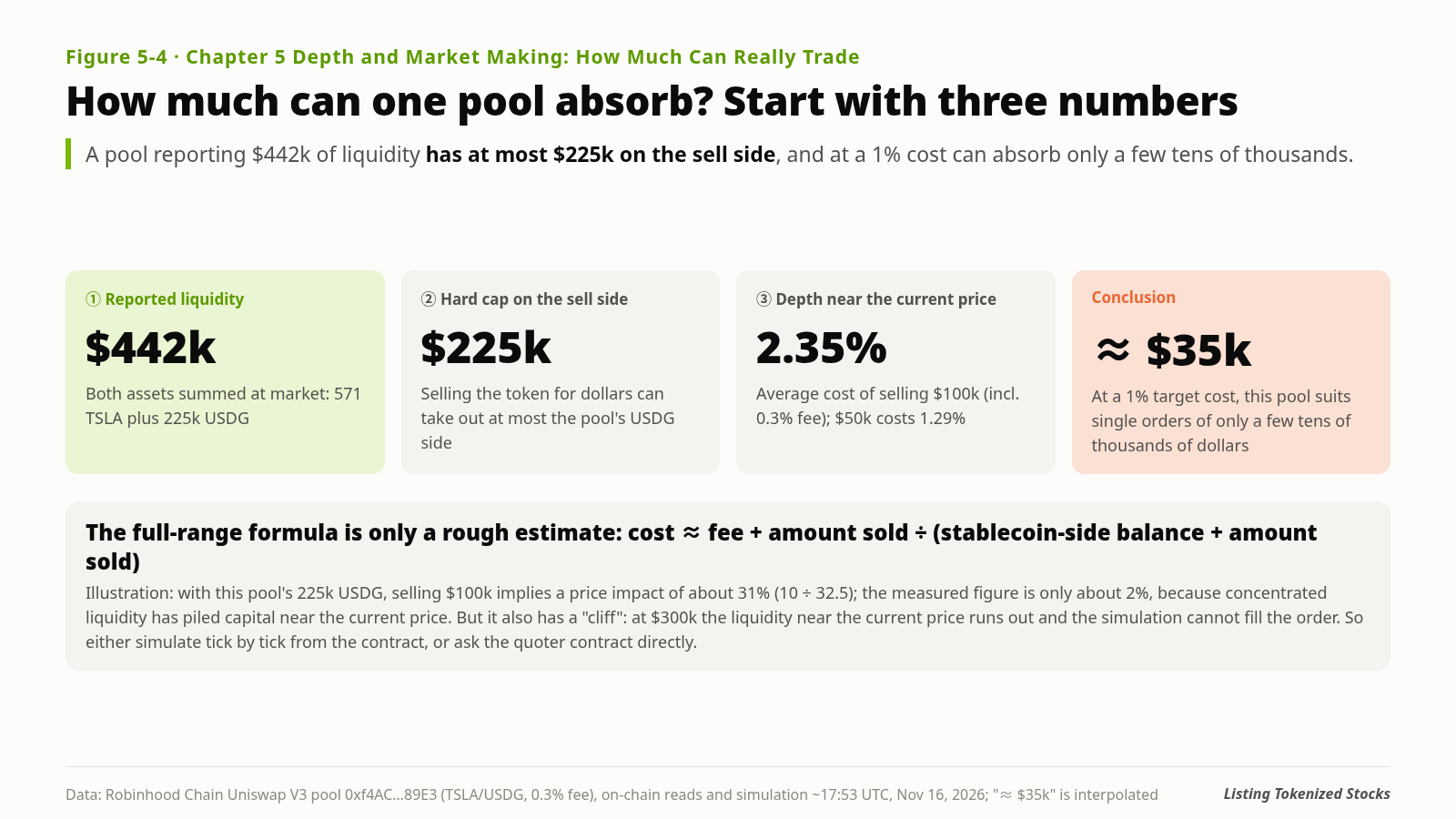
- A sell can only take one side. When you sell the token for a stablecoin, the most you can receive is the balance on the stablecoin side of the pool, usually about half of the reported liquidity. The largest TSLA/USDG pool on Robinhood Chain reports $442,000, of which only $225,000 is USDG.
- Concentrated liquidity counts only the part near the current price. In pools such as Uniswap V3, liquidity providers can place capital in any price range. Positions more than 20% away from the current price are included in the total, but a normal order never touches them.
- The fee is a fixed cost. Pool fees range from 0.05% to 2%, and you pay them however small the order. The piece on price sources showed that the main pools on Ondo’s Ethereum route charge 1.5% and 2%, so the price can sit anywhere within the fee band without moving. This piece looks at the other side of the same fact: trading in such a pool starts at 2%.
So reported liquidity is useful only as a first screen: anything too small is ruled out. In the multi-ticker monitoring at 17:58 UTC on November 16, Ondo’s MSFT token on Ethereum had only about $1,800, and Ondo’s NVDA token on BNB Chain about $2,500; in pools like these, a single normal order can push the price away. The deployments that rank near the top still need their depth checked one by one.
At the same moment, the deployment with the most reported liquidity for each of the 10 tickers was spread across different issuers: for NVDA, bStocks / BNB Chain ($4.46 million); for SPY, Robinhood Chain ($5.62 million); for CRCL, xStocks / Solana ($4.24 million); for TSLA, Ondo / Ethereum ($8.34 million). No single issuer is deepest on every ticker. A platform that picks its routes by issuer across the board will pick wrong for at least some tickers.
2. The same order: what it costs to sell, and where
Between 17:51 and 18:06 UTC on November 16 (12:51 to 13:06 ET, during regular trading), we ran a round of measurements on the main venues for Tesla tokens:
- Centralized-exchange order books: Kraken (TSLAx/USD), Binance (TSLAB/USDT), Bybit (TSLAX/USDT), OKX (XTSLA/USDT), Gate (TSLAX/USDT). We read the bids and asks from public APIs and computed the average cost of taking a given amount in one go, relative to the best price, excluding taker fees;
- The Lighter order book on Robinhood Chain: the TSLA spot token and the TSLA perpetual future, same method;
- On-chain AMM pools: the largest stablecoin pool on each of Ethereum, BNB Chain, Robinhood Chain and Ink. We read the current price, liquidity and per-tick liquidity changes from the contract and simulated a sell tick by tick, including the pool fee, relative to the in-pool price (for the small 1%-fee pool on Ethereum we cross-checked against Uniswap’s official quoter contract; the simulation and the quote differed by less than 0.3 percentage points);
- A Solana aggregator: Jupiter’s public quote API, which splits an order across several pools, measured relative to the execution price of a $100 trade.
Cost of selling Tesla tokens:
- Lighter TSLA perp: Sell $10k: 0.1 bp; Sell $100k: 1.3 bp; Sell $1M: 32.7 bp
- Kraken TSLAx/USD: Sell $10k: 3.2 bp; Sell $100k: 6.6 bp; Sell $1M: Not fillable
- Binance TSLAB/USDT: Sell $10k: 1.9 bp; Sell $100k: 6.2 bp; Sell $1M: Not fillable
- Bybit TSLAX/USDT: Sell $10k: 2.3 bp; Sell $100k: 5.1 bp; Sell $1M: Not fillable
- OKX XTSLA/USDT: Sell $10k: 2.9 bp; Sell $100k: 15.8 bp; Sell $1M: Not fillable
- Lighter TSLA spot: Sell $10k: 0; Sell $100k: 15.3 bp; Sell $1M: Not fillable
- Gate TSLAX/USDT: Sell $10k: 8.4 bp; Sell $100k: 49.9 bp; Sell $1M: Not fillable
- Solana aggregator (Jupiter): Sell $10k: 8 bp; Sell $100k: 91 bp; Sell $1M: 4,017 bp
- BNB Chain largest pool (0.25% fee): Sell $10k: 34 bp; Sell $100k: 144 bp; Sell $1M: Not fillable
- Robinhood Chain largest USDG pool (0.3%): Sell $10k: 50 bp; Sell $100k: 235 bp; Sell $1M: Not fillable
- Ethereum Ondo largest pool (2%): Sell $10k: 202 bp; Sell $100k: 217 bp; Sell $1M: 372 bp
(bp = basis point, 1 bp = 0.01%. “Not fillable” means the orders returned by the API, or the pool’s liquidity within about 27% above and below the current price, did not add up to this amount. Order-book APIs have depth limits (Bybit 200 levels, Gate 100 levels), so orders further away were not counted. The in-pool price of the Ethereum Ondo pool was about 1.2% above the stock; measured against the stock, the seller’s actual loss is somewhat smaller than shown in the table, for the reasons explained in the piece on price sources.)
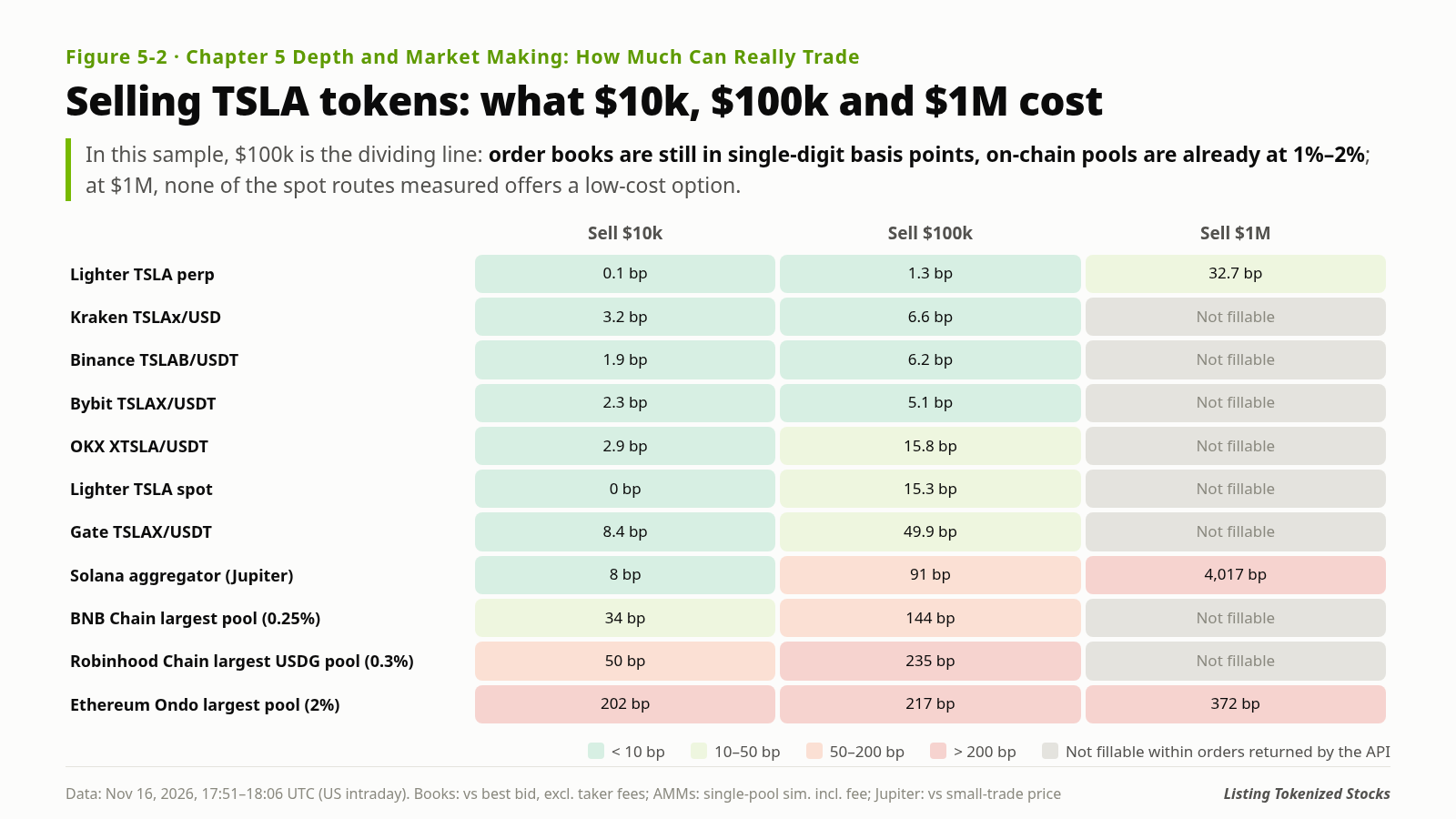
Three things can be read from this table.
First, in this sample, up to $10,000 can be sold almost anywhere. Order books were all within 10 bp, and the Solana aggregator at 8 bp. The only exceptions were pools whose fee is high to begin with (Ondo’s 2%) and very thin pools (Ink, where selling $10,000 cost 6.8%). For retail-sized orders, the choice of route makes little difference to the platform.
Second, in this sample, $100,000 is the dividing line. The order books of the main exchanges were still at 5–16 bp, while on-chain pools had reached 1%–2.4%: more than an order of magnitude apart. On November 2 the author took another measurement on Robinhood Chain using Lighter’s public API, and the direction was the same: at that time, taking $100,000 in the SPY spot token cost 29.1 bp, while the perp on the same underlying cost only 0.7 bp. Both are single points in time; they show direction only and cannot be treated as stable thresholds.
Third, in this sample, at $1 million none of the public spot paths measured offered a low-cost execution. Every spot venue either could not fill $1 million or charged 3.7% or more; selling $1 million through the Solana aggregator was quoted 40% below the small-trade price. Paths we could not measure are not in this table: market-maker RFQs, OTC blocks and issuer creation/redemption may all offer better prices, and Sections 5 and 6 below discuss how to turn them into verifiable commitments. The low-cost depth visible at the same moment was in perpetual futures: selling $1 million in Lighter’s TSLA perp cost 32.7 bp, the SPY perp about 5–6 bp, the NVDA perp about 34 bp; on November 2, the SPY perp was 12.4 bp and the NVDA perp 25.6 bp.
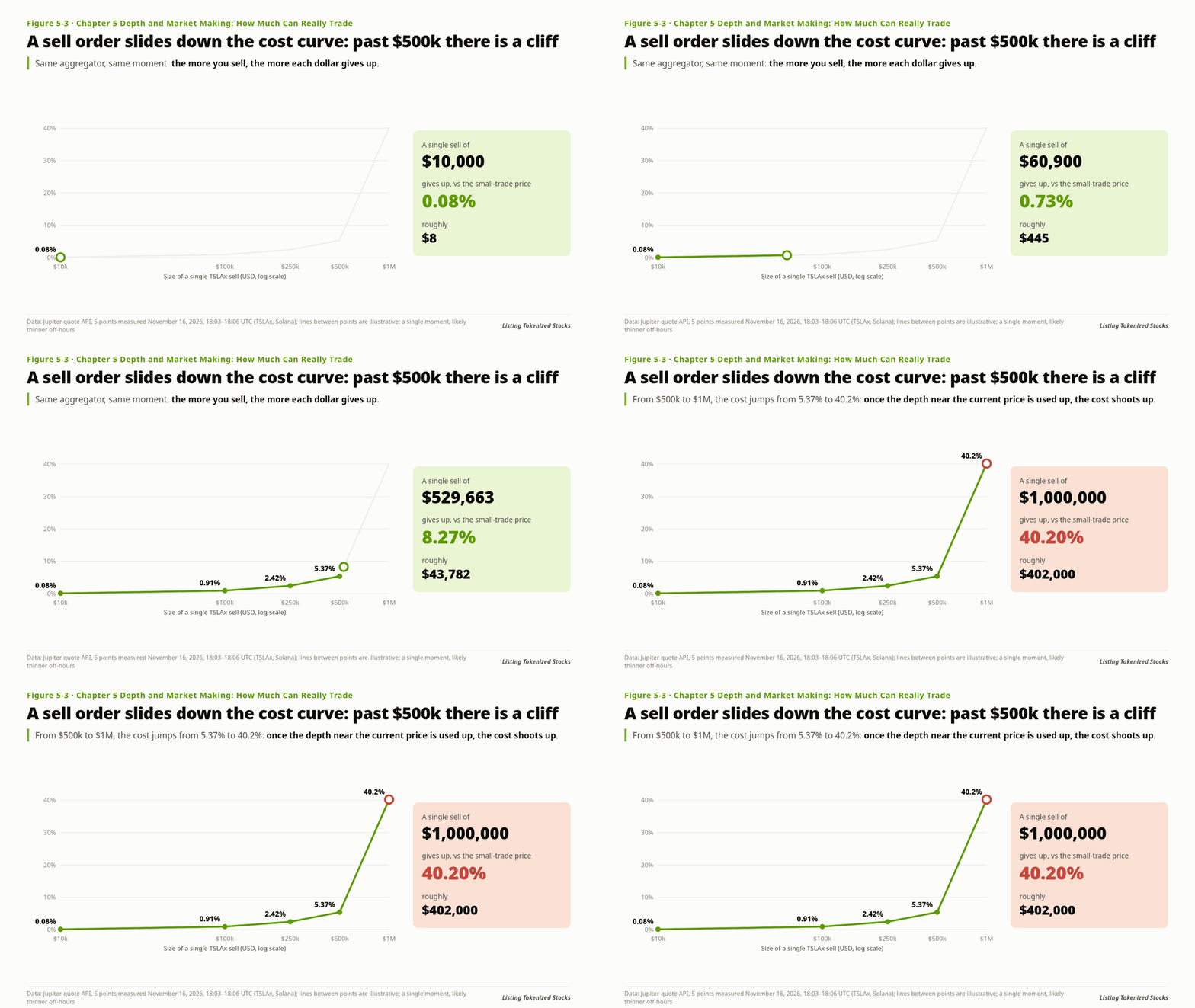
At the same moment we also measured two more sizes on the Solana aggregator, $250,000 and $500,000: 2.42% and 5.37% respectively. Connecting the five points shows the shape more clearly than the table: up to $500,000 the cost rises gradually; past $500,000 the depth near the current price is exhausted and the cost jumps to 40%. This is a curve from a single moment; off-hours it may be thinner.
There is a distinction here that matters a great deal to platforms: perpetual futures provide price exposure; they do not deliver the token. If what you need to sell on a user’s behalf is the token itself, perp depth cannot be used directly. Its role is covered in the piece on collateral and in Section 6 of this piece: a liquidator or market maker can hedge on the perp first and then sell the token gradually.
3. Estimating a pool’s slippage without a quote API
Not every chain has an aggregator quote like Jupiter’s, and not every pool lets you call a quoter contract directly. For a listing assessment, you can estimate in three steps:
- Read both balances to set a hard cap. The cap on the sell side is the stablecoin balance. DexScreener’s API returns the amount of each asset in the pool, so you do not need to compute it.
- Make a rough estimate with the full-range formula. Treat the pool as a constant-product pool. With sell amount Q, stablecoin-side balance R and fee f, the average cost is roughly f + Q ÷ (R + Q). Illustration: in a pool with $500,000 on the stablecoin side and a 0.3% fee, selling $50,000 gives a rough cost of 0.3% + 5 ÷ 55 ≈ 9.4%.
- For concentrated-liquidity pools, simulate tick by tick or ask the quoter contract directly. The full-range formula is far off for these pools. The TSLA/USDG pool on Robinhood Chain has $225,000 on the stablecoin side; by the formula, selling $100,000 costs about 31%, but the tick-by-tick simulation gives only 2.35%, because liquidity providers’ capital is piled up near the current price. Selling $300,000, however, uses up the capital near the current price, and the order cannot be filled. In a concentrated-liquidity pool, once the depth near the current price is used up, the cost of large orders rises steeply.
On top of these three steps, add the deviation of the price itself: the in-pool price may already be stale, or may sit a full fee above the stock. Slippage is measured from the in-pool price; how far the in-pool price is from the stock has to be added separately.
4. Order books on centralized exchanges
Tokenized stocks are listed on more centralized exchanges than many people assume. The Tesla token pairs we found directly in public APIs this time were: Kraken’s TSLAx/USD (xStocks); xStocks pairs on Bybit, OKX and Gate; and Binance spot TSLAB/USDT (bStocks, status: trading normally).
Their characteristics are the opposite of on-chain pools: very cheap from small sizes up to $100,000, but the visible total is limited. At that moment during the session, Kraken’s TSLAx bids totaled about $416,000, Binance’s TSLAB about $400,000, Bybit’s top 200 levels about $210,000, and OKX’s top 400 levels about $190,000. A $1 million sell order could not be fully absorbed by the visible bids at any of them.
Kraken’s approach is worth studying. Its announcement of xStocks margin trading states that position limits are set “based on order book depth”. In its public API, the one-sided margin position limit for TSLAx/USD is 250 tokens, about $95,000 at the time; other xStocks range from 150 to 1,400 tokens, e.g. SPYx 150 tokens (about $110,000), NVDAx 550 tokens (about $86,000), AAPLx 400 tokens (about $140,000). That magnitude falls right within the range where taking $100,000 on its own order book costs single-digit basis points.
One more point to remember: Kraken has acquired Backed, the issuer of xStocks. When an exchange is also the issuer’s parent company, a platform should get clear, before connecting, on how the order book’s market-making arrangements relate to the creation/redemption channel.
5. How a platform should decide: order limits, market making, aggregators
Single-order limit. Set a target cost first, then work backward to the size:
Single-order limit = the size at which the taker cost, on the venues you actually route to, reaches the target cost; one notch lower during off-hours.
Illustration: set the target cost at 50 bp. Using the intraday data from November 16, a Tesla token routed through the Solana aggregator cost 47 bp to sell $50,000, so the limit is around $50,000 (in this sample); routed to Robinhood Chain’s largest pool, $10,000 already cost 50 bp, so the limit is $10,000; routed to Kraken’s or Binance’s order book, $100,000 cost less than 10 bp, so the limit can be set above $100,000, but not above one third of the visible bids. This number must be updated daily: when depth changes, the limit changes with it.
Market-making arrangements. There are three options, with different costs:
- Connect only to external venues (pools, exchanges): Benefit: No inventory risk for you; Cost: Depth is not yours to decide; orders above $100,000 must be split or rejected
- Sign an external market maker, with performance terms: Benefit: You can require “$100,000 two-sided, spread within X bp, uptime Y%” (terms in Section 6); Cost: You pay fees or rebates; off-hours, market makers widen or pull their quotes
- Connect to the issuer’s creation/redemption or RFQ channel: Benefit: In theory, depth matches the underlying; Cost: Open only to eligible institutions, with hours and minimums; the depth is the issuer’s claim, and you cannot see it
The problem with the third option is “you cannot see it”. In its April 15, 2026 risk assessment of xStocks, Jupiter Lend wrote that xStocks trade mainly via request for quote (RFQ), with “more than $100 million of sell-side liquidity per asset at any time”. That is its assessment, and we cannot verify it. What we can measure are the public on-chain paths: on the same day, selling $1 million through the aggregator was quoted 40% lower. When the two numbers are this far apart, it means depth depends on whom you can call. A platform that sets limits based on RFQ depth needs a written market-making commitment, and needs to confirm that the counterparty will still be quoting when you need to sell, especially during off-hours.
Whether to connect an aggregator. An aggregator noticeably improves execution for orders under $100,000: Jupiter splits a $50,000 order across three or four pools, at a much lower cost than routing to the largest pool alone. But add three restrictions:
- Contract allowlist. On Ethereum-family chains, xStocks pools trade a wrapper contract, not the base contract (called wrapperAddressV2 in the official xStocks API); on Robinhood Chain, the same TSLA also has pools with absurd quotes (on November 16 DexScreener listed a TSLA/USDG pool at $155). The aggregator may only route through contracts and pools you have verified.
- Pool filtering. Exclude pools with fees of 1% or more, pools with too few trades in 24 hours, and pools whose price deviates from the multi-issuer median beyond a threshold.
- Quote protection. Before placing the order, run a price-band check against the stock reference price and reject the order if it falls outside, rather than trusting the aggregator’s “best price”.
6. The market-making agreement: what to sign
Section 5 said “sign an external market maker, with performance terms”. If the performance terms cannot be written as numbers, the contract is just a rebate schedule: the market maker collects the rebates, and the depth is still whatever the exchanges and on-chain pools already had. This section breaks the contract into nine categories of terms, each with a formulation you can check every day.
First, two reference points: how regulated markets write it. Under the EU’s MiFID II, an investment firm pursuing a market-making strategy on a trading venue must sign a written market-making agreement with the venue. The accompanying Delegated Regulation (EU) 2017/578 (RTS 8) sets the minimum content: which instruments are covered; obligations on presence, quote size and spread, measured per trading day; obligations when trading resumes after a halt; monitoring, compliance and audit; flagging market-making quotes so they are distinguishable from other orders; and records of quotes and trades that can be provided to the venue and the regulator. It also defines market making: on at least half the trading days in a month, posting firm, simultaneous two-way quotes for at least 50% of the continuous trading session, with the two sides differing in size by no more than 50% and prices within the venue’s maximum spread.
The two US examples are more specific. FINRA Rule 6272 requires OTC market makers to quote continuously on both sides during regular hours; for designated stocks such as those in the S&P 500, quotes may not be more than 8% away from the national best price (widened to 20% for the first 15 minutes after the open and the last 25 minutes before the close). The obligation begins only after the first regular-session trade of the day, and is suspended while the security is halted or paused. Cboe BZX’s Lead Market Maker (LMM) program for listed ETPs sets the following base-tier requirements from December 1, 2025: two-sided quotes more than 98% of the time while the security is trading; for US-equity ETPs, $150,000 on each side of the best bid and offer within 1% of the best price for 90% of regular hours; and a market-wide best bid-ask spread of no more than 0.5% for 95% of the time. Meeting these earns the base payment; meeting a stricter tier earns an enhanced payment.
Next, the programs crypto exchanges publish. Kraken’s Liquidity Provider Program covers xStocks alongside spot and futures, with five tiers based on share of maker volume over a rolling 30 days, and maker rebates of up to 0.020% (2 bp); it offers a two-month grace period at launch and then allows two misses per year. Binance’s spot liquidity provider program tiers by share of weekly maker volume; in the September 2024 version, the first tier’s threshold was 0.05%. Both public pages specify volume only; they say nothing about quote size, spread or uptime, which, if they exist, sit in non-public contracts. When a platform signs a market maker, it can borrow the exchanges’ tiering approach for rebates, but its performance terms should follow how RTS 8 and Cboe write them.
Where the terms come from: the same sell-cost curve. The table in Section 2 also gives the lower and upper bounds for negotiation:
- Floor: once a market maker takes your order, it has to hedge or unwind elsewhere. In this sample, selling $10,000 of the TSLA token on several exchanges’ order books cost 1.9–3.2 bp, and $100,000 cost 5.1–15.8 bp; at $1 million only the perp could absorb the hedge, at 32.7 bp, and the perp hedges only price: the token inventory is still on the books. Push the spread cap below this line and the market maker will not keep quoting for long.
- Ceiling: what your users would pay routing on their own if you sign no market maker. Through the Solana aggregator, 8 bp for $10,000 and 91 bp for $100,000; through Robinhood Chain’s largest pool, 50 bp and 235 bp. Set the spread cap above this line and the rebates you pay buy nothing.
The contract numbers fall between these two lines. The numbers in the term sheet below are illustrative values derived from the TSLA curve in this sample; replace them with your own routing curve.
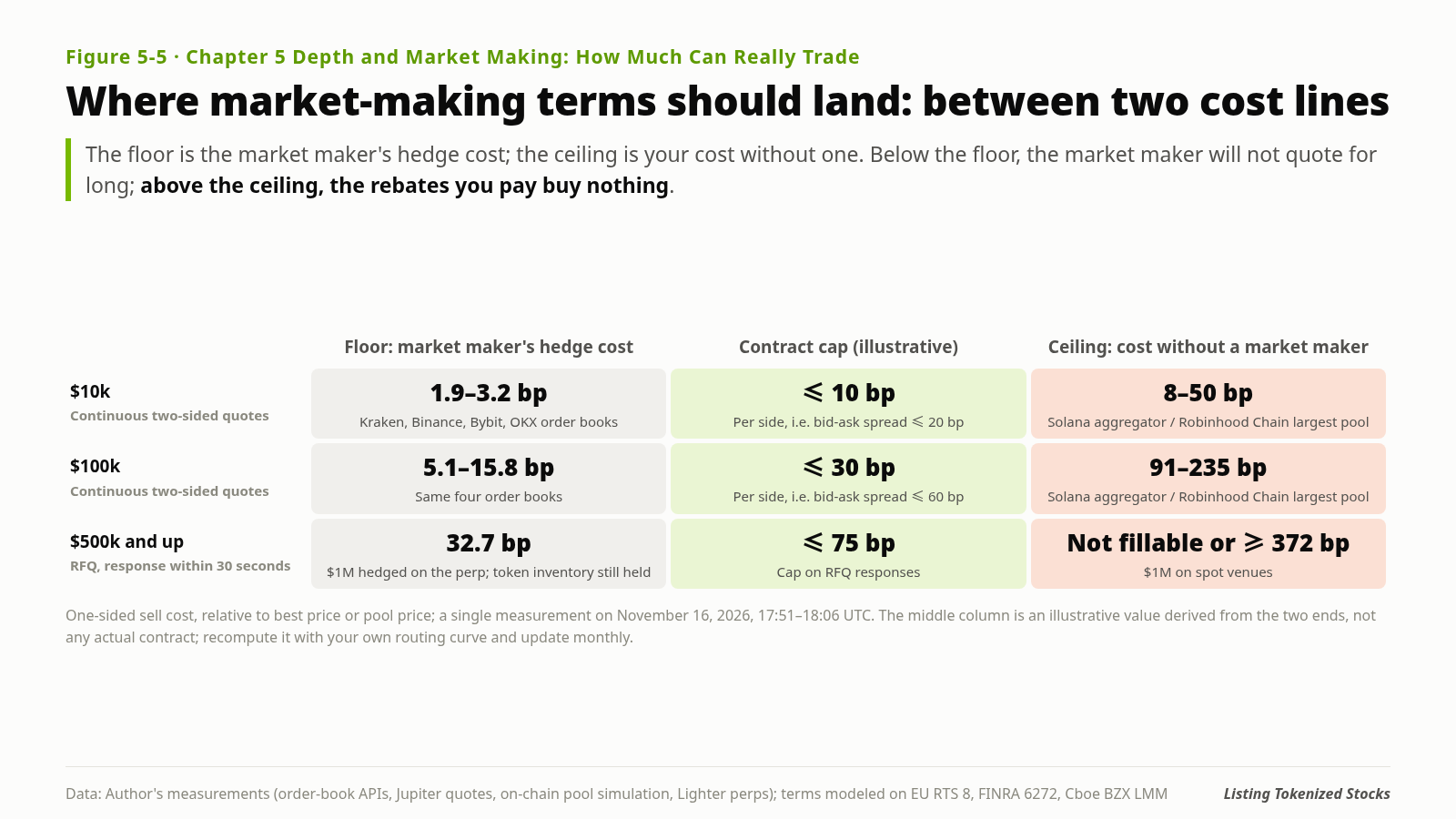
- Quote size tiers: Suggested wording (illustrative): At least two tiers of continuous two-sided quotes: $10,000 and $100,000; $500,000 and above via RFQ, with a response within 30 seconds; How to set it: Tiers follow your single-order limit (Section 5) and the kink in the cost curve; in this sample the kink is at $100,000
- Maximum spread: Suggested wording (illustrative): $10,000 tier no more than 10 bp per side, $100,000 tier no more than 30 bp per side; RFQ no more than 75 bp; How to set it: Above the market maker’s hedge cost (order books, perps), below your fallback routing cost; recompute monthly with a new curve
- Uptime: Suggested wording (illustrative): Two-sided quotes present 95%+ of US regular hours; pre-market/after-hours, overnight and weekends measured separately, may be set lower, but not below 50%; How to set it: Based on Cboe’s 98% and RTS 8’s 50% definition; below 50% does not count as market making
- Off-hours: Suggested wording (illustrative): On weekends and when US markets are closed, size halved and the spread cap widened to 3x; reference price from the price source chosen in the piece on price sources; How to set it: Off-hours is exactly when you most need a market maker, so it cannot be exempted wholesale; how much to widen depends on whether the market maker can mint/redeem and hedge off-hours
- Exceptions: Suggested wording (illustrative): Halt or circuit-breaker pause in the underlying; issuer suspends creation/redemption or freezes the contract; reference price timeout; chain or bridge outage; platform’s own failure. Declared, recorded and notified afterward by the platform, never self-declared by the market maker; an exception lasts at most until the end of the current trading session; How to set it: Follows FINRA 6272’s suspension during halts and RTS 8 Articles 3 and 4; “high volatility” cannot on its own be an exception
- Corporate actions: Suggested wording (illustrative): Cancel quotes N minutes before a multiplier or balance update; resume within M minutes after the on-chain update is confirmed; ex-dividend dates and split dates listed separately; How to set it: N and M follow the update times published by the issuer; trades at wrong prices during this window are cancelled per the contract or borne by the market maker
- Inventory and hedging: Suggested wording (illustrative): State with which issuer the market maker mints/redeems, in what capacity, and during which hours; loss of creation/redemption eligibility must be notified within 1 business day; if the platform lends tokens or funds, state the rate, collateral and recall conditions; How to set it: A market maker that can mint/redeem has a way out even when the door is closed; one that can only unwind in the secondary market needs looser off-hours terms
- Breach and penalties: Suggested wording (illustrative): Compliance measured per trading day, settled monthly; if non-compliant days in a month exceed the agreed share, that month’s rebates are forfeited; two consecutive non-compliant months allow the platform to terminate; two-month grace period at launch; How to set it: Pay only for compliant days, following Cboe’s “base / enhanced” tiers; wash trading or self-trading means immediate termination and clawback of rebates
- Fees and rebates: Suggested wording (illustrative): Maker rebates or a fixed monthly fee, either or both; rebates tied to uptime and spread compliance, not just volume; How to set it: Kraken’s maximum 2 bp maker rebate is small next to a 30 bp spread on the $100,000 tier; the market maker’s real income is the spread, and the rebate buys obligations
- Data and reporting: Suggested wording (illustrative): Market-making quotes flagged; daily reports of uptime by session, average spread by tier, trades, inventory and hedging venues; quote and trade records retained and auditable by the platform; affiliations and conflicts of interest disclosed in writing; How to set it: Follows RTS 8 Article 2 (e)–(g); ask about affiliations separately: an exchange and an issuer under the same owner, or one market maker quoting the same token on several exchanges, may mean the depth is the same money counted twice
Three further points.
Uptime must be measured by session, not reported as a single total. For a 24/7 token, US regular hours make up only about 19% of the week. A market maker can quote well in regular hours, barely quote on weekends, and still show a good overall uptime. The contract must split it: regular hours, pre-market/after-hours, overnight and weekends, each with its own number.
Whether the market maker can mint and redeem determines how tight the off-hours terms can be. The piece on creation and redemption listed the four doors: Ondo is open to institutions and individuals who pass KYC, and some tokens can be minted and redeemed on weekends; xStocks is open to individuals from $5,000, following US trading days; Robinhood is open only to authorized participants, with only one at launch; bStocks’ conversion works on weekends, but the cash side is closed. When the door is closed, the market maker’s inventory can only be hedged with perps until it can be unwound on Monday, and it will price that risk into the spread. The more weekend depth you want, the more you need to ask what it will use to hedge on weekends.
Depth commitments must be measurable by you. The “RFQ depth of more than $100 million” cited by Jupiter Lend is something you cannot verify (Section 5). Only quotes that are visible and recordable on your own platform can go into the contract: sample your own order book every day, compute uptime and spreads by tier, and reconcile against the market maker’s reports. Where they disagree, your sample governs.
Twelve questions to ask the issuer, the market maker (or yourself) before listing
- On which venues does this token have stablecoin-quoted pools or order books? How much reported liquidity does each have, and how much is on the stablecoin side for sells?
- On the venues you actually route to, what does it cost to sell $10,000, $100,000 and $1 million? How often is it measured?
- From which target cost was your single-order limit derived? What does it drop to off-hours?
- What are the fees of the pools you route to? Are any pools with fees of 1% or more mixed in?
- Do you read the in-pool price or the stock price? How far apart are they, and from which price is slippage measured?
- Is there a written commitment for the issuer’s or market maker’s RFQ depth? Does it still hold off-hours?
- How much of the centralized-exchange order-book depth is provided by the same market maker? What is its relationship to the issuer?
- Which contracts and pools may the aggregator route through? Have wrapper contracts and base contracts been mixed up?
- How are orders above the limit handled: split, rejected, or passed to manual RFQ?
- Have you counted perp depth? If so, are you delivering the token to users, or price exposure?
- From which cost curve were the quote size tiers, maximum spreads and uptime in the market-making contract derived? Are regular hours, pre-market/after-hours, overnight and weekends assessed separately? Who does the sampling, and whose data is used for settlement?
- With which issuer can the market maker mint and redeem, and during which hours? How soon must it notify you if it loses eligibility? Who declares exceptions for halts, suspended creation/redemption and multiplier updates, and how long can each last?
Conclusion
Reported liquidity tells you how much money is in a pool; depth tells you how much you can sell, and at what price. In this sample (intraday, November 16), selling $100,000 of Tesla tokens cost a few basis points on order books, 1%–2% in on-chain pools, and more than 2% on the route with the most reported liquidity. Derive the single-order limit backward from cost, not forward from liquidity; and derive the quote sizes and spreads in a market-making contract from the same cost curve, written as numbers that can be checked every day.
Sources
- Author’s multi-ticker monitoring:
stocks_spread.csv, snapshot at 17:57–17:58 UTC on November 16, 2026 (10 tickers × the official deployments of Ondo / xStocks / bStocks / Robinhood; DexScreener last-trade prices, only stablecoin-quoted pools with liquidity of $1,000 or more, pools more than 3% from the liquidity-weighted median removed, liquidity-weighted); contract list and official sources instocks_tokens.json(Ondo documentation token list, the xStocks public API api.xstocks.fi, Binance coin configuration, Robinhood Chain asset registry API, retrieved November 16, 2026). - On-chain pool simulation (author, around 17:51–17:55 UTC on November 16, 2026): reads
slot0(),liquidity(),fee(),tickSpacing()and per-tickticks()from Uniswap V3 / PancakeSwap V3-compatible contracts and simulates tick by tick with the concentrated-liquidity formula. Pools: Ethereum 0xF2006D44339E5C2c479d450a97884d4E20D028AD (TSLAon/USDC, CommunityV3, 2% fee), 0x49b7b66457297f9E0E763BBb151B6DB0c149E988 (1.5%), 0x31227b50eCCDC9C589826AA2D9E7C5619B1895Da (Uniswap V3, 1%); Robinhood Chain 0xf4ACdAEEB7022862A763C9B1B885e11191c889E3 (TSLA/USDG, 0.3%); BNB Chain 0xB0f5E5400E8F0F7C242F2b7740C004f020579c41 (TSLAB/USDT, 0.25%); Ink 0x09444CbDfF5CD4437150a1f26865a3Ed85D8ED5E (wTSLAx/USDG, 0.05%). Cross-check: smartsquote_uniswap_v3_swap(Uniswap QuoterV2, Ethereum block 26,429,197). - Solana aggregator: Jupiter public quote API lite-api.jup.ag/swap/v1/quote, TSLAx (mint XsDoVfqeBukxuZHWhdvWHBhgEHjGNst4MLodqsJHzoB), 17:56–18:06 UTC on November 16, 2026.
- Order books (17:57 UTC on November 16, 2026): Kraken
/0/public/Depth?pair=TSLAxUSD,/0/public/AssetPairs?aclass_base=tokenized_asset(margin position limits); Bybit/v5/market/orderbook(TSLAXUSDT); OKX/api/v5/market/books(XTSLA-USDT); Gate/api/v4/spot/order_book(TSLAX_USDT); Binance/api/v3/depthandexchangeInfo(TSLABUSDT); Lighter Robinhood instance api.rh.lighter.xyzorderBookDetails,orderBookOrders. - Meaning of Kraken fields: docs.kraken.com/api/docs/rest-api/get-tradable-asset-pairs (long_position_limit in base currency); position limits set based on order-book depth: Kraken blog “Introducing xStocks margin trading on Kraken Pro” (February 20, 2026).
- Author’s measurement on Robinhood Chain on November 2, 2026 (Lighter public API
orderBookOrders, SPY/NVDA spot and perps); recorded in the author’s research notes on on-chain investing (round-trip costs and access). - Jupiter Lend, “Collateral Asset Assessment: Tokenized Equity SPYx, QQQx, NVDAx, TSLAx”, April 15, 2026, static-r2.jup.ag/lend/risk-research/xstocks-risk-report.pdf.
- Commission Delegated Regulation (EU) 2017/578 (RTS 8, market-making agreements and schemes), Articles 1–7: definition of a market-making strategy (half the trading days in a month, at least 50% of the continuous trading session, sizes on the two sides differing by no more than 50%), minimum content of agreements, exceptional circumstances and the procedure for declaring them: eur-lex.europa.eu/legal-content/EN/TXT/?uri=CELEX:32017R0578 (accessed November 16, 2026).
- FINRA Rule 6272 (Character of Quotations): continuous two-sided quotes, 8% for designated stocks (20% for 9:30–9:45 and 15:35 to the close), suspended during halts and pauses: finra.org/rules-guidance/rulebooks/finra-rules/6272 (accessed November 16, 2026).
- Cboe BZX Equities, “Updated Lead Market Maker (LMM) Program Requirements” (Reference ID C2025103107, effective December 1, 2025, pending regulatory review): base tier two-sided quotes 98%, US-equity ETPs $150,000 on each side within 1% of the best price (90% of the time), market-wide best spread within 0.5% (95% of the time): cdn.cboe.com/resources/fee_schedule/2025/Updated-Cboe-BZX-Equities-Lead-Market-Maker-Program-Requirements-Updated-.pdf.
- Kraken Liquidity Provider Program page: covers spot, futures and xStocks; five tiers; rolling 30 days; maker rebates up to 0.020%; two-month grace period and two exceptions per year: kraken.com/pro/liquidity-provider-program (accessed November 16, 2026; tier thresholds and the Program Terms page not provided).
- Binance spot liquidity provider program update announcement (September 9, 2024): first tier at 0.05% share of weekly maker volume or $25 million: binance.com/en/support/announcement/6311b67d26804bf48c5d62f5beb91202 (checked against a search-result summary; whether it is still in effect in 2026 is not confirmed).
- All of the above are readings from a single point in time, checked November 16, 2026.
Not yet confirmed:
- xStocks RFQ channel “more than $100 million of sell-side liquidity per asset”: from Jupiter Lend’s assessment; there is no first-hand data from the issuer or market makers.
- The specific values of Ondo’s off-hours limits: Ondo’s documentation says only that they are set per asset and adjusted dynamically; the values are on the status.ondo.finance page and API, which we did not read this time.
- Concentration of market makers in each exchange’s order book (whether it is the same firm): public APIs do not disclose it.
- Depth in this piece was measured only during a window of about 15 minutes intraday on November 16, 2026, so all conclusions are “in this sample”. Depth during off-hours and in the first half hour after the open was not measured; given the observations on off-hours quotes in the piece on price sources, it is expected to be worse, pending multi-time-point data.
- Binance’s spot liquidity provider program tiers: we read only a search-result summary of the September 9, 2024 announcement and did not verify the tiers in effect in 2026.
- The term values in Section 6 (quote size tiers, maximum spreads, uptime) are illustrative values derived from the cost curve in this sample, not actual contract terms of any platform or market maker; the tier thresholds and contract terms (Program Terms) of Kraken’s market-making program are not public, and we did not read them this time.
— Excerpted from Listing Tokenized Stocks, Chapter 5: Depth and Market Making: How Much Can Really Trade
Full book: https://pickful.ai/books/kspm
Repost this post?
Share with your followers.
Reply