
Contents (8)

·
Following a Launchpad Team's Wallet: Zero Tokens Sold, 48.3M Burned, Books Balance to the Cent
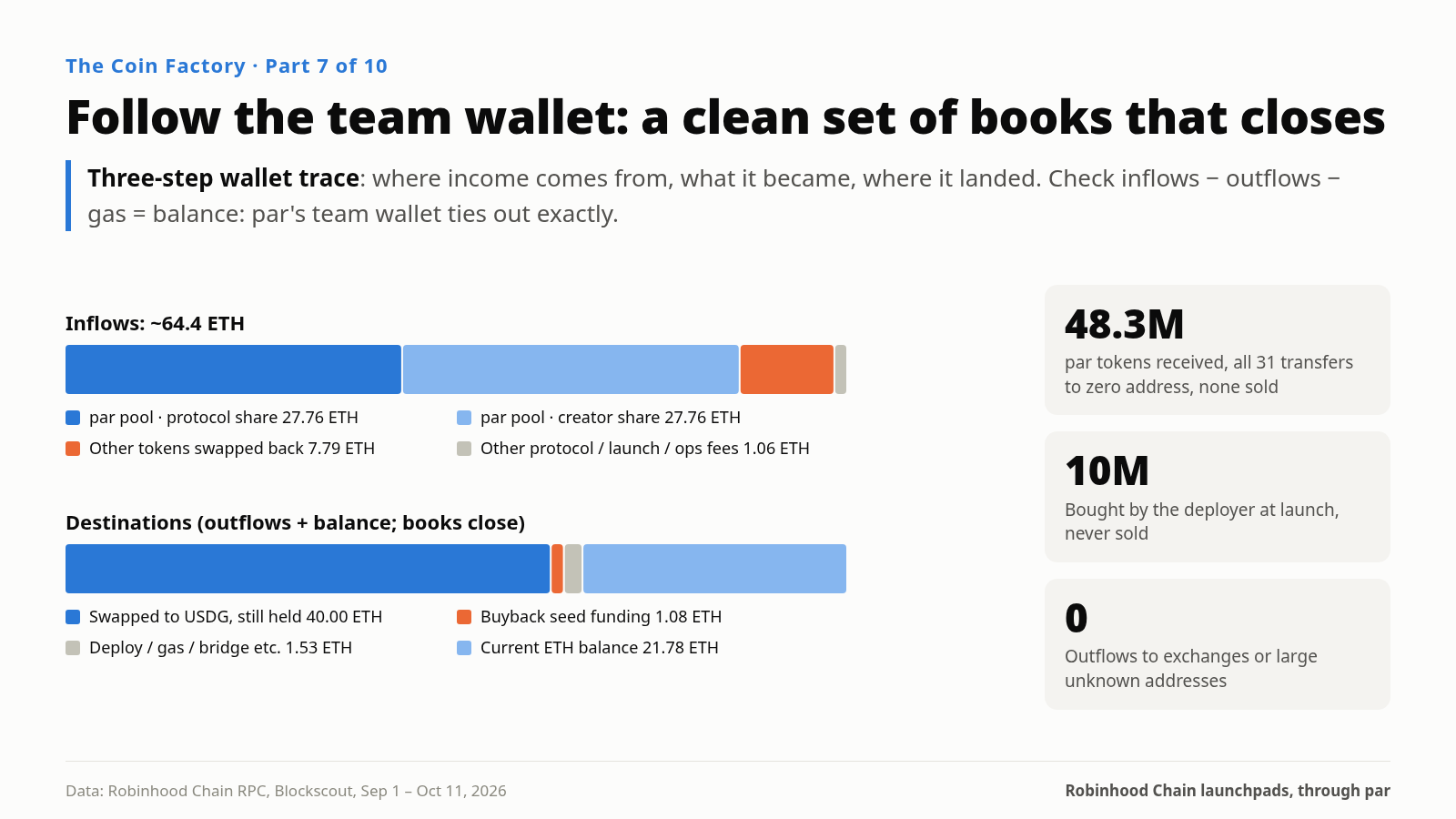
A three-step trace of par.family's team wallet on Robinhood Chain: ~64.4 ETH in, 48.3M platform tokens received and all burned, 40 ETH swapped to 98,644 USDG and still held, nothing sent to exchanges, and books that reconcile exactly. A reproducible due-diligence method.
If you’re doing due diligence on an on-chain project, whether for an investment, a listing or a partnership, this piece gives you a method you can reproduce with nothing but a public block explorer. The sample is the team wallet of par.family on Robinhood Chain: 0x6053fc7a871af434f5f26701b206469bacb03966.
The conclusion first. From September 1 to October 11, this wallet:
- took in about 64.4 ETH, nearly all of it from protocol fee splits;
- received 48.3 million platform tokens (call them par tokens) and burned every one, selling none;
- swapped 40 ETH into 98,644 USDG, a dollar stablecoin, on September 10, and has kept it in the wallet ever since without moving it;
- sent nothing to exchanges and made no large transfers to unknown addresses;
- reconciles: inflows, outflows and balance all tie out.
For an early-stage project barely a month old, that’s a very clean set of books.
Ruling out four common explanations
When a platform token drops sharply in its first month, there are four usual explanations: a backdoor in the contract, a weak product, the team dumping, or fake volume. The par token is down about 96% from its intraday high on September 5, and the on-chain evidence supports none of the four:
| Common explanation | On-chain evidence |
|---|---|
| Contract backdoor | Inherits only OpenZeppelin’s standard ERC20 plus voluntary burn; no minting, no owner, no pause, no blacklist, no transfer tax, not upgradeable; liquidity permanently locked |
| Weak product | Any-token quoting, up to 5 market pairings, index tokens, fees that can go to holders, a burn or a price floor, fees paid straight to an X account, multichain |
| Team dumping | The 10 million tokens the deployer bought at launch have never been sold; every par token the team wallet received was burned |
| Fake volume | The main pool’s latest 2,000 trades came from 618 unique addresses, with buys and sells roughly balanced (36.7 vs 37.4 ETH); the largest single trader accounts for 7.8% |
What’s left once you rule those out are the environmental factors early launchpads generally face. par went live on September 4; the next day was the peak of launchpad fees across the whole chain, and 25 days later the gas subsidy expired. The chain’s phase-one heat faded across the board after par launched. That’s the situation of its timing, not a problem with the product or the team.
Method: the three-step wallet trace
- Where the income comes from: classify every inflow by source contract.
- What it was converted into: find changes in asset form, like ETH swapped to stablecoins or received tokens sold.
- Where it ended up: the current balance, plus the destination of every outflow.
Then check: opening balance + total inflows − total outflows − gas = current balance. If it doesn’t tie, you’re missing data.
All you need is three kinds of records from a block explorer (Blockscout here): regular transactions, internal transactions and token transfers. Internal transactions are the easiest to miss. Protocol fee splits almost always arrive as internal transactions; look only at the regular transaction list and you’ll wrongly conclude the wallet has almost no income.
Step one: where the income comes from
| Source | ETH | What it is |
|---|---|---|
| Locker contract | 28.25 | Direct payments of the protocol share; 27.76 ETH of it from the par token’s own pool |
| Fee escrow contract | 27.76 | Claims of the creator share; matches the indexer record exactly |
| Other tokens received as fees | 7.79 | Mostly the protocol share from tokens launched before the splitter went live, swapped back to ETH via the Axiom terminal |
| Launch fees | ~0.36 | 0.0005 ETH each, ~720 launches |
| Splitter contract operating share | ~0.21 | |
| Total | ~64.4 |
About 86% of income comes from the par token’s own pool. That matches the platform’s early structure: the platform token is the most active asset on the platform. As volume in other tokens on the platform grows, that structure will shift; the “self-consumption ratio” in the next piece is the metric for tracking it.
Step two: what it was converted into
par tokens: all burned. The token portion of the creator share, 47.33 million, plus about 970,000 from the Locker and splitter contracts, totals 48.3 million, all sent to the zero address. This was income the team was free to do anything with.
Other tokens: swapped back to ETH. par lets any token act as a quote asset, so the fees the protocol collected included dozens of tokens such as AI, PONS, CASHCAT, BONER, FOMO and PAIR, plus several stock tokens. The team swapped them into about 7.79 ETH across 52 transactions. None of those 52 involved par tokens.
ETH: part converted to stablecoins as an operating reserve. Between 20:18 and 20:20 UTC on September 10, the team wallet sent four transactions through the Uniswap router, putting in 5, 10, 10 and 15 ETH and receiving 98,644 USDG in total. That USDG has stayed in the same wallet since. With about 393 more trickling in from the splitter contract, the current balance is 99,037 USDG. For a project with a single developer that has to maintain contracts, an indexer and a front end for the long haul, converting part of operating income into stablecoins to lock in development runway is standard financial practice.
Step three: where it ended up
| Destination | ETH |
|---|---|
| Swapped to USDG (still in the wallet) | 40.00 |
| Seed funding for the buyback wallet (09-06 to 09-07) | 1.08 |
| Other small outflows (gas for the deployer, one bridge transfer, two personal wallets) | 1.47 |
| Transaction fees and gas | ~0.06 |
| Total outflows | ~42.6 |
Check: total inflows of about 64.40 ETH, minus outflows of about 42.61 ETH and gas of about 0.009 ETH, equals about 21.78 ETH, which matches the current balance. The books close. The wallet currently holds about 21.78 ETH plus 99,037 USDG, roughly $153,000 in total, almost all of it still there.
The next governance upgrade
Besides collecting money, this wallet is the owner of the factory contract, both fee recipients for the par token pool, and the operating treasury for the splitter contract. The factory owner can change fee rates for future launches, turn off launches, and transfer the fee recipient address after a three-day notice period. It can’t touch existing pools, locked liquidity or the tokens themselves.
It’s common for an early project to have one wallet play several roles; it makes fast iteration easier. As the platform grows, moving ownership to a multisig and separating the fee-recipient role from the admin role are upgrades that take just a few on-chain transactions, and they’re the easiest progress signals for outside observers to verify.
Five things to check in due diligence
Where income comes from: classify by source contract to see the platform’s revenue structure.
Asset conversions: what the team converted, how much, and whether the money is still there.
Where the platform token went: sold, sent to exchanges, burned, or held.
Whether the books close: if they don’t, there’s a channel you haven’t seen.
Role structure: how admin rights, fee rights and buyback execution are distributed, and whether there’s a plan to upgrade.
Closing
Follow the money, and par’s team wallet comes up clean.
Not one platform token sold, everything received burned, the stablecoins sitting untouched in the wallet.
Only teams whose books close can stand up to on-chain scrutiny.
When you do diligence on a project, do you check the team wallet first?
— Excerpted from Chapter 7, “par’s First Month,” and Chapter 8, “Follow the Money,” of The Coin Factory
Repost this post?
Share with your followers.
Reply