
目錄(8 節)

·
An Issuer Not Naming Hong Kong Does Not Mean You Can Sell to Hong Kong Retail
The question this piece answers: where are your users, whom can you sell to, what must you test before you sell, what must the product page say, and where must you not go at all?
Note: This piece is a checklist. It is not legal advice and it is not tax advice. It tells you what to check in each jurisdiction, where the primary sources are, and which questions to put to your lawyers and tax advisers. The conclusions have to come from lawyers admitted in your jurisdiction and in your users’ jurisdictions. Regulatory status is as of November 16, 2026.
The question this piece answers: where are your users, whom can you sell to, what must you test before you sell, what must the product page say, and where must you not go at all?
1. One Hong Kong retail investor, four issuers, four answers
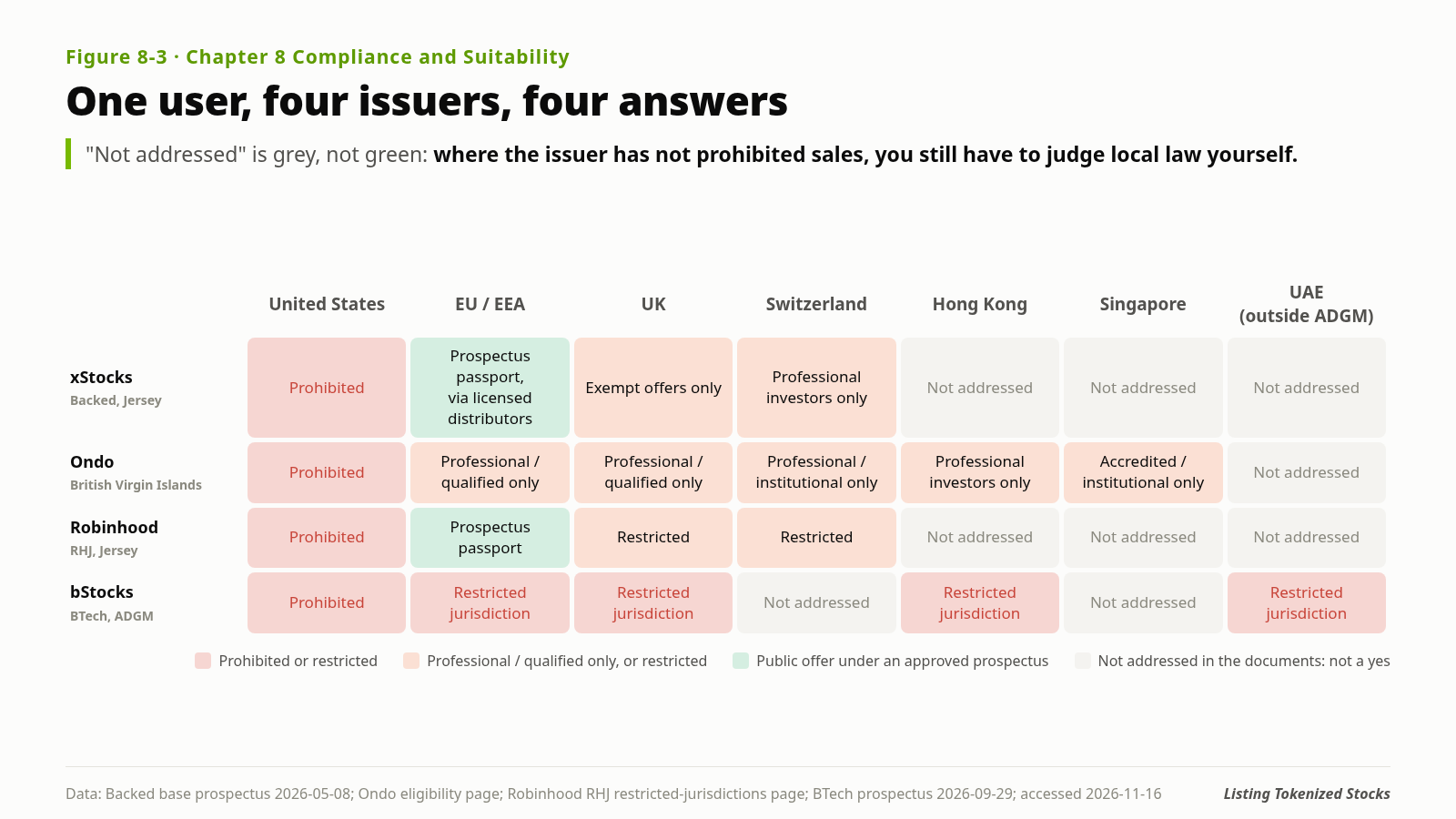
The monitoring behind this series tracks the same Tesla token across four issuers: Ondo, xStocks, bStocks and Robinhood. The piece on price sources covered how their prices differ. This piece asks a different question: if an ordinary retail investor in Hong Kong wants to buy, what does each issuer say?
- Ondo: its eligibility page lists Hong Kong as a “restricted jurisdiction” and issues only to professional investors under the Securities and Futures Ordinance.
- bStocks: the prospectus BTech Holdings had approved on September 29, 2026 puts Hong Kong among 55 “restricted jurisdictions”, where the products may not be sold or transferred.
- Robinhood (RHJ): its restricted-jurisdictions page names only the United States, Canada, the United Kingdom and Switzerland, plus 11 sanctioned prohibited countries. Hong Kong is not mentioned.
- xStocks (Backed): the base prospectus only makes arrangements for public offers in the European Economic Area. It has no specific provisions for Hong Kong.
Two say no, or professional investors only; two say nothing. Many platforms read “says nothing” as “allowed”. This piece asks you to stop reading it that way. Clause 31.2 of the RHJ prospectus is blunt: where the laws of a jurisdiction require an offer to be made by a licensed bank, broker or other licensed party, the offer in that jurisdiction is deemed to be made by that licensed party on behalf of the issuer. In a platform’s terms: an issuer’s selling-restrictions list only marks the scope the issuer itself is willing to take on. Outside that list, whether a local licence is needed, who holds it, and what tests must be run before a sale all fall on whoever sells the token to the user. That is you.
So the decision in this piece is: for each user location and user type, decide “can we sell, to whom, what do we test first, and what do we tell the user”, rather than treating the issuer’s list as the answer.
2. Check three layers: the product, the user, yourself
Ask the same three layers in every jurisdiction:
- Product layer: what this token is locally. A security, a financial instrument, a structured product, a certificate, or a crypto-asset? The classification decides which law applies. The piece on issuance structures sorted the tokenized stocks in circulation into three types: issuer-tokenized, custodial third-party, and synthetic (linked) securities. By their own offering documents, the largest offshore issuers are all the issuer’s own debt instruments or certificates.
- User layer: whom you can sell to and what you test first. Retail, professional investors, qualified investors, or nobody? Is there a prospectus, and has it been passported into the user’s country? Is a suitability or knowledge test required (Section 4)?
- Platform layer: what status your activity requires. Matching secondary trades, dealing on behalf of clients, custody and promotion each map to different licences. Whatever approvals the issuer holds do not extend to you automatically.
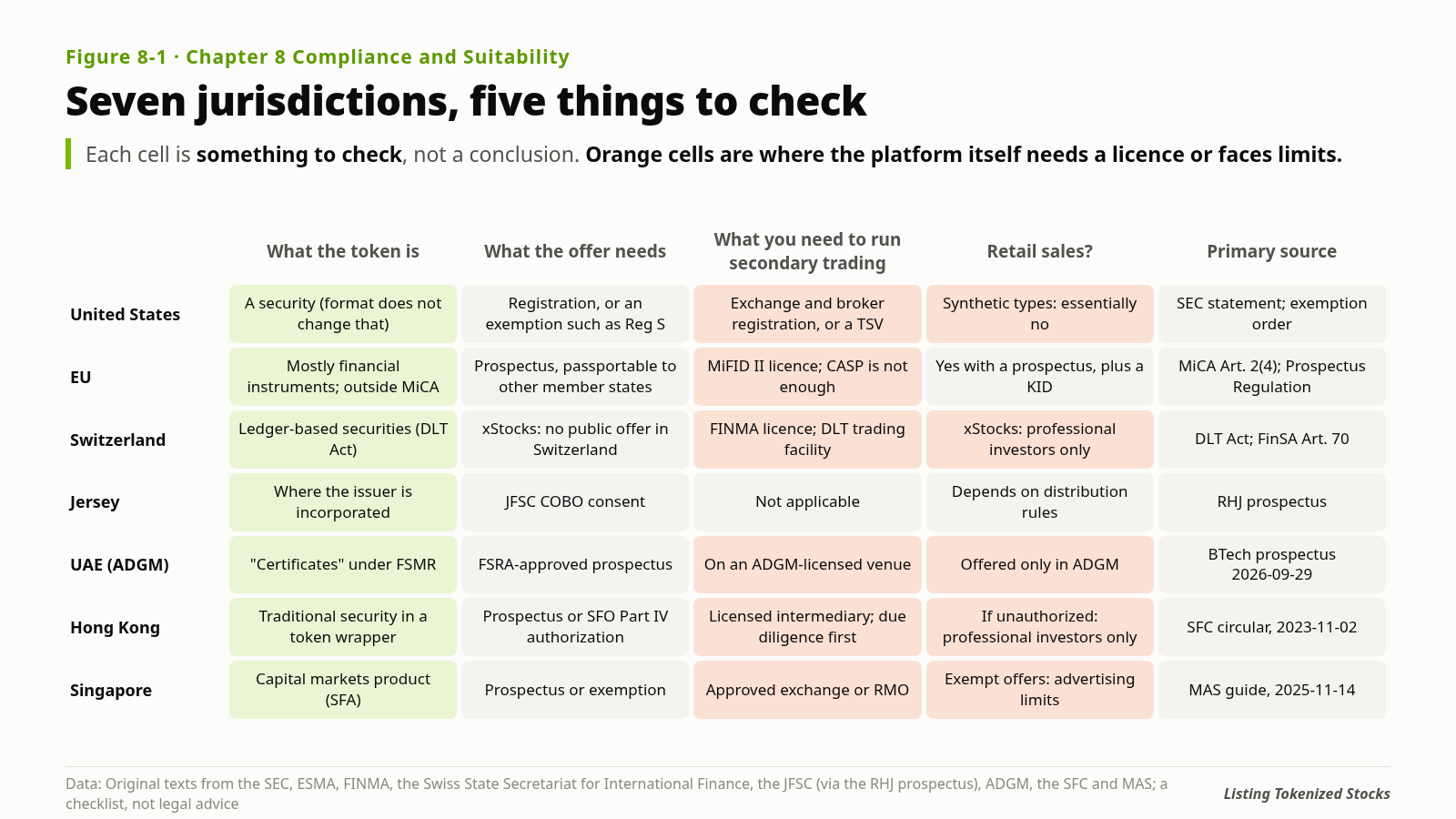
3. Jurisdiction by jurisdiction: only what bears on listing
Leave the regulatory history of each jurisdiction to the lawyers’ memo. Below, each jurisdiction gets three things only: how it classifies the token, whom it opens the door to, and what you must do before listing.
United States: the offering documents themselves say “not for sale here”. The SEC’s Division of Corporation Finance, Division of Investment Management and Division of Trading and Markets issued a Statement on Tokenized Securities on January 28, 2026. It says that whether a security is issued and recorded on-chain or off-chain “does not affect the application of the federal securities laws”. Third-party “linked securities” that provide synthetic exposure, if they are security-based swaps, require an effective registration statement for sales to anyone who is not an “eligible contract participant”, and must trade on a national securities exchange. Backed, RHJ, Ondo and BTech all state that their products are not registered under the Securities Act of 1933, are offered outside the United States only in reliance on Regulation S, and may not be sold to “U.S. persons” (as defined in Rule 902) or held for their benefit. The BTech prospectus has the most concrete definition of a “U.S. Prohibited Person”, and you can borrow it directly as a screening rule: besides U.S. persons and people located in the United States, it covers anyone using a U.S. address, a U.S. phone number, U.S. tax documentation, a U.S. payment method, a U.S. bank account or a U.S. IP address.
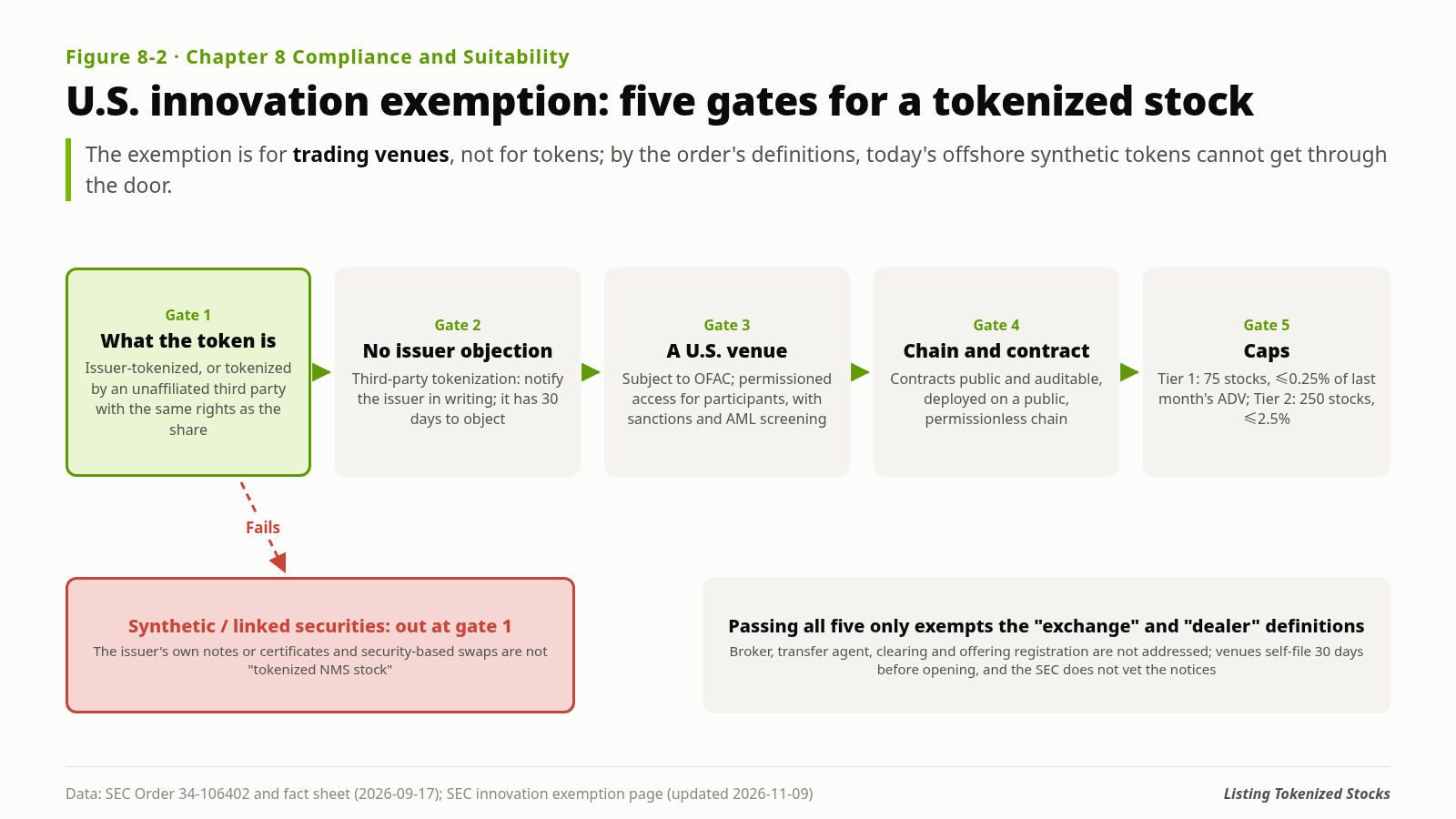
SEC Order No. 34-106402 of September 17, 2026 (the “innovation exemption”, valid for five years) provides that a tokenized securities venue (TSV) is not an “exchange”, and that a Covered Firm supplying liquidity to its AMM pools is not a “dealer”. But its scope extends only to issuer-tokenized stock, or to tokens issued by an unaffiliated third party that carry the same rights as the underlying share. Securities issued by a third party on its own account that provide synthetic exposure are out of scope. TSVs file their own notices and check themselves against the conditions; the SEC’s web page states that appearing on the list of notices “does not mean that the entity meets the definition of a TSV or the conditions of the exemption”. As of the November 9 update, four had filed notices: TSV LLC, OKXICE TSV, Kephas Corporation (as Perpetuals.com) and Formation Securities LLC.
European Union: not MiCA, but MiFID II and the Prospectus Regulation. Article 2(4) of MiCA excludes “financial instruments”. Once a tokenized stock is classified as a financial instrument, it falls under MiFID II, the Prospectus Regulation and PRIIPs. How to classify it is governed by ESMA’s Guidelines on the conditions and criteria for the qualification of crypto-assets as financial instruments, published December 17, 2024; the final answer is case by case. That creates the first trap for platforms: a CASP licence under MiCA does not cover these tokens. Trading, brokerage and custody need a MiFID II investment firm licence or the corresponding trading-venue authorization. The base prospectuses of Backed (May 8, 2026) and RHJ (June 25, 2026) were both approved by Liechtenstein’s Financial Market Authority (FMA) and passported into 29 EEA countries. A prospectus only settles “may be offered to the public”; distributors still have to do their own target-market assessment and suitability (Section 4). Ondo issues in the EEA only to professional clients or qualified investors. On October 7, 2026, Austria’s Assetera announced it would use its own MiFID II licence to offer more than 450 Ondo tokens to qualified investors in 30 EEA countries. The DLT Pilot Regime admits shares only from issuers with a market capitalization below €500 million; stocks like Tesla and NVIDIA cannot enter, so for now it has no bearing on listing decisions.
Switzerland and Jersey: legal form in one place, issuer in another. The xStocks issuer, Backed Assets (JE) Limited, is incorporated in Jersey (registration number 152608). Under Swiss law the products are “ledger-based securities” under Article 973d et seq. of the Swiss Code of Obligations. In Switzerland they may be offered only to professional clients as defined in the Financial Services Act (FinSA). Ondo serves only professional or institutional clients in Switzerland, and RHJ lists Switzerland as a restricted jurisdiction, so in practice Swiss retail investors have no door. On the Jersey side, the RHJ prospectus states that the “COBO consent” obtained by the issuer does not confer “regulated” status, and that the issuer “is not authorised or regulated by the JFSC, the FMA or any other competent authority”. Some third-party data sites describe such issuers as “regulated by the JFSC and the FMA”, which contradicts the prospectus. What goes on your product page should be the original text of the offering documents, not a second-hand paraphrase.
UAE, ADGM: the selling restrictions are written into the contract. The bStocks issuer, BTech Holdings Ltd, is incorporated in ADGM. The products are “Certificates” representing financial instruments under FSMR, “offered only in ADGM”, with 55 restricted jurisdictions, including every EEA country, the United Kingdom, Hong Kong, Japan, and the UAE outside ADGM. The restrictions survive after the token leaves Binance and are written into the smart contract as transfer restrictions: if the holder is in a restricted jurisdiction, the token can be frozen, revoked or cancelled. What obligations this creates for your platform needs three separate checks: the token’s own transfer restrictions, whether you have any contractual commitment to the issuer, and how the local regulator enforces. Whichever applies, the frozen asset belongs to your user, and the complaint comes to you.
Hong Kong and Singapore: both treat it as “a traditional security in a wrapper”. The two share a starting point: same activity, same risk, same regulation.
- Product layer: the SFC’s circular of November 2, 2023 says tokenized securities are “fundamentally traditional securities with a tokenisation wrapper”. MAS’s Guide on the Tokenisation of Capital Markets Products of November 14, 2025 says tokens that constitute capital markets products under the Securities and Futures Act (SFA) are regulated as capital markets products.
- User layer: in Hong Kong, public offers are governed by the prospectus regime and Part IV of the Securities and Futures Ordinance; products that are not authorized may be sold only to professional investors or under another exemption. In Singapore, a public offer requires a registered prospectus; otherwise it relies on exemptions such as the accredited-investor exemption, and exempt offers carry advertising restrictions. In 2019 MAS halted a security token offering because the issuer had promoted it publicly. None of the four issuers is cleared for public offers in either place: Ondo sells only to professional investors in Hong Kong and only to accredited or institutional investors in Singapore; bStocks lists Hong Kong as a restricted jurisdiction.
- Platform layer: Hong Kong requires a licensed intermediary, which must do due diligence on the token itself, the issuer and its third-party service providers before listing. In Singapore, providing a platform for secondary trading is likely to amount to operating an “organised market”, which requires approval as an approved exchange or recognition as a recognised market operator; dealing on behalf of clients requires a capital markets services licence. Since June 30, 2025, digital token service providers set up in Singapore that serve only overseas clients must also be licensed.
Questions for your lawyers in each jurisdiction, limited to those that bear directly on listing:
- United States: is our U.S.-person screening (residence, IP, phone, payment method, tax documentation) enough to support an “offshore transaction” finding under Reg S? Could global promotion amount to “directed selling efforts” in the United States?
- European Union: in the member state where we are licensed, what kind of financial instrument is this token? Which steps among trading, custody and promotion does our existing licence cover? What obligations apply to tokens transferred in on-chain rather than bought through us?
- Switzerland and Jersey: with an unregulated issuer, how are holders’ rights enforced? What can the security agent do if the issuer defaults?
- UAE: can users in the UAE outside ADGM (Dubai VARA, DIFC) access bStocks? What does “offered only in ADGM” mean for the secondary market?
- Hong Kong: does secondary trading require Type 1 and Type 7 licences, or is a virtual asset trading platform licence enough? The underlying is a U.S. stock and the wrapper is an offshore debt certificate: how far down does the complex-product assessment look through?
- Singapore: does matching trades in tokenized stocks amount to an “organised market”? When the issuer relies on the accredited-investor exemption, what restrictions apply to our marketing?
4. Suitability and disclosure: what to test and what to say before you sell
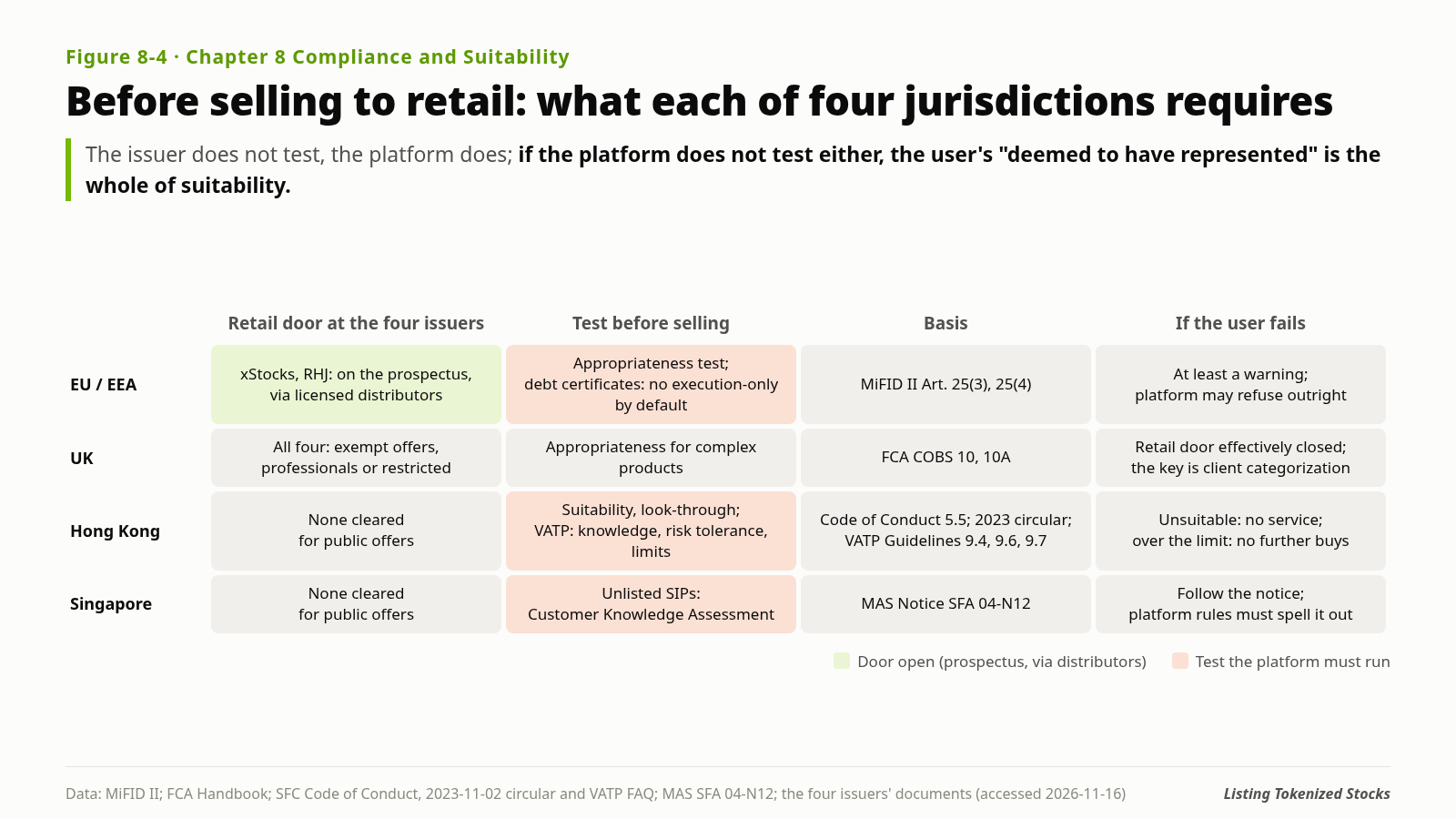
The offering documents have already pushed suitability onto whoever is closest to the user. The Jersey provisions of the Backed prospectus state that the products are “designed for sophisticated investors with professional knowledge and experience”, and that the JFSC “does not consider them suitable for other types of investors”. Anyone who buys in the secondary market is deemed to have represented that they have read the prospectus, that the product suits them, and that they are a professional investor or have received a risk warning. The RHJ prospectus says that buying from or selling to an authorized participant means passing the authorized participant’s KYC, suitability and target-market assessment, and that the authorized participant can refuse the order. The bStocks prospectus requires “eligible secondary investors” on the Binance platform first to meet Binance’s own KYC and suitability requirements. All three documents say the same thing: the issuer does not test, the platform does; if the platform does not test either, the user’s “deemed to have represented” is the entirety of suitability.
By user type:
- Retail: Where the door is open, per the four issuers’ documents: EEA: xStocks and RHJ may be sold on the strength of the prospectus through a licensed distributor. Hong Kong, Singapore, Switzerland, UK: none of the four is open to the public; The minimum a platform does: Open only in countries the prospectus is passported into; run a suitability or knowledge test, deliver the KID, state the legal object on the product page
- Professional / qualified investors: Where the door is open, per the four issuers’ documents: Ondo’s main channel; xStocks’ exempt offers in Switzerland and the UK; The minimum a platform does: Verify status against the local definition and keep the evidence; do not accept self-certification by checkbox. Hong Kong individual professional investors face a portfolio threshold, Singapore accredited investors an asset or income threshold, and EU retail clients asking to be treated as professional must meet quantitative criteria
- Institutional: Where the door is open, per the four issuers’ documents: Open at every issuer; creation/redemption eligibility is a separate matter; The minimum a platform does: KYB and sanctions screening; the product page can be simplified, but the legal object and freeze powers must still be disclosed in writing
Where testing is a hard requirement:
- European Union. MiFID II Article 25(3): even for services that do not include investment advice, the firm must ask about the client’s knowledge and experience and assess whether the product is appropriate; if it is not, or the information is insufficient, it must warn the client. The Article 25(4) “execution-only” exemption applies only to non-complex instruments; bonds and securitized debt that embed a derivative or have a structure that makes the risk hard for the client to understand are excluded. Most offshore tokenized stocks are the issuer’s own debt certificates, so do not default to “execution-only”; let your lawyers decide whether they are complex. In a speech on September 1, 2025, ESMA Executive Director Natasha Cazenave named these products: they “often do not confer shareholder rights”, and where they are a synthetic claim rather than direct shareholding they create a “specific risk of investor misunderstanding”.
- United Kingdom. FCA Handbook COBS 10 and 10A require an appropriateness assessment for non-advised sales of complex products. But all four issuers use only exempt offers, professional investors, or outright selling restrictions in the UK, so the UK retail door is effectively closed and the platform’s core task is client categorization.
- Hong Kong. Paragraph 5.5 of the SFC Code of Conduct: when dealing in complex products, whether or not there is solicitation or advice, the intermediary must ensure the transaction is suitable for the client. Paragraphs 23–24 of the 2023 circular require a “look-through” approach to assessing the complexity of tokenized securities: “tokenisation should not change the complexity of the underlying securities”. If you serve retail as a virtual asset trading platform, the Guidelines for Virtual Asset Trading Platform Operators add three more: the knowledge assessment in paragraph 9.4 (assessed as a whole, with an audit trail kept), the risk-tolerance assessment in paragraph 9.6, and the exposure limit in paragraph 9.7. The SFC’s FAQ states that for clients assessed as unsuitable, the platform “should not provide services” to them.
- Singapore. MAS Notice SFA 04-N12: before dealing in listed Specified Investment Products, conduct a Customer Account Review; before dealing in unlisted Specified Investment Products, conduct a Customer Knowledge Assessment. Offshore tokenized stocks are not listed on an exchange in Singapore, so if they are Specified Investment Products, they fall on the Customer Knowledge Assessment side.
Six risks the product page must show:
- Issuer: How far to go: Legal name, place of incorporation, whether regulated; for an “unregulated” issuer, quote the original wording; Source: Offering documents, prospectus Q&A
- Legal object: How far to go: The user holds the issuer’s debt certificate or certificate, not shares; no voting rights; how dividends are reflected (multiplier or balance); Source: Product terms, final terms
- Redemption eligibility: How far to go: Whether this user can redeem directly; if not, who can, with what minimums and in which hours; Source: Issuer documentation, terms of sale
- Off-hours pricing: How far to go: Who quotes when the market is closed, which reference price the platform uses, how far spreads may widen; Source: Platform rules, market-making agreement
- Custody concentration: How far to go: Which broker or custodian holds the underlying shares, who the security agent is, whether the shares can be lent out; Source: Prospectus security and custody provisions
- Freeze powers: How far to go: Who can freeze, cancel or blocklist, and the triggers (sanctions, restricted jurisdiction, court order); Source: On-chain permission readings, prospectus transfer restrictions
Paragraphs 19–20 of the Hong Kong circular add five disclosures: whether settlement is final on-chain or off-chain, transfer restrictions, whether the smart contracts were audited before deployment, the management controls and business-continuity arrangements for events such as forks and network attacks, and the custody arrangements. If you serve Hong Kong users, merge these five into the table above.
What to block when a user fails suitability:
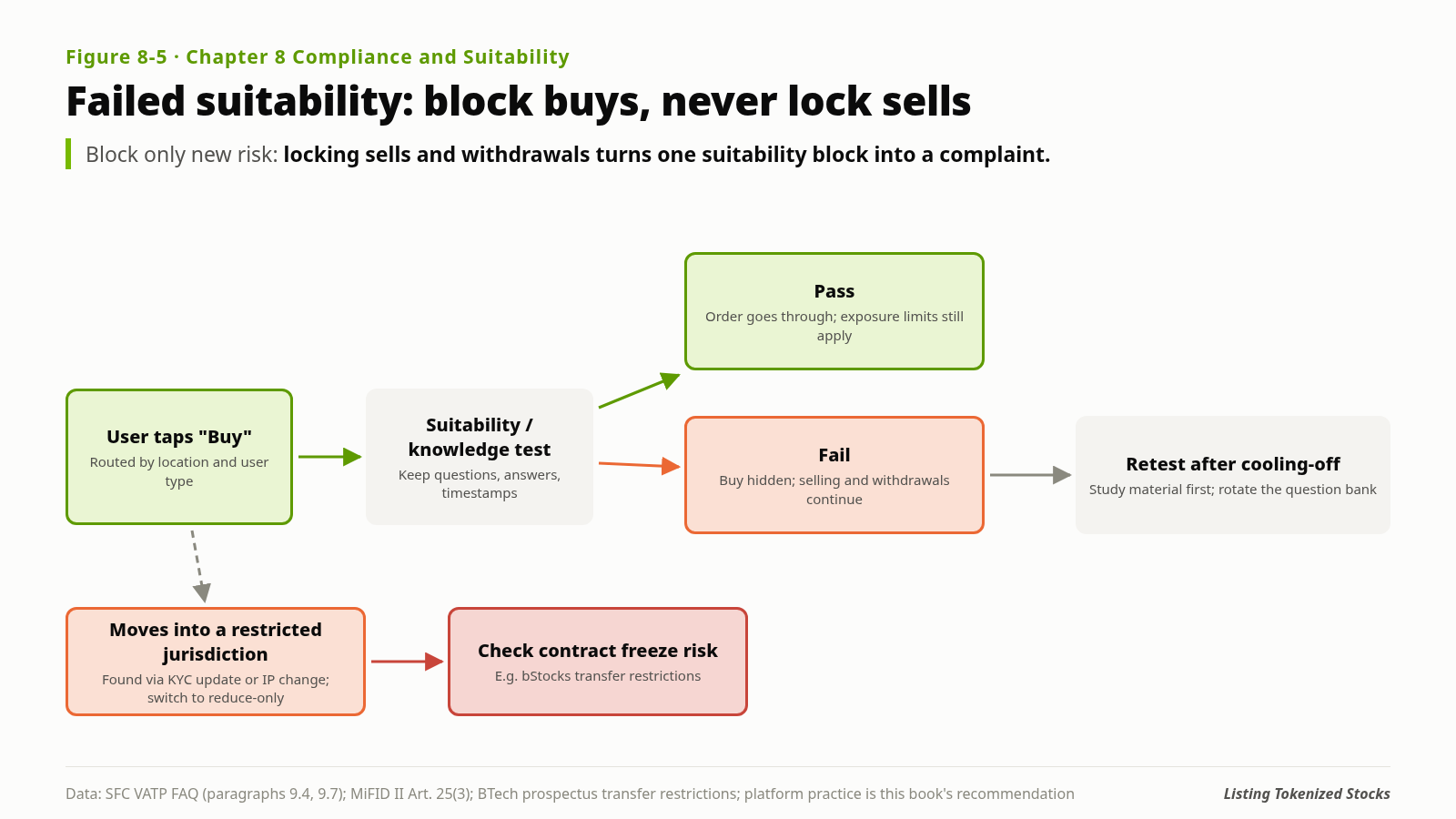
- Block buys only, never sells or withdrawals. A user who fails sees the buy button hidden; existing positions can still be sold or withdrawn. Locking sells creates new complaints and new losses.
- In the EU, build it as a warning; the platform may go stricter. MiFID II requires only a warning; a platform may choose to refuse. If you let the user proceed, keep the warning text, the user’s acknowledgement and the timestamp.
- Retests need a cooling-off period and study material. The Hong Kong FAQ requires training content that covers general knowledge of virtual assets. A platform can require a waiting period after a failed test, rotate the question bank, and not allow repeated attempts on the spot until the user passes.
- Once an exposure limit is hit, reduce-only. Paragraph 9.7 in Hong Kong requires stopping the client from adding to the position once over the limit.
- Reassess when identity or location changes. If a user moves into a restricted jurisdiction (KYC update, IP change), switch the account to reduce-only and check whether the token carries contract-level freeze risk (bStocks).
- Professional-investor status needs evidence and periodic review. Ticking “I am a professional investor” is not verification.
5. Three cross-cutting issues: sanctions, KYC, marketing
Sanctions screening takes the union. RHJ lists 11 prohibited countries; Ondo’s prohibited list also includes Canada and several conflict-affected regions; bStocks combines sanctioned countries and securities-law restrictions in one list. A platform should take the OFAC, EU and UN lists, plus the lists of the jurisdictions where it is licensed, add each issuer’s prohibited list, and apply the strictest. Tokenized stock contracts usually carry freeze and blocklist functions; when an issuer enforces sanctions, the freeze may land on your hot wallet or pool address.
Secondary-market KYC sits with you. Issuers only do KYC for the primary market: RHJ does institutional KYB on authorized participants only; Ondo onboards users who mint and redeem. The bStocks prospectus provides that anyone who receives the token on-chain is deemed to have represented that they are not a U.S. Prohibited Person and not in a restricted jurisdiction. Responsibility for enforcing that “deemed” falls on whoever is closest to the user.
Marketing is judged by where the audience is, not where you are incorporated. Reg S prohibits “directed selling efforts” in the United States; the EU Prospectus Regulation sets requirements for advertisements; Singapore and Hong Kong restrict advertising and public offers for exempt offerings; the bStocks prospectus states “no public offer outside ADGM”. One global set of posts, or one KOL campaign, can trip several jurisdictions at once. Solflare’s disclosure page states that its xStocks promotions are funded by a Payward affiliate; funding relationships of this kind should also be disclosed to users.
6. Tax and accounting: the responsibilities a platform must confirm
This section does not explain how each country taxes these products. It only lists the questions to which a platform needs written answers before launch.
Dividend withholding. Several issuers withhold tax at their own level and then reinvest. The BTech prospectus states that dividends on the underlying are reinvested through the multiplier after 30% U.S. withholding tax (except where a treaty applies), and the issuer does not gross up. The RHJ prospectus states that dividend entitlements are reflected through the multiplier net of withholding and other taxes borne by the issuer, also without gross-up. The questions:
- For each token’s multiplier adjustment, at what rate and at what point was tax withheld? Can the issuer provide withholding details for each event?
- Section 871(m) of the U.S. Internal Revenue Code treats certain payments on derivatives linked to U.S. stocks as “dividend equivalents” subject to withholding. None of the three prospectuses we searched (Backed, RHJ, BTech) mentions 871(m). Does the issuer or its tax adviser consider these tokens in scope? Who bears the withholding obligation?
Tax treatment of dividend reinvestment. The user received no cash, but the value or quantity of the holding changed. Ask: does the user’s country treat a multiplier adjustment as dividend income? How is cost basis adjusted? When stock splits and multiplier updates happen, how should the platform’s statements show them so that users (and tax authorities) do not mistake reinvestment for trading gains?
Information reporting. Jersey has implemented the CRS, and the Backed prospectus states that the issuer may ask holders for additional tax information. The BTech prospectus requires holders to provide FATCA and CRS classification information, and where they do not, the issuer may take whatever measures it considers necessary. The EU’s DAC8 (Directive 2023/2226) has applied since January 1, 2026. Ask: are we a reporting financial institution under CRS/FATCA? Are these tokens reported as traditional financial accounts, or under DAC8 or the OECD Crypto-Asset Reporting Framework (CARF)? If a screening failure lets a U.S. person in, who carries the Form 1099 reporting obligation?
The platform’s balance sheet. Ask your auditors:
- Are tokens held by clients on or off our balance sheet? That depends on the custody arrangements and the client agreement. The U.S. SEC rescinded SAB 121, which required client crypto-assets to be recorded as liabilities, with Staff Accounting Bulletin No. 122 in January 2025, but the judgment under other accounting standards has to be made separately.
- Are market-making inventory and tokens lent out or taken as collateral measured as financial assets or as crypto-assets? Which price source and which time are used for fair value?
- How is impairment assessed when the issuer suspends redemptions or the token is frozen?
7. Ten questions to ask the issuer (or yourself) before listing
- What is the legal nature of your product in the offering documents, and what is the governing law? Which countries is your prospectus passported into, when does it expire, and are there final terms for the token we are listing?
- Where are your full prohibited list and restricted-jurisdictions list? How often are they updated, and how will you notify us when they change?
- In jurisdictions you “do not list”, do you believe we may sell to retail? Will you say so in writing?
- What are your definitions of “U.S. person” and “U.S. Prohibited Person”? Which indicators must our screening cover?
- Which suitability and KYC obligations does your “deemed to have represented” clause shift onto us? Do your final terms include a MiFID II target-market statement? Is there a KID?
- For each of the six risks on the product page, can you give us quotable original wording?
- What are the triggers for the freeze, blocklist and cancellation powers in the contract? Could they land on our custody or pool addresses?
- How much tax was withheld on each multiplier adjustment, and at what rate? Do you think 871(m) applies? Which CRS/FATCA information do you need from us?
- Do you need to review our promotional material? Do you have any arrangement paying for promotion that we must disclose?
- In the jurisdictions where we are licensed, what licences do we need to trade, custody and promote this token, and under which rule do we run suitability tests? (Ask your own lawyers.)
Conclusion
An issuer’s selling-restrictions list marks the scope it takes on, not the scope in which you may sell; its “deemed to have represented” clause also leaves suitability to you. Compliance for tokenized stocks is not about finding one licence that works “everywhere”. It is about answering four things jurisdiction by jurisdiction: what it is, whom you can sell it to, what you test before you sell, and what the product page tells the user.
Sources (checked November 16, 2026)
United States
- SEC Order No. 34-106402 (2026-09-17), 91 FR 60168 (2026-09-22): TSV and Covered Firm exemptions, token scope, five-year term, caps: Order text, SEC press release 2026-90, SEC fact sheet
- SEC innovation exemption page (updated 2026-11-09): notice procedure, list does not imply eligibility, four notices filed: SEC Innovation Exemption
- Statement on Tokenized Securities by three SEC divisions (2026-01-28): SEC statement
- Regulation S (17 CFR 230.901–905): Rule 902(k) U.S. person, Rule 902(c) directed selling efforts: eCFR
- U.S. Internal Revenue Code Section 871(m) and Treasury Regulation §1.871-15 (dividend equivalents): eCFR 26 CFR 1.871-15
- SEC Staff Accounting Bulletin No. 122 (2025-01-23, rescinding SAB 121): SEC SAB 122
Issuer documents
- Backed Assets (JE) Limited base prospectus (2026-05-08, approved by the FMA, valid until 2027-05-07): Jersey registration number, notification to 29 countries, ledger-based securities under Swiss law, Switzerland limited to professional investors, Jersey RoS Order and SPB Order provisions (“designed for sophisticated investors”, JFSC does not consider them suitable for other investors, secondary buyers deemed to have represented), MiFID II product governance and distributors’ own target-market assessment, Jersey CRS, FATCA, Reg S: Prospectus (filed with Malta’s MFSA)
- xStocks product legal overview: xStocks Docs
- Solflare product disclosures: xStock KIDs, promotion funded by a Payward affiliate: Solflare
- Robinhood Assets (Jersey) Limited base prospectus (2026-06-25, approved by the FMA): notification to 29 countries, COBO consent does not confer regulated status, issuer unregulated, Clause 31 selling restrictions, authorized participants’ KYC/suitability/target-market assessment, dividends reflected via the multiplier net of withholding without gross-up, CRS/FATCA: RHJ prospectus
- RHJ restricted-jurisdictions page: Robinhood docs; authorized participants: Stock Tokens docs
- Ondo Global Markets (BVI) Limited eligibility and legal pages: Ondo eligibility, Ondo legal and regulatory
- Assetera lists more than 450 Ondo tokens (2026-10-07): Assetera press release
- BTech Holdings Ltd prospectus (approved by the FSRA 2026-09-29): certificate classification, offered only in ADGM, 55 restricted jurisdictions, U.S. Prohibited Person definition, in-contract transfer restrictions and freezes, eligible secondary investors must meet Binance KYC and suitability requirements, reinvestment after 30% U.S. dividend withholding without gross-up, FATCA/CRS information: Prospectus filed with ADGM
European Union and United Kingdom
- MiCA (Regulation (EU) 2023/1114), Article 2(4): EUR-Lex
- MiFID II (Directive 2014/65/EU), Articles 25(3) and 25(4): EUR-Lex
- ESMA final report, Guidelines on the conditions and criteria for the qualification of crypto-assets as financial instruments (ESMA75453128700-1323, 2024-12-17): ESMA PDF
- Natasha Cazenave keynote (2025-09-01, ESMA75-1322421554-607): tokenized stocks “often do not confer shareholder rights”, “specific risk of investor misunderstanding”: ESMA PDF
- DLT Pilot Regime thresholds: ESMA
- DAC8 (Directive (EU) 2023/2226): EUR-Lex
- FCA Handbook COBS 10 and 10A (appropriateness): FCA Handbook COBS 10A
Hong Kong
- SFC Circular on intermediaries engaging in tokenised securities-related activities (2023-11-02): disclosures in paragraphs 8 and 19–20, look-through complexity assessment in paragraphs 23–24, professional-investors-only restriction no longer mandatory in paragraphs 25–27: SFC
- SFC FAQ for virtual asset trading platforms, “Dealing with clients” (2023-05-31): paragraph 9.4 knowledge assessment and audit trail, paragraph 9.6 risk tolerance, paragraph 9.7 exposure limits and blocking further purchases, no services for clients assessed as unsuitable: SFC FAQ
- SFC Code of Conduct paragraph 5.5 (complex products): as cited in paragraph 24 of the circular above
Singapore
- MAS Guide on the Tokenisation of Capital Markets Products (2025-11-14): MAS PDF
- MAS Notice SFA 04-N12 (Customer Account Review for listed Specified Investment Products, Customer Knowledge Assessment for unlisted ones; last revised 2018-10-05): MAS
- MAS halts a security token offering (2019): MAS media release
- Licensing of Singapore digital token service providers from 2025-06-30: Giants Go On-Chain, the piece on multipliers (verified)
Not yet confirmed:
- The specific quantitative thresholds for Hong Kong individual professional investors, Singapore accredited investors and EU “elective professional clients”: the text says only that “thresholds exist” and does not cite the Securities and Futures (Professional Investor) Rules, SFA Section 4A or Annex II of MiFID II clause by clause.
- SFC Code of Conduct paragraph 5.5: this time cited only via the 2023 circular; the Code itself was not opened.
- How FCA COBS 10/10A applies specifically to offshore tokenized stocks: only the existence of the provisions was confirmed; scope of application was not checked clause by clause against the FCA text.
- Whether Section 871(m) applies to these tokens: no relevant wording could be found in the three prospectuses; this is a question for issuers and tax advisers to answer, not a conclusion.
- xStocks’ selling position in Hong Kong, Singapore and the UAE: neither the Backed prospectus nor the xStocks documentation addresses these specifically; the text treats them as “not listed” and the issuer was not asked.
- The U.S.-person screening, marketing and tax sections only list questions and do not constitute a legal or tax judgment on any jurisdiction.
— Excerpted from Listing Tokenized Stocks, Chapter 8: Compliance and Suitability: One Table per Jurisdiction
Full book: https://pickful.ai/books/kspm
轉發此貼文?
與您的關注者分享。
回覆