
目录(6 节)

·
The Stock-Token "Premium" Is a Crooked Ruler: Dividends Cut by 31%, and the Real Premium on Weekends
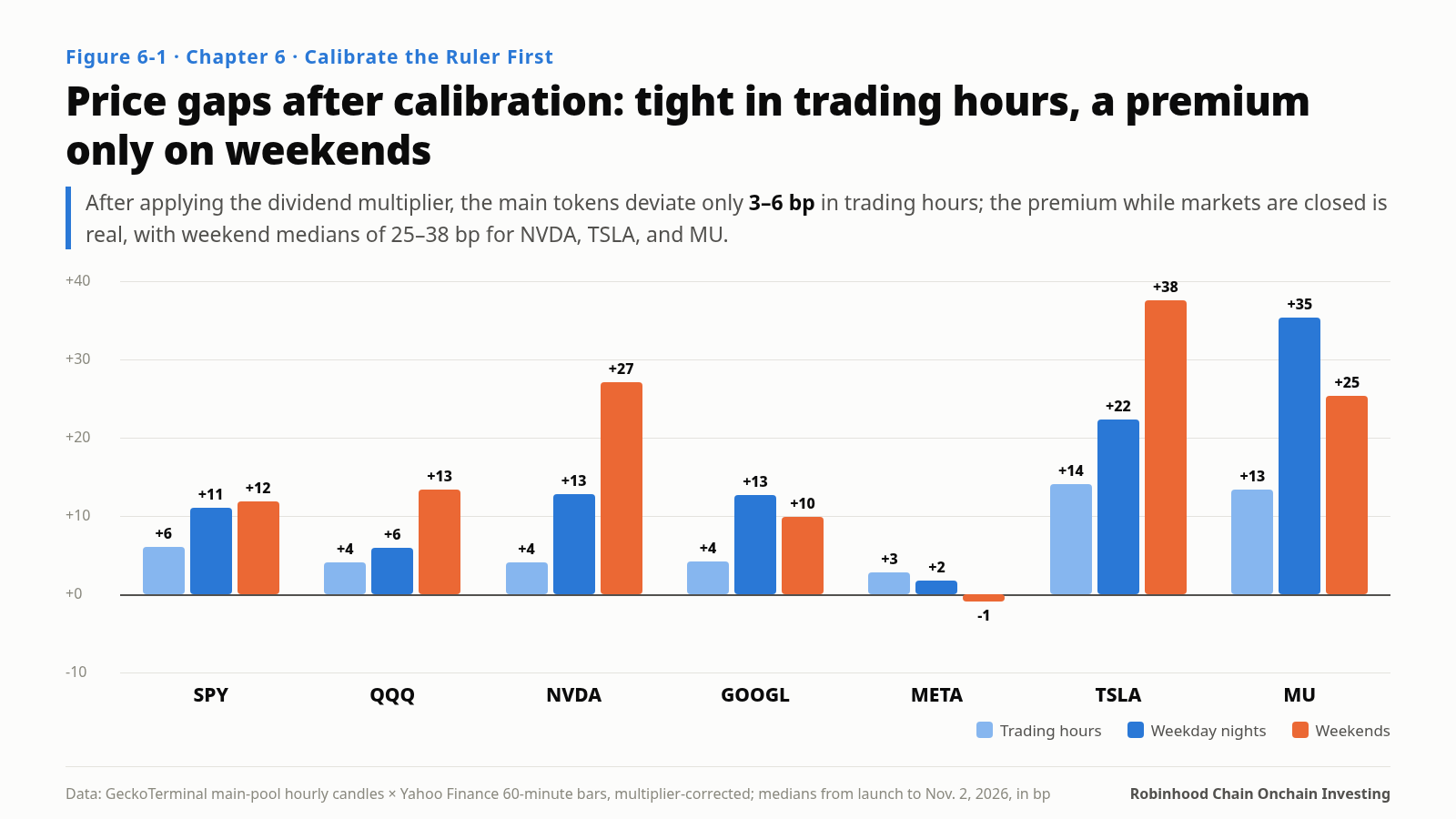
The SPY token trades about 20 basis points above the share, which looks like an onchain premium but is mostly a dividend-multiplier illusion, and about 31% of each dividend is withheld before reinvestment. After calibration, trading-hours gaps are 3–6 basis points; the real premium appears on weekends and tracks Monday's gap. The piece also sizes stock-token market making: about $1.2 million a year in fees.
If you hold or plan to hold Robinhood’s stock tokens, or you are thinking about making markets in them, this piece answers four questions: is the price you pay fair, where do the dividends go, does the weekend onchain price carry information, and how much money is there in market making?
First, a conclusion I almost got wrong.
The natural first step in studying stock tokens is to compare the onchain price with the share. I lined up GeckoTerminal’s hourly SPY/USDG candles against SPY’s 60-minute bars (including pre- and post-market). The result was clear: the SPY token was almost always more expensive, with a median around +20 basis points since mid-September. More expensive during trading hours, overnight and on weekends, by about the same amount.
That makes a neat headline: there is a standing onchain premium, and stock-token buyers pay 0.2% extra.
It is wrong. The ruler is crooked.
One Token Is Not One Share
Robinhood’s stock-token contracts have a function called uiMultiplier(), which returns how many shares one token represents. At launch every token was 1.0. Each time the underlying pays a dividend, Robinhood does not pay cash; it raises the multiplier, reinvesting the dividend.
Since September 18, one SPY token represents 1.001718 shares. Multiply the share price by that and most of the “standing premium” disappears.
Reading the multiplier events for seven major tokens turned up something else. For SPY, QQQ, NVDA, META and MU, the multiplier increase was almost exactly 0.69 times the dividend yield. About 31% of each dividend was withheld before reinvestment. The most plausible explanation is the 30% U.S. withholding tax on dividends paid to non-U.S. persons, plus about 1% in processing cost.
For long-term holders, that is a real cost. SPY yields about 1.0% a year in dividends; a token holder effectively receives about 0.69%, about 0.31 percentage points less per year. An investor holding SPY directly from a treaty country with 15% withholding loses only about 0.15 points. TSLA, which pays no dividend, is unaffected; high-dividend stocks are hit hardest.
The dividends did not disappear. They were paid at about 69 cents on the dollar and quietly turned into more shares.
After Calibration: Tight in Trading Hours, a Premium on Weekends
With the multiplier corrected, I recomputed hourly data for seven tokens from launch to November 2 (1,600 to 2,800 hours each), split into three sessions:
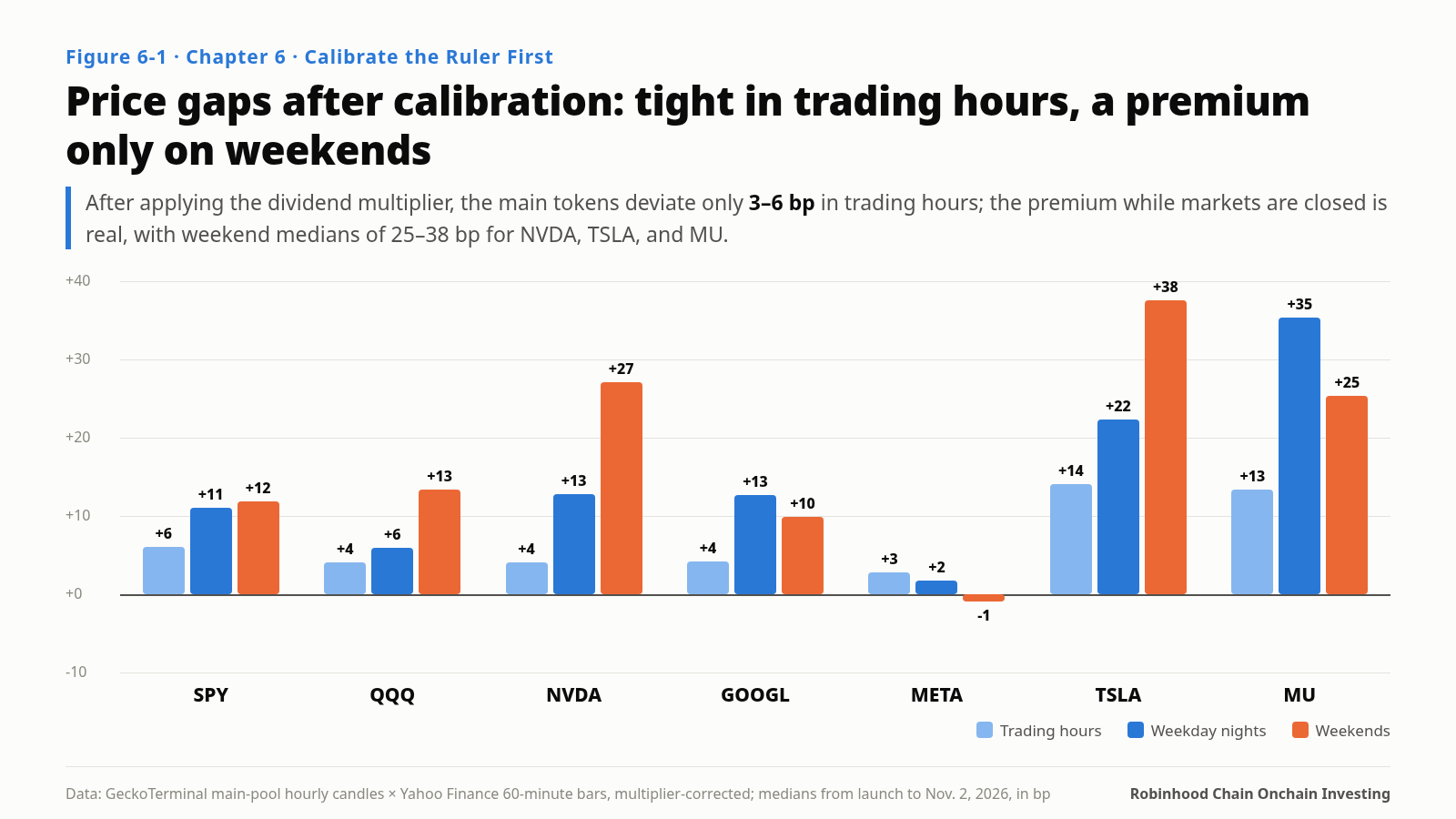
- Trading hours are tight. When U.S. markets quote, major tokens deviate from the share by a median of 3–6 basis points, a fraction of the pool fee. Arbitrageurs are watching. TSLA and MU are a bit wider, about 13–14 basis points, since their main pools charge 0.3%.
- Closed hours carry a real premium. After correction, the weekend premium shows up: about 27 basis points for NVDA, 38 for TSLA, 25 for MU, 12–13 for SPY and QQQ. META is the exception, near zero.
- The tails are wide. The 95th percentile of weekend deviation is about 83 basis points for SPY and more than 250 for NVDA and MU. One weekend hour in twenty is beyond that.
The source of the weekend premium is straightforward. When U.S. markets are closed, anyone who wants to buy can only buy onchain, and few market makers can hedge: the share can’t trade, so hedging means perpetuals or waiting until Monday. Market makers carrying a whole weekend of price risk want to be paid. The premium is the price of weekend liquidity.
The Weekend Price Carries Information
If the weekend onchain price were noise, the premium would be pure cost. If it carries information, it is a signal.
For each weekend, I measured the token’s move from the share’s last Friday quote to early Monday, then compared it with the share’s Monday pre-market gap. Over 16 weekends, TSLA’s direction matched 15 times, a correlation of 0.88. QQQ, META, GOOGL and MU ranged from 0.81 to 0.98; SPY was 0.64 and NVDA 0.46.
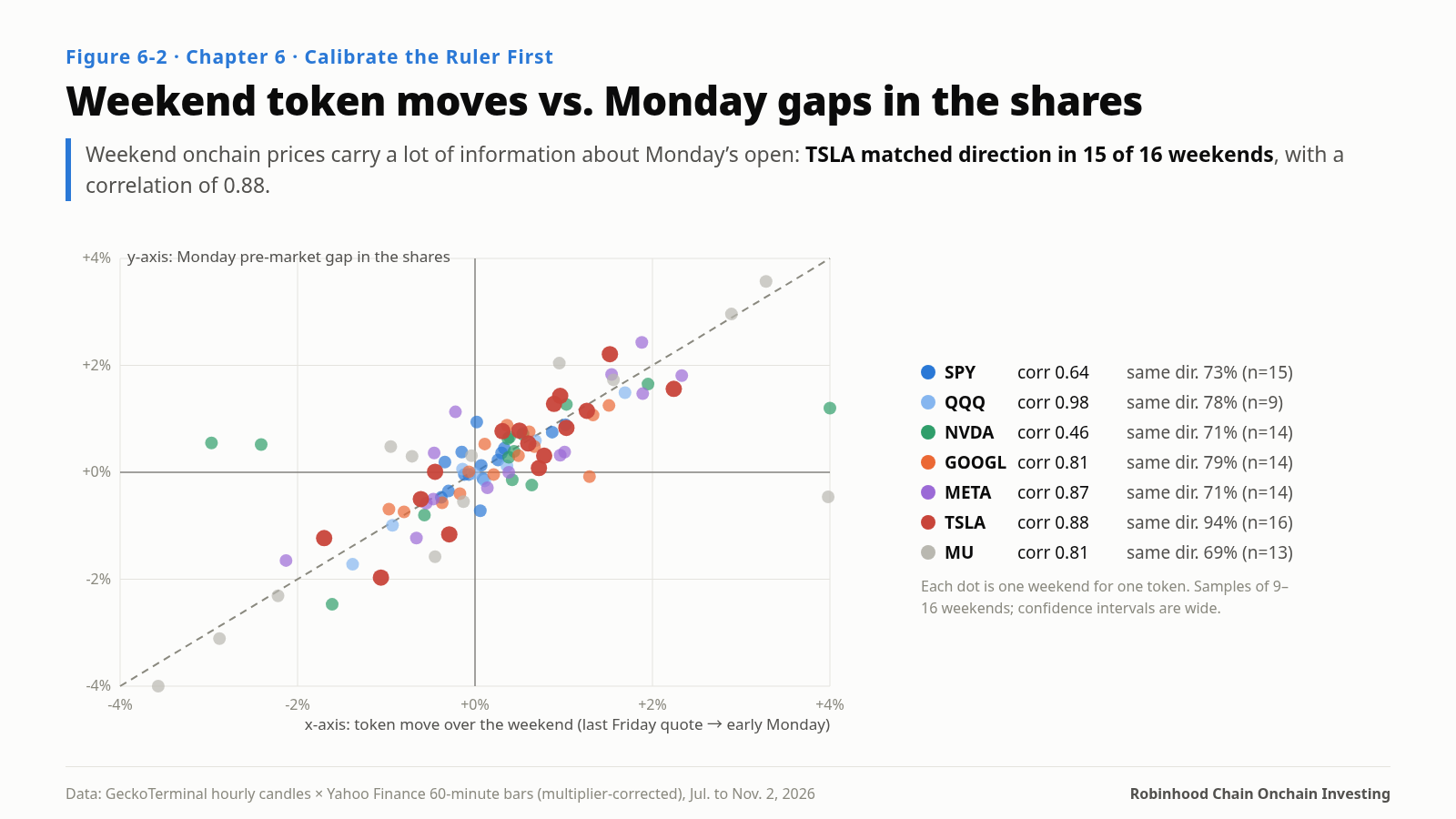
Two limits: the samples are only 9 to 16 weekends, so confidence intervals are wide; and this shows that weekend prices reflect weekend news, not that they let you profit on Monday, since by the time you can trade the share, the gap has already happened. Where it helps: if you plan to adjust a brokerage position on Monday, the weekend token price is a more timely, more quantitative guide than headlines.
Market Making: About $1.2 Million a Year
Market makers see another set of tempting numbers.
Using daily share data since July 2026, I computed the relative volatility of the two assets in the five main SPY pools and compared LVR (loss versus rebalancing; for a full-range AMM, roughly relative volatility squared divided by 8) with fee yield. The SPY/USDG 0.05% pool: LVR about 0.15%, fee yield about 21.8%. SPY/WETH: LVR about 2.5%, fees about 32%. In all five, fees clearly exceeded the market-making loss, the opposite of Ethereum mainnet’s major pools, where fees and LVR are often about equal.
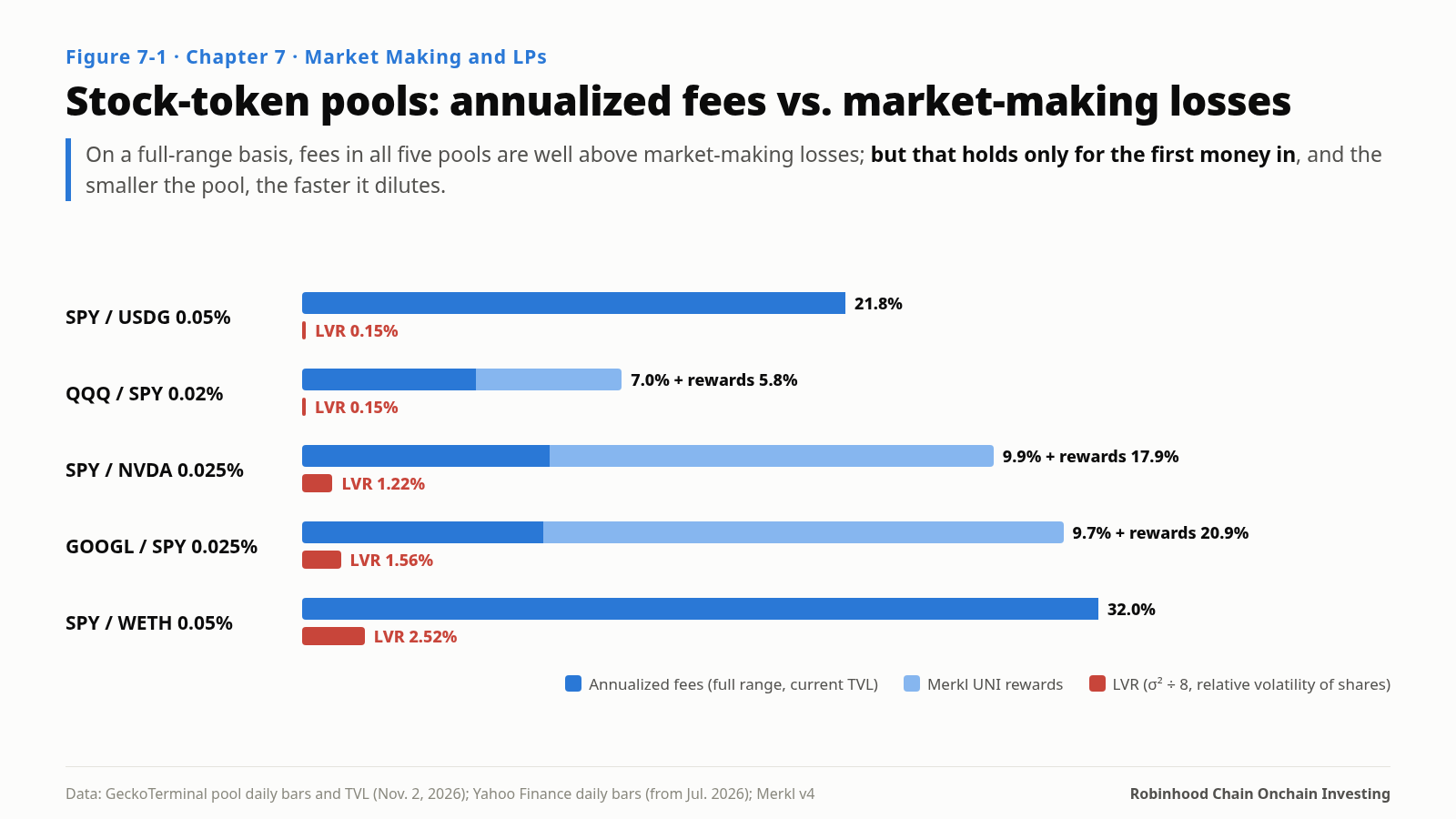
But first add up the total. At 30-day average volume times fee rate, these five pools generate about $1.2 million in fees a year. Other stock-token pools are smaller. At early-November volumes, making markets in stock tokens across the whole chain earns a little over a million dollars a year.
Fees are a fixed-size cake split by TVL. Add $1 million to the SPY/USDG 0.05% pool and its TVL doubles, cutting its fee yield from about 22% to about 11%. For stock tokens, market making is a capacity question first and a yield question second.
Two more cautions: some of the volume is arbitrage, which is itself the source of LVR; and most of these pools use concentrated liquidity, so if the price leaves your range your position becomes one-sided. Actual returns depend on range management.
Stock Against Stock: A Pool You Rarely See Elsewhere
This chain has a kind of pool that is rare elsewhere: stock on both sides. In August Uniswap opened a set of V4 pools pairing SPY with TSLA, AMZN, META, QQQ and others, with UNI rewards through Merkl.
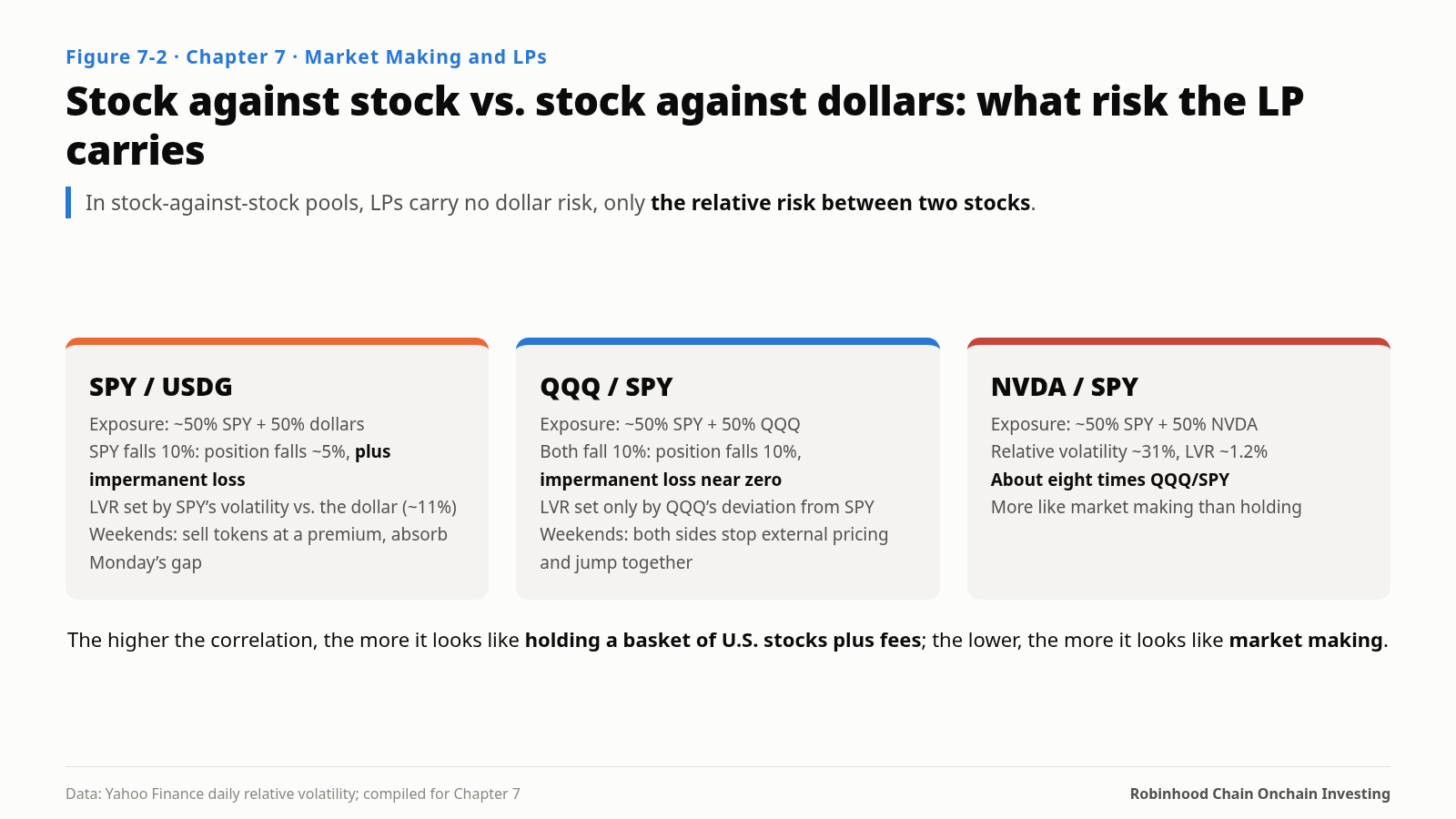
The economics differ completely from an ordinary pool. In a QQQ/SPY pool, if both fall 10%, your position falls 10%, but impermanent loss is near zero because the ratio did not change. You do not carry risk against the dollar; you carry the relative risk between two stocks.
So it suits one kind of investor: someone who already plans to hold a basket of U.S. stocks for the long term. QQQ/SPY has an LVR of only about 0.15%; putting two ETFs you already want into the pool means collecting about 7% in fees and about 6% in UNI rewards while you hold them. NVDA/SPY and GOOGL/SPY have relative volatility of 31–35% and eight to ten times the LVR; that is market making, not holding.
Weekends cut both ways for LPs. Buyers outnumber sellers, so LPs sell tokens at a premium. On Monday the share gaps and arbitrageurs drag the pool price over in one move, and LPs absorb those large deviations. Stock-against-stock pools stop and jump together, so they are hit far less.
If You Trade, Hold or Make Markets
-
Always multiply by the multiplier first. Read
uiMultiplier()before any price comparison; it is one RPC call. - Avoid buying on weekends unless you must; selling on weekends can work in your favor. The premium benefits sellers.
- For high-dividend stocks, consider other ways to hold. A 31% dividend haircut matters little on SPY’s 1% yield and costs more than a point a year on a 3–4% yielder.
- For market making, calculate capacity first. Thirty-day volume times the fee rate, divided by “existing TVL plus your money,” is the yield you will actually get.
- Set concentrated ranges to survive at least one weekend gap: about ±1% for SPY, ±3–5% for single stocks.
Stock tokens are not cheaper stocks. They are more flexible stocks. The extra cost buys 24/7 trading, self-custody and composability; whether it is worth it depends on whether you use them.
Have you ever checked the multiplier on a stock token you hold?
—Adapted from Where the Yield Comes From: An Investor’s Handbook for Robinhood Chain, Chapter 6, “Calibrate the Ruler First,” and Chapter 7, “Market Making and LPs”
The full book (15 chapters, 42 figures): https://pickful.ai/books/dgpy
转发此帖子?
与您的关注者分享。
回复