
Contents (9)

·
From "No Politics" to Crypto's Biggest Political Force
2020–2024 The mission-first letter, Stand With Crypto and Fairshake
On September 27, 2020, Brian Armstrong published a post on the company blog titled “Coinbase is a mission focused company.”
America was deeply divided that year: the pandemic, the racial justice movement, an approaching presidential election. Silicon Valley companies were taking public stances one after another, employees were arguing fiercely on internal forums, and some companies changed business decisions because of employee protests.
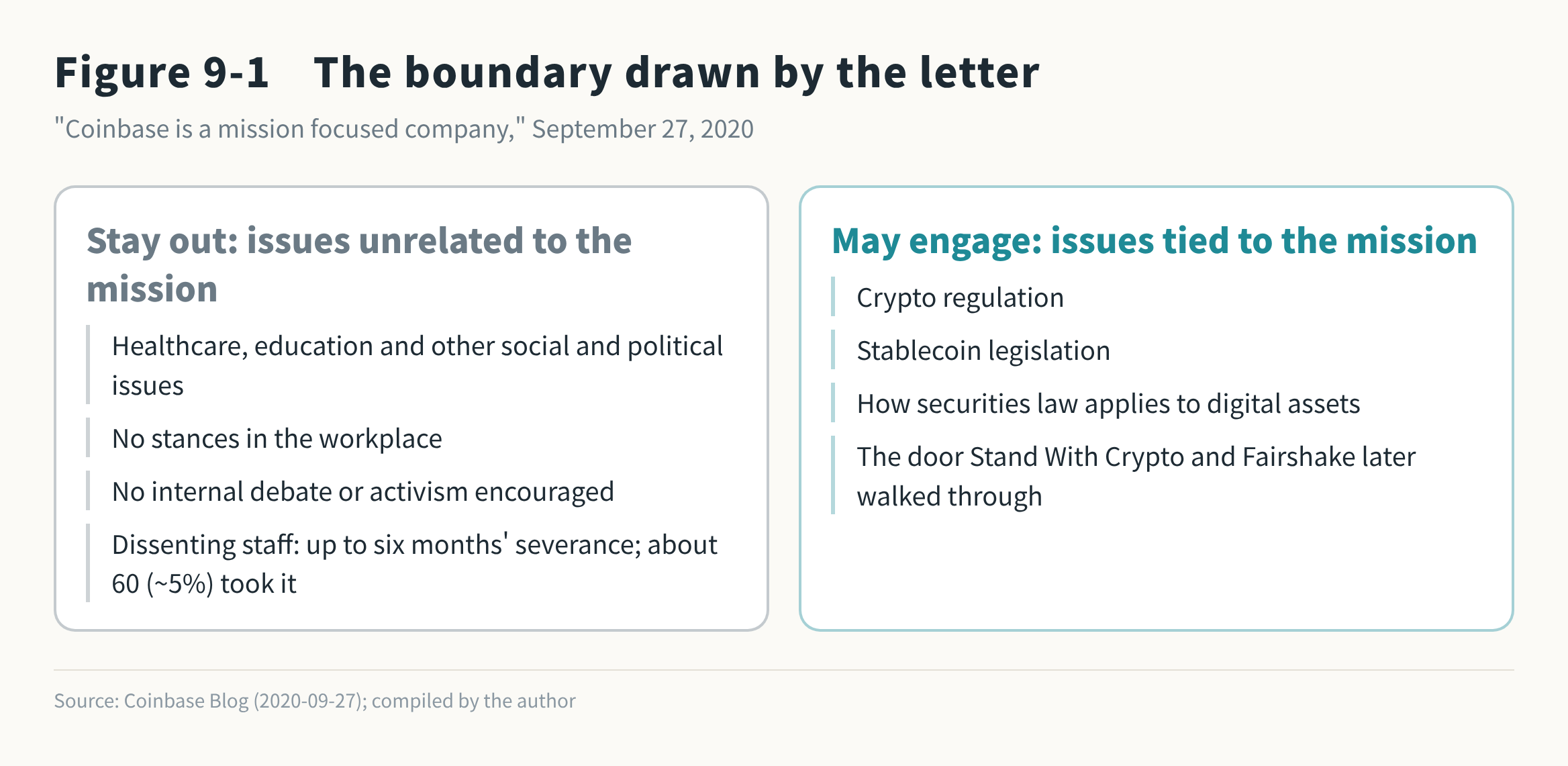
Armstrong’s post went against the current. Coinbase, Armstrong wrote, would focus on its mission of building an open financial system for the world; the company would not engage in social and political issues unrelated to that mission in the workplace, and it did not encourage employees to debate or act on such issues inside the company.
A few days later Armstrong went further: employees who didn’t agree with this approach could take an exit package of up to six months’ severance.
In the end, about 60 employees took it, roughly 5 percent of the 1,200 employees at the time.
The post caused an uproar in Silicon Valley. Supporters saw a rare honesty from a CEO; critics saw indifference and evasion, arguing that at a moment of dramatic social change, “taking no position” was itself a position.
Four years later, in the 2024 US election, Fairshake, the crypto industry super PAC funded largely by Coinbase, and its affiliated groups raised nearly $240 million, making them among the biggest sources of political money of the cycle. They spent about $40 million helping defeat a sitting senator.
From “no politics” to “the biggest political force,” Coinbase took just four years.
Was this a betrayal of its founding principle, or an extension of mission-first logic?
1. The 2020 letter
To answer that, you first have to read the letter carefully.
In 2020, Armstrong drew a clear boundary: the company would not engage in social and political issues unrelated to its mission. But the letter left an opening for policy issues related to its mission: on issues like crypto regulation that directly affect its mission, Coinbase “may engage”; on issues unrelated to the mission, such as healthcare and education, the company would take no position.
In other words, “no politics” didn’t mean “no political involvement.” It meant “political involvement only where crypto is concerned.”
The distinction drew little attention in 2020. The focus then was on the 5 percent of employees who left and on Silicon Valley’s “culture war.” Many people remembered only the label “Coinbase stays out of politics” and missed the door the letter had left open.
From a management perspective, the letter’s effects were quite clear:
- Focus. The company stopped arguing endlessly about issues unrelated to its business, and employees concentrated on product and mission.
- Selection. Employees who cared more about expressing views on social issues left, and those who stayed identified more with the mission-first culture.
- Cost. Coinbase left an impression of “coldness” with some prospective employees and users, and recruiting suffered somewhat. Senior executives including Dan Yoo, vice president of business and data, and John Russ, head of global marketing, left one after another.
But the letter’s biggest significance only became visible years later: it set the boundaries and the rationale in advance for Coinbase’s later large-scale political involvement.
2. Why it had to get involved
In 2023, Coinbase was sued by the SEC. That led Armstrong and Coinbase’s leadership to a conclusion: courts can only settle individual cases; rules have to be written by Congress.
The fundamental problem facing the crypto industry in the US was the lack of a dedicated law. Regulators each applied rules written decades earlier for stocks, futures and banks to crypto assets, fought among themselves over jurisdiction, and left the industry feeling its way along blurry boundaries, liable to be sued at any time.
The only way to change that was to push Congress to legislate. And pushing legislation required political influence.
In the US, political influence ultimately comes from two things: votes and money.
Coinbase decided it wanted both.
3. Votes: Stand With Crypto
In August 2023, Coinbase launched an independent nonprofit: Stand With Crypto.
Its goal was to organize the tens of millions of Americans who hold crypto into a politically influential voting bloc. Its methods were direct:
- Grade politicians. Based on each member of Congress’s and each candidate’s public statements and votes on crypto, it assigned a grade from A to F so voters could see at a glance.
- Mobilize voters. It encouraged users to sign up as “crypto advocates,” vote for crypto-friendly candidates and contact their representatives with their demands.
- Turn users into voters. Coinbase promoted Stand With Crypto in its own app and website, turning its tens of millions of users into a potential political mobilization network.
The logic: crypto holders in the US had become a sizable group. If they voted “as crypto voters” in elections, politicians could no longer ignore the industry’s demands.
4. Money: Fairshake
The other line was money.
Fairshake is a crypto industry super PAC. Under US law, a super PAC can raise and spend unlimited amounts to support or oppose candidates, as long as it doesn’t coordinate directly with campaigns.
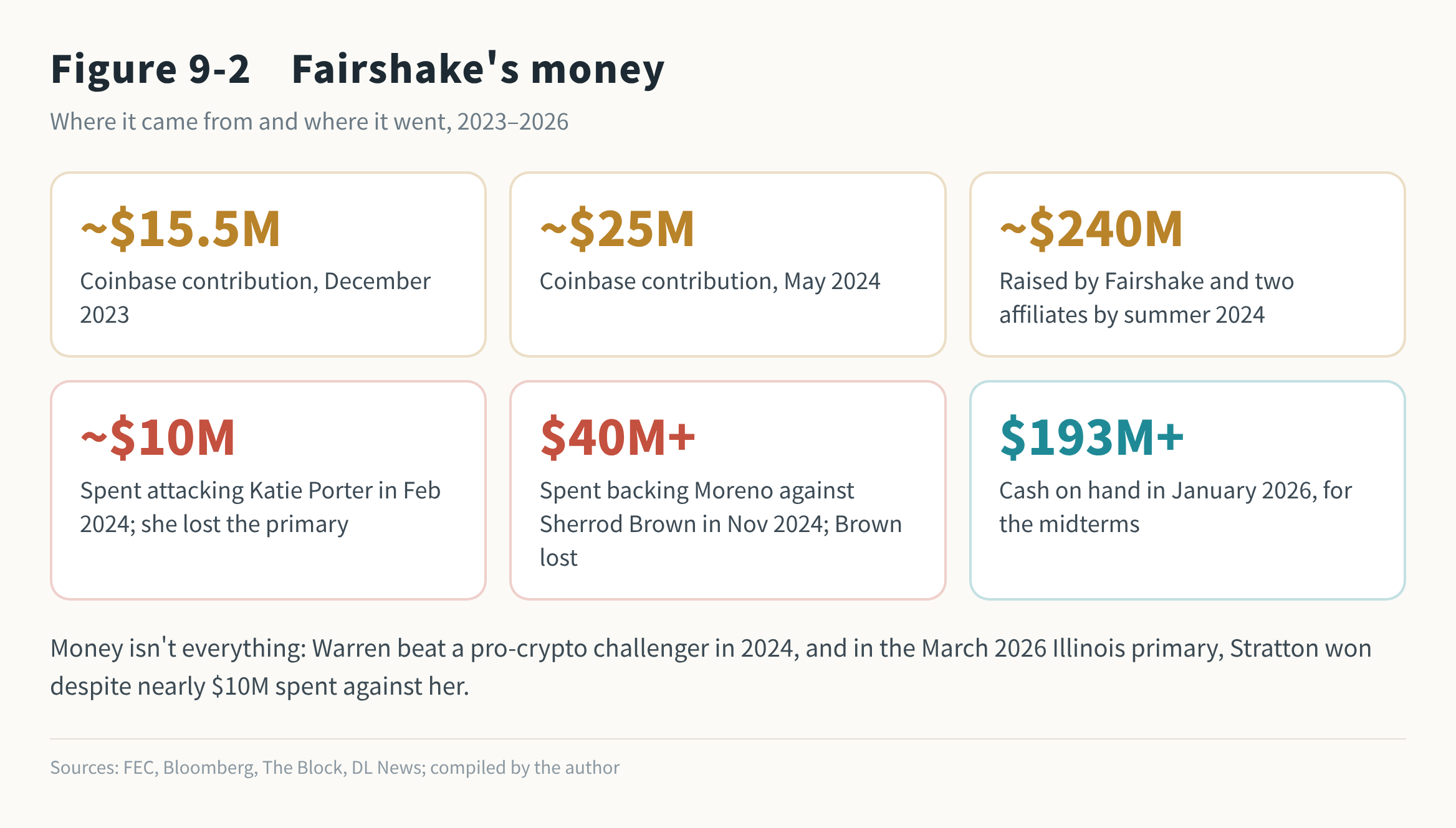
Coinbase was one of Fairshake’s main funders, alongside Ripple and the venture firm a16z. According to Federal Election Commission records, Coinbase gave Fairshake about $15.5 million in December 2023 and added about $25 million in May 2024.
By summer 2024, Fairshake had raised more than $200 million; together with its two affiliates, Defend American Jobs and Protect Progress, the total was nearly $240 million.
The money was spent with great precision:
- February 2024: Fairshake spent about $10 million on ads attacking Democratic candidate Katie Porter in California’s Senate primary. Porter lost the primary in March.
- November 2024: In Ohio’s Senate race, Fairshake’s affiliate Defend American Jobs spent more than $40 million supporting Republican Bernie Moreno against sitting Democratic Senator Sherrod Brown. Brown chaired the Senate Banking Committee and was one of the crypto industry’s harshest critics in Congress. Brown lost.
Those two races sent Washington an unmistakable signal: being an enemy of the crypto industry has a price.
Across the whole cycle, Fairshake said it spent about $135 million supporting crypto-friendly candidates, the vast majority of whom won. But money wasn’t everything: in Massachusetts, Elizabeth Warren, one of the senators least friendly to crypto, easily defeated pro-crypto Republican challenger John Deaton.
Notably, Fairshake’s strategy was bipartisan: it supported crypto-friendly Republicans and crypto-friendly Democrats alike, and targeted candidates with hard-line positions on crypto, not a particular party. Formally, this continued the logic of the 2020 letter: care only about crypto, not about other issues.
5. After the 2024 election
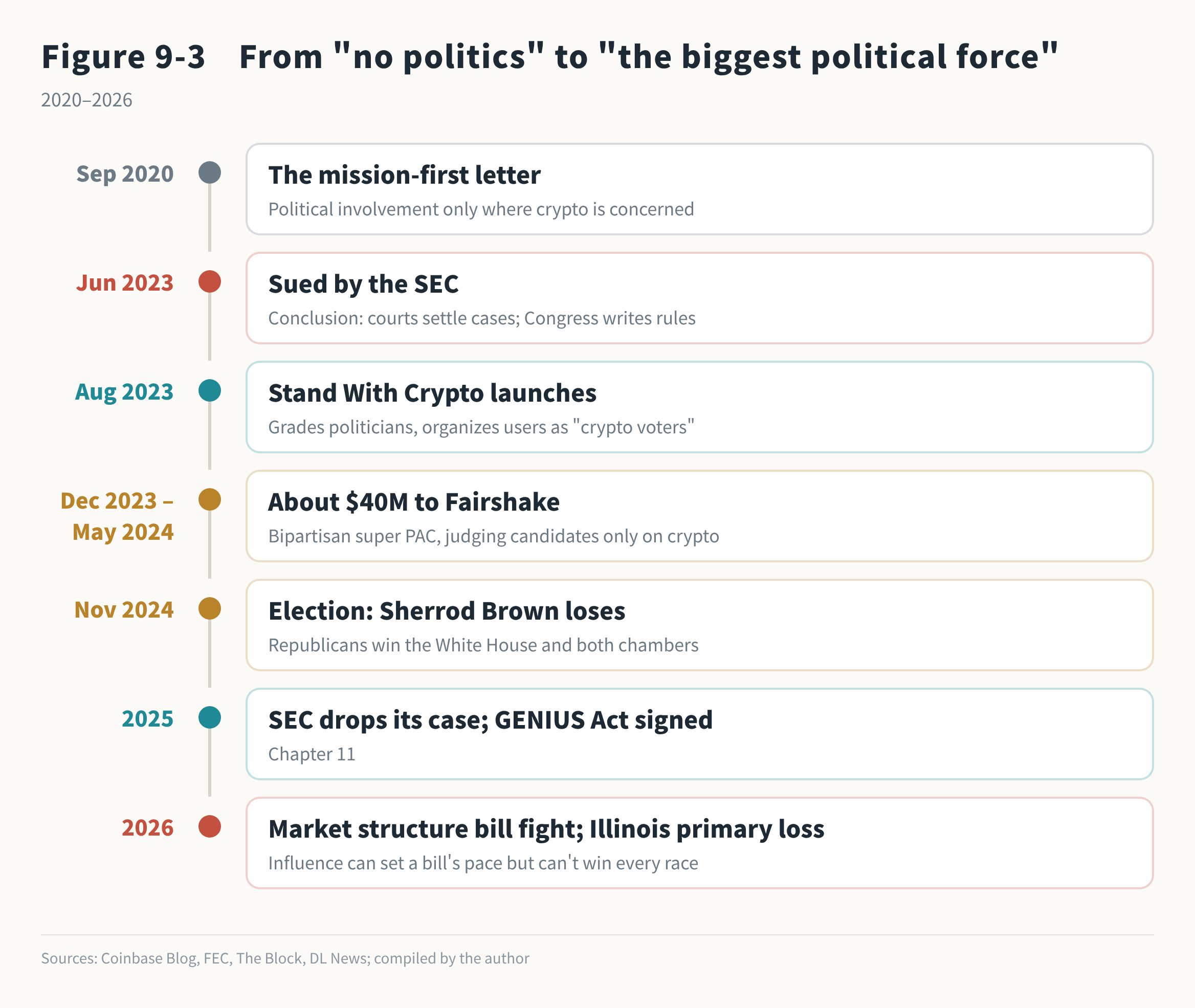
In November 2024, the results came in. Republicans won the White House and both houses of Congress, and the new administration said explicitly that it wanted to make the US “the crypto capital of the planet.”
The change in politics quickly passed through to regulation:
- SEC leadership changed, and the new leadership’s attitude toward the crypto industry shifted fundamentally;
- In February 2025, the SEC dropped its case against Coinbase;
- In July 2025, the GENIUS Act, America’s first dedicated stablecoin law, was signed.
Of course, these changes can’t all be credited to Fairshake and Stand With Crypto. Elections are decided by countless factors, and the crypto industry was only one of them. But on crypto, a growing number of politicians in both parties began openly supporting clear crypto legislation, and the industry’s political mobilization played a part in that.
6. 2026: money isn’t everything
A few days before the 2024 results came in, on October 31, 2024, Armstrong announced that Coinbase was pledging another $25 million to Fairshake for the 2026 midterms, and that it would help Stand With Crypto grow its “crypto advocates” from about 1.8 million to 4 million.
The political bets didn’t stop in 2024. By January 2026, Fairshake said it had more than $193 million in cash on hand, with Coinbase, Ripple and a16z still its main backers.
Political influence also began to be used on the details of legislation. In January 2026, as the Senate worked on a crypto market structure bill, Coinbase withdrew its support for the draft at the time, arguing that its provisions on tokenized stocks, stablecoin rewards and other issues were unfavorable; the Senate Banking Committee promptly postponed its markup. One company’s stance could now affect the pace of a bill.
But 2026 also brought Fairshake its first clear setback. In Illinois’s Democratic Senate primary in March, Fairshake spent nearly $10 million opposing Lieutenant Governor Juliana Stratton, and Stratton still won the nomination. The media widely saw this as the first major defeat of the cycle for crypto political money.
Money can make politicians take you seriously, but it can’t win every election for you. In a polarized political environment, the more the crypto industry uses money to influence elections, the easier it is for opponents to paint it as “just another industry buying politics.” That is the other side of the question from the first section: once you get involved, you have to accept every counterforce that comes with it.
7. Looking back: a betrayal, or an extension of the mission?
This is the book’s most contested chapter, and the one most worth thinking about.
The case for “an extension of the mission”: The 2020 letter always left a door open for crypto-related political involvement. When Coinbase entered politics, the issues it engaged on were always directly tied to its mission: crypto regulation, stablecoin legislation, the scope of securities law. Fairshake’s strategy was bipartisan and looked only at candidates’ positions on crypto, not their other views. From this angle, Coinbase used politics as a tool for its mission, within mission-first logic.
The case for “a betrayal of its principle”: The spirit of the 2020 letter was to keep the company away from political division and conflict. By 2024, Coinbase was deep inside America’s fiercest elections, spending enormous sums to defeat specific politicians. However much it insisted it was “only about crypto,” it had objectively become a significant force on the US political map, and that force would inevitably intersect with other issues and other interests. In a highly polarized environment, “caring only about crypto” is very hard to pull off.
The deeper question: Is it reasonable for a company to spend huge sums influencing elections to win favorable regulation for its industry? Finance, energy and pharmaceuticals in the US faced this question long ago. The crypto industry simply covered in a much shorter time the road those traditional industries took decades to travel.
What if Coinbase had stayed out?
It might have kept slugging it out with the SEC in court, waiting for an uncertain outcome. The crypto industry’s voice in Washington might have been drowned out by negative sentiment after FTX’s collapse. US crypto legislation might have been delayed by years more. And Coinbase, a company that “could only accept the rules passively,” would always have been on the back foot.
The lesson of this chapter: when your industry has no rules yet, sooner or later you must decide whether to wait for others to write them or to help write them; and once you choose to take part, you must accept all the controversy that comes with it.
Decision Card
- Situation: 2020: a divided society and heated political debate inside the company. 2023: sued by the SEC, in an industry with no dedicated legislation
- Options: A: keep a low profile and fight only through courts and lobbying B: get involved at scale, organizing voters and funding elections to push legislation
- Choice: In 2020, first drew the line at “only mission-related issues”; in 2023–2024 launched Stand With Crypto and became a main funder of Fairshake
- Outcome: Showed formidable political influence in the 2024 election, and the regulatory environment shifted fundamentally in 2025; but Coinbase became mired in political controversy
- Lesson: When your industry has no rules, you must sooner or later decide whether to wait for them or help write them; taking part means accepting the controversy that comes with it
Key line: “No politics” never meant “no political involvement.” It meant “political involvement only for our own mission.”
Sources
- The 2020 mission-first letter and exit packages: The Block; The Block: exit package; Decrypt; CoinDesk; Axios; CoinDesk: executive departure
- Fairshake fundraising and spending: The American Prospect; BNN Bloomberg; Washington Examiner; Washington Times
- Coinbase’s contributions to Fairshake: Fortune, 2024-06-03; Bloomberg Law
- Contents of the letter and executive departures: Wikipedia: Brian Armstrong; CoinDesk: VP departure; CoinDesk: marketing head departure
- Coinbase’s contribution records and Ohio spending: Follow the Crypto (FEC data); The Block; Wikipedia: Fairshake
- 2024 election results and Fairshake spending: Decrypt; Cointelegraph; Invezz, 2024-11-07
- The $25 million pledge for 2026 and Stand With Crypto’s growth target: Bloomberg, 2024-10-31; The Block
- Fairshake’s cash above $193 million; Coinbase withdrawing support for the market structure draft: The Block, 2026-01-28
- The Illinois primary: DL News; CBS Chicago; Washington Monthly, 2026-03-17
From my new book Coinbase: On the Side of the Rules: https://pickful.ai/books/tqn4
Repost this post?
Share with your followers.
Reply