
Contents (8)

·
Crypto Companies Are Earning Less and Less from Crypto Trading
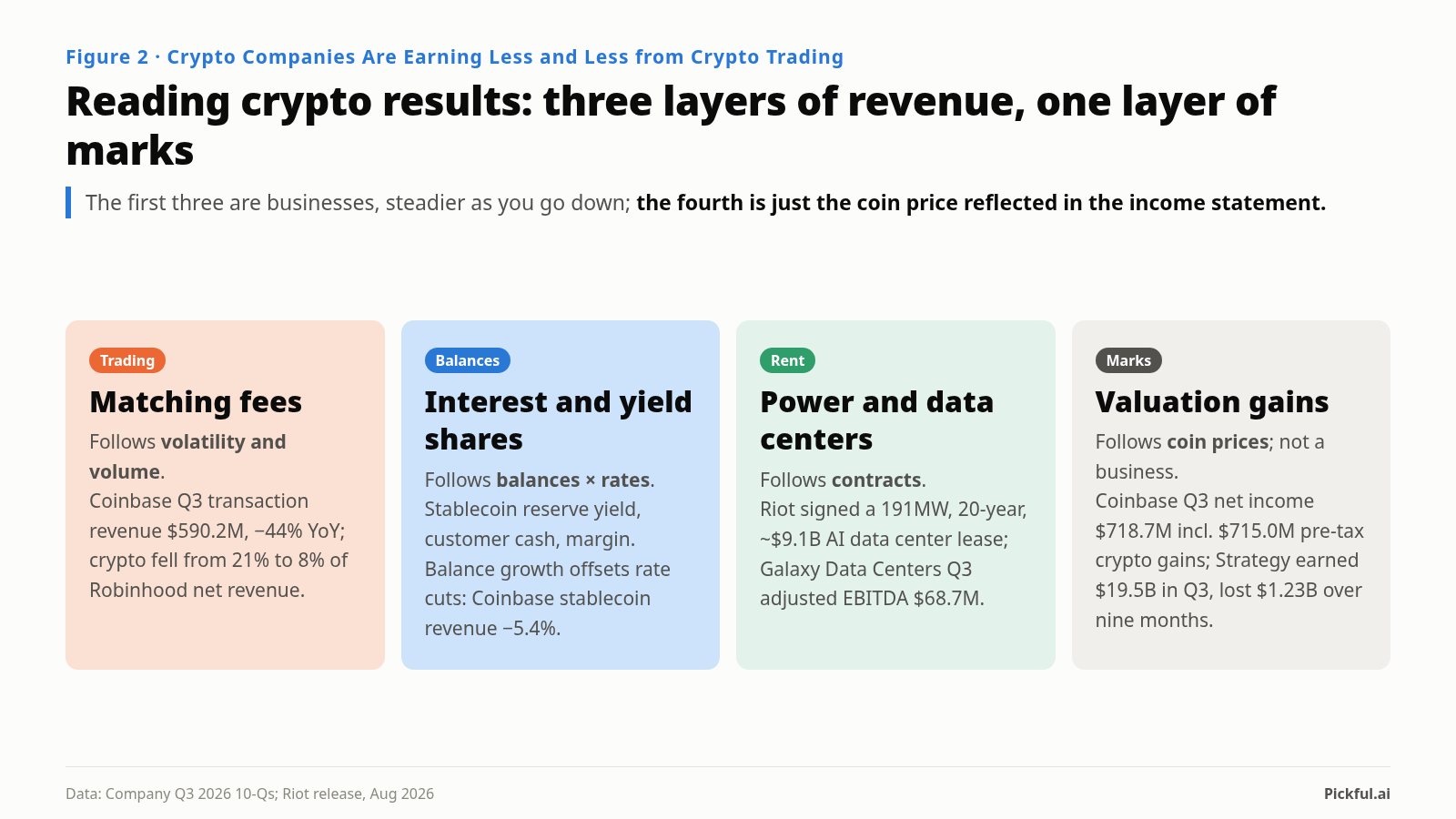
In Q3 2026, Coinbase transaction revenue fell 44% while stablecoin revenue fell just 5.4%, and Robinhood earned more from prediction markets than from crypto trading. A four-layer way to read where crypto companies' profits actually come from.
If you work at a bank, a brokerage or a payments company and you are weighing a crypto business, you probably picture it as a trading business: users buy and sell, the platform takes a fee, good markets pay more and bad markets pay less.
The third-quarter 2026 filings tell a different story.
In Robinhood’s 10-Q, crypto transaction revenue fell from $268M a year earlier to $120M, down 55%, and its share of total net revenue dropped from 21% to 8%. In the same table, prediction markets (event contracts) rose from $27M to $173M. A year ago crypto trading brought in a fifth of this broker’s revenue; in Q3 it earned more from prediction markets than from crypto trading.
Coinbase reported Q3 net income of $718.7M, which looks like a good quarter. Read further down the income statement and it includes $715.0M (pre-tax) of “gains on crypto assets held for investment”, meaning the coins on its own balance sheet went up. For the first nine months combined, Coinbase lost money (−$34.9M).
Both numbers point the same way: the place where crypto companies actually make money is moving away from trading.
This piece started from 16 issues of Delphi Digital’s newsletter over the past three months. In early November Delphi ran a table of Q3 results and concluded, in short, that strong reported profits did not necessarily reflect stronger operating performance. What the table did not answer is where the profit comes from if not from trading, and what keeps each of those sources going.
The trading layer: half of it gone in a year
Coinbase’s Q3 transaction revenue was $590.2M, against $1,046.3M a year earlier, down 44%. The company’s own explanation is plain: total market spot volume fell 6% quarter over quarter, derivatives volume fell 11%, and crypto asset volatility dropped 15% to multi-year lows.
Volatility is an exchange’s raw material. When prices swing, people trade; when prices drift sideways, they stay away. There is only so much a platform can do here; this layer of revenue mostly follows the market. BTC rose about 40% in Q3, and Coinbase’s transaction revenue was still down 44% year over year: prices were rising while volatility sat at multi-year lows, and retail attention was being pulled elsewhere.
Pulled where? Delphi spent most of the past three months writing about it: memecoin launchpads on Pump.fun and Robinhood Chain, perpetuals on Hyperliquid, and the prediction markets that Robinhood and Coinbase both now run. Coinbase also said its prediction markets business has passed a $200M annualized revenue run rate.
The trading layer has two problems: it is highly cyclical, and the traffic is moving. The same user is still trading, just not on your spot order book.
The balance layer: rates fell, and it only lost single digits
The Fed hiked in September, and the 10-year Treasury yield touched 5.37%, its highest since 2002. Seeing those two facts, it is easy to assume crypto companies’ interest income rose this year. The catch is that the long end and the short end are different things.
Crypto companies’ interest income sits mostly at the short end: stablecoin reserves are held in T-bills and reverse repos, and customer cash sits in overnight and short-term products. Short-term rates are lower than a year ago. The Fed cut three times in 2025, reaching 3.50%–3.75% in December, and only hiked back to 3.75%–4.00% in September 2026. Circle’s 10-Q says it plainly: the average yield on its reserve assets fell 61 basis points year over year in Q3.
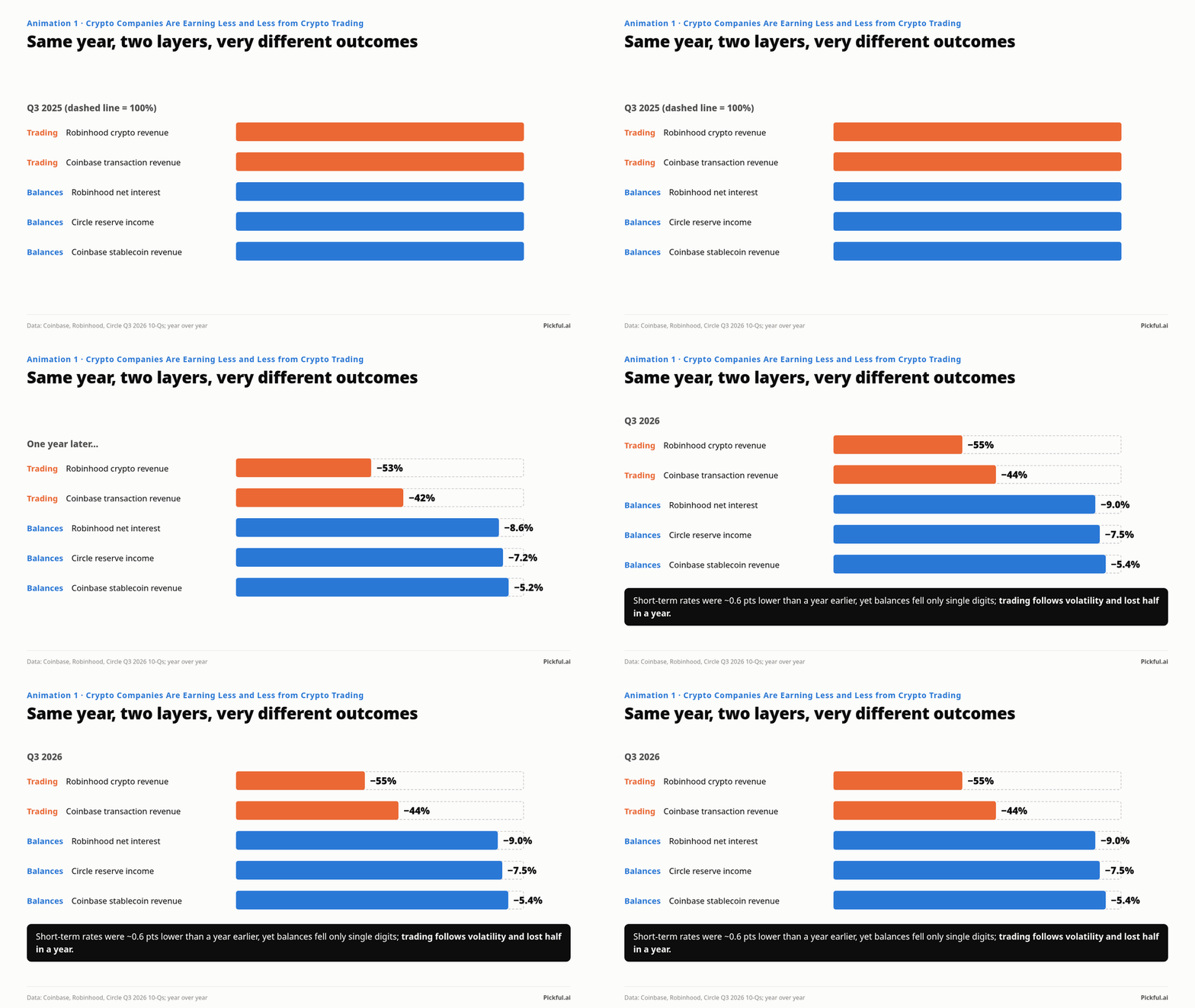
Rates fell, and balance-layer revenue barely moved:
- Coinbase stablecoin revenue: $306.9M, down 5.4% year over year;
- Circle reserve income: down 7.5% year over year;
- Robinhood net interest revenues: $415M, down 9% year over year;
- Tether: $1.5B of Q3 net operating profit, flat with Q2, mainly from U.S. Treasuries and reverse repos (BDO attestation).
Rates down 0.6 percentage points, this layer down 5% to 9%; the trading layer down 44% to 55% over the same period.
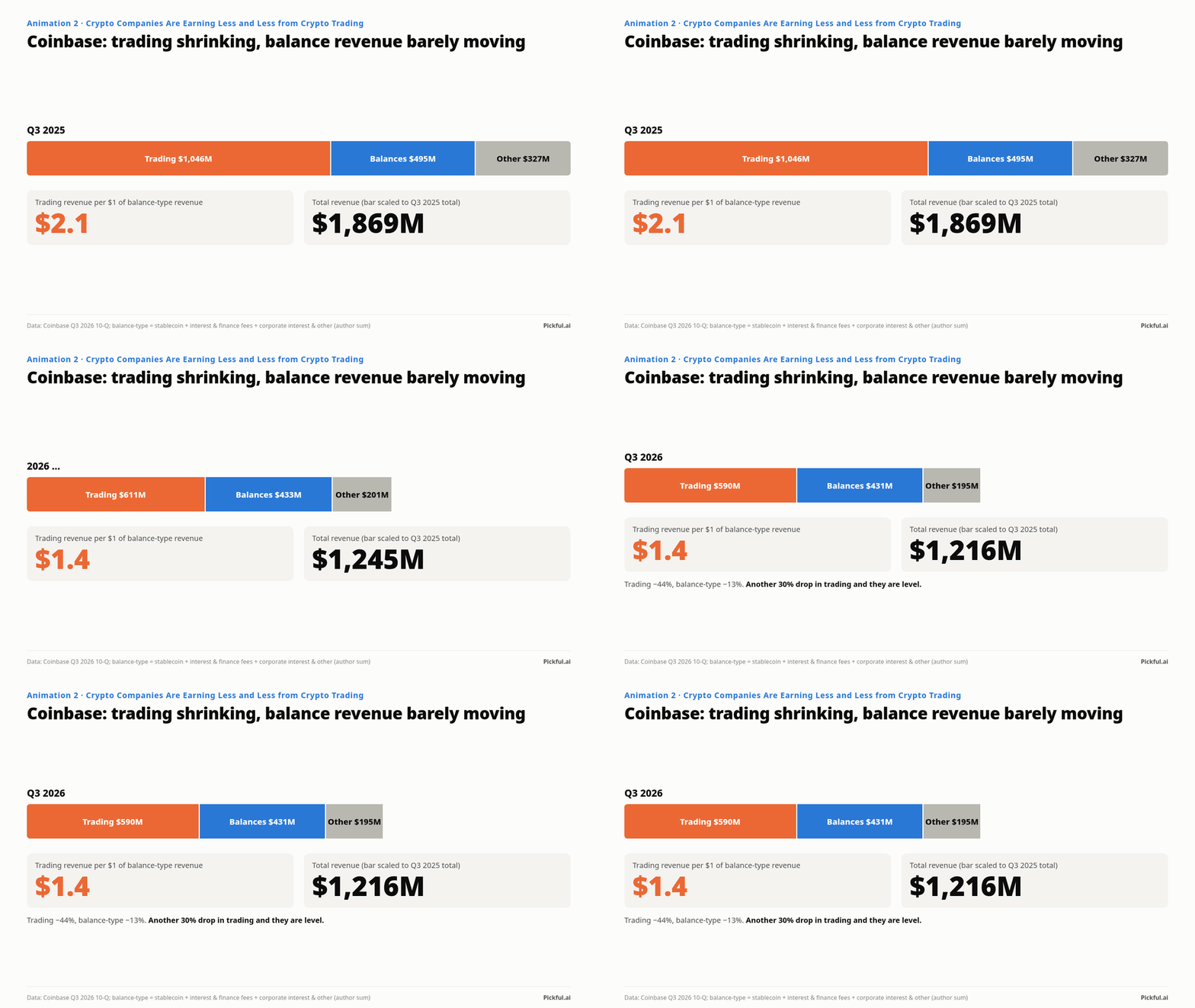
Coinbase’s revenue makes the point most clearly when split apart. I added stablecoin revenue, interest and finance fee income, and corporate interest and other income together as “balance-type revenue”. A year ago that was $495.1M, and transaction revenue was 2.1 times it. Now balance-type revenue is $430.6M and transaction revenue is only 1.4 times it. Another 30% drop in transaction revenue and the two would be level.
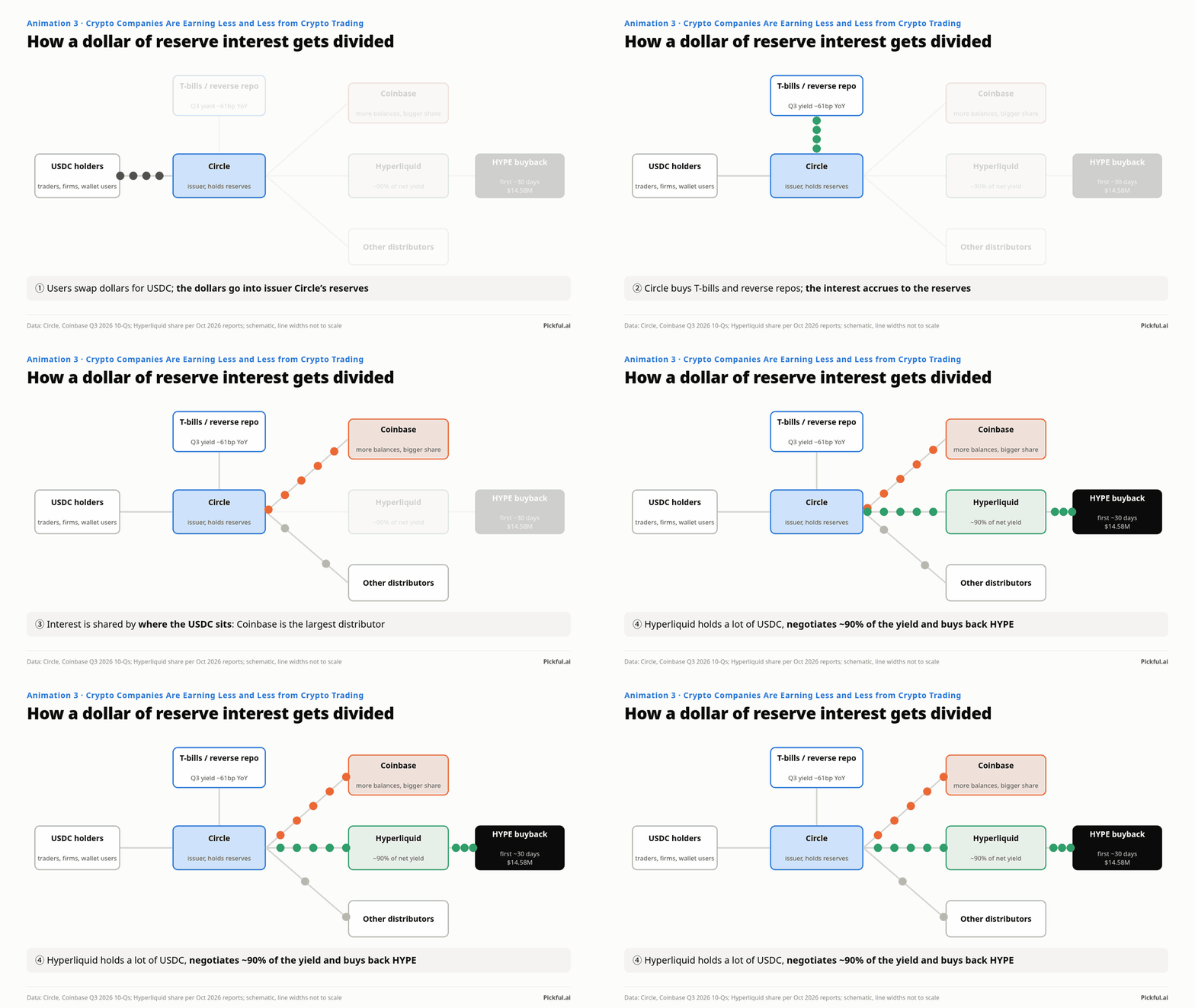
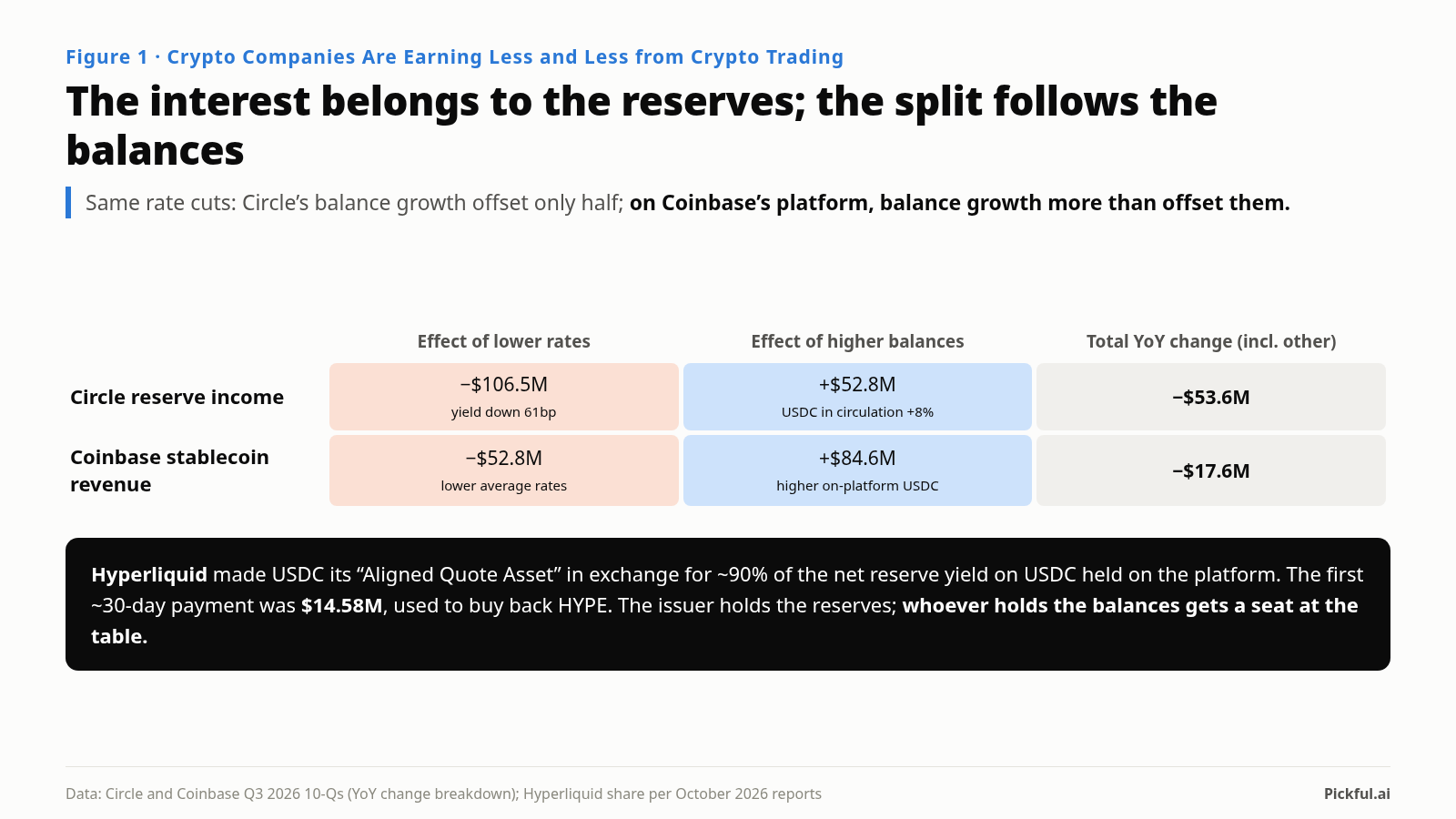
Why does the balance layer hold up against falling rates? Because balances are growing. Coinbase’s 10-Q splits the change in stablecoin revenue in two: lower average rates cost it $52.8M, and higher average USDC balances in Coinbase products added $84.6M. Circle uses the same split: lower yields cost $106.5M, and an 8% rise in average USDC in circulation added $52.8M.
Under the same rate cuts, Circle’s balance growth offset only half the damage, while balance growth on Coinbase’s platform offset more than all of it. Circle is the issuer of USDC and holds the reserves, but it pays a large share of reserve income to distributors. Coinbase is the largest of them, and how much it receives depends on how much USDC sits on Coinbase’s platform.
The issuer holds the reserves; the interest is split according to where the balances sit.
A post-mortem: Hyperliquid turned an exchange into a balance business
Hyperliquid applies this rule most directly.
It was the project Delphi wrote about most over these three months. It started as a classic trading-layer company: an onchain perpetuals exchange that uses its fees to buy back its own token, HYPE. More volume, more buybacks; less volume, fewer.
In August 2026 it made USDC the platform’s “Aligned Quote Asset”. In exchange, about 90% of the eligible net yield on the USDC reserves backing balances on the platform goes to Hyperliquid. The yield started accruing on August 26, and the first payment of $14.58M, covering about 30 days, arrived in early October and went straight into the Assistance Fund to buy back HYPE.
$14.58M is not a lot. Fee-funded buybacks in September were estimated at about $55.67M, so the balance share is roughly a quarter of that. But it is a different kind of money: fee-funded buybacks follow volume, while the balance share follows how much USDC sits on the platform and where rates are. When volume cools, the money keeps coming as long as the USDC stays.
What changed is who gets a seat at the negotiating table. For eight years, the interest on USDC reserves went largely to the issuer and its largest distribution partner. Hyperliquid has not issued any stablecoin. It has one thing: a large amount of USDC parked on its platform. On that alone, it took about nine tenths of the yield from the issuer.
Whoever holds the balances gets a seat at the table. This is what a distributor’s “channel tax” on an issuer looks like in stablecoins.
The rent layer: mines becoming data centers
The third layer is the furthest from crypto, yet one of Delphi’s mid-August newsletters was titled after it: AI Wants Bitcoin’s Megawatts.
In August Riot signed a data center lease: 191MW of critical IT capacity at its Rockdale campus in Texas for a frontier AI lab, with an initial term of 20 years running to June 2048 and about $9.1B of contract revenue. The company expects an average annual NOI contribution of $365M to $411M. Over the same period, Riot’s cost to mine had reached 69.6% of production value, up from 49.6% a year earlier.
The same megawatt, used to compute hashes, earns according to bitcoin’s price and network hashrate; leased to an AI lab, its revenue is written into a 20-year contract.
Galaxy’s Q3 segment data lays out the contrast: the Data Centers segment posted $68.7M of adjusted EBITDA, while the Digital Assets segment posted −$9.0M. A company built on crypto trading and investment banking made its operating money in Q3 from data centers.
This layer is the most stable and the heaviest: you have to build, wire up power and borrow. Galaxy’s Data Centers segment carried $75.4M of notes interest in Q3 alone, so on a net income basis the segment still lost a little. Rent is a good business, but it is an infrastructure company’s business, valued in a completely different way from an exchange.
The fourth layer is not a business: mark-to-market
One more layer has to be taken out of the profit, because it is the easiest to misread.
Coinbase’s Q3 net income of $718.7M includes $715.0M (pre-tax) of gains on crypto it holds. Customers did not pay a cent of it. Adjusted EBITDA, a better read on operations, was $332.9M, against $800.7M a year earlier, down almost 60%.
Strategy is more extreme: Q3 net income of $19.53B, almost all of it from a $20.91B gain on digital assets; for the first nine months combined it lost $1.23B. Its quarterly profit is driven mainly by how much BTC moved in the quarter. BTC was around $85,000 at the end of Q3, and Delphi’s November 9 newsletter had it at about $73,700. If it ends Q4 near there, Q4 will carry a large mark-to-market loss.
Valuation gains are not meaningless, but they are different in kind from the first three layers: the first three are what customers pay, this one is what the market prices. Counting them toward “crypto companies are very profitable” amounts to using the coin price to prove the coin price.
How a professional reader would push back
Objection one: the balance layer lives on rates, so a cutting cycle makes it more fragile than trading.
The risk is real. Circle’s 61-basis-point drop in yield cost it $106.5M of reserve income directly. If the Fed returns to cutting, the balance layer takes a hit every quarter.
But Q3 shows two things. First, balance growth can offset much of a rate cut; on Coinbase’s platform, revenue from higher balances exceeded what lower rates took away. Second, trading and balances often react to rates in opposite directions: hikes tend to dampen risk appetite and hurt trading while lifting interest income. Coinbase’s Q4 outlook has exactly that shape: transaction revenue through October 25 was only about $165M, while subscription and services revenue is guided at $550M to $630M, partly on higher average rates. One quarter’s guidance does not prove a long-run pattern, but it shows the two layers can cushion each other inside the same company.
Objection two: the balance layer’s revenue split is set by regulators and contracts, and can change at any time.
This one is more worrying. U.S. banks have long opposed stablecoins passing yield to holders, and it has been one of the points of contention in the CLARITY Act negotiations. According to Delphi’s November 9 newsletter, Democrats won both chambers of Congress in the midterms, raising the odds of tighter rules. In Europe, MiCA requires stablecoin issuers to keep a large share of reserves in bank deposits, which directly lowers reserve yields, and Circle is lobbying against it. Hyperliquid’s 90% and Coinbase’s on-platform share are, at bottom, contract terms, and contracts can be renegotiated.
What the balance layer can hold on to is the balances themselves; the split is in the hands of issuers, regulators and counterparties.
If you are building one, or analyzing one
When you pick up a crypto company’s results, do three things first:
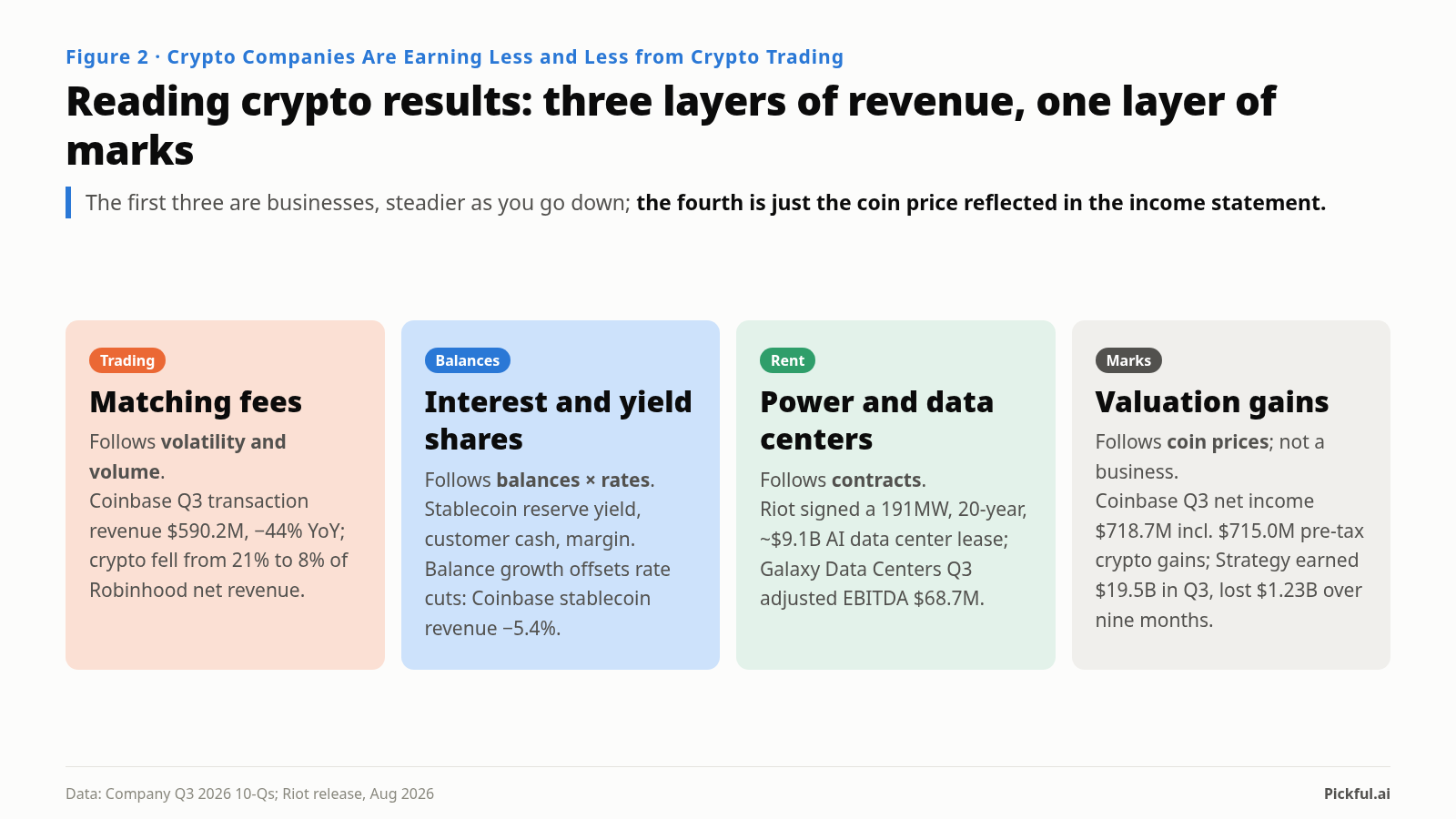
- Split revenue into the four layers. Trading, balances, rent and marks: how big each one is and what it follows, whether volatility, balances times rates, contracts or coin prices. The bigger the trading share, the harder next quarter is to predict.
- Look at where the balances sit. Within balance-layer revenue, how much comes from balances the platform keeps itself, and how much is someone else’s balances shared with you. The first gives you bargaining power; the second depends on how much others are willing to share. Coinbase discloses the average USDC held in its products every quarter, and it is the line most worth reading in its report.
- Take valuation gains out of net income. What remains is what the company earned as a business.
If you are designing a crypto business rather than investing in one: trading is how you acquire users, balances are how you keep them and make money. A user who trades once pays you one fee; a user who leaves money with you pays you every day.
Conclusion
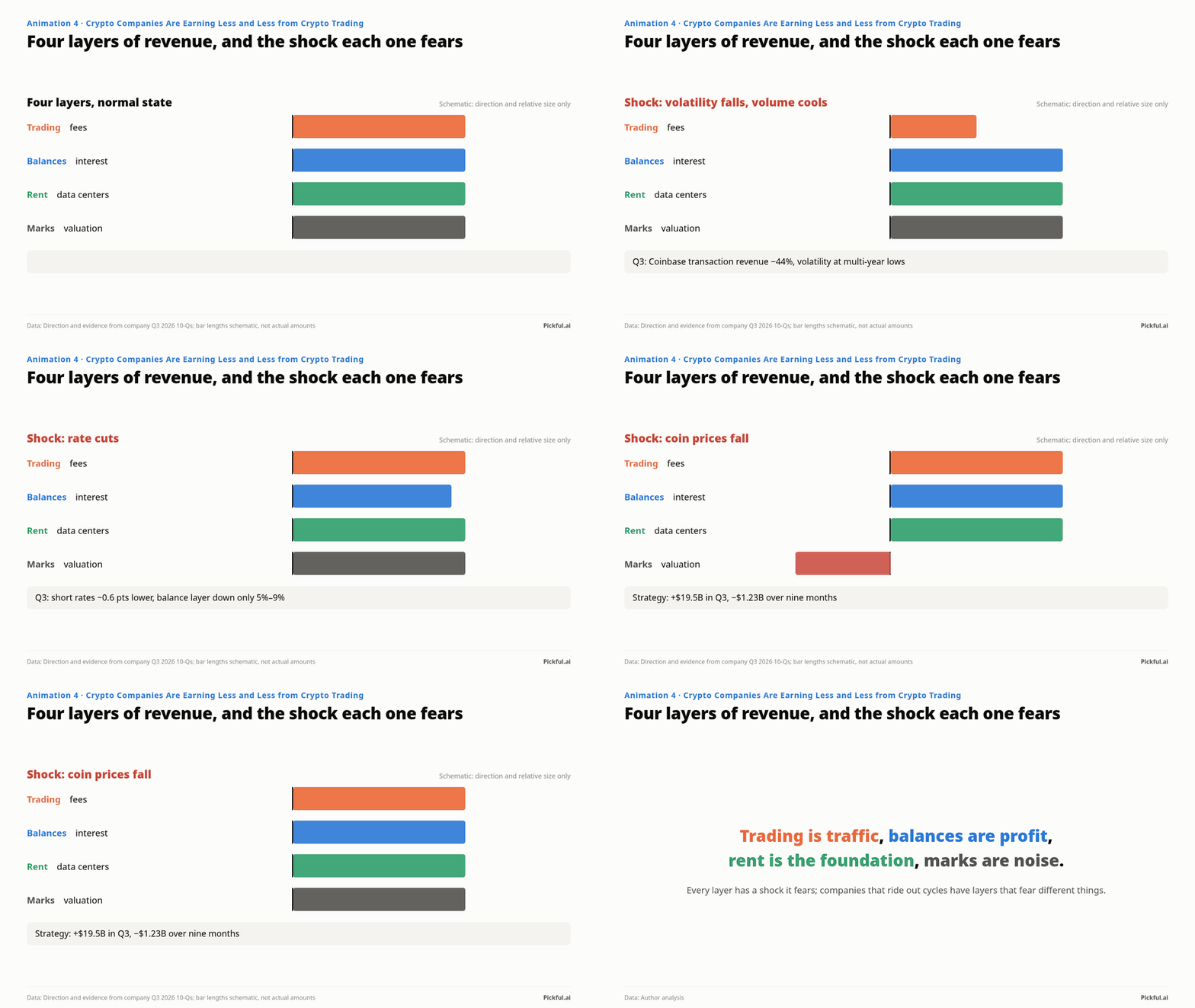
Trading is traffic, balances are profit, rent is the foundation, marks are noise.
In Q3 results, the trading layer lost half its revenue in a year, the balance layer slipped only single digits despite rate cuts, and the rent layer signed 20-year contracts. Crypto companies’ profits depend less and less on crypto trading, and more on where users leave their money.
What is worth watching next quarter is whether more platforms follow Hyperliquid: no token sale for the purpose, no stablecoin of their own, just the balances in hand, used to negotiate a share from the issuer.
Sources
- Coinbase Q3 2026 10-Q (filed 2026-10-29): transaction revenue, stablecoin revenue and its change breakdown, net income, gains on crypto held for investment, adjusted EBITDA, nine-month net loss. Q4 outlook and volatility description from its Q3 earnings materials (as reported by Investing.com).
- Robinhood Q3 2026 10-Q (filed 2026-10-28): crypto and event contract revenue, shares of revenue, net interest revenues, Cash Sweep impact from short-term rates.
- Circle Q3 2026 10-Q (filed 2026-11-04): reserve income change and its split into rate and circulation effects, change in distribution costs paid to Coinbase.
- Galaxy Q3 2026 10-Q (filed 2026-11-09): segment adjusted EBITDA, Data Centers notes interest.
- Strategy Q3 2026 10-Q (filed 2026-11-02): quarterly net income, digital asset gains, nine-month net loss.
- Riot Q2 2026 results release, August 10, 2026 (8-K Exhibit 99.1): 191MW lease terms and NOI estimate; cost-to-mine ratio from Yahoo Finance reporting (original not checked).
- Tether Q3 BDO attestation: per multiple media reports, original not read.
- Hyperliquid’s first $14.58M USDC reserve yield payment and ~90% share: FinanceFeeds and Cryptonomist, October 2026; September fee-funded buybacks of ~$55.67M are a FinanceFeeds estimate, not official.
- Fed rate path: hike to 3.75%–4.00% on September 16, 2026, hold on October 28 (CNBC, U.S. Bank).
- Market and industry background, midterm results: Delphi Digital newsletters, August 10 to November 9, 2026 (not independently verified).
Repost this post?
Share with your followers.
Reply