
目錄(7 節)

·
Ondo's Minting and Redemption Broke for 6 Hours 40 Minutes. Status Alerts Were Switched Off
At 01:23 UTC on October 21, 2026, 9:23 on a Tuesday evening in New York, during the U.S. overnight session, Ondo's status page posted a notice: minting and redemption of Ondo Stocks were "intermittently failing due to an issue with an upstream pricing provider". Three and a half hours later the notice was updated to problems at "multiple upstream providers". Only at 08:04 UTC did it say "resolved", about 6 hours 40 minutes in all. Six days later, during U.S. trading hours on
At 01:23 UTC on October 21, 2026, 9:23 on a Tuesday evening in New York, during the U.S. overnight session, Ondo’s status page posted a notice: minting and redemption of Ondo Stocks were “intermittently failing due to an issue with an upstream pricing provider”. Three and a half hours later the notice was updated to problems at “multiple upstream providers”. Only at 08:04 UTC did it say “resolved”, about 6 hours 40 minutes in all. Six days later, during U.S. trading hours on October 27, the same page posted another: quotes for “a small subset of assets” were failing, for 1 hour 26 minutes. Push notifications for these status updates were switched off (the API field reads notify_subscribers: false). People who had subscribed by email received nothing; only those who actively read the page or the API knew.
That night, if someone on your platform had a large TSLAon buy order resting, or your lending market was valuing collateral off the price of Ondo’s on-chain pools, when would your on-call colleague have noticed the door was shut? Did they have the authority to widen the price band and stop new borrowing? Who would sign off the restart the next morning?
The decision in this piece is: before launch, write a playbook and a permissions table that set out, for each of eight incident types, which signals to watch, what to halt first and what later, who approves a halt, who approves a restart, and what to tell users. If you start discussing these on the night of the incident, you are already too late.
All thresholds in this piece are examples meant to show the structure; set the actual numbers from your own monitoring data. The spread data in the piece on price sources currently covers a single weekend.
1. Set the action ladder first, then the signatories
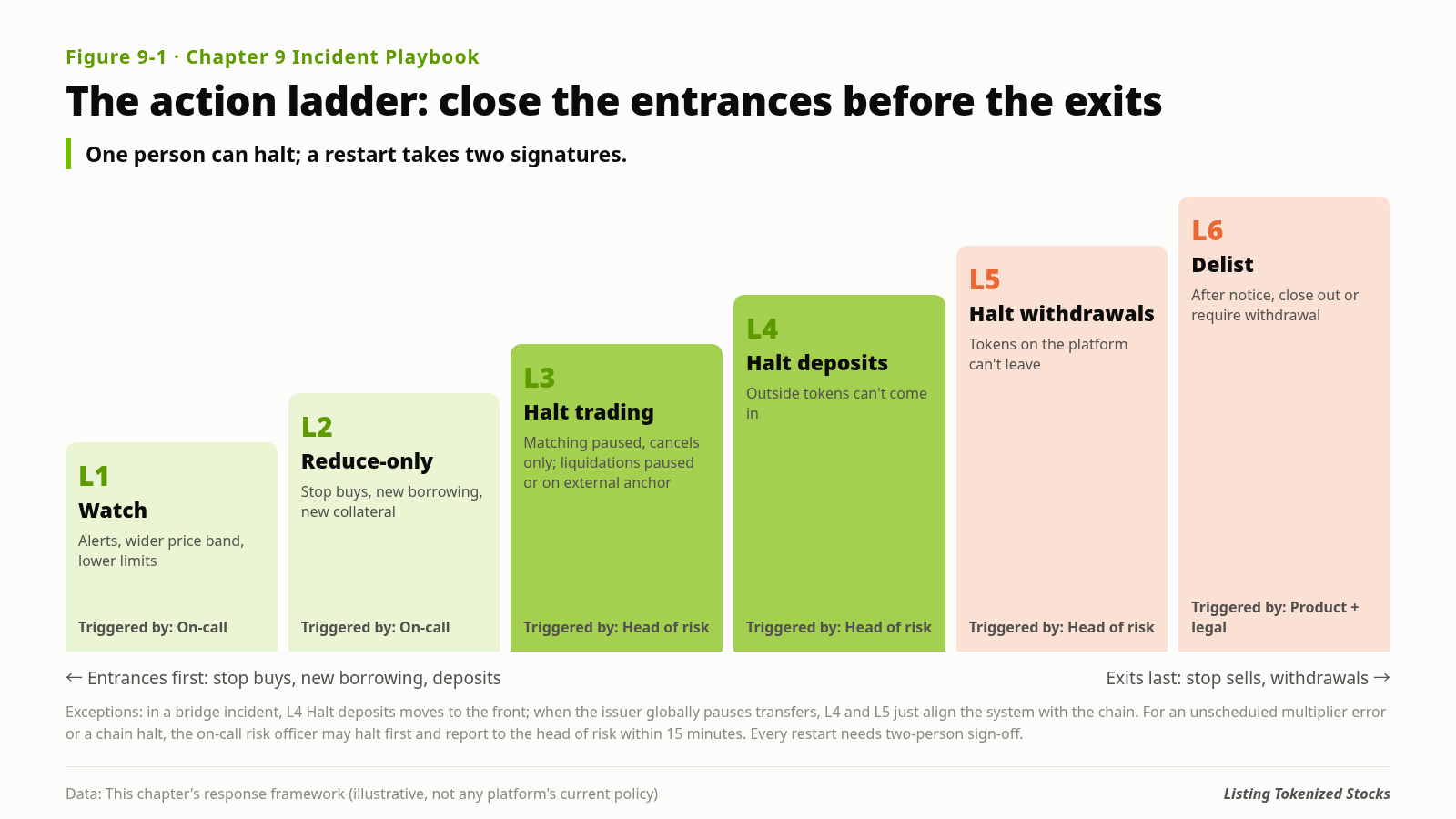
Every response can be arranged on a ladder, from light to heavy:
- L1 Watch: Action: Alerts, widen the price band, lower per-order and daily limits; Effect on users: Barely noticeable
- L2 Reduce-only: Action: Stop buys, new leveraged positions, new borrowing and new use of the token as collateral; sells, repayments and top-ups continue; Effect on users: Can’t get in, can get out
- L3 Halt trading: Action: Matching paused, cancels only; the lending market pauses liquidations or liquidates only against an external anchor; Effect on users: Nothing moves on the platform
- L4 Halt deposits: Action: Stop on-chain deposits of the token (or of the chain); Effect on users: Outside tokens can’t come in
- L5 Halt withdrawals: Action: Stop on-chain withdrawals of the token (or of the chain); Effect on users: Tokens on the platform can’t leave
- L6 Delist: Action: After a notice period, close out positions or require withdrawal; Effect on users: Product ends
Behind the order is one principle: close the entrances that enlarge exposure before the exits that let users leave. Stop buys before sells; halt deposits before withdrawals. As long as users can leave, the damage from an incident stops spreading. Close the exits too and users are locked in, watching the price move.
There are two exceptions, both about the possibility that the token itself is fake. When a cross-chain bridge fails, the destination chain may suddenly hold a batch of unbacked tokens. The most dangerous thing then is deposits: an attacker deposits the fake tokens, sells them for real stablecoins and withdraws. So in a bridge incident, L4 moves to the front. When the issuer globally pauses transfers on-chain, deposits and withdrawals are impossible anyway; L4 and L5 simply align your system’s state with on-chain reality.
Signatories come in three tiers:
- The on-call risk officer (online 24/7) may trigger L1 and L2 alone, and confirm L3 after an automatic circuit breaker fires. After triggering L2, they must report to the head of risk within 1 hour, and the head of risk decides whether to keep or lift it. There are two further cases of “halt first, report after”: on discovering an unscheduled error in the multiplier or a corporate-action field, the on-call officer may trigger L3 first; when a chain halts or a sequencer goes down, the on-call officer may trigger L4 and L5 first. In both cases they report to the head of risk within 15 minutes, and the head of risk decides whether to keep or lift the halt.
- The head of risk approves L3, L4 and L5, and approves every restart. Rules for automatic halts (multiplier effective windows, stale oracles, deviation thresholds) are approved in advance by the head of risk and the head of product; once they fire, no case-by-case approval is needed.
- The head of product together with legal & compliance approve the final version of any public notice, L6 delisting, and any compensation.
Two more rules. First, one person can halt; a restart takes two signatures (two-person sign-off): one checks the chain and the issuer’s status, the other checks prices and positions, and only when both confirm does trading resume. Second, automate every halt that can be automated: multiplier effective windows, stale oracles, deviations past threshold. Humans only confirm and restart. An incident is about as likely to happen in the small hours of a Sunday as on a Tuesday afternoon.
2. Playbooks for eight incident types
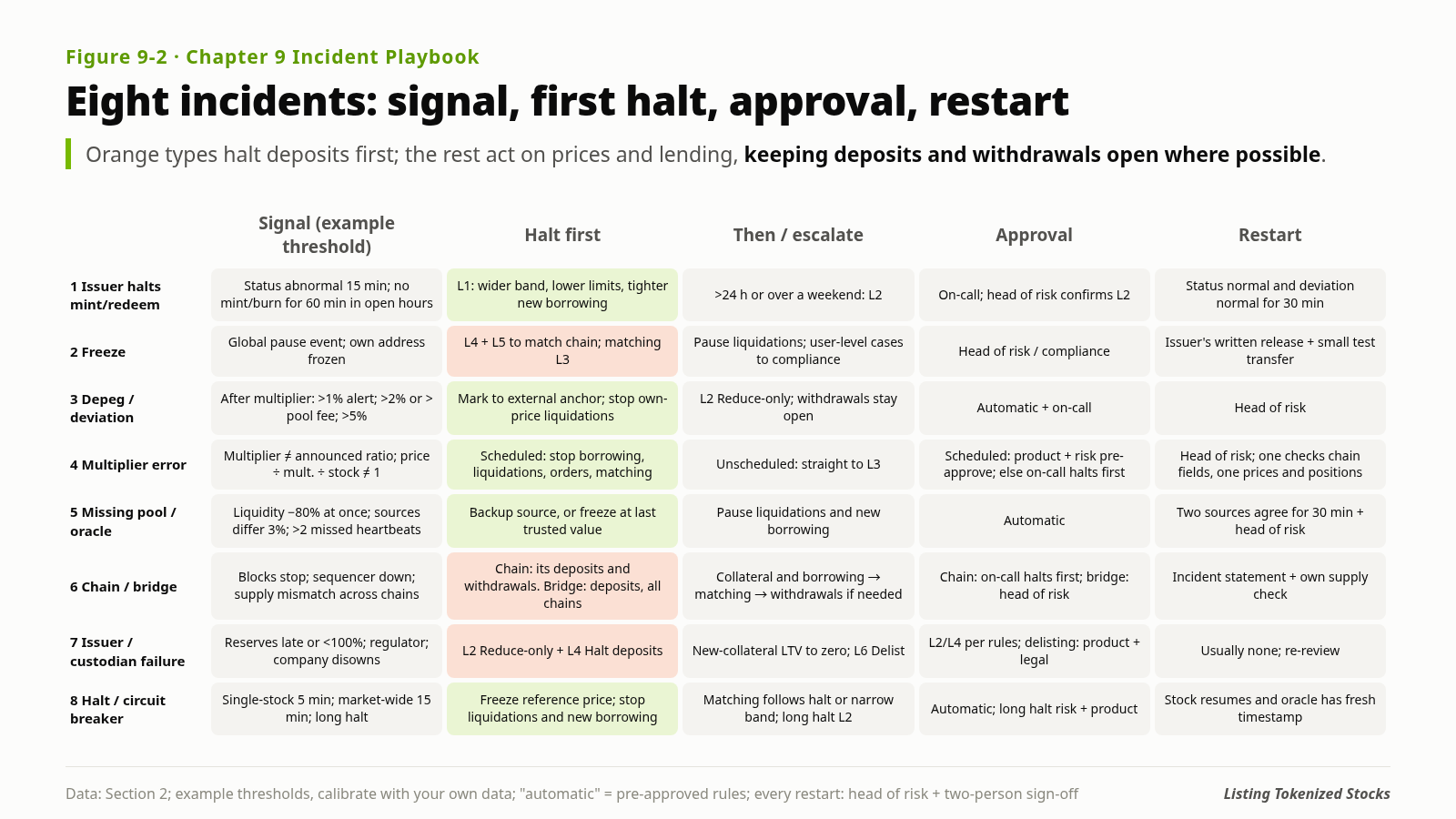
Each of the eight incident types below follows the same format: signals, sequence of actions, who approves, key points for the notice, and what the post-mortem must check. Start with the overview.
1. Issuer suspends creation and redemption
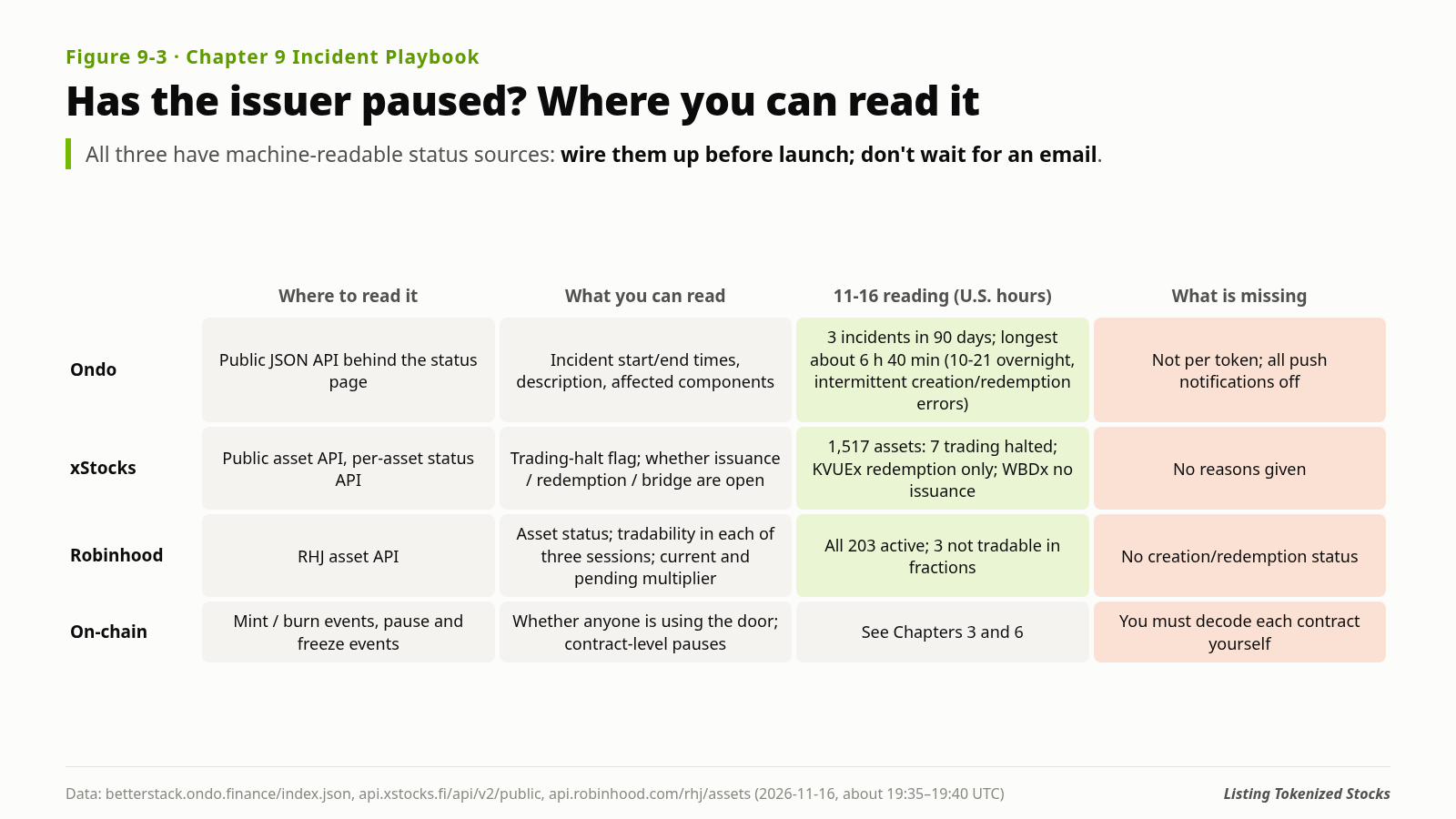
Signals. All three major issuers have machine-readable status sources, and these should be wired up before launch:
- Ondo’s status page sits on a public JSON endpoint that lists the start, update and end time of every incident. Ondo’s product page states that minting and redemption may be temporarily paused for corporate actions, “market conditions (e.g. excessive volatility)” or “system risk controls”, with the status page as the authority.
- xStocks’ public API gives each asset an
isTradingHaltedflag and anallowedOperationslist (issuance, redemption, bridge). At 19:38 UTC on November 16, 2026, during U.S. trading hours, we read all 1,517 assets: 7 were flagged as trading halted; Kenvue’s KVUEx allowed redemption only, and Warner Bros. Discovery’s WBDx allowed redemption and bridging but not issuance. The API gives no reasons. KVUEx and WBDx are not among the 7 halted assets; what is restricted is creation/redemption access, and both match corporate actions. Kimberly-Clark’s acquisition of Kenvue closed on November 2, and KVUE stopped trading from that day’s open. Warner Bros. Discovery was acquired for cash by Paramount Skydance, closing on October 6, at $31.02 per share in cash. With the underlying no longer trading, new issuance naturally stopped: KVUEx keeps only redemption, WBDx keeps redemption and bridging. This is our inference; xStocks has made no announcement about either token. The reasons for the other 7 trading halts were not investigated. - Robinhood’s asset API states for each token whether it can trade in each of three sessions: regular, pre-market/after-hours, and overnight. Read on the same day, all 203 tokens were “active”, 3 of them not tradable in fractional amounts.
Two further pieces of corroborating evidence: mint and burn events suddenly dropping to zero during open-door hours (the method from the piece on creation and redemption), and widening cross-issuer deviation. Example thresholds: the status source shows an abnormal state for more than 15 minutes, or there are no mint or burn events for 60 minutes in hours when creation/redemption usually happens.
Actions. With the door shut, the on-chain price loses its mechanism for converging on the underlying, but nothing is wrong with the token itself. So go to L1 first: switch the price band to its off-hours setting and lower per-order limits. The lending market tightens new-borrowing capacity for the token (stopping new borrowing entirely belongs to L2). Deposits and withdrawals stay open. If the suspension lasts more than 24 hours, or runs across a weekend, move up to L2 Reduce-only.
Approval and restart. The on-call risk officer triggers L1 and L2 alone; within 1 hour of L2, the head of risk confirms whether to keep it (see the permissions above). The restart condition is that the issuer’s status is back to normal and deviation has been back in the normal band for 30 minutes; the head of risk approves, with two-person sign-off.
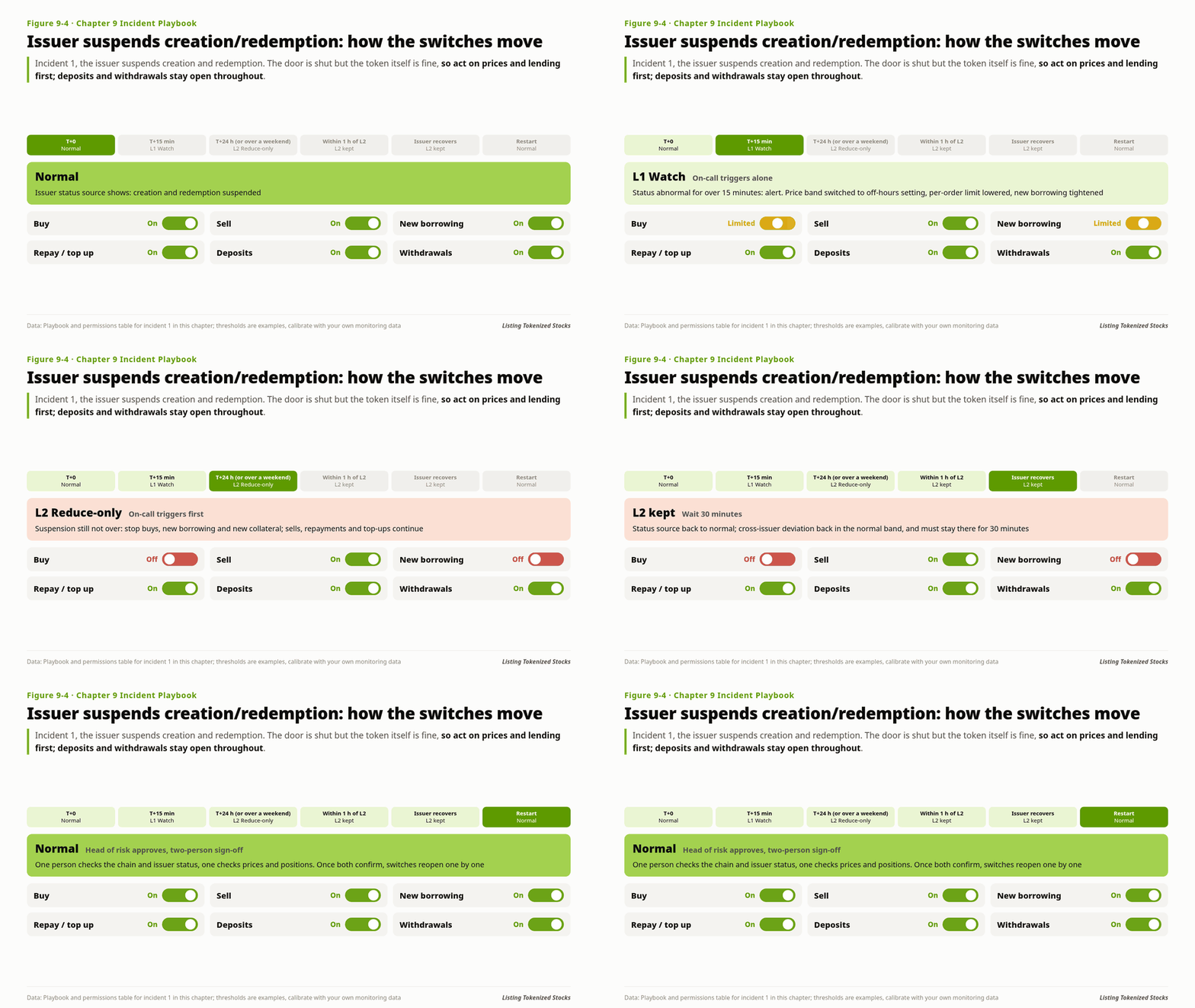
Key points for the notice. The issuer’s creation and redemption are suspended; this is not a platform failure. Trading continues, with limits. Prices may deviate from the underlying. If the issuer has given no restart time, the platform does not predict one on its behalf.
What the post-mortem checks. Deviation and volume during the suspension; whether our quotes were taken out on one side; whether we learned of it first from the status source, from the chain, or from users asking.
2. Token or user address frozen
Signals. Contract events: global pause, address freeze, blocklist change; function names differ by issuer. A sudden rise in failed deposit credits; failed outbound transfers from your own hot wallet. There is only one threshold: any global pause event, and any freeze involving one of your own addresses, triggers an immediate response.
Actions. Three cases.
- Global transfer pause: on-chain deposits and withdrawals are already impossible, so immediately switch on L4 and L5 to align the system with the chain, and move on-platform matching to L3. With the token unable to leave your platform, the on-platform price is cut off from every exit; continuing to match just has users on your platform taking each other’s positions. The lending market pauses liquidations, because liquidators cannot sell the tokens they receive. in a lending market that takes pausable tokens as collateral, losses from a price drop during the pause fall on lenders, and only an ex-ante supply cap can contain that.
- A user’s address is frozen: this concerns that user’s account, not the market; hand it to compliance.
- Your hot wallet is frozen: halt withdrawals of the token, and open written communication with the issuer at the same time.
Approval and restart. The head of risk approves L3 to L5; freezes at the user level are handled by the head of compliance (legal & compliance). Restart requires the issuer’s written confirmation that the freeze is lifted and one successful small on-chain test transfer, with two-person sign-off by risk and compliance.
Key points for the notice. Explain that this is a restriction at the level of the issuer’s contract; users’ balances on the platform ledger are preserved; disclose no information about any specific user.
What the post-mortem checks. Whether the issuer gave notice in advance (the notification clause the piece on custody and contract control requires in the agreement); whether our alerts on permission-role changes fired early.
3. Price depeg or sudden widening of cross-issuer deviation
Signals. Divide by the multiplier first, then compare three numbers: the token price against the underlying price (when the market is open), against the same stock from other issuers, and against the issuer’s creation/redemption quote. In this sample in the piece on price sources, the largest spread among the four sources other than Ondo was 0.2%–0.3% most of the time. Example bands: above 1% for 10 minutes, alert; above 2%, or above the main pool’s fee rate, move to L2; above 5%, or a deviation that appears only on your own platform, switch the mark price to the external anchor immediately.
Actions. The order is: switch the anchor first, then deal with liquidations. If the deviation appears at only one venue (usually your own), it is a liquidity problem, not a problem with the asset: switch the mark price to “underlying price × multiplier” or the issuer’s creation/redemption price, pause liquidations based on the on-platform price, and only then consider reduce-only. If the deviation appears across the whole market at once, handle it as type 7 (issuer failure). Do not halt withdrawals: if users want to sell elsewhere, let them.
Approval and restart. Switching the anchor and pausing liquidations happen automatically under pre-approved rules, confirmed by the on-call risk officer; the head of risk approves the restart, with two-person sign-off.
What the post-mortem checks. Where the deviation came from: the multiplier, a missing pool, a stale last-trade price, or genuine one-sided selling; and, for every liquidation during the period, the gap between its execution price and the external anchor at the time. The Binance case in the next section belongs to this type.
4. Multiplier errors on stock splits and ex-dividend dates
Signals. Most of these incidents can be put on the calendar in advance. Netflix announced a 10-for-1 split on October 30, 2025: record date November 10, new shares distributed after the close on November 14, trading on a split-adjusted basis from the open on November 17. The new multiplier of 10 for xStocks’ NFLXx took effect at 23:55 UTC on November 16, 2025.
Three signals need real-time monitoring: whether the change in the multiplier field matches the announced ratio; whether “token price ÷ multiplier ÷ underlying price” sits near 1; and whether the multiplier changes on a day with no corporate action (including decreases). Third-party market pages get it wrong too: as of November 16, 2026, CryptoRank’s NFLXx page still showed an all-time high of $1,265 (2025-09-09) and “95% below ATH”, drawing the split as a crash. Your users will screenshot pages like this and ask you about them.
Actions. Scheduled windows are halted on schedule: xStocks’ developer documentation recommends pausing interactions for about 15 minutes before and after the multiplier activates; for Chainlink’s Ondo price feeds, when the multiplier changes by more than 1% in a day, Chainlink publishes a price-freeze window at least 24 hours in advance. Before the window opens, stop new borrowing and liquidations in the token and pull resting orders; during the window, halt matching; after it closes, check the multiplier and reopen. An unscheduled error (the reading after it takes effect does not match the announcement) goes straight to L3, with liquidations paused as well.
Approval and restart. Scheduled windows are approved a week in advance by the head of product and the head of risk and run automatically. For an unscheduled error, the on-call risk officer triggers L3 first and reports to the head of risk within 15 minutes for confirmation (“halt first, report after”; see the permissions table). The head of risk approves the restart, with two-person sign-off under the general rule: one person checks the chain and the issuer’s status, which here means reading the on-chain multiplier field against the company announcement and the issuer’s notice; the other checks prices and positions, confirming that prices divided by the new multiplier are back in the normal band and that users’ positions convert correctly.
What the post-mortem checks. Which field was misread; whether any user traded at the wrong price. Whether such trades are cancelled and whether they are compensated should be written into a “clearly erroneous trades” rule before launch, not decided ad hoc afterwards.
5. Missing pools in a data source, frozen or stale oracle
Signals. The piece on price sources recorded one case: from 03:00 to 14:30 UTC on November 16, 2026, the list of Ondo pools returned by DexScreener lacked the two large pools, and counted liquidity dropped from about $7.92 million to $130,000–$160,000. On the same day, one Robinhood Chain pool was quoted at $155.20 on DexScreener and $383.00 on GeckoTerminal. Example thresholds: the liquidity reading drops more than 80% at once; two data sources differ by 3% or more on the same pool; an oracle fails to update for more than two heartbeat periods during hours when it should be updating.
Two things to remember on the oracle side: Chainlink’s 24/5 tokenized-stock price feeds do not separately flag holidays or trading halts; Robinhood’s oraclePaused() is only advisory and is not enforced on-chain. The only way to tell whether a price source has stopped is your own staleness check.
Actions. Mark the display price “data anomaly”; switch the trading reference price to a backup source, or freeze it at the last trusted value; in the lending market, pause liquidations, or liquidate only positions that are clearly past the liquidation threshold on the external anchor as well; stop new borrowing. Matching may continue, as long as its price band does not depend on the failing source.
Approval and restart. Triggered automatically under pre-approved rules. The restart condition is that two independent sources agree, continuously for N minutes (30 minutes in the example); the on-call risk officer checks the data and the head of risk approves, with two-person sign-off.
What the post-mortem checks. Which source was wrong, and from what time; whether any liquidations happened during the period, and at what price.
Mirror Protocol is a ready-made counterexample. It was a synthetic-stock protocol on Terra. On May 29–30, 2022, the old price oracle run by most validators on Terra Classic took the price of the new LUNA as the price of the old LUNC, which differed by several orders of magnitude, and attackers used this to drain more than $2 million from the pools of synthetic assets such as mBTC and mETH (a figure from community researcher FatMan, cited by CertiK and others; neither Mirror nor Terraform Labs published a formal incident report). According to reports at the time, the synthetic-stock pools were not hit, because U.S. markets were closed for a weekend followed by the Memorial Day holiday, and the stock price feeds had not started updating yet. What saved it was the market being closed, not a playbook.
6. Chain congestion or bridge failure
Signals. Block production stops: Solana mainnet stopped producing blocks at about 09:52 UTC on February 6, 2024 and resumed at about 15:00 UTC. A layer-2 sequencer goes down: Arbitrum One’s sequencer stalled from 10:29 ET on December 15, 2023, under a surge of inscription traffic. Robinhood Chain is built on the Arbitrum stack, and Robinhood runs its sequencer itself. Example thresholds: deposit confirmation time above 5 times normal; Chainlink’s L2 sequencer uptime feed reports downtime; the token’s supply on any chain does not reconcile with the total published by the issuer.
Bridges need watching on their own. Ondo’s bridge uses LayerZero; in the xStocks API, “bridge” sits alongside issuance and redemption as an operation that can be switched off separately. On April 18, 2026, Kelp DAO’s rsETH bridge was compromised: acting on a forged cross-chain message, the contract on Ethereum released about 116,500 rsETH against a burn that never happened, about $292 million at the time and about 18% of circulating supply. The attacker deposited the rsETH on Aave and borrowed WETH, and Aave promptly froze the rsETH market. Afterwards Kelp and LayerZero blamed each other over who was responsible for a “single-verifier configuration”, and in September Kelp sued LayerZero. Tokenized stocks cross chains differently from rsETH, but the logic is the same: whether a token you accept has a share behind it depends on the bridge it came across.
Actions. Chain halt: halt deposits and withdrawals on that chain only, leaving other chains open; pause liquidations that depend on that chain’s prices; after recovery, allow a grace period before liquidating (this is what Chainlink’s documentation for sequencer uptime feeds recommends, because the backlog of price updates arrives all at once on recovery). Bridge incident: the order reverses. First halt deposits of the token on every chain (L4), then stop accepting it as collateral and stop borrowing, then halt matching; if suspicious tokens have already been deposited, halt withdrawals too.
Approval and restart. For a chain halt, the on-call risk officer triggers L4 and L5 first and reports to the head of risk within 15 minutes for confirmation (“halt first, report after”); for a bridge incident, the head of risk approves. The head of risk approves the restart, with two-person sign-off, on condition of a written incident statement from the issuer and the bridge operator and a cross-chain supply reconciliation of your own.
What the post-mortem checks. Which contract on which chain you integrated; whether you routinely reconcile cross-chain supply; whether you accepted tokens of doubtful origin.
7. Issuer or custodian insolvency, or a regulatory stop
Signals. The first sign is rarely a bankruptcy announcement. More often it is one of these: proof of reserves stops updating or the ratio falls below 100%; a public statement from a regulator; the underlying company publicly disowning the product; the issuer’s creation/redemption platform pausing repeatedly.
Two precedents. On April 28, 2021, Germany’s Federal Financial Supervisory Authority (BaFin) publicly questioned whether Binance’s German entity had issued stock tokens without a prospectus; on July 16 Binance announced it would end support, giving holders 90 days to sell, and closed out all positions on October 15. On June 30, 2025, Robinhood launched stock tokens in the EU that included OpenAI and SpaceX; OpenAI promptly stated on X that “these ‘OpenAI tokens’ are not OpenAI equity” and “we did not partner with Robinhood, were not involved in this, and do not endorse it”. On July 7, the Bank of Lithuania told CNBC it had contacted Robinhood for clarification of the tokens’ structure and of how they were communicated to consumers.
Actions. Go to L2 Reduce-only first: stop buys and new borrowing, and cut the token’s loan-to-value (LTV) as new collateral to zero. Give existing borrowers a window to repay or swap collateral; do not force liquidations at the new parameters the moment the news breaks. At the same time halt deposits (L4), so that holders elsewhere do not dump the token onto your platform. Withdrawals stay open unless there is a legal order. The last step is L6 Delist, with Binance’s 90 days as a reference notice period.
Approval and restart. L2 is triggered by the on-call risk officer and confirmed by the head of risk within 1 hour; L4 is approved by the head of risk, per the general rules; L6 delisting and any compensation are approved by the head of product together with legal & compliance, with material cases escalated to senior management. This type usually has no “restart”, only delisting or a fresh listing review once legal advice is in hand.
Key points for the notice. State only verified facts and the actions the platform has taken; spell out what users can do (sell, withdraw) and by when; do not write things like “assets are safe” that the platform cannot verify itself.
What the post-mortem checks. Which of the four walls in the piece on custody and contract control failed first; which signal we were slow to react to.
8. Trading halt or circuit breaker in the underlying
Signals. U.S. equities have three kinds of halt: the single-stock Limit Up-Limit Down mechanism (a 5-minute pause after the price stays outside the band for 15 seconds); market-wide circuit breakers (a 15-minute pause when the S&P 500 falls 7% or 13% before 15:25, and the market closes for the day on a 20% fall; Level 1 was triggered four times, on March 9, 12, 16 and 18, 2020); and regulatory or exchange halts pending news, which can last days, up to delisting. In January 2021, GameStop (GME) triggered 40 single-stock pauses in one month, against just 1 in all of 2020, and 19 on January 28 alone.
Halt flags you can read: the trading-halt field in the xStocks API, the per-session status in Robinhood’s asset API, and Ondo’s status page. Chainlink’s 24/5 price feeds do not flag trading halts; the price simply stops, without telling you why.
Actions. Short single-stock pauses (5 minutes, 15 minutes): freeze the reference price and pause liquidations and new borrowing in the token; matching either follows the pause or trades only within “last underlying price ± a narrow band”. Do not let your venue become the only place for price discovery while the underlying is halted, or everyone who wants to front-run will come to you. Long halts or delisting: move to L2 Reduce-only and start the delisting process.
Approval and restart. Short pauses are followed automatically under pre-approved rules; moving to L2 on a long halt is confirmed by the head of risk, and starting the delisting process is approved by the head of product together with legal & compliance. Once the underlying resumes trading and the oracle delivers a price with a fresh timestamp, the head of risk approves the restart, with the rules for the first minutes after the open as in the piece on price sources.
3. Two full post-mortems
Post-mortem 1: Binance, October 10, 2025, when its own order book priced the collateral
What happened. From 21:36 to 22:16 UTC on October 10, 2025, crypto markets plunged. On Binance, USDe briefly fell to about $0.65, and wBETH and BNSOL deviated sharply from the ETH and SOL they can be converted into. Users of Binance’s unified account who had posted these three assets as collateral were liquidated en masse. According to LlamaRisk, over the same period USDe’s maximum deviation from the Chainlink price feed was only 0.65%; on Binance’s spot order book it exceeded 35%. Nothing went wrong with the assets themselves. What went wrong was how Binance valued them: in Binance’s index, 30% of BNSOL’s weight and 20% of wBETH’s came straight from Binance’s own USDT spot order books. When the books emptied, the index collapsed, and collateral values collapsed with it.
Where the signals were. The first signal came on October 6: Binance announced it would switch the index for these two assets to 100% based on the official conversion ratio, with the effective date set later (an updated announcement on October 11 brought it forward to 14:00 UTC that day). Once a fix has been announced but has not yet taken effect, that gap is the risk window. The second signal was the incident itself: within minutes, the gap between the on-platform price and the conversion value, and between it and prices on other exchanges, widened to double-digit percentages, a reading that any external anchor would have caught.
Afterwards. On October 11, Binance announced compensation for futures, margin and lending users liquidated because of the depeg of the three assets during that period, equal to the difference between the market price at 00:00 UTC on October 11 and the liquidation price, plus liquidation fees. It also added the conversion price to the three assets’ indices and set a minimum price floor for the USDe index. The October 11 announcement gave no total; Binance’s update the next day said compensation was paid in two batches, about $283 million in all (this series relies on The Block and other media citing that statement; the original Binance page was not obtained). This is separate from the $400 million “support program” Binance announced afterwards; do not add the two together.
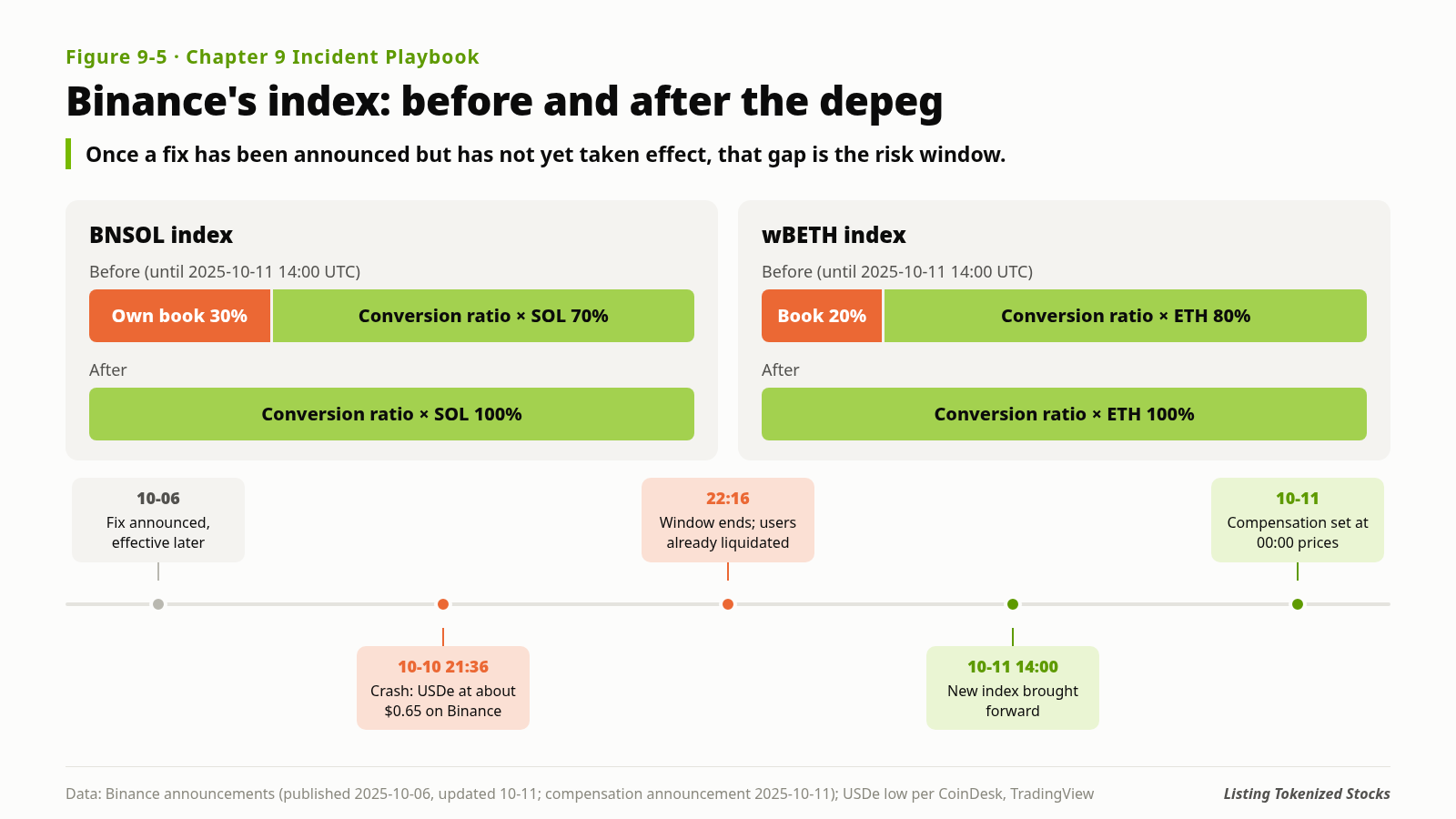
What a platform should do with tokenized stocks. Weekend tokenized stocks share one structural feature with wBETH that night: the underlying market is closed, creation/redemption is mostly closed, and the on-platform order book may be thin. How thin, and how far a sell order of a given size can push the price, has to be measured on your own venue using the method in the piece on depth. If your mark price comes mainly from your own order book, the next step after the price is pushed is likely a wave of liquidations. Three things must be done before launch: the mark price must include off-platform anchors (last underlying price × multiplier, the issuer’s creation/redemption price, prices at other venues), with a cap on the weight of your own book; when your own book deviates from the external anchor past a threshold, switch the mark price and pause liquidations automatically; and do not schedule the fix for a known pricing flaw. Either fix it the same day, or the same day cut the asset’s loan-to-value (LTV) first.
Post-mortem 2: January 28, 2021, a broker’s “position closing only”
What happened. According to the SEC staff report of October 2021, on January 27 the National Securities Clearing Corporation (NSCC) issued intraday margin calls totalling $6.9 billion to 36 members. The next day, a retail broker set 8 stocks, including GME and AMC, to “position closing only”, barring new buys. On January 29 it lifted “position closing only” and switched to position limits, with the restricted list at one point exceeding 50 names; holders of fractional shares could only sell. The restrictions eased gradually over the following week and were removed entirely on February 5. The report also notes that the NSCC waived an additional charge that day; otherwise the broker’s charge would have been more than twice its margin requirement of $1.4 billion for the day. In its listing documents, Robinhood acknowledged that from January 28 to February 5 it temporarily barred customers from buying certain stocks because its clearinghouse had raised margin requirements.
Where the signals were. The restrictions were triggered not by price but by margin requirements at the clearing end, which had already risen sharply the day before. Price signals were dense too: 19 single-stock pauses on January 28 alone.
What a platform should do. The most contested part of this episode was communication: users did not know why they could sell but not buy, or when buying would resume. The SEC report specifically records that brokers notified customers in every possible way: email, pop-ups, help-center pages and social media. For tokenized-stock platforms there are two lessons. First, write the definition, triggers and approver of “reduce-only” in advance, and execute it according to the rules when the time comes rather than deciding in a meeting on the day. Second, your upstream is longer than you can see: tokenized-stock creation and redemption ultimately land on order placement and clearing at a U.S. broker, and the piece on custody and contract control showed that several issuers share the same U.S. broker. When a broker-level restriction reaches you, it shows up as “issuer suspends creation and redemption”, that is, incident type 1.
4. Fixed formats for notices and post-mortems
Notices say five things only: what happened (the verified part); which tokens and which functions are affected; what users can and cannot do now; what the platform has done; and the time of the next update (not the restart time). No speculation about causes, no “assets are safe”, no passing off an issuer’s or chain’s problem as the platform’s, and no passing off the platform’s problem as theirs. The first notice goes out within 30 minutes of the trigger (example), then updates every 2 hours until resolution.
Post-mortems are completed within 5 business days of the restart and always answer six questions: when the first signal appeared and when we acted; which level we triggered, and whether we skipped or missed a level; whether any trade or liquidation deviated from the external anchor during the incident; the amount of user impact; who approved the restart and on what basis; and whether the thresholds and the permissions table need to change. The conclusions of every post-mortem are written back into the approval sheet and monitoring thresholds in the piece on the approval sheet.
Twelve questions to ask the issuer (or yourself) before listing
- Do your creation/redemption, trading and bridge states have a machine-readable API? Do incident starts and ends carry timestamps? Do you push them?
- What causes a suspension of creation and redemption? How are corporate actions, market volatility and system risk controls each triggered, and how much notice do you give?
- How long are scheduled pauses (multiplier activation, stock splits), how far ahead are they published, and where can we read them?
- Who can pause transfers on-chain, freeze addresses, or change the multiplier? Is the integrator notified before or after each action?
- If our hot wallet or custody address is frozen, what is the process for lifting it, and how long does it take?
- Which bridge do you use, and how many of how many verifiers must agree? How is supply reconciled across chains, and do you publish it?
- When a price source fails, does your creation/redemption quoting continue? Who is upstream of your quotes?
- When the underlying is halted or a circuit breaker trips, how are creation/redemption and your price sources handled?
- In a default or a regulatory stop, can the on-chain tokens still be transferred? How are holdings held through platforms handled?
- Who is your 24/7 incident contact?
- (Ask yourself) Is it written into policy who can trigger and who can restart each level of the action ladder? Is someone able to trigger it at 3 a.m. on a Sunday?
- (Ask yourself) Are the rules for handling and compensating clearly erroneous trades and wrong-price liquidations set before launch?
Conclusion
Most tokenized-stock incidents do not start on-chain. An upstream quote provider, a broker’s margin call, an exchange’s trading halt, a multiplier field: each reaches you as “the door is shut” or “the price is off”. You cannot stop them from happening, but you can decide who hits pause that night, and which switch they hit first.
One person can halt; a restart takes two signatures. Close the entrances before the exits.
Sources
All checked November 16, 2026 (UTC).
Primary readings (taken directly by the author):
- Ondo status page (Better Stack): https://status.ondo.finance ; incident data API https://betterstack.ondo.finance/index.json (read at about 19:35 UTC). Three incidents: 2026-10-10 01:37–02:03 UTC, elevated API error rate; from 01:23:54 UTC on 2026-10-21, “Ondo Stock minting and redemption intermittently failing due to an upstream pricing provider”, updated at 04:55 UTC to “multiple upstream providers”, resolved at 08:04 UTC; from 16:50 UTC on 2026-10-27, quote errors for “a small subset of assets”, resolved at 18:17 UTC.
notify_subscribersis false on every update. - xStocks public API https://api.xstocks.fi/api/v2/public/assets (15 pages, 1,517 assets in total, at about 19:38 UTC) and /api/v2/public/system/status/{symbol}; API documentation https://docs.xstocks.fi/apis/openapi/system/get_public_system_status_by_symbol .
isTradingHaltedtrue: QRVOx, CITICx, KVUEx, ENHAx, Tx, AXPx, VSTx;allowedOperations: KVUEx Redemption only, WBDx Redemption and Bridge, the other 1,515 Issuance, Redemption and Bridge. - Robinhood asset API https://api.robinhood.com/rhj/assets/ (at about 19:40 UTC): all 203 tokens ASSET_STATUS_ACTIVE; fractional trading in WYFI, SLS and XNDU UNTRADABLE in all three sessions.
- DexScreener search API (at about 19:37 UTC): NFLXx/USDC (Solana) $609.03, wNFLXx/USDG (Ink) $607.15, i.e. about 10 shares per raw unit.
Issuer, exchange and regulatory documents:
- Ondo Stocks product page FAQ (three reasons for pausing creation and redemption; status page as the authority): https://ondo.finance/ondo-stocks
- Netflix stock split announcement (2025-10-30): https://ir.netflix.net/investor-news-and-events/financial-releases/press-release-details/2025/Netflix-Announces-Ten-For-One-Stock-Split/default.aspx ; 8-K (2025-11-14): https://www.sec.gov/Archives/edgar/data/1065280/000106528025000450/nflx-20251114.htm
- NFLXx multiplier fields, xStocks’ recommended pause of about 15 minutes, Chainlink publishing a freeze window 24 hours ahead for Ondo multiplier changes over 1%, Robinhood
oraclePaused()advisory only, Chainlink 24/5 feeds not flagging holidays or trading halts: see the sources for the pieces on multipliers and price sources. - Binance, “Binance Margin Adjusts WBETH, BNSOL Price Indexes” (published 2025-10-06, updated 10-11; index weights before and after): https://www.binance.com/en/support/announcement/detail/d6deec042d784b6ba5d8710a8c69d79d ; “USDE, BNSOL, WBETH depeg handling and risk-control improvements” (2025-10-11; compensation basis and index changes): https://www.binance.com/en/support/announcement/detail/0989d6c7f32545bfb019e3249eaabc3f
- LlamaRisk, “When Pricing Breaks: A USDe Case” (USDe’s maximum deviation against Chainlink, Pyth and Binance spot): https://llamarisk.com/research/when-pricing-breaks-usde
- SEC staff, “Staff Report on Equity and Options Market Structure Conditions in Early 2021” (2021-10-14): NSCC margin calls, position closing only, restricted lists, removal on February 5, GME single-stock pause counts, customer notification methods. https://www.sec.gov/files/staff-report-equity-options-market-struction-conditions-early-2021.pdf
- SEC investor fast answer, “Stock Market Circuit Breakers” (7%/13%/20%, the 15:25 rule): https://www.sec.gov/fast-answers/answerstradinghalt ; NYSE filing with the SEC, Release No. 34-92428 (four Level 1 circuit breakers in March 2020, triggered at 9:34:13 on March 9): https://www.sec.gov/files/rules/sro/nyse/2021/34-92428.pdf
- Chainlink, “L2 Sequencer Uptime Feeds” (grace-period recommendation after sequencer recovery): https://docs.chain.link/data-feeds/l2-sequencer-feeds
- Robinhood Chain documentation (Arbitrum-based, first-come-first-served sequencer): https://docs.robinhood.com/chain
- Binance Germany stock tokens (BaFin 2021-04-28, support ended 2021-07-16): see the sources for the piece on custody and contract control.
Media reports (as leads, not primary sources):
- CNBC, 2025-07-07, “Robinhood stock tokens face scrutiny in the EU after OpenAI warning” (original OpenAI statement, Bank of Lithuania response): https://www.cnbc.com/2025/07/07/robinhood-stock-tokens-face-scrutiny-in-the-eu-after-openai-warning.html
- The Block, 2022-05-30, “Mirror Protocol suffers new exploit”, and related Decrypt coverage (old oracle, synthetic-stock pools spared because markets were closed): https://www.theblock.co/news/regulation/2022-05-30-mirror-protocol-suffers-new-exploit-and-could-be-drained-in-hours-149361
- The Block via TradingView, “Binance pays $283 million in compensation”: https://www.tradingview.com/news/the_block:83262e1bc094b:0-binance-pays-283-million-in-compensation-following-friday-s-depegs-covering-user-losses
- Kelp DAO rsETH bridge incident (2026-04-18; about 116,500 tokens, about $292 million, about 18% of circulating supply, Aave froze the market, LayerZero sued in September): Yahoo Finance, BeInCrypto and other reports, https://beincrypto.com/kelp-dao-sues-layerzero-rseth-exploit
- Solana block production halt on 2024-02-06 (about 09:52–15:00 UTC): CoinDesk via Yahoo Finance, https://finance.yahoo.com/news/solana-engineers-deploy-fix-network-103443002.html ; Arbitrum One sequencer stall on 2023-12-15 (from 10:29 ET): Arbitrum status updates as relayed by Coin Edition and Dedaub, https://dedaub.com/blog/arbitrum-sequencer-outage
- Ondo Bridge uses LayerZero: launch coverage via Yahoo Finance, https://finance.yahoo.com/news/ondo-bridge-onchain-securities-launches-204754321.html
- CryptoRank NFLXx page (all-time high $1,265, “95% below ATH”, accessed 2026-11-16): https://cryptorank.io/price/netflix-xstock
Not yet confirmed:
- The reasons for the 7 “trading halted” assets in the xStocks API (KVUEx and WBDx have been matched to completed acquisitions, but that is inference and xStocks has made no announcement): the API has no reason field; the 7 halted assets were flagged
openNow: falseduring U.S. trading hours, which may reflect corporate actions or risk-control halts on individual names, or simply how the API reports; not confirmed with the issuer. - Whether on-chain pool prices and mint events were affected during Ondo’s 2026-10-21 incident: on-chain data was not backfilled this time.
- Binance’s compensation total of about $283 million: from Binance’s statement of October 12 as cited by The Block and BeInCrypto; the Binance announcement page refused automated fetching and the original page was not obtained.
- Losses in the Mirror Protocol incident of May 2022: only media and community estimates exist; the project published no formal incident report.
- The “single-verifier configuration” in the Kelp DAO incident and who bears responsibility: the two sides’ accounts conflict and the lawsuit is pending; figures come from media reports.
- How Ondo, bStocks and Robinhood handled the Netflix split on the day, and whether any lending market saw wrong-price liquidations: not checked issuer by issuer in this piece.
- The duration of the Solana and Arbitrum halts: from media accounts of official status updates; the official post-incident reports were not read directly.
— Excerpted from Listing Tokenized Stocks, Chapter 9: Incident Playbook: Who Hits Pause on the Day Things Go Wrong
Full book: https://pickful.ai/books/kspm
轉發此貼文?
與您的關注者分享。
回覆